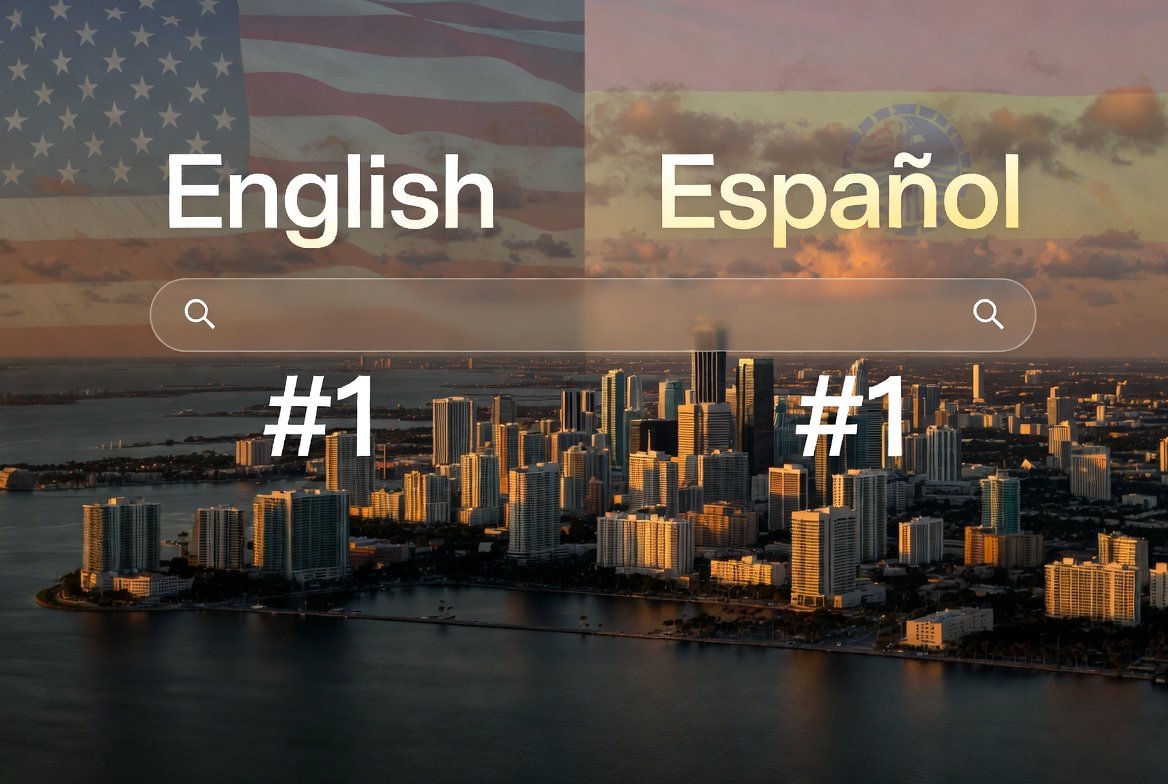
Why Bilingual SEO in Miami Is No Longer Optional in 2026
Miami is unlike any other city in the United States. It is a city where two languages share the same streets, the same restaurants, and — increasingly — the same Google search results. With over 70% of the population being Hispanic or Latino, and more than 60% of Miami residents speaking Spanish at home, the question for local businesses is no longer whether to do bilingual SEO. The question is: how fast can you start?
Here is the hard truth: 35% of all local searches in Miami happen in Spanish. That means if your website only ranks in English, you are invisible to more than one-third of your potential customers — right now, today, while your competitors are serving them.
At GetMiamiSEO, we have analyzed over 250 local SEO campaigns across Miami-Dade. The businesses that implemented a true bilingual SEO strategy — not just Google-translated pages, but culturally authentic Spanish content — saw an average traffic increase of 89% within six months. One restaurant client in Wynwood saw a 180% increase in Hispanic customer traffic within just 60 days.
This guide gives you everything you need to build a bilingual SEO strategy that actually works in Miami's unique market.
What Is Bilingual SEO and How Is It Different from Regular SEO?
Bilingual SEO is the practice of optimizing your website to rank in two or more languages — in Miami's case, English and Spanish. But it goes far deeper than simple translation.
Translation vs. Transcreation: The Miami Difference
Most agencies offer translation. We offer transcreation — and the difference is enormous.
Translation takes your English content and converts it word-for-word into Spanish. Transcreation takes your brand message and recreates it in a way that resonates culturally, emotionally, and linguistically with your target audience. Miami's Spanish-speaking community includes Cuban-Americans, Colombian-Americans, Venezuelan immigrants, and visitors from across Latin America. Each group has subtle but important differences in how they search, what they trust, and how they make purchasing decisions.
A direct translation of "best lawyer in Miami" to "mejor abogado en Miami" works technically — but a Miami Cuban-American searching for legal help is far more likely to type "abogado de accidentes en Miami" with specific cultural context baked into the query. That is the level of nuance that separates bilingual SEO from simple translation.
The Three Pillars of Bilingual SEO in Miami
- Technical Implementation — hreflang tags, separate URL structures (/en/ and /es/), and proper canonicalization so Google understands which page serves which audience.
- Culturally Authentic Content — native-speaker content creation targeting Miami-specific Spanish keyword clusters, not auto-translated copy.
- Local Signals in Both Languages — Google Business Profile optimization, Spanish-language reviews, bilingual citations in local directories from Yelp to the Miami Herald.
Miami Bilingual SEO: Keyword Research That Actually Works
Keyword research for bilingual SEO in Miami requires a completely different approach than standard SEO. Here is exactly how we do it for our clients.
High-Value English Keywords for Miami Businesses
These are the primary English-language keywords with the highest commercial intent for Miami businesses:
- "local SEO Miami" — 390 searches/month, high commercial intent
- "SEO company Miami" — 320 searches/month
- "Miami SEO agency" — 280 searches/month
- "SEO services Miami" — 260 searches/month
- "bilingual SEO Miami" — 110 searches/month, very low competition
- "Miami Beach SEO" — 190 searches/month, neighborhood-specific
- "Brickell SEO" — 120 searches/month
- "Wynwood digital marketing" — 75 searches/month
- "real estate SEO Miami" — 410 searches/month
- "restaurant SEO Miami" — 430 searches/month
High-Value Spanish Keywords Miami Businesses Are Missing
This is where the blue ocean opportunity exists. These Spanish-language keywords have real search volume in Miami — and almost zero competition:
- "SEO en Miami" — 90 searches/month, almost no competition
- "agencia SEO Miami" — 70 searches/month
- "posicionamiento web Miami" — 55 searches/month
- "marketing digital Miami" — 200 searches/month
- "abogado de accidentes Miami" — 480 searches/month (legal)
- "dentista en Miami" — 390 searches/month (medical)
- "restaurante cubano Miami" — 540 searches/month (hospitality)
- "apartamentos en Miami" — 720 searches/month (real estate)
- "mejor agente de bienes raíces Miami" — 110 searches/month
- "médico en Miami que habla español" — 95 searches/month
Long-Tail Neighborhood Keywords in Both Languages
Neighborhood-specific keywords convert 40% better than generic city-level keywords. Here are the most powerful ones for Miami:
English:
- "best seafood restaurant Miami Beach"
- "Brickell law firm near me"
- "Coral Gables dentist accepting new patients"
- "Wynwood art gallery open now"
- "Doral real estate agent"
Spanish:
- "mejor restaurante de mariscos en Miami Beach"
- "abogado en Brickell"
- "dentista en Coral Gables que acepta nuevos pacientes"
- "agente de bienes raíces en Doral"
- "médico en Little Havana"
How to Implement Bilingual SEO on Your Miami Website: Step-by-Step
Step 1: Set Up Proper URL Structure
The foundation of bilingual SEO is URL architecture. You have three options:
- Subdomain: es.getmiamiseo.com — separate authority, harder to manage
- Subdirectory: getmiamiseo.com/es/ — recommended for most Miami businesses
- Separate domain: getmiamiseo.es — only for large enterprises with separate brand identities
For most Miami small and medium businesses, the subdirectory structure (/es/) is the best choice. It consolidates your domain authority while clearly signaling to Google which language version to serve to which users.
Step 2: Implement hreflang Tags Correctly
hreflang tags are HTML attributes that tell Google: "this page is in English, and this other page is the same content in Spanish." Without them, Google may rank the wrong language version for the wrong users — or worse, treat your bilingual pages as duplicate content.
Every page on your bilingual Miami website needs this in the <head> section:
<link rel="alternate" hreflang="en" href="https://getmiamiseo.com/services/" />
<link rel="alternate" hreflang="es" href="https://getmiamiseo.com/es/servicios/" />
<link rel="alternate" hreflang="x-default" href="https://getmiamiseo.com/services/" />
Step 3: Optimize Your Google Business Profile in Both Languages
Your Google Business Profile (GBP) is the single most important local SEO asset for Miami businesses. Here is how to bilingualize it:
- Write your business description in English first (750 characters max)
- Add a Spanish version in the "Services" section with Spanish keywords naturally integrated
- Post updates in both languages — alternate weekly
- Respond to reviews in the reviewer's language — always
- Add bilingual Q&A to your GBP — Google surfaces these in the Local Pack
- Upload photos with bilingual captions in the alt-text
Pro Tip: The Review Strategy Most Miami Businesses Miss
When a Spanish-speaking customer leaves you a Google review in Spanish, respond in Spanish — always. Google reads your responses. A GBP with Spanish-language reviews AND Spanish-language responses signals to Google that your business genuinely serves the Spanish-speaking Miami community. This directly improves your ranking for Spanish-language "near me" searches.
Step 4: Create Original Spanish-Language Content — Not Translations
This is where most Miami businesses fail. They take their English blog posts, run them through Google Translate, and publish the Spanish version. Google can detect this — and it penalizes duplicate-content signals even across languages.
Instead, create original Spanish content targeting Miami's Spanish-speaking audience. Some examples that rank well:
- "Guía completa para encontrar el mejor abogado de accidentes en Miami en 2026"
- "Los 10 mejores restaurantes cubanos en Little Havana según los lugareños"
- "Cómo comprar una casa en Miami siendo inmigrante: guía paso a paso"
- "Médicos que hablan español en Miami-Dade: directorio completo 2026"
Each of these targets a specific high-intent Spanish-language search that no English content can rank for — because the intent is inherently Spanish.
Step 5: Build Spanish-Language Local Citations
Citations — mentions of your business name, address, and phone number (NAP) across the web — are a core local SEO ranking factor. For bilingual SEO, you need citations in Spanish-language directories too:
- Yelp — add a Spanish business description
- Páginas Amarillas (Spanish Yellow Pages)
- Miami Herald en Español / El Nuevo Herald
- Univision Miami local business directory
- Telemundo Miami local listings
- Directorio Latino Miami
- ChamberMiami.com — Miami Hispanic Chamber of Commerce
Bilingual SEO Results: What to Expect and When
Timeline for Bilingual SEO in Miami
Based on our 250+ Miami campaigns, here is a realistic timeline:
Days 1–30: Foundation Technical setup, hreflang implementation, GBP optimization in both languages, initial Spanish keyword research. You will see GBP improvements within the first 2 weeks.
Days 31–60: Early Wins Spanish long-tail keywords begin ranking on page 1–2. Spanish-language traffic starts appearing in Google Search Console. First Spanish-language reviews come in as you activate the review response strategy.
Days 61–90: Momentum Top 3 rankings for neighborhood-specific Spanish queries. Measurable increase in calls and WhatsApp messages from Spanish-speaking customers. English rankings remain stable or improve due to increased domain authority.
Months 4–12: Dominance Page 1 rankings for primary bilingual keywords. Full bilingual Local Pack presence. Average traffic increase of 89% across both languages. Compounding ROI as Spanish content assets build authority over time.
The 5 Biggest Bilingual SEO Mistakes Miami Businesses Make
Mistake 1: Using Google Translate for Spanish Pages
Auto-translated content reads unnaturally, lacks cultural resonance, and is easily detected by Google's quality systems. Always use native Spanish speakers or professional transcreation services.
Mistake 2: Ignoring Spanish-Language Reviews
Not responding to Spanish reviews — or responding to them in English — signals to Google that your Spanish-speaking customers are not your real audience. Always respond in the reviewer's language.
Mistake 3: Targeting the Same Keywords in Both Languages
"best dentist Miami" and "mejor dentista Miami" are different keywords with different competition levels, different SERP features, and different user intents. Do separate keyword research for each language.
Mistake 4: Forgetting Mobile Optimization for Spanish Searches
65% of internet traffic in Miami comes from mobile devices. Spanish-language searches skew even more heavily mobile. Your bilingual pages must load in under 2 seconds on mobile — especially for hospitality, restaurant, and emergency service searches where users are in the moment and ready to convert.
Mistake 5: No hreflang Implementation
Without hreflang tags, Google may show your Spanish pages to English speakers and your English pages to Spanish speakers. This increases your bounce rate, destroys your engagement metrics, and tells Google your content is not relevant — the exact opposite of what you want.
Frequently Asked Questions About Bilingual SEO in Miami
Q: How much does bilingual SEO cost in Miami?
Bilingual SEO in Miami typically costs between $2,000 and $8,000 per month depending on the number of languages, content volume, and competitive keywords targeted. At GetMiamiSEO, our bilingual packages start at $2,500/month and include native Spanish content creation, hreflang implementation, bilingual GBP management, and monthly reporting in both languages. We always start with a free audit so you know exactly what your investment will return before you commit.
Q: How long before I see results from bilingual SEO?
Most Miami businesses see measurable Spanish-language traffic improvements within 45–60 days for long-tail keywords. Competitive primary keywords typically rank on page 1 within 90–180 days. The bilingual Local Pack (Google Maps) often shows improvement in the first 30 days after GBP optimization.
Q: Do I need a completely separate website for Spanish SEO?
No. A subdirectory structure (yoursite.com/es/) on your existing domain is the most effective and efficient approach for Miami businesses. It consolidates your domain authority and is easier to manage than a separate domain.
Q: What Spanish dialect should I use for Miami SEO content?
Miami's Spanish-speaking population is predominantly Cuban-American, followed by Colombian, Venezuelan, and other Latin American communities. Cuban Spanish has specific vocabulary and expressions that resonate most strongly with Miami's core Hispanic demographic. However, neutral Latin American Spanish works well for most business content. The key is avoiding Spain-specific vocabulary (e.g., "vosotros") which reads as foreign to Miami's audience.
Q: Can I do bilingual SEO myself, or do I need an agency?
The technical components — hreflang tags, URL structure, canonicalization — require SEO expertise to implement correctly. The content component requires native Spanish speakers with SEO knowledge. The GBP management requires daily attention. Most Miami businesses find that doing all of this in-house is not cost-effective compared to working with a specialist bilingual SEO agency. That said, you can absolutely handle your Spanish-language social media and review responses in-house while partnering with an agency for the technical and content heavy lifting.
Q: Is bilingual SEO worth it for my small Miami business?
If you serve any market in Miami-Dade where Spanish speakers are present — which is virtually every neighborhood — then yes, bilingual SEO delivers a disproportionate return on investment compared to English-only SEO. The competition for Spanish-language keywords is dramatically lower, meaning lower cost per click if you run ads, faster organic rankings, and a largely untapped audience that competitors are ignoring. For small businesses especially, this is the fastest path to page 1 in Miami.
Conclusion: The Bilingual Advantage Is Available Right Now — But Not Forever
Miami's Spanish-language search market is the biggest untapped SEO opportunity in South Florida. Today, 90% of businesses optimize only for English. That means the businesses that move first on bilingual SEO will lock in page 1 rankings before the window closes.
The framework is clear: proper technical implementation, native Spanish content, bilingual GBP optimization, Spanish-language citations, and culturally authentic review management. Done right, bilingual SEO in Miami does not just add 35% more visibility — it often delivers a 2x to 3x increase in total organic traffic because Spanish-language keywords face so much less competition.
If you are ready to capture Miami's full market — both English and Spanish — GetMiamiSEO offers a free bilingual SEO audit that shows you exactly which Spanish keywords your competitors are missing, what your current bilingual technical setup looks like, and how many customers you are leaving on the table every single month.
The audit takes 48 hours. It costs nothing. And it will show you a clear path to ranking #1 in Miami — in both languages.