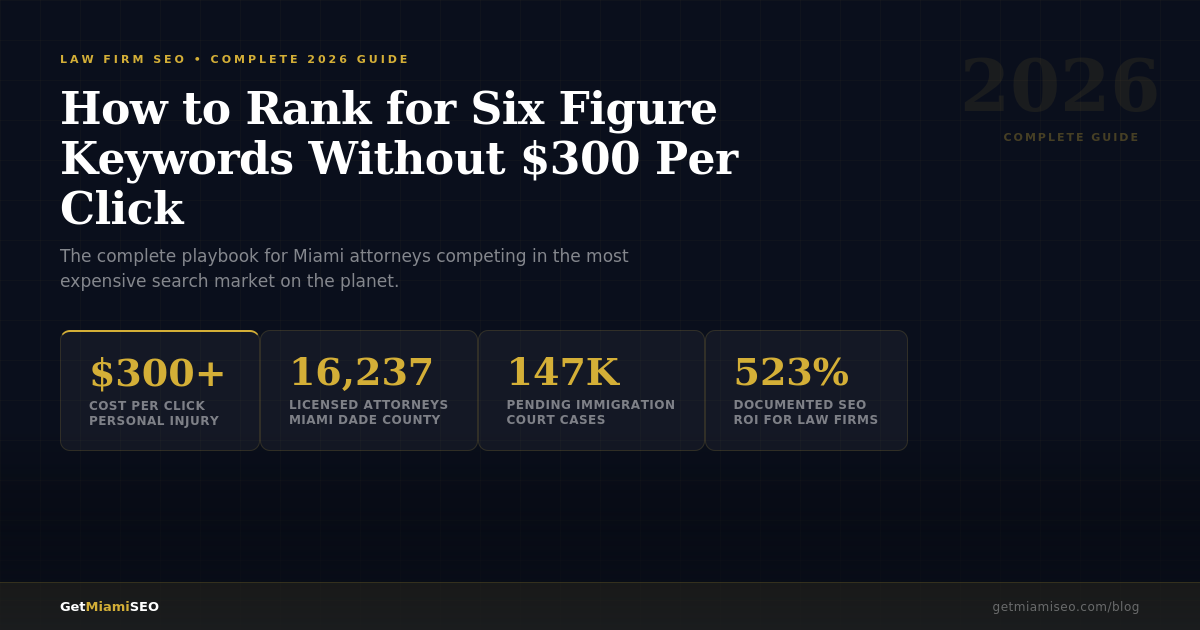
There is a number that should keep every managing partner in Miami awake at night: $300.
That is the average cost per click for a single Google Ads search on "car accident lawyer Miami" in 2026. One click. One anonymous person who may or may not become a client. Three hundred dollars. And that number is actually modest by legal advertising standards. Some Florida legal keywords have crossed the $1,000 per click threshold this year, according to Attorney at Law Magazine's 2025 keyword cost report. The most expensive term in their 2019 study was $485. Six years later, that figure has more than doubled.
Now multiply that $300 by the 100 to 200 clicks you need per month to generate a meaningful number of leads from paid search. That is $30,000 to $60,000 per month just in Google Ads spend, before you factor in the agency management fee, before you account for click fraud (which plagues the legal vertical), and before you calculate that the vast majority of those clicks will never convert into a paying client.
This is the reality for law firms competing in Miami, the most lawyer dense market in Florida. Miami Dade County alone has 16,237 licensed attorneys. The state of Florida has seen a 17% increase in lawyers over the past decade. And 18 of the top 25 U.S. law firms by headcount now maintain a Miami office.
The firms that are winning this competition are not doing it by outspending everyone on Google Ads. They are doing it by investing in search engine optimization: building the organic visibility that generates leads at a fraction of the per click cost, compounds over time instead of disappearing the moment you pause your budget, and creates a competitive moat that paid advertising can never replicate.
This guide is the complete playbook for law firm SEO in Miami in 2026. Whether your firm handles personal injury in Brickell, immigration law in Little Havana, corporate litigation in Downtown, or family law across Coral Gables, this is how you rank for the most valuable keywords in the legal industry without spending $300 per click.
In This Article:
- Miami's Legal Market by the Numbers: Why SEO Competition Is Intensifying
- The Cost Per Click Crisis: Why Paid Search Is Becoming Unsustainable
- SEO ROI for Law Firms: The Math That Changes Everything
- Keyword Strategy by Practice Area: Personal Injury, Immigration, Criminal, Family, and Corporate
- The Bilingual Advantage: 147,000 Immigration Cases and the Keywords Nobody Is Targeting
- Local SEO for Miami Law Firms: Google Business Profile and the 3 Pack
- Content Strategy: What Legal Content Actually Ranks and Converts
- E-E-A-T for Attorneys: Why Google Trusts Some Law Firm Websites and Ignores Others
- Link Building for Legal Authority in Miami
- Technical SEO Requirements Specific to Law Firm Websites
- Measuring ROI: From Rankings to Retained Clients
- Frequently Asked Questions
1. Miami's Legal Market by the Numbers: Why SEO Competition Is Intensifying
Understanding the competitive landscape is essential before investing in any marketing channel. Miami's legal market has structural characteristics that make it unlike any other city in the United States.
16,237 licensed attorneys in Miami Dade County. According to the ABA's 2024 National Lawyer Population Survey, Miami Dade has the largest concentration of attorneys in Florida. That is not per capita. That is raw headcount, more lawyers in a single county than most states have in their entire jurisdiction.
17% growth in Florida attorneys over the past decade. The legal profession in Florida is not contracting. It is expanding, rapidly. And the expansion is concentrated in South Florida, driven by the same structural factors that are attracting businesses across every sector: zero state income tax, proximity to Latin America, and a post pandemic migration wave from New York, California, and Illinois.
18 of the top 25 U.S. firms now have a Miami office. This is not a small market phenomenon. Big Law is here. Firms like Kirkland & Ellis, Latham & Watkins, and White & Case have established or expanded Miami offices in recent years. The top 100 firms in the territory saw an 8% increase in attorney headcount from 2023 to 2024 alone. For smaller and mid size firms, this means the competition for search visibility is not just local anymore. You are competing against firms with national SEO budgets and dedicated digital marketing teams.
Miami ranks #3 nationally for attorney demand. Behind only Washington DC and New York, Miami is the third most active legal market in the country. This creates a paradox: enormous opportunity paired with enormous competition. The firms that capture organic visibility will thrive. The firms that rely exclusively on paid channels will find their margins squeezed every quarter as CPC rates continue to climb.
28% of Miami law firm partners are lawyers of color. This is the highest percentage in the nation, reflecting Miami's demographic composition and the critical importance of cultural competence in legal marketing. A law firm in Miami that cannot serve Spanish speaking clients is voluntarily excluding a massive segment of its addressable market.
2. The Cost Per Click Crisis: Why Paid Search Is Becoming Unsustainable
Legal keywords have always been expensive. But the trajectory in 2025 and 2026 has pushed costs to a level that is fundamentally changing the economics of legal marketing.
Here is what the data shows:
"Car accident lawyer" now routinely exceeds $300 per click. "Personal injury lawyer near me" sits between $150 and $250. "Criminal defense attorney Miami" ranges from $80 to $200. Immigration and family law terms are comparatively cheaper at $40 to $95, but still represent significant per click costs for firms of any size. And the most extreme example: certain Florida mesothelioma and mass tort keywords have crossed $1,000 per click, more than double what they cost in 2019.
The problem is not just the raw CPC. It is the compounding effect of several factors working against law firms simultaneously.
Google Ads real estate is shrinking. AI Overviews, Local Service Ads, the Local Pack, and organic results are all pushing traditional paid ads further down the page. Fewer people are seeing your ad, which means fewer clicks, which means you need to bid higher to maintain the same lead volume.
97% of legal marketers running PPC report difficulty achieving strong ROI. That statistic alone should give every managing partner pause. When nearly all practitioners of a strategy report that it is underperforming, the strategy itself is the problem.
Click fraud disproportionately affects legal advertising. Competitors clicking your ads, bots consuming your budget, and accidental clicks from mobile users all inflate your costs without generating a single lead. In the legal vertical, where CPCs are the highest of any industry, every fraudulent click is a significant financial loss.
The fundamental flaw: paid traffic stops when spending stops. Every dollar you invest in Google Ads generates value only while the campaign is running. Pause the campaign for a month and your visibility drops to zero. Every lead you generated was rented, not owned. Contrast that with SEO, where every piece of content you publish, every backlink you earn, and every technical improvement you make continues generating value for years.
The law firms that are winning in 2026 are the ones that recognized this dynamic early and shifted budget from paid channels to organic. They still run Google Ads, but strategically, for brand protection and high intent terms where immediate visibility matters. The bulk of their client acquisition comes from organic search, where the cost per lead is 5x to 7x lower and the returns compound rather than evaporate.
3. SEO ROI for Law Firms: The Math That Changes Everything
Let's make the business case with real numbers.
According to FirstPageSage's 2026 ROI statistics, SEO campaigns achieve break even within 6 to 12 months and deliver compounding returns from that point forward. The specific ROI varies by practice area, but the math for law firms is especially compelling because of high client lifetime values.
A single personal injury case can justify an entire year of SEO investment. The average personal injury case value ranges from $15,000 to $50,000+ in attorney fees. If your firm invests $7,000 per month in SEO ($84,000 annually) and that investment generates just two to three personal injury cases per year from organic search, you have already exceeded a 100% return. In practice, a properly executed SEO campaign generates far more than two to three cases per year once rankings stabilize.
SEO leads close at 14.6%, versus 1.7% for outbound marketing. This 8.5x conversion advantage exists because organic search captures people with active intent. Someone typing "personal injury lawyer Brickell" is not browsing. They have a legal problem and they are looking for a solution right now. That intent signal produces dramatically higher conversion rates than any interruptive advertising channel.
The compounding math works decisively in SEO's favor. A Google Ads campaign costing $10,000 per month generates approximately 33 to 66 clicks for personal injury keywords (at $150 to $300 per click). After 12 months, you have spent $120,000 and generated exactly zero residual value. The same $10,000 per month invested in SEO builds content, authority, and rankings that continue producing leads in month 13, month 24, and beyond, without additional per click costs. After two years, the organic channel is typically producing leads at one fifth the cost of paid.
One law firm SEO agency documented a 523% ROI calculation. The example: a firm generating $40,500 in potential revenue from five cases attributed to SEO in a single month, against a monthly SEO cost of $6,500. That net return of $34,000 per month, repeating and compounding, illustrates why the most profitable law firms in Miami have long since stopped treating SEO as an optional marketing experiment.
4. Keyword Strategy by Practice Area: Personal Injury, Immigration, Criminal, Family, and Corporate
Every practice area has a different keyword landscape in Miami. The competition levels, CPCs, search volumes, and bilingual dynamics vary significantly. Here is the breakdown:
Personal Injury: The Most Expensive, Most Rewarding Vertical
Personal injury is the most competitive legal SEO vertical in Miami, and for good reason. Case values are the highest, which means both the cost to compete and the return on winning are enormous.
"Personal injury lawyer Miami" generates 170 monthly searches with a keyword difficulty of 80 and a CPC exceeding $95. "Car accident lawyer Miami" is even more expensive at $200 to $300+ per click. "Slip and fall attorney Miami," "motorcycle accident lawyer Miami," and "truck accident attorney Miami" each carry substantial volume with CPCs that make paid advertising a losing proposition for most firms.
The SEO strategy here is to build topical authority through comprehensive content clusters. A pillar page on "Personal Injury Lawyer Miami" supported by deep dives into each accident type (car, truck, motorcycle, slip and fall, medical malpractice, wrongful death) creates the kind of content ecosystem that Google rewards with page one rankings over time.
The bilingual angle matters here too. "Abogado de accidentes Miami" generates 480 monthly searches with a keyword difficulty under 30 and a CPC of roughly $15. That is the same client, the same case value, and a fraction of the competition. As we documented in our research on why 35% of Miami searches happen in Spanish, this is not a secondary audience. It is a primary audience that almost nobody is targeting.
Immigration Law: Miami's Blue Ocean Legal Vertical
Immigration law in Miami is structurally different from every other U.S. market. Miami Dade County currently has 147,000 pending immigration court deportation cases, the most of any county in the United States. The enforcement environment in 2025 and 2026 has intensified demand for immigration legal services dramatically, with daily deportation rates reaching 850 people in May 2025 compared to 240 per day in 2023.
"Immigration lawyer Miami" generates strong monthly search volume with a CPC of $45 to $95. But the Spanish equivalents are where the real opportunity lives: "abogado de inmigración Miami" (40 monthly searches, KD 15, CPC $22), "abogado de inmigración cerca de mí" (growing volume, near zero competition), and "abogado de deportación Miami" (growing volume driven by enforcement escalation).
Every immigration attorney in Miami should understand a fundamental truth: their client base overwhelmingly searches in Spanish. The immigration legal vertical is inherently bilingual, and yet the vast majority of immigration law firm websites in Miami are English only. Building bilingual SEO into your immigration practice is not a nice to have. It is a direct connection to the clients who need you most urgently.
Criminal Defense: Urgency Driven Keywords
Criminal defense searches carry enormous urgency. Someone searching for a criminal defense attorney is often doing so within hours of an arrest. That urgency translates to high conversion rates and high CPCs.
"Criminal defense attorney Miami" ranges from $80 to $200 per click. "DUI lawyer Miami," "drug possession attorney Miami," and "domestic violence lawyer Miami" each carry significant volume. The competitive dynamics in Miami are fierce, and the 24/7 nature of criminal defense makes Google Business Profile optimization especially critical because someone searching at 2 AM needs to see that your firm is available now.
Family Law: Steady Volume, Growing Spanish Demand
Family law in Miami generates consistent, year round search volume across divorce, custody, and support terms. "Divorce lawyer Miami" and "family law attorney Miami" carry moderate CPCs ($40 to $90) with stable monthly volumes.
The bilingual dimension is particularly important in family law because custody disputes, divorce proceedings, and domestic matters often involve families where one or both parties prefer to communicate in Spanish. "Abogado de divorcio Miami" and "abogado de custodia Miami" represent direct pipelines to clients who will choose the firm that speaks their language.
Corporate and Business Law: The High Value, Low Volume Play
Corporate law keywords in Miami have lower search volume but extremely high client lifetime values. A single corporate client may retain your firm for years with monthly billings that dwarf any individual PI case. "Business attorney Miami," "corporate lawyer Miami," and "real estate closing attorney Miami" are worth targeting not for volume but for the quality and value of the client they attract.
The international dimension is critical here. As we covered in our real estate SEO guide, Miami is home to 1,200+ Latin American multinational headquarters. These companies need corporate counsel who understands both U.S. and Latin American business law. Ranking for bilingual corporate law terms positions your firm as the natural choice for this high value segment.
5. The Bilingual Advantage: 147,000 Immigration Cases and the Keywords Nobody Is Targeting
We have explored the bilingual opportunity across multiple articles on this blog, including our complete bilingual SEO guide and our analysis of Miami's Spanish search behavior. But the implications for law firms are so significant that they deserve dedicated attention.
Miami Dade has 147,000 pending immigration court cases. That is not a typo. One hundred and forty seven thousand people in a single county who are actively engaged with the immigration court system. The vast majority of these individuals are Spanish speaking. They are searching for legal help in Spanish. And the overwhelming majority of immigration law firm websites in Miami are English only.
70% of Miami's population is Hispanic. This is not a niche market. This is the majority. When a Cuban American in Hialeah needs a criminal defense attorney, they are likely searching "abogado penalista Miami" or "abogado defensa criminal cerca de mí." When a Colombian family in Doral needs a divorce attorney, "abogado de divorcio en Doral" is the query. When a Venezuelan business owner in Wynwood needs corporate counsel, they may search in either language depending on the context.
The keyword difficulty gap between English and Spanish legal terms is enormous. "Personal injury lawyer Miami" has a keyword difficulty above 80. "Abogado de accidentes Miami" sits below 30. "Immigration lawyer Miami" competes at KD 55. "Abogado de inmigración Miami" is below 15. This gap represents the single most actionable competitive advantage available to any Miami law firm willing to invest in bilingual SEO.
The CPC arbitrage is equally dramatic. English personal injury clicks cost $150 to $300+. The Spanish equivalents cost $10 to $25. The searcher has the same legal problem, the same case value, and the same urgency. The only difference is the language they search in. Law firms that rank organically for Spanish legal terms are accessing the same revenue potential at a fraction of the competitive cost.
At GetMiamiSEO, we have worked with law firms that achieved page one rankings for Spanish legal keywords within 45 days of launching bilingual content. The same firms waited 6 to 12 months for equivalent English rankings. In a market where client acquisition speed directly impacts revenue, that time advantage is worth tens of thousands of dollars.
6. Local SEO for Miami Law Firms: Google Business Profile and the 3 Pack
For law firms, the Google Local Pack (the three map results that appear at the top of local searches) is the single most valuable piece of digital real estate. Businesses in the 3 Pack receive 126% more traffic and 93% more actions than those ranked below. For a personal injury firm, appearing in the 3 Pack for "personal injury lawyer near me" in Brickell can generate dozens of qualified consultations per month.
Here is how to optimize your law firm's Google Business Profile for Miami:
Choose the right primary category. Google allows one primary category and multiple secondary categories. "Personal injury attorney" as primary with "Law firm," "Immigration attorney," and other relevant practice areas as secondary ensures you appear in the widest range of relevant searches.
Complete every field with keyword rich content. Your 750 character business description should read naturally while incorporating your target terms: "Miami personal injury and immigration law firm serving Brickell, Coral Gables, and Miami Dade County. Bilingual legal team providing aggressive representation in English and Spanish since [year]. Over [number] cases handled with a [percentage] success rate."
Build your review profile aggressively. Law firms with 50+ reviews and a 4.8+ rating significantly outrank competitors with fewer reviews. The review velocity (how many new reviews you receive per month) matters as much as the total count. Implement a systematic process: after every case resolution, send a personalized review request. Respond to every review within 24 hours, in the reviewer's language. A Spanish language review with a Spanish language response signals to Google that your firm authentically serves the Hispanic community.
Post weekly updates. Google Business Profile posts are underused by law firms but highly effective. Post about case results (anonymized), legal updates relevant to your practice area, community involvement, and bilingual content alternating between English and Spanish. Each post contributes to your local ranking signals and keeps your profile active.
Add bilingual Q&A. The Q&A section of your Google Business Profile is surfaced directly in search results. Preemptively add the questions your clients most commonly ask, in both English and Spanish, with detailed answers. "How much does a personal injury lawyer cost in Miami?" and "¿Cuánto cobra un abogado de accidentes en Miami?" are high intent questions that can drive clicks directly from the search results page.
Optimize for every office location. If your firm has multiple offices (Brickell and Coral Gables, for example), each location needs its own Google Business Profile with unique descriptions, unique photos, and location specific keywords. A profile optimized for "personal injury attorney Brickell" will outrank a generic "personal injury attorney Miami" profile for searchers physically located in Brickell.
7. Content Strategy: What Legal Content Actually Ranks and Converts
Content marketing for law firms is not about publishing blog posts for the sake of SEO. It is about creating assets that demonstrate expertise, build trust, and capture clients at every stage of their decision making process.
Practice Area Pillar Pages (Your Highest Converting Content)
Every practice area your firm handles should have a comprehensive pillar page: a single, authoritative resource of 2,500+ words covering everything a potential client needs to know. "Personal Injury Lawyer Miami: Your Complete Guide to Filing a Claim in 2026" should cover what constitutes personal injury in Florida, statute of limitations, what compensation you can recover, how the process works, what to expect from your attorney, and a clear call to action. This page becomes the ranking target for your most valuable keywords and the hub of your internal linking architecture.
FAQ Content (The AEO Advantage)
Answer Engine Optimization is increasingly important as Google's AI Overviews and conversational search tools reshape how legal information is delivered in search results. Creating in depth FAQ content that directly answers common legal questions positions your firm to be cited in AI generated answers.
"How long do I have to file a personal injury claim in Miami?" "What should I do immediately after a car accident in Florida?" "Can an undocumented immigrant file a personal injury claim in Miami?" Each of these questions represents a potential client with an active legal need. Your content answers their question, builds trust, and naturally guides them toward contacting your firm.
Neighborhood Specific Legal Content
As we explored in our small business boom article, Miami is not one market. It is dozens of micro markets. A personal injury page targeting "car accident lawyer Brickell" captures a different searcher than "car accident lawyer Hialeah." Each neighborhood page should include local accident data, nearby hospitals, local court information, and neighborhood specific context that generic city wide pages cannot match.
Bilingual Content (Created, Not Translated)
Spanish language legal content must be written from scratch by native speakers with legal knowledge. As our bilingual SEO guide explains in detail, translation produces thin content that Google penalizes. Original Spanish articles like "Guía completa: Qué hacer después de un accidente de auto en Miami" and "Sus derechos como inmigrante en un caso de lesiones personales en Miami" target keywords that no English content can rank for, while resonating culturally with the audience that most needs legal representation.
Case Results and Social Proof Content
Anonymized case results are among the highest converting content types for law firms. "How We Secured a $2.5M Settlement for a Truck Accident Victim in Miami" (with appropriate disclaimers) demonstrates competence in a way that no amount of marketing copy can replicate. These pages earn backlinks, build E-E-A-T signals, and directly influence potential clients who are evaluating which firm to hire.
8. E-E-A-T for Attorneys: Why Google Trusts Some Law Firm Websites and Ignores Others
Google classifies legal content as YMYL (Your Money or Your Life), meaning it applies the highest quality standards to legal websites because the content directly impacts people's financial and physical wellbeing. For law firms, this means E-E-A-T (Experience, Expertise, Authoritativeness, Trustworthiness) is not optional. It is the gatekeeper to rankings.
Experience: Show that you have practiced law, not just studied it. Google wants to see content written by attorneys with real case experience. Each blog post and practice area page should include an author byline linking to a detailed attorney profile page. That profile should feature bar admissions, case results, speaking engagements, publications, and years of practice. A page written by "Staff Writer" will never outrank a page authored by a named attorney with verifiable credentials.
Expertise: Depth over breadth. A law firm website that covers 15 practice areas with 200 word pages on each will rank for none of them. Google rewards depth. A firm that publishes 5,000 words of comprehensive, accurate, well cited content on personal injury law in Florida, supported by 10 related blog posts covering specific accident types, will rank for the entire keyword cluster.
Authoritativeness: External validation. Backlinks from bar associations, legal publications, law school websites, and established news outlets tell Google that other authoritative sources trust your content. Being cited in the Miami Herald, listed in the Greater Miami Chamber of Commerce directory, or featured in Attorney at Law Magazine carries exponentially more weight than hundreds of directory listings.
Trustworthiness: The technical and design signals. HTTPS encryption, a clear privacy policy, transparent contact information, physical office addresses, bar license numbers displayed on the website, and a professional design all contribute to trust signals. A law firm website that looks like it was built in 2010, loads slowly, and lacks basic security will struggle to rank regardless of how good the content is.
9. Link Building for Legal Authority in Miami
Backlinks are weighted heavily in legal SEO because Google relies on them as signals of real world authority. For Miami law firms, the link building strategy should focus on locally relevant, legally credible sources:
Bar associations and legal organizations. The Florida Bar, Miami Dade County Bar Association, Cuban American Bar Association, and similar organizations provide high authority backlinks that directly boost your legal SEO rankings.
Legal directories with authority. Avvo, Justia, FindLaw, Martindale Hubbell, and Super Lawyers are not just directories. They are high domain authority websites that pass significant link value. Ensure your profiles are complete, accurate, and link back to your website.
Local media and press. When a significant legal development occurs in Miami, be the firm that provides expert commentary to the Miami Herald, El Nuevo Herald, South Florida Business Journal, or local TV stations. Each media mention typically includes a backlink and positions your firm as a go to source for legal expertise.
Community and civic organizations. The Greater Miami Chamber of Commerce, the Miami Dade Beacon Council, neighborhood associations, and community nonprofits all provide directory listings and sponsorship opportunities that generate local backlinks with geographic relevance.
Legal scholarship and publications. If attorneys at your firm publish articles in law reviews, legal journals, or professional publications, those citations create authoritative backlinks that are extremely difficult for competitors to replicate.
Hispanic business organizations. For firms pursuing the bilingual strategy, links from the Miami Hispanic Chamber of Commerce, Directorio Latino Miami, Univision Miami, and Telemundo Miami carry both authority and cultural relevance signals that boost Spanish language rankings.
10. Technical SEO Requirements Specific to Law Firm Websites
Law firm websites have unique technical requirements that generic SEO advice often overlooks:
Schema Markup for Legal Practices
Implement Attorney schema, LegalService schema, and LocalBusiness schema across your website. Add FAQ schema to every practice area page (Google displays FAQ rich results for legal queries, significantly increasing click through rates). If you publish case results, consider using Review schema where appropriate and compliant with bar association rules.
Site Architecture for Multi Practice Firms
A law firm handling personal injury, immigration, criminal defense, and family law needs a clear content hierarchy: Homepage > Practice Area Pages > Specific Service Pages > Supporting Blog Content. Each practice area should function as its own content cluster with strong internal linking between related pages. The personal injury pillar page should link to individual accident type pages, related blog posts, and case results. This architecture helps Google understand your topical authority in each practice area independently.
Mobile First Performance
Legal searches are increasingly mobile, especially for urgent practice areas like criminal defense and personal injury (where the searcher may literally be at an accident scene). Your website must load in under 2 seconds on mobile, have thumb friendly navigation, and feature prominent click to call buttons. A potential client searching "lawyer near me" on their phone at midnight will not wait for a slow website to load. They will call the next firm in the search results.
Hreflang for Bilingual Law Firm Websites
If you are building Spanish language pages (and in Miami, you absolutely should be), hreflang implementation is essential. Every English page needs a corresponding hreflang tag pointing to its Spanish equivalent, and vice versa. The recommended structure is subdirectories: yourfirm.com/en/ and yourfirm.com/es/. Without proper hreflang tags, Google may serve your Spanish pages to English speakers or flag them as duplicate content.
ADA Compliance
Law firm websites face heightened scrutiny regarding ADA compliance. Ensure your site meets WCAG 2.1 guidelines with proper alt text on images, keyboard navigation support, sufficient color contrast, and screen reader compatibility. Beyond the legal requirement, accessibility improvements often improve SEO performance because they align with Google's quality signals.
11. Measuring ROI: From Rankings to Retained Clients
Law firm SEO success must be measured in terms that managing partners and firm leadership care about: cases and revenue. Here is the measurement framework:
Keyword rankings by practice area. Track your position for primary keywords in each practice area, in both English and Spanish. A firm that ranks #1 for "abogado de accidentes Miami" but #15 for "personal injury lawyer Miami" has a clear bilingual advantage that is generating revenue while English rankings continue to build.
Organic traffic by practice area page. Google Analytics and Search Console will show you exactly how many people are finding your practice area pages through organic search. Pay attention to traffic trends over time, not just absolute numbers. A page gaining 15% more organic traffic month over month is compounding toward significant lead volume.
Lead attribution by source. Every phone call, contact form submission, WhatsApp message, and live chat interaction should be tracked back to its source. Use call tracking numbers on your website to distinguish organic search calls from paid ads, referrals, and direct traffic. This attribution data is what converts SEO from a "marketing expense" into a measurable revenue channel in the eyes of firm leadership.
Cost per lead comparison. Calculate your organic cost per lead (monthly SEO investment divided by organic leads generated) and compare it to your paid cost per lead. Within 6 to 12 months, the organic CPL should be dramatically lower and continuing to decrease as your rankings strengthen.
Case value attribution. The ultimate metric: how many retained cases and how much revenue is attributable to organic search? This requires coordination between your marketing team and your intake system, but it is the number that justifies every dollar of SEO investment. In a market where a single personal injury case can generate $50,000+ in fees, attributing even one case per month to organic search makes the entire SEO investment a no brainer.
12. Frequently Asked Questions
How much does law firm SEO cost in Miami?
Law firm SEO in Miami typically costs between $5,000 and $10,000 per month for comprehensive campaigns. Personal injury firms in highly competitive markets may invest $8,000 to $15,000 monthly. Solo practitioners and smaller firms can start with targeted local SEO packages from $2,500 to $4,000 per month. At GetMiamiSEO, we start every law firm engagement with a free SEO audit that shows you exactly where you stand, what your competitors are doing, and what the return on investment would look like for your specific practice areas.
How long does it take for a law firm to rank on Google in Miami?
Most Miami law firms see measurable improvements within 90 to 120 days for neighborhood specific and long tail legal keywords. Highly competitive terms like "personal injury lawyer Miami" typically take 6 to 12 months to reach page one. Immigration and family law keywords with Spanish language variations can rank within 30 to 60 days due to lower competition. Google Business Profile visibility often improves within the first 2 to 4 weeks of optimization.
Is SEO worth it for a law firm compared to Google Ads?
The data is unambiguous. Legal keywords are among the most expensive in all of digital advertising, with personal injury terms exceeding $300 per click and some Florida legal keywords reaching $1,000 per click. SEO delivers organic traffic at no per click cost. SEO leads close at 14.6% compared to 1.7% for outbound marketing. Most law firms that invest in SEO see break even within 10 to 14 months and a 523% or higher ROI within two years. The smartest firms run both channels in parallel but shift budget toward organic as rankings build.
Why do Miami law firms need bilingual SEO?
Because Miami Dade County has 147,000 pending immigration court deportation cases, the most of any county in the United States. Because 70% of the population is Hispanic and 35% of all local searches happen in Spanish. Because keywords like "abogado de inmigración Miami" and "abogado de accidentes Miami" have high search volume with almost zero SEO competition. And because 90% of law firm websites in Miami have zero Spanish language content. Bilingual SEO gives your firm access to a massive client base that English only competitors cannot reach.
What are the most valuable legal keywords in Miami?
The highest value legal keywords in Miami include personal injury terms ($150 to $300+ per click), immigration law terms ($45 to $95 per click), criminal defense ($80 to $200 per click), and family law ($40 to $90 per click). Spanish language equivalents carry similar intent but dramatically lower competition. "Abogado de accidentes Miami" converts at the same case value as "personal injury lawyer Miami" but with a keyword difficulty below 30 versus above 80.
How many law firms are competing for SEO in Miami?
Miami Dade County has 16,237 licensed attorneys, the largest concentration in Florida. The number of attorneys in the state has grown 17% over the past decade. 18 of the top 25 U.S. law firms by headcount now have a Miami office. Despite this concentration, the vast majority of firms invest minimally in SEO, particularly in Spanish language optimization. The firms that build comprehensive organic strategies now are building moats that become increasingly difficult for competitors to overcome as domain authority compounds.
Can I do law firm SEO myself or do I need an agency?
Attorneys can handle certain elements in house: Google Business Profile optimization, review solicitation, and basic content creation. However, legal SEO is uniquely complex due to YMYL classification, E-E-A-T requirements, bar association advertising compliance, bilingual keyword research, and the extremely high competition level for legal terms. Most firms find that the opportunity cost of doing SEO in house (hours taken away from billable work) far exceeds the cost of a specialized agency. A free SEO audit from GetMiamiSEO can show you exactly what professional investment would deliver for your firm.