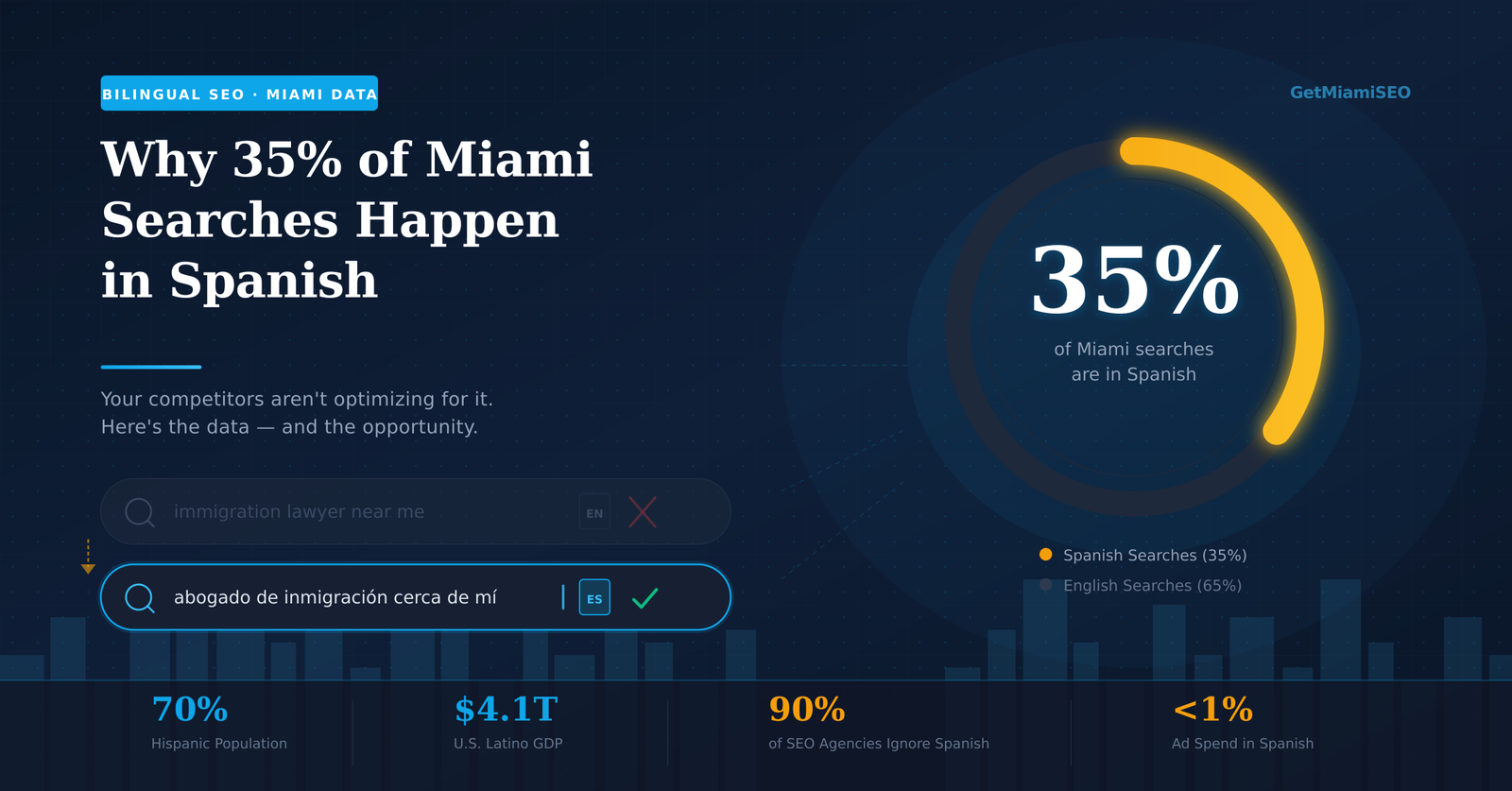
Why 35% of Miami Searches Happen in Spanish (And What It Means for Your Business)
Miami is the only major U.S. metro where more than a third of all Google searches happen in a language other than English. If your business isn't optimised for Spanish, you're invisible to over a third of your market. Here's the data that proves it.
IN THIS ARTICLE
1. The Numbers: Miami's Bilingual Search Reality
2. Why So Many Miami Searches Are in Spanish
3. The $4.1 Trillion Opportunity You're Ignoring
4. What Miami Businesses Are Getting Wrong
5. Bilingual SEO vs. Translation: Why the Distinction Matters
6. Industry Breakdown: Where Spanish Search Hits Hardest
7. What Your Business Should Do About It (Today)
8. Frequently Asked Questions
There's a statistic that stops most Miami business owners cold: roughly 35% of all local Google searches in Miami-Dade County are conducted in Spanish.
Not 5%. Not 10%. More than a third.
That means if you run a law firm in Brickell, a dental practice in Coral Gables, a restaurant in Wynwood, or a real estate brokerage anywhere in Miami-Dade, and your website only ranks for English keywords, you are structurally invisible to over one-third of the people actively searching for what you sell.
We're not talking about a nice-to-have. We're talking about a fundamental market miscalculation that costs Miami businesses hundreds of thousands of dollars in unrealized revenue every single year.
And here's what makes it worse: 90% of SEO agencies operating in Miami don't optimize for Spanish at all. They treat bilingual search as an afterthought — a "Phase 2" that never comes. The data says that's a catastrophic mistake.
Let's walk through exactly why this is happening, what the numbers actually say, and what you need to do about it.
1. The Numbers: Miami's Bilingual Search Reality
Before we get into strategy, let's establish the facts. These aren't estimates or projections — they're documented data points from the U.S. Census Bureau, the Miami-Dade Beacon Council, Pew Research Center, and Nielsen.
-> 70% of Miami-Dade's 2.7M residents are of Hispanic heritage
-> 35% of local Google searches in Miami happen in Spanish
-> 58.3% of Miami residents are foreign-born - #1 globally
-> 90% of SEO agencies serving Miami ignore Spanish entirely
Those numbers paint a picture that's hard to misinterpret. Miami-Dade is the most linguistically diverse major market in America, and Spanish isn't a secondary language here, it's a co-primary language of commerce, search, and daily life.
When someone in Doral searches "abogado de inmigración cerca de mí" instead of "immigration lawyer near me," they're looking for the exact same service. But Google treats those as entirely separate queries, with separate results, separate rankings, and separate winners. If you haven't built pages that compete for the Spanish query, you simply don't exist for that searcher.
2. Why So Many Miami Searches Are in Spanish
This isn't random. There are structural, demographic, and behavioral reasons why Miami's search landscape looks unlike any other U.S. city.
Miami Is a Majority-Hispanic Metro and It's Not Close
At 70% Hispanic heritage, Miami-Dade has a higher concentration of Hispanic residents than any other major U.S. county. According to the Beacon Council, 30% of all Miami-Dade businesses are run by people of Hispanic descent, and the county is home to 1,200 multinational corporations that headquarter their Latin American operations here.
This isn't a niche demographic. This is the majority population. And a significant portion of that majority prefers to search, read, and transact in Spanish, especially for high-stakes decisions like choosing a doctor, a lawyer, a school, or a home.
Language Preference Is Sticky, Especially on Mobile
Research from Pew Research shows that Spanish-dominant internet use among U.S. Hispanics roughly doubled between 2009 and 2015, rising from 36% to 74%. That growth hasn't slowed. By 2025, 93% of Hispanic adults own a smartphone, but 28% are "smartphone-dependent", meaning their phone is their only internet access point. When your phone's default language is Spanish, your Google queries default to Spanish. It's that simple.
And this isn't just older, first-generation immigrants. Nielsen's 2025 report found that Hispanic audiences are 29% more likely than the general population to use AI platforms like ChatGPT, and they're doing it in both languages.
Miami Is the Gateway to Latin America
43% of all U.S. flights to South America route through Miami International Airport. More than 90% of Latin American data traffic passes through Miami's data centers. The city isn't just home to Spanish speakers, it's the commercial bridge between the Americas. That means Miami's search traffic includes queries from business travelers, tourists, investors, and buyers searching in Spanish for services, properties, and products based in Miami.
The bottom line: Miami isn't a bilingual market by choice. It's bilingual by structure. The demographics, the geography, the economy, and the digital behavior all converge on a single conclusion, if you only optimize for English, you are voluntarily excluding 35% of your addressable market.
3. The $4.1 Trillion Opportunity You're Ignoring
This isn't just about search volume. It's about economic power.
The 2025 Latino GDP Report, published by the Latino Donor Collaborative in partnership with Arizona State University, documents that U.S. Latino GDP has reached $4.1 trillion, making it the equivalent of the world's fifth-largest economy. That figure surpasses the entire GDP of India, the United Kingdom, and France.
-> $4.1T in U.S. Latino purchasing power (2025)
-> 5th Largest economy globally if U.S. Latinos were a country
-> 2.7× Faster GDP growth vs. non-Latino U.S. (2010–2023)
-> <1% of U.S. retailer digital ad spend goes to Spanish-language sites
Read that last number again. Less than 1% of digital ad spend from U.S. online retailers went to Spanish-language websites in the first quarter of 2025. Nielsen measured it at roughly $3.38 million in Spanish-language spend versus $363.42 million in English, a ratio of about 107 to 1.
That disparity is even more stark when you look at organic search. Most businesses invest exactly $0 in Spanish-language SEO. They have no Spanish content. No Spanish keywords. No hreflang tags. Nothing. They're invisible to a population wielding over $4 trillion in purchasing power.
And here in Miami, where that population is the majority? The gap isn't just an oversight. It's a competitive advantage sitting unclaimed on the table for any business willing to invest in bilingual SEO.
The Compounding Math
If your business generates $50,000/month from organic search traffic and 35% of your addressable market is searching in Spanish with zero competition from your brand, you are leaving approximately $17,500/month, or $210,000 per year, in unrealized revenue. Over a 3-year period with compounding growth, that gap widens to $700,000+.
4. What Miami Businesses Are Getting Wrong
In the 250+ businesses we've audited at GetMiamiSEO, we see the same mistakes repeated over and over. The root cause is nearly always the same: treating Spanish-language search as a translation problem rather than a market problem.
Mistake #1: "We'll Just Translate Our English Pages"
This is by far the most common, and most damaging, approach. Businesses run their English website through Google Translate or hire a bilingual employee to translate a few pages, then assume they've "done" bilingual SEO.
The problem? Spanish-speaking searchers don't use the same keywords that English speakers do. They don't structure queries the same way. They don't have the same search intent patterns. And Google's algorithm treats machine-translated content as thin, duplicate, or low-quality in most cases.
Mistake #2: No Hreflang Tags
Even businesses that create Spanish content often fail to implement hreflang tags, the HTML markup that tells Google which language each page targets and how the English and Spanish versions relate to each other. Without hreflang, Google may serve the wrong language version to the wrong user, or worse, flag your Spanish pages as duplicate content and suppress them entirely.
Mistake #3: Spanish Content Lives on a Subdomain Nobody Visits
Some businesses create a separate Spanish version of their site on a subdomain (es.yourbusiness.com) and then never link to it, never promote it, and never build authority for it. It sits there like a ghost town, technically present but practically invisible. A proper bilingual architecture requires internal linking, separate authority building, and dedicated content strategies for each language.
Mistake #4: Ignoring Google Business Profile in Spanish
Your Google Business Profile is often the first thing a potential customer sees. Yet most Miami businesses only optimize their GBP in English. Adding Spanish descriptions, responding to Spanish reviews, and posting bilingual updates can dramatically increase your visibility in Spanish local searches, and it's free.
Mistake #5: Assuming "Everyone Speaks English"
Even in a bilingual city, language preference matters. A 2025 ThinkNow Research study found that 53% of U.S. Hispanic adults actively look for websites or retailers that offer Spanish-language options when shopping online. In Miami, where that percentage is likely even higher, the absence of Spanish signals a disconnect between your brand and a huge portion of your potential customers.
It's not about ability. Many bilingual Miami residents can navigate your English website. But given the choice between two businesses, one that speaks their language and one that doesn't, they'll choose the one that feels like it was built for them. Every time.
5. Bilingual SEO vs. Translation: Why the Distinction Matters
We need to be very precise about terminology here, because this distinction is the core of what separates agencies that get results in Miami from those that don't.
Translation takes existing English content and converts it to Spanish. The output is linguistically accurate but strategically irrelevant, because the keywords, the intent, the cultural framing, and the competitive landscape in Spanish are entirely different from English.
Bilingual SEO builds two parallel search strategies from the ground up. It involves:
- Independent keyword research in each language. The top keywords in Spanish are not translations of the top keywords in English. "Dentist in Coral Gables" has different volume, difficulty, and intent than "dentista en Coral Gables." Both need their own research.
- Culturally authentic content creation. Not just linguistically correct, but culturally resonant. A native Spanish speaker in Little Havana reads differently than a bilingual professional in Brickell. Tone, formality, regional vocabulary, all of it matters.
- Proper technical implementation. Hreflang tags, language-specific sitemaps, correct URL structures (subdirectories vs. subdomains), and canonical tags that prevent cross-language duplicate content issues.
- Separate authority building. Spanish-language backlinks from Spanish-language publications, directories, and community organizations. English backlinks don't transfer authority to your Spanish pages.
- Bilingual Google Business Profile optimization. Descriptions, posts, responses, and Q&A in both languages. This is free and immediately impactful for local SEO in Miami.
The Translation Trap
We've audited Miami businesses that spent $5,000+ on "translated" websites that generated zero organic traffic in Spanish. The reason? The translated pages targeted keywords nobody was searching for, had no backlinks, no hreflang tags, and were flagged by Google as thin duplicate content. Translation without SEO strategy is money burned.
7. What Your Business Should Do About It (Today)
You don't need to rebuild your entire digital presence overnight. But you do need to start treating bilingual SEO as a core business strategy, not a checkbox. Here's a prioritized roadmap based on what we implement for our clients at GetMiamiSEO:
Phase 1: Audit & Foundation (Week 1–2)
Start with a free bilingual SEO audit. You need to know your current Spanish-language visibility (it's probably zero), your competitors' Spanish presence, and the actual Spanish keywords your audience uses. This audit should cover your website, your Google Business Profile, your local citations, and your content.
Phase 2: Technical Setup (Week 2–4)
Implement the technical infrastructure for bilingual SEO: hreflang tags on all existing pages, a language-switching mechanism (subdirectory structure recommended: yoursite.com/es/), language-specific sitemaps submitted to Google Search Console, and a properly configured Google Business Profile with Spanish descriptions and bilingual Q&A.
Phase 3: Content Strategy (Month 2–3)
Build Spanish-language landing pages for your highest-value services. Don't translate, create. Use native Spanish keyword research to identify the real queries in your market. Write culturally authentic content that addresses the specific needs and concerns of Spanish-speaking clients in Miami. Start with your 3–5 highest-revenue services.
Phase 4: Authority Building (Month 3–6)
Build Spanish-language authority through local directories, Hispanic business organizations, Spanish-language press, and community partnerships. Get listed in bilingual directories. Earn reviews in Spanish on your Google Business Profile. Create a bilingual blog that publishes regularly in both languages, not translations of each other, but complementary content targeting different keyword clusters.
Phase 5: Scale & Optimize (Month 6+)
Expand your bilingual content to cover more keywords, more neighborhoods, and more services. Layer in AI and voice search optimization (voice searches in Spanish are growing even faster than English). Build retargeting audiences from your Spanish-language traffic. And measure everything, bilingual SEO should be tracked with the same rigor as any other revenue channel.
The Urgency Factor
Right now, Spanish-language SEO in Miami is a blue ocean. Competition is minimal. Rankings are achievable in weeks, not months. But this window won't last forever. As more agencies and businesses wake up to the 35% gap, the cost to compete will rise. The businesses that move first will build authority that's extremely difficult to displace.
8. Frequently Asked Questions
What percentage of Miami searches are in Spanish?
Approximately 35% of all local searches in Miami-Dade County are conducted in Spanish. This figure is driven by a population that is 70% Hispanic, where 58.3% of residents are foreign-born, the highest rate of any major city in the world.
Do I need a bilingual website for my Miami business?
If you serve customers in Miami-Dade County, bilingual optimization is no longer optional, it's foundational. A 2025 ThinkNow Research study found that 53% of U.S. Hispanic adults actively seek out Spanish-language websites when shopping. In a 70% Hispanic market like Miami, ignoring this preference means voluntarily surrendering over a third of your potential traffic and revenue.
What is bilingual SEO and how is it different from translation?
Translation converts English text to Spanish. Bilingual SEO builds two independent search strategies, one for each language, with separate keyword research, separate content, proper hreflang implementation, and culturally authentic messaging. Translation gives you words. Bilingual SEO gives you rankings, traffic, and revenue.
How much revenue am I losing by not ranking in Spanish?
If 35% of your market searches in Spanish and you have zero visibility for those queries, you're missing approximately 35% of your organic revenue potential. For a business generating $50,000/month from organic search, that's roughly $17,500/month or $210,000/year in unrealized revenue, with near-zero competition for most Spanish keywords.
How long does it take to rank in Spanish on Google?
Because competition for Spanish-language keywords in Miami is so thin, many businesses see page-1 rankings within 30–60 days for low-to-medium competition terms. Higher competition keywords (legal, medical) typically take 60–90 days. Compare that to 6–12 months for competitive English keywords, and the ROI math becomes very clear.
Can I just use Google Translate on my website?
No. Machine-translated content typically gets flagged by Google as low-quality or thin content. It misses culturally relevant keywords, sounds unnatural to native speakers, and can actually harm your SEO rather than help it. Bilingual SEO requires native-level content creation, not automated translation.