Miami is the only major real estate market in the United States where nearly half of all new construction buyers come from outside the country, where a third of property searches happen in a language other than English, and where a single condo listing can attract interest from 73 different nations in a single quarter. Two adjacent Miami guides complete the transaction picture: the insurance timeline every closing now depends on and the movers your buyers hire the week after.
It is also one of the most digitally competitive real estate markets on the planet. Over 97% of home buyers start their search on Google. In a metro area where the median home price sits at $570,000, where foreign buyers spent $4.4 billion on residential property in 2025 alone, and where single family home prices are projected to rise 4% by the end of 2026, visibility on Google is not a marketing luxury. It is the difference between closing deals and watching competitors close them instead.
And yet, the vast majority of Miami realtors, brokers, and real estate firms are making the same critical mistake: they are either ignoring SEO entirely, relying on Zillow and Realtor.com for all their lead generation, or running basic English only websites that are invisible to the largest concentration of international real estate buyers in the Western Hemisphere.
This guide is built to fix that. Whether you run a boutique brokerage in Coral Gables, manage luxury listings in Brickell, or serve first time buyers across Doral and Kendall, this is the complete playbook for dominating Google search results in Miami's real estate market in 2026.
In This Article:
- Why Real Estate SEO in Miami Is Different from Everywhere Else
- The $4.4 Billion International Buyer Opportunity Most Realtors Miss
- Real Estate SEO ROI: The Numbers That Should Change Your Budget
- Miami Real Estate Keyword Strategy: English, Spanish, and Neighborhood Targeting
- On Page SEO for Real Estate Websites: What Google Wants in 2026
- Google Business Profile Optimization for Miami Realtors
- Content Strategy: What to Publish and Why It Converts
- Link Building for Miami Real Estate Authority
- The Bilingual Advantage: Why Spanish Real Estate SEO Is Your Biggest Competitive Edge
- Technical SEO Foundations Every Real Estate Website Needs
- Measuring What Matters: KPIs for Real Estate SEO in Miami
- Frequently Asked Questions
1. Why Real Estate SEO in Miami Is Different from Everywhere Else
Every real estate market in America benefits from SEO. But Miami's market has structural characteristics that make organic search not just valuable, but uniquely powerful compared to markets like Dallas, Chicago, or Los Angeles.
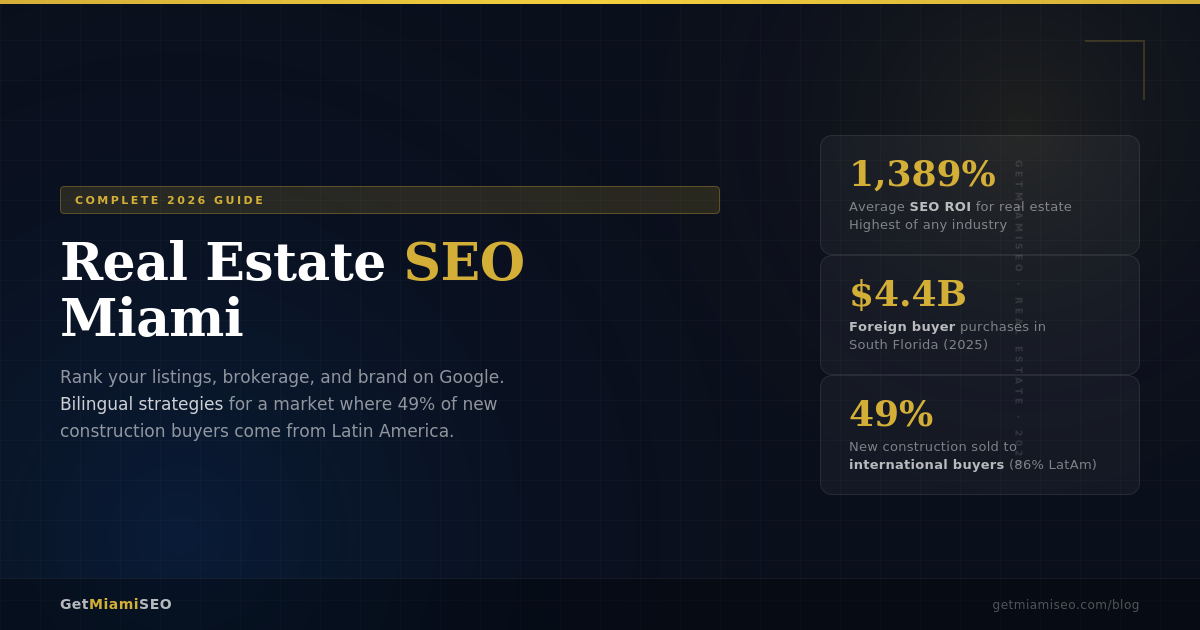
The international buyer concentration is unmatched. According to MIAMI Realtors, foreign buyers purchased $4.4 billion in South Florida residential real estate in 2025, making Miami the #1 U.S. market for international home purchases. These buyers come from 73 different countries, and 86% of them originate from Latin America, primarily Colombia, Argentina, Brazil, and Mexico. They search in Spanish. They search in Portuguese. And they search with purchase intent that is remarkably high: 53% pay entirely in cash.
The bilingual search volume is unlike any other city. As we documented in our research on why 35% of Miami searches happen in Spanish, Miami's search landscape is split between two languages in a way that no other U.S. metro experiences at this scale. Keywords like "apartamentos en Miami" generate 720 monthly searches. "Agente de bienes raíces Miami" pulls 110 searches per month. "Casas en venta en Doral" generates consistent volume every single month. And virtually nobody is competing for them.
The neighborhood micro market structure demands hyperlocal SEO. Miami is not one market. Brickell is a financial district attracting corporate professionals and Latin American executives. Wynwood is an arts and culture hub. Miami Beach caters to tourism and luxury waterfront buyers. Coral Gables serves the established wealth and medical professional market. Each neighborhood has entirely different search behavior, buyer demographics, and competitive landscapes. A realtor who ranks #1 for "condos for sale Brickell" is capturing a completely different buyer than one who ranks for "family homes Kendall," even though both searches happen within the same county.
The luxury segment operates on a different level. Miami ranked #4 globally for the highest concentration of ultra wealthy individuals with either a primary or secondary residence, according to the 2025 Altrata report. The city recorded one of its strongest years on record for sales above $10 million. For the luxury real estate segment, SEO is not about volume. It is about positioning. When a Colombian executive searches for "luxury waterfront condo Brickell" or "penthouse Miami Beach," the realtor who owns that search result is looking at a potential seven figure commission. The stakes of real estate SEO in Miami are proportionally enormous.
2. The $4.4 Billion International Buyer Opportunity Most Realtors Miss
Let's talk about the elephant in the room that 90% of Miami real estate websites are ignoring.
MIAMI Realtors published landmark data in 2025 showing that international buyers accounted for 49% of all new construction, pre construction, and condo conversion sales in South Florida over an 18 month period. The data was aggregated from 9,115 units across 37 projects. Of those international buyers, 86% came from Latin America. Colombia ranked as the #1 foreign country purchasing South Florida real estate, followed by Argentina, Brazil, and Mexico.
These are not casual shoppers. The median purchase price for international buyers in Miami reached $558,700 in 2025, which is 13% higher than the national foreign buyer median. And 53% of these purchases were all cash transactions, meaning these buyers have capital ready to deploy and decisions are made quickly once trust and information align.
Now here is the gap: the overwhelming majority of Miami real estate websites are built exclusively in English. They target exclusively English keywords. Their Google Business Profiles are written in English. Their blog content, if they have any, speaks to a domestic American audience. They are structurally invisible to a buyer pool that spent $4.4 billion in a single year.
This is not a theoretical gap. It is measurable.
A realtor in Brickell who ranks for "Brickell condos for sale" is competing against dozens of established firms. The same realtor who ranks for "apartamentos en venta en Brickell" or "condos de lujo en Miami" is likely competing against almost nobody. The keyword difficulty for most Spanish language real estate terms in Miami sits below 20 on a 100 point scale. The English equivalents often sit above 60.
At GetMiamiSEO, we call this the bilingual arbitrage opportunity. The demand exists. The buyers are real. The money is flowing. The only thing missing is visibility. And for real estate specifically, where a single transaction can mean $15,000 to $150,000+ in commission, the ROI math on bilingual SEO is almost absurdly favorable.
3. Real Estate SEO ROI: The Numbers That Should Change Your Budget
If you are a realtor or broker still wondering whether SEO is worth the investment, consider this: real estate has the highest documented SEO ROI of any industry.
According to FirstPageSage's 2026 ROI research, real estate SEO campaigns deliver an average return of 1,389%. That figure places real estate ahead of financial services (1,031%), SaaS, ecommerce, and every other measured vertical. The data is based on thought leadership style campaigns running between Q1 2021 and Q3 2025, with break even typically occurring within ten months.
The broader data supports this finding across multiple dimensions:
SEO leads convert at 14.6%, compared to 1.7% for outbound marketing. That is an 8.5x conversion advantage, driven by the simple fact that someone searching "homes for sale in Coral Gables" has purchase intent baked into their query. They are not being interrupted by an ad. They are actively looking for what you sell.
Organic search drives 53% of all traffic to real estate websites, according to BrightEdge research. Paid search drives a fraction of that, and social media even less. When you look at where your next client is most likely to find you, the answer is overwhelmingly Google.
Listings with SEO optimized, keyword rich descriptions sell 23% faster. This applies to both your website listings and your individual property pages. Descriptive, locally relevant content does not just attract Google. It attracts buyers.
Local SEO contributes to 78% of mobile real estate searches leading to offline actions. That includes calls, visits, direction requests, and appointment bookings. For a Miami realtor, this means that a properly optimized Google Business Profile and local landing page are not just digital assets. They are direct revenue generators.
The cost comparison against paid channels is decisive. Google Ads in Miami's real estate vertical cost between $20 and $50 per click for standard terms, and $50+ for luxury and competitive keywords. A realtor spending $5,000 per month on Google Ads might generate 100 to 250 clicks, depending on competition. The same $5,000 invested in SEO compounds over time. After six months, organic search typically delivers leads at 5x to 7x lower cost per acquisition than paid. After twelve months, the gap widens further because the content and authority you have built continue working without additional per click costs.
The Zillow comparison matters too. Zillow leads in Miami run $20 to $60 each, and they are shared with competing agents. You are paying for the privilege of being one of several options presented to a prospect who already searched on Zillow, not on your brand. SEO generates exclusive leads. People who find your website through Google are landing on your content, your brand, your listings. There is no lead sharing. There is no bidding against other agents for the same prospect. That exclusivity is worth more than any lead source comparison can capture in raw numbers.
4. Miami Real Estate Keyword Strategy: English, Spanish, and Neighborhood Targeting
Keyword research for real estate SEO in Miami requires three parallel strategies operating simultaneously. Each captures a different segment of the buyer population, and each has distinct competitive dynamics.
Tier 1: High Volume English Keywords
These are the competitive, high intent terms that every major brokerage targets. They are valuable but crowded:
"Real estate SEO Miami" pulls 410 searches per month with a keyword difficulty of 65. "Realtor SEO Miami" generates 170 monthly searches. "Luxury real estate SEO Miami" brings 90 monthly searches at a CPC of $45, indicating very high commercial value. "Real estate marketing Miami" drives 260 monthly searches.
For individual property searches, the volumes are even higher. "Homes for sale Miami" generates thousands of monthly searches. "Brickell condos for sale," "Coral Gables luxury homes," "Miami Beach waterfront real estate," and similar terms each pull hundreds of monthly searches with strong purchase intent.
The strategy here is not to avoid these keywords. It is to build topical authority around them through pillar content, neighborhood pages, and supporting blog posts that collectively tell Google your website is the most comprehensive, most relevant, and most authoritative source for Miami real estate information.
Tier 2: Spanish Language Real Estate Keywords (The Blue Ocean)
This is where the arbitrage lives. As we detailed in our complete bilingual SEO guide, Spanish keywords in Miami real estate represent a massive, underserved market:
"Apartamentos en Miami" generates 720 searches per month with almost no competition. "Casas en venta en Miami" pulls consistent monthly volume. "Agente de bienes raíces en Miami" brings 110 monthly searches. "Condos de lujo en Brickell" and "casas en Doral" represent neighborhood level Spanish queries that convert at extraordinarily high rates because the searcher is both specific about location and specific about language preference.
The keyword difficulty for most of these terms sits below 25. For comparison, their English equivalents often exceed 60. A Miami realtor who builds out Spanish landing pages, Spanish blog content, and a bilingual Google Business Profile can achieve page one rankings for these terms in 30 to 60 days. In English, the same level of visibility might take six to twelve months.
And remember: the people searching these terms are not a secondary audience. They represent 49% of new construction buyers. They are spending $558,700 per transaction on average. They are paying cash more than half the time. This is your most valuable buyer segment, and they are practically being handed to you because your competitors refuse to optimize for their language.
Tier 3: Neighborhood Level Long Tail Keywords
Neighborhood specific keywords convert 41% better than generic city level terms, according to Instapage research. In Miami, where each neighborhood functions as a distinct micro market, this is especially powerful:
English neighborhood terms: "Best realtor in Brickell," "Coral Gables homes under 1 million," "Wynwood lofts for sale," "Doral new construction," "Aventura condos with ocean view," "Coconut Grove family homes near schools," "Edgewater waterfront condos 2026."
Spanish neighborhood terms: "Apartamentos en Brickell para inversionistas," "casas en Coral Gables cerca de escuelas," "condos en Doral para familias," "propiedades en Miami Beach frente al mar."
Informational long tail terms that attract early stage buyers: "How to buy a condo in Miami as a foreign buyer," "Miami neighborhoods for families 2026," "cost of living Brickell vs Coral Gables," "property tax rates Miami Dade County," "best neighborhoods for investment in Miami 2026."
Each of these informational queries represents a person at the beginning of their buying journey. They may not be ready to call a realtor today, but they are researching. If your website answers their question, you are the first brand they encounter. When they are ready to buy (and 97% of them will eventually search for a realtor on Google), your brand carries recognition and trust that no paid ad can replicate.
5. On Page SEO for Real Estate Websites: What Google Wants in 2026
Google's ranking algorithm in 2026 places enormous emphasis on E-E-A-T: Experience, Expertise, Authoritativeness, and Trustworthiness. For real estate, this translates into specific on page requirements that most realtor websites fail to meet.
Title Tags and Meta Descriptions Must Be Location Specific
Every listing page, neighborhood page, and service page on your website needs a title tag that includes the target neighborhood, property type, and year. "Brickell Condos for Sale | Luxury Miami Real Estate 2026" performs significantly better than "Our Listings | [Brokerage Name]." Meta descriptions should include a call to action and a value proposition: "Browse 200+ verified Brickell condo listings. Bilingual agents serving international and local buyers since 2015. Schedule a showing today."
Schema Markup Is Non Negotiable
Structured data helps Google understand your content and display it in rich results. Real estate websites should implement RealEstateAgent schema, LocalBusiness schema, and FAQ schema at a minimum. Listing pages benefit from Product schema with price, availability, and location data. Implementing schema correctly can increase your click through rate by up to 43%, according to Moz research.
Page Speed and Core Web Vitals
Real estate websites are notoriously slow because of high resolution listing photos and embedded map widgets. But Google penalizes slow pages, and users bounce. Sites with load times under 2 seconds experience 30% lower bounce rates. Compress your images. Lazy load your gallery photos. Minimize JavaScript. Your Miami buyer is searching on mobile (80%+ of traffic), likely on cellular data, possibly from another country. If your page takes 5 seconds to load, they are gone.
Content Depth on Every Page
Google rewards comprehensive content. A neighborhood landing page should not be 200 words of generic copy with a listing feed. It should include neighborhood demographics, price trends, nearby amenities, school information, walkability data, commute times, and lifestyle context. The realtor websites that rank #1 for neighborhood terms are the ones that provide more useful information on a single page than the buyer could find across ten competing sites.
Internal Linking Architecture
Every neighborhood page should link to related blog posts. Every blog post should link to relevant service pages. Your listing pages should link to the neighborhood guide. This internal linking web tells Google how your content relates and distributes page authority throughout your site. A real estate website with 50 pages and strong internal linking will outrank a site with 200 pages and no linking strategy.
6. Google Business Profile Optimization for Miami Realtors
Your Google Business Profile is the single most impactful local SEO asset you own, and it is free.
Verified Google Business Profiles receive over 21,000 views per year. Businesses in the Google 3 Pack (the top three map results) capture 126% more traffic and 93% more actions than those ranked below. For a Miami realtor, appearing in the 3 Pack for "realtor near me" or "real estate agent Brickell" can generate dozens of qualified leads per month without spending a dollar on advertising.
Here is how to optimize it for Miami's unique market:
Complete every field. Name, address, phone, website, hours, service areas, business category (use "Real estate agency" as primary, with "Real estate consultant" and "Property management company" as secondary if applicable). Upload a minimum of 20 photos showing your office, team, properties, and Miami neighborhood context.
Write your description with keywords. You have 750 characters. Use them strategically: "Miami's bilingual real estate team specializing in Brickell condos, Coral Gables luxury homes, and Doral family properties. Serving international and local buyers in English and Spanish since [year]. Over [number] successful transactions across Miami Dade County."
Add bilingual content. Write your services section in both English and Spanish. Post weekly updates alternating between languages. This signals to Google that you serve both language communities, improving your visibility in both English and Spanish local searches.
Build your review profile. Businesses with 50+ reviews and a 4.5+ rating significantly outperform those with fewer reviews. Ask every client for a review. Respond to every review within 24 hours, in the reviewer's language. When a Colombian buyer leaves a review in Spanish, respond in Spanish. Google reads these responses and uses them as signals for language specific ranking.
Post regularly. Google Business Profile posts function like mini blog entries. Share market updates, new listings, neighborhood guides, and client success stories weekly. Each post is indexable and contributes to your local ranking signals.
7. Content Strategy: What to Publish and Why It Converts
Content marketing for real estate SEO in Miami is not about blogging for the sake of blogging. It is about creating assets that attract specific buyer personas at specific stages of their decision making process.
Neighborhood Guides (Highest Converting Content Type)
Comprehensive neighborhood guides are the single highest performing content type for real estate SEO. A guide to "Living in Brickell: Everything You Need to Know in 2026" can rank for dozens of related keywords, attract buyers who are actively researching where to live, and establish your brokerage as the authoritative source for that neighborhood.
Each guide should cover: neighborhood history, current market data (median price, inventory, days on market), lifestyle and amenities, school ratings, commute information, dining and entertainment, investment potential, and a clear call to action to schedule a consultation.
Market Reports and Data Content
Monthly or quarterly market reports position your brokerage as a data driven authority. "Miami Real Estate Market Report: Q1 2026" targeting "Miami real estate market 2026" keywords attracts both buyers and investors. Include real data: median prices, sales volume, inventory levels, days on market, and year over year comparisons. This type of content earns backlinks from media, other real estate blogs, and industry publications.
Buyer Journey Content
Answer the questions your clients actually ask:
"How to buy a condo in Miami as a foreign investor" targets the international buyer segment with a transactional query that has strong purchase intent. "Miami property tax guide 2026" attracts buyers doing financial due diligence. "Brickell vs Coral Gables: Which neighborhood is right for you?" captures comparison shoppers who are narrowing their decision. "New construction vs resale in Miami: Pros and cons for 2026 buyers" addresses a common decision point.
Each of these articles serves as a lead magnet. A foreign buyer reading your comprehensive guide to purchasing property in Miami as a non resident is exponentially more likely to contact you than a competitor they have never heard of.
Bilingual Content (Not Translations)
As we outlined in our bilingual SEO guide, Spanish language content must be created from scratch, not translated. Write original guides like "Cómo comprar una casa en Miami siendo extranjero: Guía completa 2026" and "Los mejores barrios de Miami para familias latinoamericanas." These target Spanish keywords that your English content cannot rank for, regardless of how good your English SEO is.
8. Link Building for Miami Real Estate Authority
Backlinks remain one of the strongest ranking factors in 2026. For Miami real estate, the link building strategy should focus on local, relevant, and authoritative sources:
Local directories and organizations. Get listed with the Greater Miami Chamber of Commerce, the Miami Association of Realtors, the Miami Dade Beacon Council, local neighborhood associations, and Hispanic business organizations like the Miami Hispanic Chamber of Commerce.
Local media and press. Contribute market commentary to the Miami Herald, El Nuevo Herald, South Florida Business Journal, and local real estate publications. When Miami Realtors publishes market data, create your own analysis and reference it. Media outlets link to sources that provide original analysis and local expertise.
Industry partnerships. Title companies, mortgage brokers, home inspectors, and property management firms are natural link partners. Cross reference each other's content, co author guides, and build resource pages that link to trusted local partners.
Community content. Sponsor local events, participate in neighborhood associations, and create content about local developments. When the Miami Freedom Park stadium opens in 2026, be the first to publish "How Miami Freedom Park Will Impact Nearby Real Estate Values." That type of timely, locally relevant content earns links organically because nobody else has written it yet.
9. The Bilingual Advantage: Why Spanish Real Estate SEO Is Your Biggest Competitive Edge
We have covered the data in earlier sections, but it bears repeating in the context of competitive strategy: bilingual SEO for real estate in Miami is not an add on feature. It is arguably the single most powerful competitive advantage available to any brokerage willing to invest in it.
The math is straightforward. 49% of new construction buyers are international. 86% of those are from Latin America. 53% of Hispanic adults actively seek Spanish language websites when making purchasing decisions. 35% of all Miami searches happen in Spanish. And 90% of real estate websites in Miami have zero Spanish language content.
That last number is the one that matters most. When 90% of your competition is ignoring a market segment that accounts for nearly half of all new construction sales and billions of dollars in annual transaction volume, the competitive moat you build by serving that segment is enormous. And because domain authority and content authority compound over time, the brokerage that builds Spanish language real estate content today will be nearly impossible to displace two years from now.
The implementation is not trivial, and we covered the technical requirements in depth in our complete bilingual SEO guide. But the payoff is proportionally massive. We have seen Miami real estate clients achieve page one rankings for Spanish keywords within 45 days of launching bilingual content, while their English equivalents took six months or longer.
If you take one thing from this entire guide, let it be this: the realtors and brokerages that will dominate Miami's search results over the next five years are the ones building bilingual now. Everyone else will be playing catch up.
10. Technical SEO Foundations Every Real Estate Website Needs
Real estate websites have specific technical challenges that require targeted solutions:
Mobile First Design (Non Negotiable)
Over 80% of real estate search traffic in Miami comes from mobile devices. For international buyers searching from Latin America, that percentage is even higher. Your website must be fully responsive, fast loading on mobile networks, and designed with thumb friendly navigation. Google uses mobile first indexing, meaning it evaluates the mobile version of your site for ranking purposes. If your mobile experience is poor, your rankings suffer regardless of how good your desktop site looks.
IDX Integration Without SEO Penalties
Many real estate websites use IDX (Internet Data Exchange) feeds to display MLS listings. The problem: IDX content is often duplicated across hundreds of agent websites, creating thin content issues. To avoid penalties, add unique descriptions to featured listings, create original neighborhood context around IDX feeds, and use canonical tags to signal the original source. Never rely on IDX pages alone for your SEO strategy. They should supplement your original content, not replace it.
Site Architecture for Scalability
A well structured real estate website follows a clear hierarchy: Homepage > Neighborhood Pages > Individual Listing Pages, with supporting Blog Posts and Resource Pages linking throughout. Each neighborhood should have its own landing page (English and Spanish) with unique content, market data, and embedded listings. This structure makes it easy for Google to crawl and understand your site while distributing link authority effectively.
Hreflang for Bilingual Properties
If you are building a bilingual site (and you should be), hreflang tags are essential. Every English page needs a corresponding hreflang tag pointing to its Spanish equivalent, and vice versa. Without these tags, Google may serve the wrong language version to the wrong audience, or flag your Spanish pages as duplicate content. The recommended structure is a subdirectory approach: yoursite.com/en/ for English and yoursite.com/es/ for Spanish.
11. Measuring What Matters: KPIs for Real Estate SEO in Miami
Real estate SEO success should be measured across four categories:
Visibility metrics: Track keyword rankings for your target terms across English and Spanish. Monitor impressions in Google Search Console for both language segments. Track your Google Business Profile views, searches, and actions monthly.
Traffic metrics: Organic sessions by neighborhood page, by language, and by device. Pay special attention to traffic from international locations (Colombia, Argentina, Brazil, Mexico) as these indicate your bilingual strategy is working.
Lead metrics: Form submissions, phone calls, WhatsApp inquiries (critical for international buyers), and email inquiries originating from organic search. Track which pages generate the most leads, not just the most traffic. A neighborhood guide that generates 10 leads per month from 500 visits is more valuable than a blog post that generates 2 leads from 2,000 visits.
Revenue metrics: Closed transactions attributable to organic search. This requires proper attribution tracking through your CRM, but it is the ultimate measure of SEO ROI. A single closed transaction from an organic search lead in Miami's market can return the entire annual SEO investment.
12. Frequently Asked Questions
How much does real estate SEO cost in Miami?
Real estate SEO in Miami typically ranges from $3,500 to $8,500 per month depending on competition level, number of neighborhoods targeted, and whether bilingual optimization is included. Basic local SEO packages start around $1,500 per month. Comprehensive bilingual campaigns targeting luxury and international buyer keywords can reach $10,000+ per month. At GetMiamiSEO, we start every engagement with a free SEO audit so you know exactly what your investment will return before you commit.
How long does it take for a realtor to rank on Google in Miami?
Most Miami real estate agents see measurable ranking improvements within 60 to 90 days for neighborhood specific and long tail keywords. Competitive primary terms like "Miami luxury real estate" or "best realtor Miami" typically take 6 to 12 months. Spanish language real estate keywords often rank within 30 to 60 days due to minimal competition. The Google Business Profile usually shows improvement within the first 2 to 4 weeks of optimization.
Why do Miami realtors need bilingual SEO?
Because 49% of new construction purchases in South Florida are made by international buyers, 86% of whom come from Latin America. Because 35% of all local searches in Miami happen in Spanish. And because 90% of competing real estate websites have zero Spanish content. Bilingual SEO gives you access to a buyer pool spending $4.4 billion annually that your competitors cannot reach.
What is the ROI of SEO for real estate in Miami?
Real estate has the highest documented SEO ROI of any industry at 1,389%, according to FirstPageSage research. SEO leads close at 14.6% compared to 1.7% for outbound marketing. For Miami realtors, this translates to a 5x to 7x lower cost per lead compared to Google Ads within 6 months of consistent organic optimization. Given Miami's average transaction values, a single closed deal from an organic lead can cover an entire year of SEO investment.
Should I invest in SEO or Zillow leads for my Miami real estate business?
Both serve different roles, but SEO is the higher ROI long term investment. Zillow leads are immediate but expensive ($20 to $60 per lead in Miami), shared with multiple competing agents, and disappear the moment you stop paying. SEO builds owned traffic that compounds over time, delivering exclusive leads at a fraction of the cost. The most effective strategy is using Zillow for short term lead flow while building SEO as your long term, highest ROI acquisition channel.
What real estate keywords should I target in Miami?
Focus on three tiers: high volume English terms ("Miami homes for sale," "Brickell condos," "Coral Gables luxury real estate"), Spanish equivalents ("apartamentos en Miami," "casas en venta en Doral," "agente de bienes raíces Miami"), and neighborhood level long tail terms that convert 41% better than generic queries. Informational queries like "how to buy a condo in Miami as a foreign buyer" attract high intent prospects early in their journey and build your authority for commercial keywords.
Can I do real estate SEO myself or do I need an agency?
You can handle some elements yourself, particularly Google Business Profile optimization, review generation, and basic content creation. However, bilingual keyword research, hreflang implementation, schema markup, strategic link building, and competitive analysis require specialized expertise. Most Miami brokerages find that the opportunity cost of doing SEO in house (time taken away from selling) exceeds the cost of hiring a specialist agency. The free SEO audit from GetMiamiSEO can show you exactly where you stand and what the return on professional investment would look like.