Miami's Small Business Boom: How 4,900 New Businesses Can Win on Google (Before 1 in 5 Disappear)
Miami-Dade is now America's #1 county for small business creation. But most new businesses never appear in a single Google search. Here's the data-backed playbook that separates the businesses that grow from the ones that vanish.
In This Article:
- The Boom: Miami's Small Business Explosion by the Numbers
- The Survival Problem: Why 1 in 5 Won't Make It
- The Visibility Gap: 58% of Small Businesses Never Optimize for Local Search
- Why Local SEO Is the Highest-ROI Channel for New Miami Businesses
- The First 90 Days: An SEO Checklist for New Miami Businesses
- Neighborhood Matters: Where Miami's Business Growth Is Concentrated
- The Bilingual Advantage: Why Spanish SEO Is Your Secret Weapon
- Frequently Asked Questions
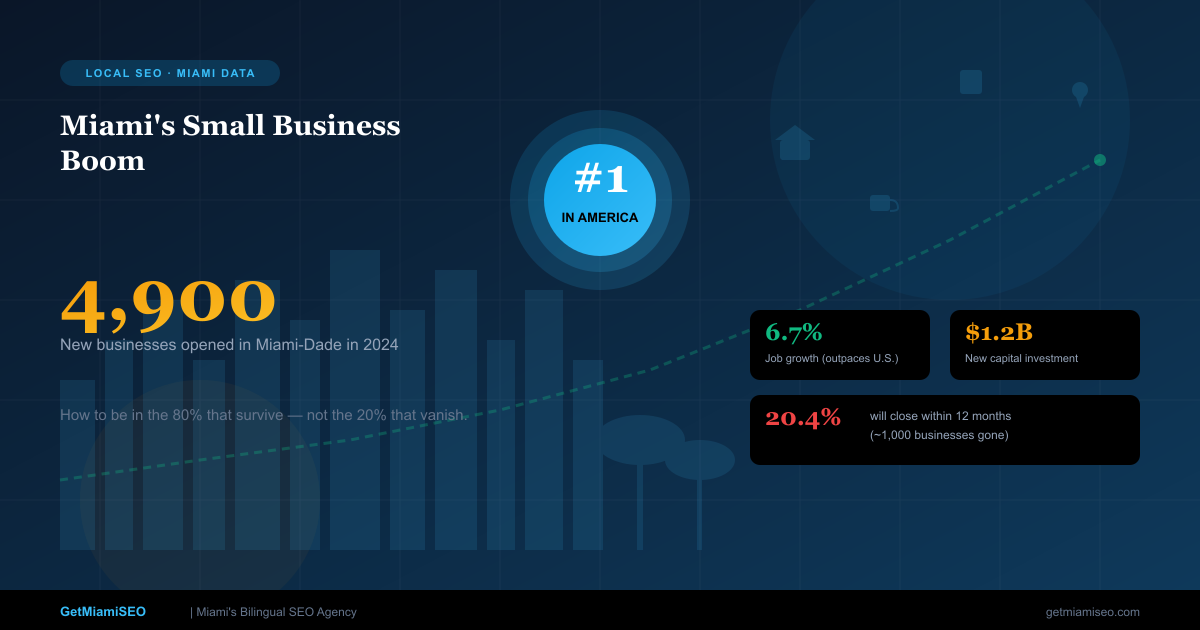
Something remarkable is happening in Miami-Dade County. According to a Clarify Capital report, Miami-Dade has surged to the #1 county in the United States for small business creation, with roughly 4,900 new businesses opened in 2024 alone.
That's not a typo. Nearly five thousand new businesses in a single year, in a single county. More than Austin. More than Brooklyn. More than anywhere else in America.
But here's the number nobody's celebrating: 20.4% of those businesses will close within 12 months. That's roughly 1,000 of those 4,900 new businesses gone before their first anniversary, according to the U.S. Bureau of Labor Statistics.
Why do so many fail? The reasons are well-documented: cash flow, lack of market demand, competition. But there's one factor that's less talked about and entirely preventable: invisibility. In 2026, if your business doesn't appear when someone Googles what you sell, you functionally don't exist.
And the data is staggering: 58% of small businesses still don't optimize for local search. In a city where 98% of consumers search online before choosing a local business, that's not a strategy gap. That's a survival gap.
This article is for the 4,900. Here's the playbook that separates the businesses that grow from the ones that disappear.
1. The Boom: Miami's Small Business Explosion by the Numbers
Miami's rise as America's entrepreneurial capital isn't accidental. It's the result of structural advantages that no other U.S. metro can replicate: zero state income tax, a gateway position to Latin America, a majority-bilingual workforce, and a post-pandemic migration wave that brought both capital and talent from New York, San Francisco, and São Paulo.
#1 U.S. county for small business creation (2024)
4,900 new businesses opened in Miami-Dade in 2024
6.7% job growth in Miami-Dade (2018–2023), outpacing U.S. by 3.1%
$1.2B new capital investment attracted in 2024–2025
The Miami-Dade Beacon Council reports that the county has attracted over 160,000 new jobs and $8.4 billion in investment since 1985. But the acceleration since 2020 has been extraordinary: 49,200 jobs added in the most recent 12-month period alone, a 1.7% growth rate that outpaced the national average of 1.4%.
Miami's startup ecosystem is now ranked 28th globally, with an annual growth rate of 28.5%, the fastest of any major ecosystem in the world's top 100. The metro area raised an estimated $3.5–$4 billion in venture capital in 2025, and is home to 60+ international banks and 1,200+ Latin American multinational headquarters.
This isn't just a boom. It's a structural shift. Miami is becoming to entrepreneurship what Silicon Valley was to tech: the default destination. And that creates both an enormous opportunity and an enormous problem, because with 4,900 new competitors entering the market every year, standing out has never been harder.
2. The Survival Problem: Why 1 in 5 Won't Make It
The national business failure data is sobering. According to the Bureau of Labor Statistics, the failure rates are remarkably consistent across economic cycles:
In the first year, about 20.4 percent of new businesses fail, which means roughly 1,000 of the 4,900 new businesses in Miami will close.
By the third year, around 40 percent will have shut down, translating to approximately 1,960 business closures.
By the fifth year, the failure rate rises to 49.4 percent, so about 2,420 businesses will no longer be operating.
By the tenth year, nearly two thirds of new businesses fail. At a 65.3 percent failure rate, roughly 3,200 of the original 4,900 businesses will have closed.
The top reasons businesses fail, according to CB Insights analysis of 100+ post-mortems: 42% cited no market need, 29% ran out of cash, 23% didn't have the right team, and 19% were outcompeted. But look at that first reason carefully: "no market need" doesn't mean the market didn't exist. It means the business couldn't reach the market that existed.
In 2026, "reaching your market" overwhelmingly means one thing: being found on Google.
The Invisible Business Problem
A restaurant in Wynwood with incredible food but zero Google visibility will lose to a mediocre restaurant that ranks #1 for "restaurants near me." A plumber in Doral who doesn't appear in the Google Map Pack is invisible to the 76% of people who search "plumber near me" and visit a business within 24 hours. Visibility isn't a marketing advantage anymore. It's a survival requirement.
3. The Visibility Gap: 58% of Small Businesses Never Optimize for Local Search
Here's where the opportunity gets real. Despite the data proving that local search is the highest-converting channel available to small businesses, the majority still aren't investing in it.
Let that sink in: 98% of your potential customers are searching for you online. Nearly half of all Google searches are looking for something local. Three-quarters of those searches lead to an in-person visit within a single day. And yet more than half of small businesses have done nothing to appear in those results.
In Miami, this gap is even wider because of the bilingual factor. Our research on Miami's Spanish search behavior shows that 35% of local searches happen in Spanish, and 90% of SEO agencies ignore Spanish entirely. A new business in Hialeah or Little Havana that doesn't rank for Spanish keywords is invisible to a plurality of its own neighborhood.
The math is stark: If you're one of the 58% that doesn't invest in local SEO, you're competing for customers against the 42% that does, and those 42% are capturing 76% of the foot traffic, 78% of the purchases, and virtually all of the Google Map Pack visibility. In a market with 4,900 new competitors per year, that's not a disadvantage. It's a death sentence in slow motion.
4. Why Local SEO Is the Highest-ROI Channel for New Miami Businesses
New businesses have limited budgets. Every dollar needs to work hard. Here's why local SEO delivers more per dollar than any other channel for a Miami small business:
SEO Leads Convert at 8.5× the Rate of Outbound
According to Doyen Digital research, SEO leads close at 14.6% compared to 1.7% for outbound marketing, an 8.5× difference. The reason is intent: someone searching "dentist Coral Gables" or "abogado de accidentes Miami" is actively looking for what you sell. They have intent. They have urgency. They're ready to buy. Compare that to a cold Instagram ad interrupting someone's feed.
Google 3-Pack Dominates Local Discovery
Businesses that appear in Google's local 3-pack (the top three results with the map) receive 126% more traffic and 93% more actions (calls, direction requests, website clicks) than businesses ranked 4–10. For a new Miami business, getting into that 3-pack is the single most impactful thing you can do for visibility.
The Cost Advantage Over Paid Ads
Google Ads in competitive Miami verticals cost $15–$200 per click. A personal injury keyword? $150+. A real estate keyword? $20–$50. Local SEO has an upfront investment but compounds over time, meaning your cost per lead decreases every month as your organic rankings strengthen. After 6 months, the cost per acquisition through organic is typically 5–7× lower than paid.
Real Numbers: The Google Business Profile Impact
Verified Google Business Profiles receive over 21,000 views per year on Google. Customers are 2.7× more likely to trust a business with a complete profile. And 88% of consumers who find you via local search will visit or call within 24 hours. For a new business with zero brand recognition, a fully optimized Google Business Profile is the fastest path to your first customers.
5. The First 90 Days: An SEO Checklist for New Miami Businesses
You don't need a $10,000/month budget to start ranking. You need the right actions in the right order. Here's the prioritized checklist we use for every new Miami business we work with at GetMiamiSEO:
Week 1–2: Foundation (Cost: $0–$500)
- Claim and complete your Google Business Profile. Fill every field: name, address, phone (NAP), business category, hours, service area, description, photos (minimum 10), and attributes. This is free and takes 30 minutes.
- Set your NAP consistency. Your business name, address, and phone number must be identical across your website, Google, Yelp, Facebook, Apple Maps, and every directory. Even minor inconsistencies (Suite vs. Ste.) confuse Google.
- Build your website with local keywords. Every page should reference your city, neighborhood, and service. "Plumber in Doral" is a keyword. "Plumber" alone isn't local SEO.
- Submit to the top 20 local directories. Google Business Profile, Yelp, Facebook, Apple Maps, Bing Places, Foursquare, Yellow Pages, BBB, Nextdoor, and industry-specific directories for your vertical.
Week 3–6: Authority Building (Cost: $500–$1,500)
- Get your first 10 reviews. Ask every customer for a Google review. Respond to every review within 24 hours, positive and negative. Businesses with 10+ reviews and a 4.5+ rating significantly outrank those without.
- Create 3–5 location-specific landing pages. If you serve Brickell, Coral Gables, and Doral, create dedicated pages for each with unique content, local keywords, and embedded Google Maps.
- Publish your first 2 blog posts. Answer the most common questions your customers ask. "How much does [your service] cost in Miami?" and "Best [your service] in [neighborhood]" are high-intent, low-competition keywords.
- Earn 3–5 local backlinks. Join your neighborhood Chamber of Commerce. Sponsor a local event. Get listed on the Greater Miami Chamber of Commerce directory. Each local link signals to Google that you're a real Miami business.
Week 7–12: Scale & Differentiate (Cost: $1,000–$3,000)
- Add bilingual content. If your customers speak Spanish (and in Miami, at least 35% do), add Spanish pages, a Spanish Google Business Profile description, and respond to Spanish reviews. This is where 90% of your competitors stop, making it your blue ocean.
- Implement schema markup. Add LocalBusiness, Service, and FAQ schema to your website so Google can understand and display your business information in rich results.
- Build a review generation system. Automate review requests via text/email after every job. Consistent review velocity matters more than having 100 reviews from three years ago.
- Track everything. Set up Google Search Console, Google Analytics, and call tracking. Know which keywords drive traffic, which pages convert, and what your cost per lead is. What you can't measure, you can't improve.
6. Neighborhood Matters: Where Miami's Business Growth Is Concentrated
Miami isn't one market. It's dozens of micro-markets, each with different demographics, competition levels, and search behavior. Where you're located determines your SEO strategy.
The key insight: competition varies dramatically by neighborhood. A new law firm in Brickell faces fierce online competition from established firms with years of authority. The same law firm targeting Hialeah or Homestead in Spanish could rank on page 1 within weeks. Neighborhood-level keyword targeting is one of the most underused strategies in Miami SEO.
7. The Bilingual Advantage: Why Spanish SEO Is Your Secret Weapon
We wrote an entire data-backed article on why 35% of Miami searches happen in Spanish. But the short version for new businesses is this:
70% of Miami-Dade residents are Hispanic
35% of all local searches in Miami happen in Spanish
90% of SEO agencies ignore Spanish entirely
53% of Hispanic adults seek Spanish-language websites when shopping
For a new business, this is arguably the single biggest competitive advantage available in Miami. Why? Because bilingual SEO lets you compete in a market where almost nobody else is competing.
English keywords in Miami are crowded. "Personal injury lawyer Miami" has a keyword difficulty of 70+ and a $150 CPC. But "abogado de accidentes Miami"? Keyword difficulty under 30. CPC under $15. And the searcher has the exact same intent and the exact same budget.
New Miami businesses that build bilingual into their SEO from day one don't just get a head start. They get a structural moat that compounds for years — because Spanish-language authority, once established, is extremely difficult for competitors to catch up to.
Quick Win: Bilingual Google Business Profile
You can add Spanish content to your Google Business Profile today for free. Add a Spanish description, respond to reviews in Spanish, and post bilingual updates. This single action can increase your visibility in Spanish local searches immediately — and it takes less than 30 minutes.
8. Frequently Asked Questions
How much does SEO cost for a small business in Miami?
Local SEO for a small business in Miami typically ranges from $1,000 to $3,000 per month for core optimization. This includes Google Business Profile management, local keyword targeting, citation building, review strategy, and on-page optimization. Businesses in competitive verticals like law, real estate, or medical may invest $3,000–$8,500/month for comprehensive bilingual SEO campaigns.
How long does it take for a new Miami business to rank on Google?
New businesses targeting local keywords can see Google Business Profile visibility within 2–4 weeks and organic page-1 rankings for low-competition terms within 60–90 days. Highly competitive keywords may take 6–12 months. Spanish-language keywords rank significantly faster due to minimal competition — often within 30–60 days.
Is SEO worth it for a brand-new business?
Absolutely. SEO leads convert at 14.6% versus 1.7% for outbound marketing. For new businesses with limited budgets, local SEO delivers the highest ROI because you're reaching people with active purchase intent. A fully optimized Google Business Profile alone can generate 21,000+ views per year — for free.
What is the most important SEO action for a new business in Miami?
Claiming and fully optimizing your Google Business Profile is the single highest-impact action. Complete it with accurate NAP data, business hours, service descriptions, a minimum of 10 photos, and bilingual content. Then focus on earning your first 10+ reviews within 30 days. These two actions alone can get you into local search results within weeks.
Do I need a website, or is Google Business Profile enough?
Both. Your Google Business Profile drives local pack visibility (the map results), but a website with locally optimized content builds organic rankings that compound over time. Businesses with both a strong GBP and an optimized website capture significantly more total search traffic than those with only one.
Should I invest in SEO or Google Ads first?
If you need leads immediately (within days), start with Google Ads — but plan to transition budget to SEO within 3–6 months. Ads stop the moment you stop paying. SEO compounds. After 6 months, organic search typically delivers leads at 5–7× lower cost per acquisition than paid. The smartest strategy is both in parallel, with a gradual shift toward organic as your rankings build.