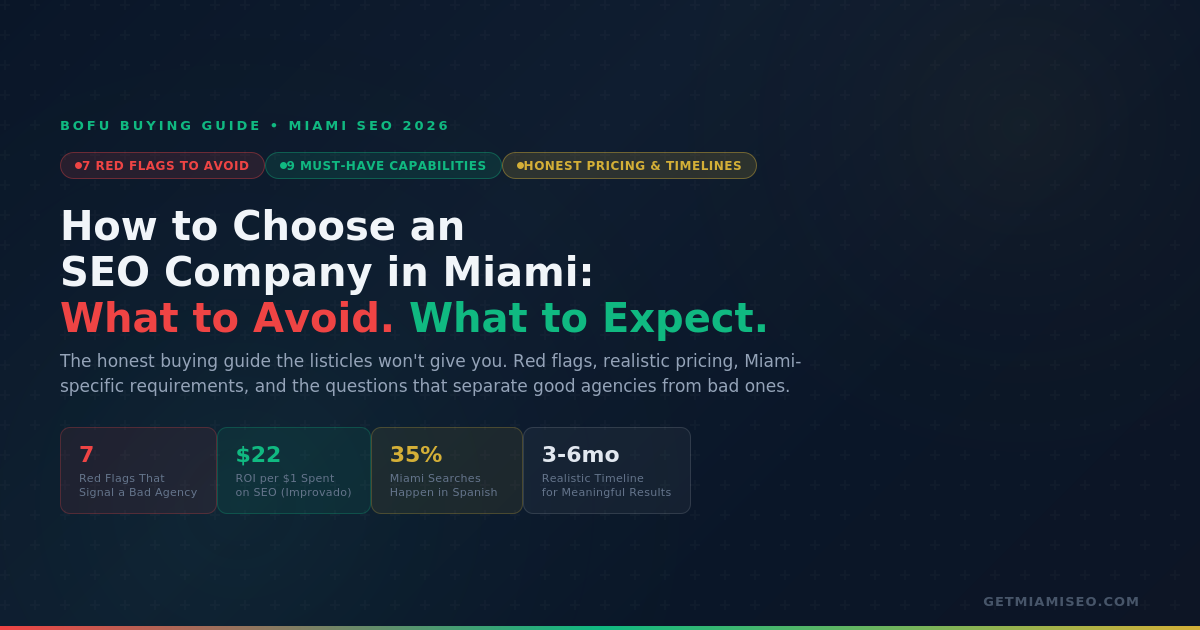
Search "best SEO company in Miami" and you will find listicle after listicle of agencies ranking themselves at the top of their own list. Clutch, DesignRush, GoodFirms, Semrush, and a dozen agency blogs all publish "Top 10 Miami SEO Companies" articles that exist for one purpose: to generate leads for the agencies that paid to be featured or wrote the article.
None of those lists tell you how to actually evaluate whether an agency is right for your business. None explain what to expect from realistic pricing or timelines. None address the specific requirements of doing SEO in Miami, where 69% of the population is Hispanic, 35% of searches happen in Spanish, and 28.2 million annual visitors create seasonal demand patterns that national agencies do not understand.
This guide exists to give you the information you need to make a good decision. We wrote it knowing that some of you will use it to choose a different agency. That is fine. A well-informed buyer is better for the entire industry. The SEO companies that do good work benefit from educated clients. The ones that do not benefit from confusion.
The 7 Red Flags That Signal a Bad SEO Agency
Red Flag 1: Guaranteeing specific rankings. No legitimate SEO company can guarantee a #1 position on Google. Google's algorithm evaluates over 200 ranking signals and is updated multiple times per year. The 2026 Whitespark survey identified 149 individual ranking factors scored by 47 experts. No third party controls these signals. An agency can optimize your site to be competitive. It cannot guarantee a specific outcome. An agency that guarantees rankings is either lying, planning to use tactics that will eventually get your site penalized, or targeting obscure keywords nobody searches for.
Red Flag 2: Refusing to explain their methodology. "Our process is proprietary" is the SEO equivalent of "trust me." If an agency cannot explain in plain language what they will do to your website, why they are doing it, and how it connects to your business goals, they are either hiding something or they do not understand their own process. Every legitimate SEO strategy can be explained clearly: technical audit to fix crawl errors and speed issues, on-page optimization to target the right keywords, GBP optimization for local visibility, content creation for topical authority, and link building for domain strength. If an agency cannot articulate their plan, find one that can.
Red Flag 3: No case studies or verifiable client references. An agency that cannot show you real results for real businesses either does not have results to show or is hiding poor performance. Ask for case studies in your industry or a similar one. Ask for client references you can contact directly. An agency confident in its work will provide both without hesitation.
Red Flag 4: Requiring long-term contracts with no performance benchmarks. A 12-month contract with no exit clause and no defined success metrics locks you into paying even if nothing improves. The best agencies earn retention through results, not contracts. Month-to-month or quarterly agreements with clear KPIs protect both parties: the agency knows what it needs to deliver, and the client can leave if those deliverables are not met.
Red Flag 5: Offering one-size-fits-all packages. "Bronze, Silver, Gold" packages signal that the agency is selling a template, not a strategy. A law firm in Coral Gables competing for "$250 CPC personal injury keywords" needs a fundamentally different strategy than a restaurant in Wynwood that needs Google Maps visibility and review velocity. If the agency offers the same package to both, neither will get what they actually need.
Red Flag 6: No bilingual capability in Miami. This is the red flag specific to this market. An SEO agency operating in Miami-Dade that does not offer Spanish-language optimization is leaving a third of its clients' addressable market uncaptured. Spanish keywords carry 75% to 85% lower difficulty. The bilingual opportunity is not a nice-to-have. It is the single easiest way to double a Miami business's search visibility with dramatically less competition. Ask any prospective agency: "Do you do keyword research in Spanish? Do you create original Spanish content or just translate? Do you manage bilingual GBP profiles?" If the answer is no to any of these, they do not understand the Miami market.
Red Flag 7: No technical audit before starting work. An agency that proposes a strategy without first auditing your website is prescribing medicine without a diagnosis. Over 60% of websites experience significant traffic drops after redesigns that ignore SEO. Technical issues like crawl blocks, broken redirects, missing canonical tags, and slow load times can make every other SEO effort useless. If an agency does not start with a comprehensive technical audit, they are building on a foundation they have not inspected.
The 9 Things a Good Miami SEO Company Should Offer
1. A comprehensive initial audit. Before any work begins, the agency should analyze your website's technical health, current rankings, competitive landscape, keyword opportunities, GBP performance, and backlink profile. This audit is the foundation for the entire strategy.
2. A customized strategy document. Not a template. A strategy built specifically for your business, your industry, your geographic targets, and your competitive environment. The document should include target keywords, content plan, technical fix priorities, local SEO actions, and measurable goals with timelines.
3. Technical SEO capability. Can they fix crawl errors, implement redirects, optimize Core Web Vitals (LCP under 2.5s, INP under 200ms, CLS under 0.1), implement schema markup, and manage site migrations without destroying rankings? Technical SEO is the foundation. Without it, content and links are wasted effort.
4. Local SEO expertise. GBP signals represent 32% of Map Pack ranking factors (Whitespark 2026). The agency should know how to optimize your Google Business Profile, manage citations, build review velocity, and create neighborhood-specific content that captures local searches.
5. Content strategy and creation. The #1 organic local ranking factor is "dedicated page for each service" (Whitespark 2026). The agency should be capable of producing substantive, expert-level content that targets the right keywords and demonstrates real expertise on the topic.
6. Bilingual optimization. In Miami, this is not optional. The agency should offer independent Spanish keyword research (not just translation), original Spanish content creation, bilingual GBP management, and proper hreflang implementation.
7. Link building strategy. Links represent 13% of Map Pack factors and 26% of organic local factors (Whitespark 2026). The agency should pursue quality local links from Miami media, chambers of commerce, industry associations, and community organizations rather than buying low-quality links from irrelevant sites.
8. Transparent reporting. Monthly reports in plain language showing keyword movements, traffic trends, GBP metrics, technical fixes completed, content published, and links earned. You should understand what happened, why it matters, and what is planned next.
9. AI search awareness. In 2026, SEO is not just about Google rankings. AI Overviews appear in 60%+ of queries. 68% of searches end without a click. The agency should understand how to optimize for AI visibility alongside traditional rankings.
What SEO Actually Costs in Miami (Honest Numbers)
The pricing transparency in the SEO industry is terrible. Many agencies hide their pricing because they charge different clients different amounts based on perceived budget. Here is what the market actually looks like in 2026.
$500 to $1,000/month: Typically covers basic local SEO only: GBP optimization, citation management, and minor on-page fixes. Suitable for very small businesses with limited competition. Does not include content creation, link building, or technical SEO.
$1,500 to $3,500/month: The standard range for a single-location local business. Includes technical audit and fixes, GBP optimization, on-page optimization, basic content creation (1 to 2 pieces per month), citation management, review strategy, and monthly reporting. For a detailed breakdown, see the honest pricing guide.
$3,500 to $6,500/month: For businesses in competitive industries (legal, medical, real estate) or targeting multiple locations. Includes everything above plus aggressive content production (4+ pieces per month), link building campaigns, bilingual optimization, and comprehensive competitor monitoring.
$6,500 to $15,000+/month: For multi-location businesses, hotel groups, restaurant groups, or enterprises with complex service offerings and highly competitive keyword targets. Includes dedicated account management, custom reporting dashboards, and integrated content, technical, and link building strategies.
The ROI context: SEO returns an average of $22 for every $1 invested compared to Google Ads' $2 per $1 (Improvado). 75% of local businesses say SEO brings more qualified leads than paid advertising (WiserReview). And unlike paid advertising, where traffic stops when spending stops, SEO builds compounding assets that continue generating leads.
The agency charging $300/month is almost certainly either outsourcing your work to low-quality overseas providers, using automated tools with minimal human oversight, or providing so little service that the investment produces no meaningful return. Price alone does not determine quality, but prices significantly below market rate should raise questions about what you are actually getting.
How Long SEO Takes (Realistic Timelines)
Honest timeline expectations prevent the most common frustration in client-agency relationships.
Weeks 1 to 4: Foundation. Technical audit, strategy development, GBP optimization, initial on-page fixes. You should see technical health improvements in Google Search Console almost immediately.
Months 2 to 3: Early signals. GBP impressions and actions begin increasing. Lower-competition keywords start moving. Review velocity picks up if the review strategy is implemented. First content pieces are indexed.
Months 3 to 6: Meaningful movement. Mid-competition keywords reach page one. Map Pack positions improve for local terms. Organic traffic trend turns upward. Phone calls and form submissions from organic search increase measurably.
Months 6 to 12: Compounding growth. High-competition keywords reach competitive positions. Content library builds topical authority. Backlink profile strengthens. The gap between your site and competitors widens.
Any agency promising #1 rankings in 30 days for competitive terms is either targeting keywords nobody searches for, using black-hat tactics that will eventually crash, or simply lying. Google's algorithm evaluates hundreds of signals, and building genuine authority takes time. The payoff is that once earned, those rankings are durable. Paid ad traffic disappears the day you stop paying. Organic rankings compound.
Local Agency vs. National Agency: When It Matters
For businesses that depend on local customers in Miami-Dade, a Miami-specialized agency offers advantages a national firm cannot easily replicate.
Neighborhood expertise. Brickell search behavior is different from Coral Gables. Miami Beach has a 120-to-1 visitor-to-resident ratio that creates unique search patterns. A national agency based in Texas or New York does not intuitively understand that "abogado de accidentes" converts differently than "personal injury lawyer" in the same zip code.
Bilingual market fluency. Understanding that 35% of Miami searches happen in Spanish is one thing. Knowing how to execute bilingual keyword research, create culturally authentic Spanish content, and manage a bilingual GBP strategy is another. This requires native-level Spanish proficiency, not Google Translate.
Tourism calendar awareness. Art Basel ($565M impact), F1 ($1B+ in three years), the World Cup ($280M F&B spend), and Miami Spice all create seasonal demand surges. A local agency builds content and optimization around these events months in advance. A national agency may not even know they exist.
Local link building relationships. Links from the Miami Herald, South Florida Business Journal, Coral Gables Chamber of Commerce, and neighborhood publications carry more local ranking weight than links from national blogs. A Miami-based agency has existing relationships with these outlets.
National agencies can be effective for businesses with a broader geographic target (e-commerce, SaaS, national service companies). But for local SEO in Miami specifically, local expertise is a genuine competitive advantage, not just a marketing claim.
The Miami-Specific Requirements Most Agencies Miss
Beyond bilingual optimization and tourism awareness, there are dynamics specific to Miami that affect SEO strategy.
Market density. 300,000+ businesses compete for 2.7 million residents. Coral Gables packs 10,000 businesses into 13 square miles. This density makes proximity a fierce ranking factor and makes neighborhood-level content strategy essential.
"Open at time of search" matters more here. Miami's culture runs late. This factor entered the top 5 Map Pack ranking signals in 2026 (Whitespark). Restaurants that serve until midnight, law firms that take weekend calls, medical practices with evening hours all benefit from accurate GBP hours. An agency that does not audit and update your hours is missing a top-5 ranking factor.
4,900 new businesses launch annually, but 1 in 5 disappear within five years. The competitive churn in Miami is relentless. SEO is one of the few investments that builds a compounding moat: rankings, reviews, content, and authority that new competitors cannot replicate overnight.
How to Evaluate an Agency's Own SEO Performance
The simplest test of an SEO agency's credibility: do they practice what they preach?
Search for them. Google "SEO company Miami" or "SEO agency Miami." If they do not appear on page one for their own industry keywords, consider why. An agency that cannot rank itself may struggle to rank you.
Check their website speed. Run their site through PageSpeed Insights. If their Core Web Vitals are failing, they are not prioritizing technical SEO for their own business. Why would they prioritize it for yours?
Read their content. Is their blog substantive and updated, or is it generic filler from 2021? Do they demonstrate genuine expertise on the topics they write about? Do they show evidence of the strategies they claim to offer (bilingual content, local optimization, technical depth)?
Check their GBP. Is their own Google Business Profile fully optimized? Do they have photos, posts, and reviews? Do they respond to their own reviews? An agency with a neglected GBP is unlikely to manage yours effectively.
Look at their backlink profile. Use Ahrefs or Semrush to check their domain authority and referring domains. An agency with a strong backlink profile has demonstrated the ability to earn links, which is one of the services they will be performing for you.
The Questions to Ask During a Discovery Call
These questions separate agencies that know what they are doing from those that do not.
"What does your initial audit include, and how long does it take?" The right answer involves technical crawl, keyword analysis, competitive landscape, GBP review, and backlink assessment. If they say "we will get you set up right away" without mentioning an audit, that is a red flag.
"How do you approach bilingual SEO?" In Miami, this is essential. The right answer involves independent Spanish keyword research, original content creation (not translation), hreflang implementation, and bilingual GBP management.
"Can you show me case studies from businesses in my industry or a similar one?" The right answer is specific: "We helped a [law firm / restaurant / medical practice] increase organic traffic by X% in Y months." Generic claims without specifics suggest a lack of real results.
"What will my monthly reporting include?" The right answer describes specific metrics: keyword rankings, organic traffic, GBP actions, technical health, content published, links earned. Vague answers like "we send a report" without specifying content should concern you.
"How do you stay current with algorithm changes and AI search trends?" The right answer references specific developments: Google AI Overviews, the Whitespark 2026 ranking factors, GEO and AEO, and Core Web Vitals evolution. Vague answers about "staying up to date" without specifics suggest the agency is not actively tracking industry changes.
"What happens if I want to leave?" The right answer is straightforward: you own your website, your content, your GBP access, and your data. Nothing is held hostage. Month-to-month or quarterly terms are available.
What a Good Monthly Report Looks Like
A monthly report should answer three questions in plain language: What happened? Why does it matter? What is planned next?
What happened: Keyword ranking changes for your target terms (with month-over-month and baseline comparison). Organic traffic trend (sessions, users, new users). GBP performance (impressions, calls, direction requests, website clicks). Technical fixes completed. Content published or optimized. Backlinks earned. Review count and rating changes.
Why it matters: Which ranking improvements directly connect to business goals (leads, calls, reservations). Which traffic increases came from target keywords vs. irrelevant queries. Which GBP actions represent real customer engagement.
What is planned next: Specific actions for the coming month with rationale. Content topics to be published and why they were chosen. Technical items to be addressed. Link building targets.
A report full of charts with no plain-language interpretation is not useful. A report that only shows "activity completed" without connecting it to business outcomes is not useful. Demand reporting that tells you whether your investment is working and in language you can understand.
FAQ: Choosing an SEO Company in Miami
How much should SEO cost in Miami? $1,500 to $6,500/month for most single-location businesses. Competitive industries: $3,500 to $6,500+. Multi-location: $6,500 to $15,000+. SEO returns $22 per $1 vs Google Ads' $2.
How long does SEO take? 3 to 6 months for meaningful ranking improvements. 6 to 12 months for significant traffic growth. Technical fixes can produce results within weeks. Any agency promising #1 rankings in 30 days is misleading you.
What are the biggest red flags? Guaranteeing rankings, refusing to explain methodology, no case studies, long-term contracts without performance benchmarks, one-size-fits-all packages, no bilingual capability, and no technical audit before starting.
Should I hire a local or national agency? For local SEO in Miami: local expertise provides genuine advantages in neighborhood-level strategy, bilingual optimization, tourism calendar awareness, and local link building. For broader geographic targets: national agencies can work.
What should a monthly report include? Keyword rankings, organic traffic, GBP metrics, technical fixes, content published, links earned, and clear next-month priorities. All in plain language.
Do I need bilingual SEO? In Miami, yes. 69% Hispanic, 35% Spanish searches, 75-85% lower keyword difficulty. Any agency without bilingual capability is leaving a third of your market uncaptured.