About This Report
We have spent two years studying how Miami businesses appear on Google. We have audited hundreds of websites, analyzed thousands of keywords, tracked rankings across 12 industries and 6 neighborhoods, and published 50 articles documenting what we found.
This is the annual report. Not advice. Not a guide. A snapshot of what the data says about SEO in Miami right now, what changed since last year, and where the field is heading. Every statistic is sourced. Every trend is documented. Every prediction is grounded in the data we have, not the data we wish we had.
Bookmark this page. Reference it in proposals, strategy meetings, and conversations with your agency. Come back when the 2027 edition drops.
The Big Numbers
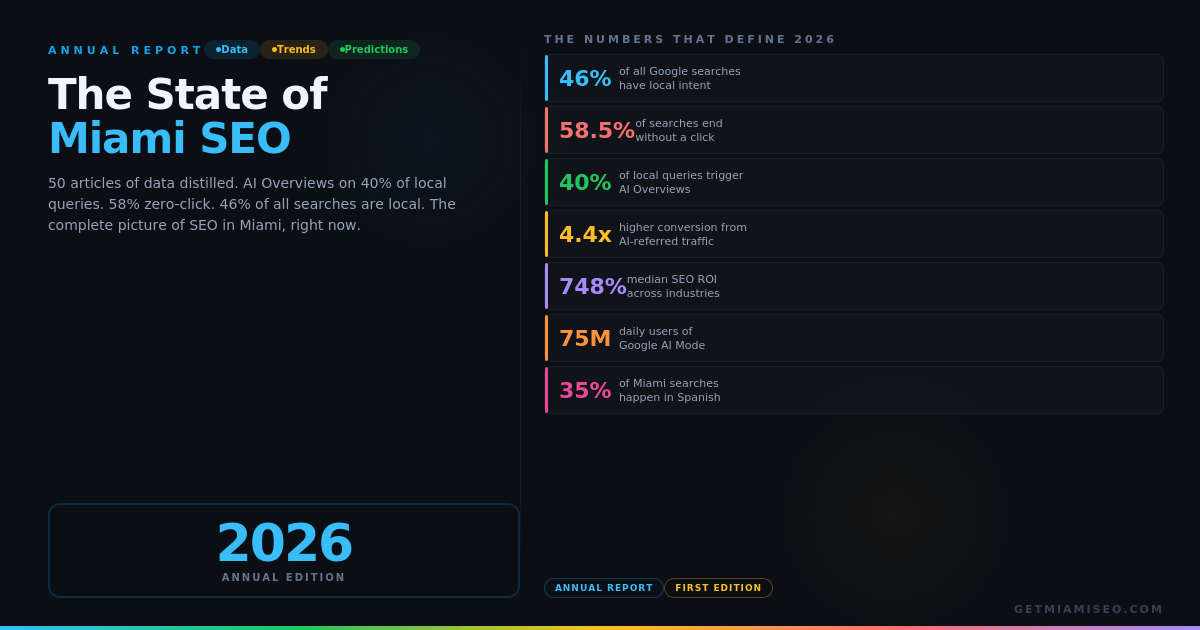
46% of all Google searches have local intent (Digital Applied 2026, up from 30% in 2019). Nearly half the searches on the planet are people looking for something nearby. For Miami businesses, this is the denominator that makes every other number in this report matter.
58.5% of Google searches end without a click on any external website (GoodFirms 2026). On mobile, even higher. In Google's AI Mode, 75% of sessions resolve without leaving the results page. The zero-click search is not a trend. It is the default.
76% of people who search for something local visit a business within 24 hours (SeoProfy 2026). Local search is not browsing. It is buying.
80% of US consumers search for local businesses online at least once per week. 32% search daily (SOCi Consumer Behavior Index 2026).
$31 cost per lead from organic search versus $181 from PPC (HubSpot/First Page Sage). The gap has not closed. It has widened.
748% median SEO ROI across industries (First Page Sage 2026). For every $1 invested in SEO, the median business earns $7.48 back.
AI Search: The Landscape Has Shifted
A year ago, AI Overviews were an experiment. In 2026, they are infrastructure.
AI Overviews appear on approximately 40% of local business queries (LocalFalcon 2026). For informational queries, the trigger rate is higher: up to 57-80% depending on category (Whitespark 2026). For purely local intent ("plumber near me"), AI Overviews remain more limited at around 7% (Heroic Rankings 2026), though this number is rising quarter over quarter.
Google AI Mode has reached 75 million daily active users and over 100 million monthly active users, a 4x increase since May 2025 launch (Digital Applied 2026). It has expanded to 53 languages and 40+ markets.
AI-referred visitors convert at 4.4x the rate of standard organic traffic (DemandSage 2026). When someone finds your business through an AI recommendation, they are further along in the decision process than a typical organic visitor.
Only 14% of marketers currently track AI visibility (GoodFirms 2026). The vast majority of businesses have no way to measure whether they appear in AI-generated recommendations. This is the biggest measurement gap in the industry.
65% of marketers cite AI-driven search changes as their single biggest challenge in 2026 (GoodFirms survey).
What this means for Miami: The AI Overviews guide and AI search guide cover the tactical response. The strategic implication is this: businesses that build entity recognition and AI-citable content today are locking in visibility for a search surface that is expanding, not contracting.
Zero-Click: The New Normal
The zero-click search has crossed from trend to default behavior.
58.5% of all Google searches end without a click (GoodFirms 2026). 75% of Google AI Mode sessions end without external visits (Position Digital 2026). 93% of searches in AI Mode result in zero clicks to external sites (Semrush 2025).
The searcher gets their answer from the AI Overview, the Map Pack, the Knowledge Panel, or the People Also Ask box without clicking any website.
What this means for Miami businesses: The old measure of SEO success (organic clicks and traffic) is no longer the complete picture. A dental practice in Coral Gables that appears in the Map Pack and gets calls directly from the listing generates revenue from zero-click searches. A practice cited in an AI Overview generates brand awareness from zero-click searches. The businesses that win in a zero-click world are the ones present inside every section of the search results page, not just the organic links at the bottom.
Google Business Profile: Still the Highest-Impact Factor
GBP signals account for 32% of Local Pack ranking (Whitespark 2026). That number has held steady. What has changed is GBP's role in AI search.
GBP data now feeds AI recommendations directly. When Google's AI or Gemini generates a local recommendation, it pulls from GBP attributes: categories, services, reviews, Q&A, and business descriptions. A complete GBP is no longer just a Map Pack asset. It is an AI input source.
Businesses with complete profiles are 2.7x more likely to be considered trustworthy (SeoProfy 2026). Verified GBP listings average 200 interactions per month (SeoProfy 2026). Listings with 100+ photos receive 520% more calls (BrandCatalyst360 2026).
Review volume filtering is now a factor. Google Maps includes review volume filters in most service categories. Businesses below approximately 30-50% of the average review count among top-20 results may be filtered out entirely, even with excellent star ratings (SOCi April 2026). Review velocity now outweighs total count.
87% of consumers read online reviews for local businesses (Digital Applied 2026). 88% of consumers use Google Maps for finding local businesses (Backlinko 2026).
The Miami Bilingual Dimension
No national SEO report covers this. It is specific to Miami and it is the single largest competitive advantage available to any local business in this market.
35% of Miami searches happen in Spanish. 1.9 million residents speak Spanish at home. Spanish keywords carry 75-85% lower difficulty than English equivalents across Miami-Dade.
The AI gap in Spanish is wider. AI entity understanding in Spanish is thinner than in English. Fewer Spanish-language websites have implemented schema markup. Fewer have built FAQ content in Spanish. The result: a Hialeah business that builds bilingual entity signals today locks in AI citation authority in a landscape with approximately zero optimized competitors.
Neighborhood variation is extreme. Hialeah: 95% Hispanic, 93% Spanish at home. Doral: 85% Hispanic. Brickell: predominantly English-speaking professionals. Miami Beach: 28.2 million visitors who search in dozens of languages. A single Miami SEO strategy applied uniformly fails. Each neighborhood is a different search market.
Industry Vertical Rankings: Easiest to Hardest
Based on our analysis across 12 industry verticals:
Lowest competition (fastest results): Home services and CPA/accounting in Spanish queries. Near-zero competition. 30-90 day ranking timelines for neighborhood-specific queries.
Moderate competition (3-6 month results): Restaurants, beauty/med spa, construction. Established competitors but significant content and bilingual gaps.
High competition (6-12 month results): Medical practices, real estate, ecommerce. Strong existing competitors with established authority.
Highest competition (12+ months): Law firms (CPCs exceeding $300, deepest competitive moats), luxury hotels competing against OTAs with DR 90+ domains.
The pattern across all verticals: Spanish queries are 1-2 difficulty tiers lower than English equivalents in the same vertical. A law firm facing 12+ month timelines in English may see 3-6 month results in Spanish.
Content and Links: What Moves Rankings in 2026
Content depth matters more than content length. Pages with original research rank 20% higher than those without it (AFFiNCO 2026). Content that loads faster is more likely to be included by AI systems (Position Digital 2026). 44.2% of AI citations are pulled from the first 30% of an article's body text (DemandSage 2026). Structure the most important information at the top.
Link signals account for 26% of local organic ranking (Whitespark 2026, unchanged). Top-ranking pages earn 5-14.5% more do-follow backlinks from new sites every month (Ahrefs 2026). The compounding effect is real: established pages with link momentum pull further ahead over time.
Citation diversity matters for AI. The top-10 citation rate in AI Overviews dropped from 76% to 38% (Digital Applied 2026). AI systems increasingly pull from diverse source types including Reddit threads, niche authority sites, and structured data sources that may not appear in traditional top-10 results. Being on page one of Google is no longer a guarantee of AI citation.
Mobile, Voice, and the Discovery Fragmentation
84% of local searches are conducted on mobile (RedLocalSEO 2026). Mobile local searches are growing 50% faster than overall searches (SynUp 2026). 78% of mobile local searches lead to purchases (Search Engine Land 2026).
Voice search continues growing. 58% of people use voice search for local business information (BrightLocal 2026). 72% use voice to search for local businesses (SynUp 2026). 76% of voice searches have local intent (SynUp 2026). Voice queries are conversational and favor FAQ-structured content that provides direct answers.
Discovery is fragmenting beyond Google. 19% of consumers now use AI tools like ChatGPT for local discovery (Uberall 2026). In the US, nearly 1 in 4 consumers prefer AI tools for local business discovery. Social platforms (Instagram, TikTok) are becoming discovery channels for Gen Z. But Google still processes 8.5 billion searches daily. The fragmentation adds channels. It does not replace the primary one.
Predictions for 2027
Based on the trajectory of every data point in this report:
AI Overviews will exceed 50% of local queries by mid-2027. The expansion rate is accelerating, not plateauing. Categories currently below 40% will cross it. Categories already above 40% will approach 70-80%.
Zero-click will cross 65%. As AI Mode expands and AI Overviews cover more query types, more queries will resolve on the results page. The businesses that survive this will be the ones whose information is inside the answer, not below it.
Bilingual AI search in Miami will become competitive by late 2027. The current window of near-zero competition for Spanish AI citations is temporary. As more Miami businesses implement bilingual entity signals, the early movers will have compounding authority advantages that late movers cannot easily overcome.
GBP will absorb more features. Google has been expanding GBP with booking links, products, messaging, video, and AI-powered review summaries. Each new feature is a new ranking signal. Businesses that adopt features early get measurement advantages.
The measurement gap will close. The 14% of marketers tracking AI visibility will become 40%+ as tools mature and the revenue impact becomes undeniable. Businesses that build measurement infrastructure now will have 12-18 months of data when competitors start from zero.
What This Means for Your Business
If you read one section of this report, make it this one.
The data says three things clearly:
1. Local search is the primary discovery channel and it is increasingly AI-mediated. 46% of searches are local. 40% of local queries trigger AI Overviews. 76% of local searchers visit within 24 hours. If you are a Miami business with a physical location, local search is not a marketing channel. It is THE marketing channel.
2. Visibility has moved from rankings to presence. Zero-click searches mean that being ranked #5 and being invisible can be the same thing if the searcher never scrolls past the AI Overview and Map Pack. Winning in 2026 means being present across every section of the results page: AI Overview, Map Pack, organic, PAA, and Knowledge Panel.
3. Miami's bilingual advantage is a ticking clock. The 75-85% difficulty gap between English and Spanish keywords exists because competitors have not built Spanish content yet. That gap will narrow as more businesses catch on. The businesses that build bilingual authority now lock in an advantage that compounds. The ones that wait will compete for the same ground at higher cost.
Start with the Scorecard. Grade yourself across all 10 dimensions. The number tells you where to begin. The 50-article library tells you how.
This report will be updated annually. The 2027 edition will publish in Q1 2027 with updated data, revised benchmarks, and an assessment of which 2027 predictions came true and which did not.
Want this data applied to your specific business? ->