What Hurricane Irma Revealed About Emergency Search in Miami
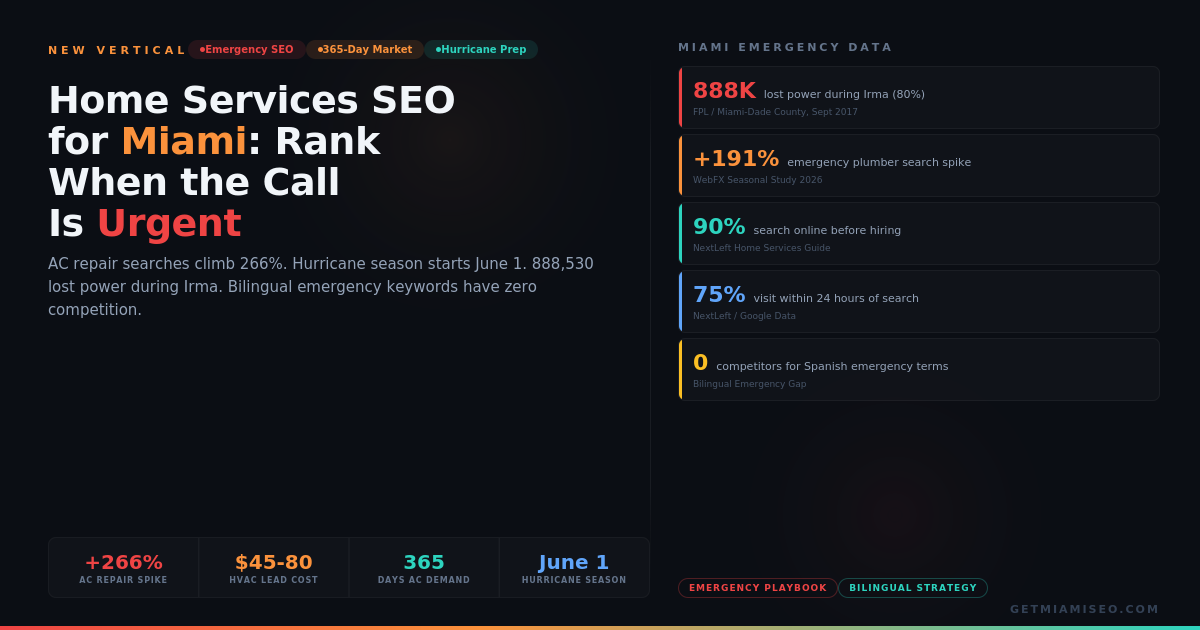
On September 10, 2017, Hurricane Irma made landfall in the Florida Keys as a Category 4 storm with 130 mph winds and tore north through Miami-Dade County. By the following morning, 888,530 Florida Power and Light customers in Miami-Dade had lost electricity. That was roughly 80% of the county (FPL data, via Wikipedia/NPR). Three-quarters of all South Florida electrical service customers went dark, many for close to a week (NWS Local Report). At the Rehabilitation Center at Hollywood Hills, just north of Miami-Dade, 12 residents died from heat exposure after the facility lost power to its air conditioning units (PMC/JAMA Network Open, 2022).
In the 72 hours after the storm passed, search demand for emergency plumbing, AC repair, and roof repair in South Florida surged to levels Google Trends had not previously recorded for the region. The plumbing and HVAC companies that already ranked on page one of Google for those terms captured thousands of calls that week. They didn't increase their ad spend. They didn't launch a new campaign. They had built the organic foundation before the storm, and when 880,000 households suddenly needed help, those businesses were the ones that appeared.
The companies that didn't rank watched from the sidelines. Their phones stayed quiet while their competitors' trucks filled the streets.
Irma was an extreme event. But the principle it revealed is not extreme at all. It's the fundamental truth about home services SEO in Miami: the time to build search visibility is before the demand arrives, because once it arrives, there's no way to outrank a competitor who started earlier. That applies to hurricane season. It applies to the August afternoon when someone's AC dies. It applies to the midnight pipe burst on a holiday weekend. And in Miami, where the average temperature is 77 degrees and the AC runs ten to twelve months a year, that demand is not seasonal. It's constant. The same before-the-demand principle rules Miami's insurance market, where carriers suspend new policies the moment a storm is named.
Why Miami Is a 365-Day Emergency Market
Every national home services SEO guide treats HVAC as a seasonal business. They map "AC repair" to summer and "furnace repair" to winter, and they build marketing strategies around those two peaks. That framework works in Chicago, where January temperatures average 27 degrees and July averages 76. It does not work in Miami.
Miami's average annual temperature is 77.2 degrees Fahrenheit (NOAA Climate Data). The city averages 248 days per year above 80 degrees. Air conditioning is not a seasonal convenience here. It's infrastructure. The AC runs from March through November at full load and from December through February at reduced load. There is no off-season. There is no month when a Miami homeowner does not need a functioning AC system.
National data from WebFX's seasonal search study shows "AC repair" searches climb 266% nationally from February to July. In Miami, the baseline never drops as low as the national average because the demand floor is year-round. "Emergency AC repair" nationally increases nearly 400% from winter to late fall. In Miami, the winter baseline is higher than most cities' summer peak.
Layer hurricane season on top. June 1 through November 30, six months per year, Miami homeowners face the threat of power outages, flooding, roof damage, and system failures caused by tropical storms and hurricanes. Pre-storm preparation drives searches for AC maintenance, generator installation, and storm shutters starting in May. Post-storm recovery drives emergency searches for plumbing, electrical, roofing, and AC within hours of a storm passing.
And then there's the plumbing dimension. Miami sits at sea level. The water table is high. Flooding is routine during heavy rain events that occur outside of hurricane season. "Emergency plumber" searches nationally rise 191% from April to July (WebFX). In Miami, that demand is compounded by geography.
The result: Miami home services businesses operate in a market where emergency search demand exists 365 days a year, intensifies during a six-month hurricane season, and peaks unpredictably whenever a major weather event hits. The SEO strategy has to match.
The Annual Search Calendar: What Miami Homeowners Search For and When
Understanding when searches happen lets contractors build content and campaigns that are already ranked when the demand arrives. Here's how the Miami search calendar maps across a full year.
January through March. The closest thing Miami has to an off-season for HVAC. Temperatures occasionally dip into the 50s and 60s, which triggers a small number of heating-related searches (heat pump repair, space heater recommendations). Plumbing demand stays steady. This is the window for maintenance content: "pre-summer AC tune-up Miami," "spring plumbing inspection checklist." Condo associations often approve building projects in Q1, which drives commercial HVAC and plumbing searches from property managers.
April through May. AC demand begins climbing sharply. "AC repair Miami" and "AC tune-up near me" start their ascent toward the summer peak. This is also the pre-hurricane preparation window. Content published now about hurricane readiness, generator installation, and emergency plumbing preparation has time to index and rank before June 1. The World Cup in June 2026 will add hotel and short-term rental demand for AC maintenance across Miami-Dade.
June through August. Peak emergency season. AC failures, burst pipes from summer storms, and the beginning of hurricane season create the highest search volume of the year. "Emergency AC repair Miami" and "plumber near me" hit their annual peaks. Emergency searches spike between 6 PM and midnight (Hook Agency data), when homeowners discover problems after business hours. Contractors who answer calls during these hours capture leads that competitors miss entirely. Google Local Services Ads cost more during this period (emergency AC leads can exceed $100 per lead in major metros, per PipelineOn 2026), which makes organic rankings even more valuable.
September through November. Hurricane season peaks statistically in September and October. Post-storm repair demand can dwarf anything that happens during the summer heat peak. Roof repair, water damage restoration, electrical system repair, and AC replacement searches all surge after a named storm. The businesses that prepared content in May and June capture this demand. The businesses that didn't are invisible when it matters most.
December. Miami's snowbird season begins. Seasonal residents return from the northeast and discover maintenance issues in properties that sat empty for months. "AC maintenance Miami," "plumber inspection Coral Gables," and "pool service near me" spike as winter residents reactivate their homes. Art Basel brings nearly 100,000 visitors to Miami in early December, increasing demand for hospitality-adjacent services.
Google Local Services Ads vs. Organic SEO for Contractors
Google Local Services Ads changed the economics of lead generation for home services companies. They sit above regular Google Ads, above the Map Pack, above everything else on the page. They display the company name, star rating, phone number, and a Google Verified badge that signals the business has passed background checks, license verification, and insurance review.
The business model is pay-per-lead, not pay-per-click. A contractor is charged only when a qualified lead contacts them through the ad. HVAC leads in major metros run $45 to $80 per lead, with emergency AC during summer spiking past $100 (PipelineOn, January 2026). Plumbing leads cost $35 to $65 (PipelineOn). Traditional Google Ads, by contrast, charge $18 to $65 per click (HomeServiceDirect), and many of those clicks never become calls.
In 2021, 28% of contractors ran LSAs. By 2026, that number approached 70% (HomeServiceDirect). The advantage of early adoption is shrinking. But the advantage of combining LSAs with organic SEO is not.
Here's why. A contractor who appears in LSAs and the organic Map Pack and organic search results for the same query captures a disproportionate share of calls. The user sees the company name three times on the same page. Recognition compounds trust. Google's own data and third-party analysis suggest that contractors visible across multiple placements on the same SERP see significantly higher call volume than those appearing in only one position.
The comparison between SEO and paid acquisition in Miami shows that organic traffic costs nothing per click once rankings are established, while LSA costs reset every week. The optimal strategy is not one or the other. It's both: LSAs for immediate lead capture, organic SEO for compounding long-term visibility, and the combination creating trust through multi-placement presence.
The honest counter-argument. LSAs deliver faster results than SEO. A new contractor can be live on LSAs within 30 days after verification. Organic SEO takes 3 to 6 months to produce meaningful results. If cash flow is the immediate constraint and the business needs leads this month, LSAs are the right starting point. The SEO foundation should be built simultaneously, but the first dollars should go where the first leads come from. Once organic rankings build, the balance shifts.
The Bilingual Emergency Gap: Spanish Searches Nobody Is Competing For
Miami-Dade is 69% Hispanic. 1.9 million residents speak Spanish. And 35% of all local searches happen in Spanish.
For home services, Spanish emergency searches represent what might be the largest uncontested keyword set in any Miami industry. "Plomero emergencia cerca de mi." "Reparación aire acondicionado urgente Miami." "Electricista 24 horas Miami." "Plomero Hialeah." "Aire acondicionado Doral." These queries have real search volume, high purchase intent, and almost zero SEO competition.
The reason: most Miami plumbing and HVAC companies have English-only websites, English-only Google Business Profiles, and English-only review profiles. When a Spanish-speaking homeowner in Hialeah (96% Hispanic) or Doral (85% Hispanic) searches for a plumber in Spanish at 2 AM, the search results are thin. Google has fewer options to return. The business that shows up with a Spanish-language service page, Spanish GBP description, and Spanish reviews owns that query.
Spanish-language keywords carry 75-85% lower difficulty than English equivalents across the board. For emergency home services in Miami, that gap is even wider because the competition is effectively zero in most trades.
And the AI search dimension compounds this advantage. When someone asks ChatGPT in Spanish "¿Cuál es el mejor plomero de emergencia en Miami?", the AI searches for Spanish-language content to build its response. A plumber with bilingual content is citable. A plumber with English-only content is invisible to that query.
Google Business Profile for Home Services: The Trust Stack
For home services, the Google Business Profile is not just a listing. It's the primary conversion surface. When someone searches "emergency plumber near me" at midnight, they're not visiting websites. They're scanning the Map Pack, checking star ratings, reading the first review that catches their eye, and tapping the call button. The entire journey from search to phone call happens inside the GBP.
GBP signals account for 32% of Map Pack ranking factors (Whitespark 2026). For home services specifically, the most impactful GBP elements are:
Primary category accuracy. "Plumber" is not the same as "Plumbing Service." "HVAC Contractor" is not the same as "Air Conditioning Contractor." Google matches the primary category to the search query. Choose the most specific category that matches your core service.
Service descriptions. List every service you offer with a description. "Emergency pipe repair," "water heater installation," "drain cleaning," "sewer line replacement." Each service description is indexed by Google and helps your profile appear for those specific queries.
Photos of real work. Before and after photos of real jobs in real Miami homes. Photos of your trucks, your team, your equipment. Google rewards profiles with photos: listings with photos receive 42% more requests for directions and 35% more clicks to websites (Google data, via SeoProfy 2026).
Review volume and recency. 87% of consumers won't consider a business with low ratings (NextLeft). For home services, review recency matters as much as volume. A plumber with 300 reviews but none newer than six months looks inactive. A plumber with 80 reviews and 4 this week looks responsive. Google's algorithm weights recency as a signal of active business operation.
Response to reviews in the reviewer's language. In Miami, this means Spanish reviews get Spanish responses. English reviews get English responses. Matching the language signals to both Google and the customer that the business genuinely serves the bilingual market.
Content Strategy for Contractors Who Don't Think They Need Content
Most home services businesses believe they don't need blog content. They believe their customers just search "plumber near me" and call whoever appears. That's partly true. But it misses the search demand that exists before and around the emergency moment.
A homeowner whose AC is making a strange noise doesn't search "AC repair near me" immediately. They search "AC making clicking noise" or "why is my AC blowing warm air" first. They're diagnosing the problem. The plumber or HVAC company that answers that question on their website is the one the homeowner already trusts when the diagnosis confirms they need to call someone.
This is the content strategy for home services: capture the customer during the research phase, not just the emergency phase.
Service pages. One page per service, with specific descriptions, pricing ranges (if possible), photos of real work, and customer testimonials. "Emergency Pipe Repair Miami," "AC Installation Coral Gables," "Water Heater Replacement Doral." Each page targets a specific keyword and includes schema markup for the service type.
Neighborhood pages. A plumber serving six neighborhoods should have six location-specific pages. "Plumber in Brickell," "Plumber in Coral Gables," "Plomero en Hialeah." Each page mentions the neighborhood, the specific challenges of that area (older pipes in Coral Gables, high-rise plumbing in Brickell, flooding risk in low-lying neighborhoods), and includes testimonials from customers in that area.
Seasonal and event content. "How to Prepare Your AC for Hurricane Season in Miami." "Pre-Summer AC Maintenance Checklist for Miami Homeowners." "What to Do If Your AC Fails After a Storm." These pieces rank for searches that happen every year at predictable times. They don't expire. They compound.
FAQ content. "How much does a plumber cost in Miami?" "How long does AC installation take?" "Do I need a permit for a water heater in Miami-Dade?" These questions mirror exactly how people now ask ChatGPT and Google AI. Well-structured FAQ pages get cited by AI engines when users ask full-sentence questions.
The Numbers: What Leads Cost and What They Return
The economics of home services lead generation in Miami in 2026 are clear enough that contractors can model their expected return before they spend a dollar.
Google Local Services Ads. HVAC leads: $45 to $80 per lead in major metros. Emergency AC during peak summer: $100+ per lead. Plumbing leads: $35 to $65 per lead. Electrical: $40 to $75 per lead. Roofing: $55 to $90, with storm damage queries hitting $150+ after active weather events (PipelineOn, January 2026). At a 30% close rate, an $80 HVAC lead translates to roughly $267 in acquisition cost per booked job.
Traditional Google Ads. $18 to $65 per click for most home services terms (HomeServiceDirect). At a 5 to 8% click-to-call conversion rate, the effective cost per lead ranges from $225 to $1,300 per lead for competitive terms. Personal injury lawyers pay $300+ per click; home services costs are lower but still substantial at scale.
Organic SEO. After the initial investment period (3 to 6 months), organic leads cost nothing per click. SEO cost-per-lead is more than 60% lower than paid advertising over a 12-month period (NextLeft). For a plumber who ranks in the Map Pack for "emergency plumber Miami" and "plomero emergencia Miami," those positions deliver calls 24 hours a day, 365 days a year, with no per-lead charge.
The ROI scenario. An HVAC company investing $3,000 per month in SEO reaches Map Pack visibility in months 4 to 6. By month 7, that company is receiving an estimated 15 to 25 organic leads per month at zero incremental cost. At an average job value of $850 (PipelineOn HVAC scenario data) and a 30% close rate, that's 5 to 8 booked jobs per month, or $4,250 to $6,800 in revenue from a $3,000 SEO investment. The ROI improves every month after that because the cost remains flat while the traffic compounds.
Common Mistakes Home Services Companies Make With SEO
Treating the website as a brochure. A homepage that says "We provide quality plumbing services in the Miami area" with a phone number and nothing else is not an SEO asset. It's a digital business card. It doesn't rank for anything specific because it doesn't say anything specific.
Ignoring the Spanish-language market entirely. In a county where 35% of searches happen in Spanish, an English-only website misses a third of the market. The fix isn't complicated: Spanish service pages, Spanish GBP description, Spanish review responses. The competition for these terms is effectively zero.
Not responding to reviews or responding with copy-paste templates. Google's algorithm detects templated review responses (SeoInHouse, 2026). A response that says "Thanks for the great review!" on every review is worse than no response at all. Personalized responses that mention the specific service, the customer's name, and the neighborhood signal to both Google and future customers that the business is actively managed.
Running LSAs without organic SEO. LSAs deliver leads immediately, but you pay for every one. A business running only LSAs with no organic presence is renting visibility. The moment the budget pauses, the leads stop. The compounding effect of SEO is what creates long-term competitive advantage.
No schema markup. A plumber's website without LocalBusiness schema, Service schema, and FAQ schema is invisible to AI search engines. GPT-4 accuracy improves from 16% to 54% when content includes structured data. Without schema, the AI cites the competitor who has it.
Waiting until hurricane season to publish hurricane content. Content published in June doesn't rank in June. It takes 4 to 8 weeks to index and accumulate ranking signals. Hurricane prep content should be live by April. Post-storm recovery content should be live by May. The businesses that prepare in spring capture the demand that arrives in summer and fall.
What Miami Contractors Should Build This Month
Week 1. Claim and complete your Google Business Profile if you haven't already. Fill every field. Upload 10+ photos of real work. Add every service with a description. Set your service area. Post an update. This single action can produce Map Pack visibility within 2 to 4 weeks.
Week 2. Audit your review profile. If you have fewer than 50 reviews, implement a systematic ask: every completed job gets a review request via text or email within 2 hours of service completion. Ask in the customer's language. Respond to every existing review you haven't responded to yet.
Week 3. Create your three highest-priority service pages: your most-called emergency service, your most profitable installation service, and one Spanish-language service page targeting your most-searched term in Spanish. Add LocalBusiness and Service schema to each. The SEO audit checklist covers the technical requirements.
Week 4. Publish your first piece of seasonal content: "How to Prepare Your Miami Home for Hurricane Season 2026." This piece should be live now. Hurricane season starts June 1. It needs 4 to 6 weeks to index. Every week you wait reduces the capture window.
FAQs: Home Services SEO in Miami
How long does SEO take for a plumbing or HVAC company? GBP improvements show within 2 to 4 weeks. Service page rankings for neighborhood-specific terms (lower competition) can appear in 2 to 3 months. Competitive terms like "plumber Miami" take 6 to 12 months. Spanish-language terms with low competition can rank in 30 to 60 days. The SEO timeline and cost guide covers expectations by industry.
Do I need Local Services Ads and SEO? Ideally both. LSAs deliver immediate leads while organic rankings build. Once organic visibility is established, LSA spend can be reduced or reallocated to expansion areas. Contractors visible in both LSAs and organic results capture disproportionate call volume.
What's the most important thing I can do right now? Complete your Google Business Profile. It's free, it takes an afternoon, and GBP signals account for 32% of Map Pack ranking factors. A complete, active GBP with photos, services, and recent reviews is the single highest-impact action for local visibility.
Should I create content in Spanish? In Miami, yes. 35% of searches happen in Spanish. Spanish emergency keywords for home services have virtually no competition. A single Spanish service page can capture an audience that none of your competitors are reaching.
How much should I spend on SEO? $1,500 to $5,000 per month for most home services businesses in Miami. The lower end covers GBP optimization, basic content, and review strategy. The higher end adds bilingual content, LSA management, and multi-neighborhood page development.
Can AI search affect my home services business? Yes. 45% of consumers now use ChatGPT for local recommendations (BrightLocal 2026). When someone asks an AI "Who is the best emergency plumber in Coral Gables?", the AI needs structured data, detailed reviews, and well-organized content to generate a recommendation. Home services businesses with schema markup and FAQ content are citable. Those without are not.
How do I choose the right SEO agency for my home services business? Look for experience with home services specifically, not just generic local SEO. Ask for contractor client examples, not restaurant or law firm case studies. Verify they understand Miami's bilingual market, seasonal demand patterns, and the LSA-SEO interaction. The agency evaluation guide covers the full criteria.
What should I do before hurricane season starts? Publish hurricane preparation content by April. Update your GBP with emergency service messaging. Ensure your website has dedicated pages for storm-related services (emergency plumbing, AC repair after power restoration, roof leak repair). Set your LSA budget to increase automatically when storm watches are issued. The businesses that prepare before June 1 capture the demand. The businesses that wait are invisible when it matters.
The Pipes Are Already Under Pressure
On September 10, 2017, Miami-Dade discovered what happens when 880,000 households need emergency services at the same time and only a handful of contractors are visible on Google. The plumbers and HVAC companies that had built organic visibility before the storm didn't just survive that week. They built customer relationships that lasted for years. The ones who were invisible didn't get a second chance to rank retroactively.
Hurricane Irma was an extreme case. But the underlying dynamic plays out on a smaller scale every day in Miami. Every August afternoon when an AC unit fails. Every midnight pipe burst in a Brickell high-rise. Every Saturday morning when a Hialeah homeowner discovers a leak and searches in Spanish for "plomero cerca de mi."
The US home services market is $650 to $750 billion (BDR, 2025). By 2027, the country faces a projected shortage of 550,000 plumbers (NewsNation). Demand is growing. Supply is tightening. And the businesses that own the search results in their neighborhoods are the ones that will capture the work as both forces converge.
Hurricane season 2026 starts on June 1. That's 59 days from today.