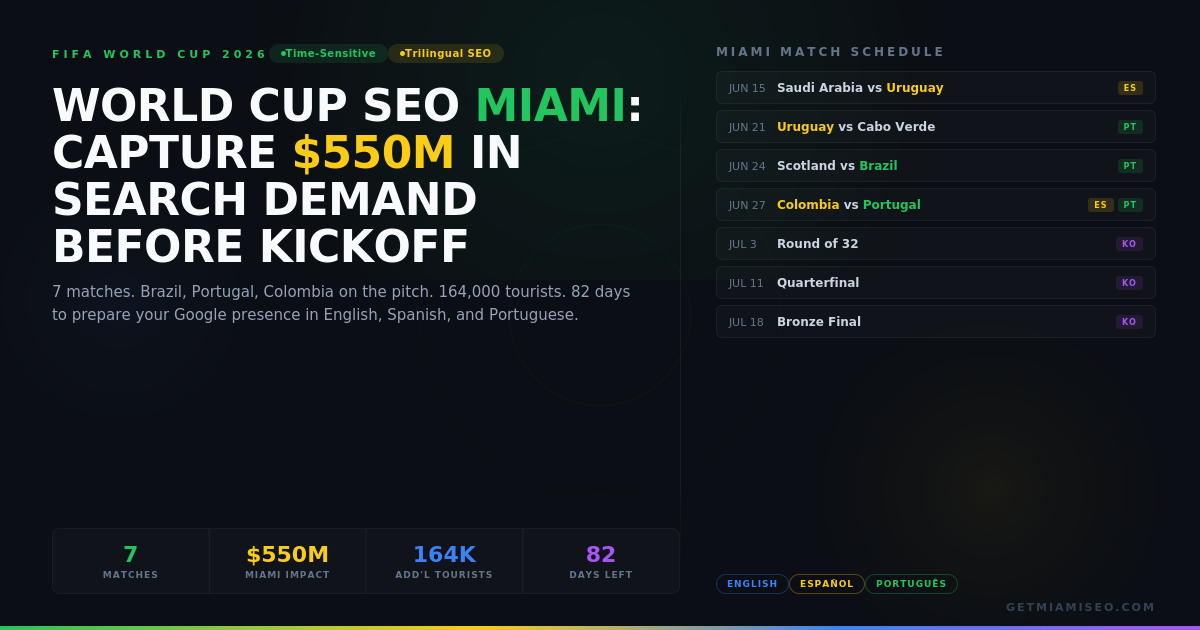
82 Days. 7 Matches. $550 Million. The Clock Is Running.
On June 15, 2026, Saudi Arabia and Uruguay will walk onto the pitch at Hard Rock Stadium for Miami's first FIFA World Cup match. From that moment through July 18, when the Bronze Final closes Miami's tournament run, seven matches will bring the planet's attention to South Florida.
This is not a normal tourism event. AHLA spokesman Ralph Posner compared the 2026 World Cup's scale to "nearly eighty Super Bowls within a singular month" (Travel and Tour World, March 2026). FIFA's own socioeconomic analysis with the World Trade Organization projects the US portion alone at $17.2 billion in GDP impact and 185,000 full-time equivalent jobs (FIFA/WTO, Emory Wheel March 2026). Miami's share of that impact is projected at $550 million, with $280 million in food and beverage spending (Deloitte/Airbnb).
The search demand is already building. FIFA reports that 2 million tickets have been purchased from 212 countries, with top purchasing nations including Brazil, Colombia, Spain, Argentina, and France. Every one of those ticket holders will search for restaurants, hotels, transportation, and entertainment in Miami. They will search in English, Spanish, and Portuguese.
And here is the part that matters for your business: 82 days from today is not enough time to build SEO from scratch. But it is enough time to optimize what you already have. The businesses that prepare now will capture search demand from June through July. The businesses that wait until match week will find their competitors already occupying the positions they wanted.
This guide provides the exact preparation plan, mapped to the match schedule, with trilingual keyword strategy, GBP optimization, and industry-specific playbooks for restaurants, hotels, bars, retail, and transportation. Every recommendation is actionable within the 82-day window.
The local SEO fundamentals still apply. This guide builds on top of them with event-specific tactics that work only when the world is watching.
The Match Schedule: What Miami Businesses Need to Know
Miami hosts 7 FIFA World Cup matches at Hard Rock Stadium (officially "Miami Stadium" for the tournament) in Miami Gardens. Here is the full schedule with strategic implications for local businesses:
Group Stage Matches:
June 15 (Sunday, 6 PM ET): Saudi Arabia vs. Uruguay Miami's opening match. Uruguay's fanbase is passionate and travel-ready. Expect moderate foot traffic around Miami Gardens and Brickell/Downtown, where South American visitors tend to stay. Search spike: "restaurants near Hard Rock Stadium," "Uruguay fans Miami."
June 21 (Saturday, 6 PM ET): Uruguay vs. Cabo Verde A Saturday match means all-day tourism activity. Fans arriving for the afternoon match will search for brunch, activities, and nightlife. This is Cabo Verde's first World Cup match in Miami, bringing fans from the Portuguese-speaking African nation.
June 24 (Tuesday, 6 PM ET): Scotland vs. Brazil The biggest single match for Miami businesses. Brazil brings the largest traveling fanbase of any team, and Brazilian fans search overwhelmingly in Portuguese. This is the day to have Portuguese-language content live. Search spike: "bares perto do Hard Rock Stadium" (bars near Hard Rock Stadium in Portuguese), "restaurantes brasileiros Miami."
June 27 (Friday, 7:30 PM ET): Colombia vs. Portugal The most linguistically significant match. Colombian fans search in Spanish. Portuguese fans search in Portuguese. Miami's existing Hispanic population adds domestic Spanish-speaking demand. This Friday night match will drive the highest nightlife and bar traffic of the group stage. Search spike: "mejores bares para ver el mundial Miami," "restaurantes colombianos Miami."
Knockout Rounds:
July 3 (Thursday, 6 PM ET): Round of 32 (Group J Winner vs. Group H Runner-up) Teams TBD based on group results. By this point, the tournament atmosphere in Miami will be at full intensity. Repeat visitors and word-of-mouth will drive secondary searches: "best watch parties Miami World Cup," "where to eat near Hard Rock Stadium."
July 11 (Friday, 5 PM ET): Quarterfinal High-stakes match with global viewership. The four remaining best teams. Friday afternoon start time means watch party demand starts at noon. Search spike: "world cup quarterfinal watch party Miami."
July 18 (Friday, 5 PM ET): Bronze Final (Third Place Match) Miami's final World Cup match. This is one of the last matches of the entire tournament (the Final is July 19 in New Jersey). Two semifinal losers play for third place. While sometimes dismissed, the Bronze Final routinely draws massive viewership because fans of eliminated favorites still watch. Friday evening in Miami after a month of World Cup energy means significant nightlife and celebration demand.
The strategic takeaway: Miami's match schedule spans 33 days (June 15 to July 18). That is 33 days of elevated search demand, not just 7 match days. Fans arrive early, stay between matches, and explore Miami between games. The search opportunity is continuous, not episodic.
The Economic Impact: Numbers That Should Change Your March Priorities
This is not speculation. These are projections from FIFA, the World Trade Organization, Oxford Economics, Boston Consulting Group, and Tourism Economics:
National (United States): - $17.2 billion in GDP impact and 185,000 FTE jobs (FIFA/WTO socioeconomic analysis, Emory Wheel March 2026) - $30.5 billion in gross output (FIFA/WTO) - $5 billion+ in short-term economic activity across North America (Boston Consulting Group) - $160 to $620 million in incremental economic activity per host city (BCG) - 1.2 million international visitors to the US (Tourism Economics, CBS News Nov 2025) - 5 to 7 million additional tourists entering the US (MICE Travel Advisor, March 2026) - Hotel room revenues +7% to +25% in June 2026 (Oxford Economics, Spectrum Local News Dec 2025) - 2 million tickets purchased from 212 countries (FIFA, Dec 2025)
Miami specifically: - $550 million projected economic impact (Deloitte/Airbnb) - $280 million in F&B spending - 164,000 additional tourists (Airbnb) - 7 matches over 33 days (June 15 to July 18) - Teams playing in Miami include Brazil, Portugal, Colombia, Uruguay: four nations with massive, travel-ready fanbases - Hard Rock Stadium capacity: 65,000+ per match
The comparison that puts this in perspective: Miami already receives 28.2 million annual visitors spending $21.3 billion (GMCVB 2024). The World Cup adds 164,000 visitors concentrated into a 33-day window, spending at rates significantly above average tourist levels. Hotel rates during knockout rounds could increase by 46% (Deloitte projections from previous tournament data).
If your business serves tourists, visitors, or the local population that will be caught up in World Cup energy, these numbers justify immediate action on your SEO.
The Trilingual Opportunity No One Is Preparing For
Here is the insight that makes this guide different from every other World Cup preparation article: the teams playing in Miami create a trilingual search demand pattern that no other host city will experience in the same way.
English searches: The baseline. All fans, regardless of nationality, will conduct some searches in English (especially navigational queries like "Hard Rock Stadium parking" or "Uber to Miami Stadium").
Spanish searches: Colombia plays on June 27. Uruguay plays on June 15 and June 21. Miami's domestic population is 69% Hispanic with 1.9 million Spanish speakers. Spanish-language search demand during the World Cup will be enormous, combining visiting fans with the local population watching matches at bars and restaurants. The queries: "mejores bares para ver el mundial en Miami," "restaurantes cerca del estadio Hard Rock," "dónde ver Colombia vs Portugal en Miami."
Portuguese searches: Brazil plays on June 24. Cabo Verde (Portuguese-speaking) plays on June 21. Portugal plays on June 27. Brazil alone sent the fourth-most ticket purchasers to FIFA's early sales (FIFA, Dec 2025). Brazilian fans will search in Portuguese: "restaurantes brasileiros em Miami," "bares perto do estádio Miami," "onde assistir Brasil x Escócia em Miami."
No other US host city has this trilingual dynamic. Los Angeles will see Spanish demand. New York will see diverse multilingual searches spread thin. But Miami is the only city where three major languages converge because of the specific teams assigned to play there AND the existing demographics of the city.
What this means for your SEO:
Bilingual SEO has been a core recommendation for Miami businesses. The World Cup temporarily extends this to trilingual. You do not need to build a permanent Portuguese SEO strategy. You need Portuguese content live for a specific 33-day window, particularly around June 21 (Cabo Verde), June 24 (Brazil), and June 27 (Portugal).
The practical steps: add Portuguese to your Google Business Profile description during June and July. Create one blog post or landing page in Portuguese targeting "restaurantes em Miami para a Copa do Mundo." Post GBP updates in Portuguese the day before and day of Brazil's match. Respond to any Portuguese-language Google reviews in Portuguese.
The Spanish-language keywords already carry 75 to 85% lower competition than English equivalents. Portuguese keywords during the World Cup will have virtually zero competition because no one in Miami is optimizing for them. A restaurant that posts "Bem-vindos torcedores do Brasil! Venha assistir o jogo conosco" on their GBP the day before Brazil vs. Scotland may be the only result Google surfaces to Portuguese-language searchers near Hard Rock Stadium.
Google Business Profile: Your World Cup Command Center
Your Google Business Profile is the single most important asset during the World Cup. GBP signals account for 32% of Map Pack ranking factors (Whitespark 2026), and match-day searches are overwhelmingly local and mobile: "restaurants near me," "bars open now near Hard Rock Stadium," "parking near Miami Stadium."
Pre-tournament GBP optimizations (do these now):
Update your business description to mention your proximity to Hard Rock Stadium and World Cup match viewing. Include distance and drive time. "Located 12 minutes from Hard Rock Stadium" is a concrete, useful detail that Google can surface.
Add World Cup to your GBP services or products section. If you are a restaurant, add "World Cup Watch Parties" or "Copa del Mundo en Pantalla Grande" as a service. If you are a bar, add "Live World Cup Matches" and "Partidos en Vivo."
Upload new photos showing any TV screens, outdoor viewing areas, or sports-related setup. Google prioritizes businesses with recent, relevant photos in local results.
During-tournament GBP tactics:
Post GBP updates before every Miami match day. These posts should mention the specific match ("Scotland vs. Brazil, June 24"), any specials or promotions, and include a call to action (reservation link, WhatsApp number, direction button). Post in English and Spanish for every match. Post in Portuguese for the June 21, June 24, and June 27 matches.
Update your hours if you are extending them for match days. GBP's "special hours" feature lets you set exceptions. "Open now" is a critical filter for match-day searchers.
Respond to every review immediately during the tournament. Review velocity (the speed at which new reviews appear) is a ranking signal, and World Cup visitors are more likely to leave reviews if they had a memorable experience. Respond in the reviewer's language.
Keyword Strategy: What Fans Will Search and When
Keyword demand during the World Cup follows a predictable pattern. Here are the clusters to target, mapped to timeline:
Pre-tournament (now through June 14): - "world cup miami 2026 schedule" / "calendario mundial miami 2026" - "world cup watch parties miami" / "dónde ver el mundial en miami" - "hotels near Hard Rock Stadium world cup" - "restaurants near miami stadium" / "restaurantes cerca del estadio miami" - "things to do miami world cup 2026"
Match-day keywords (June 15 through July 18): - "[Team A] vs [Team B] watch party miami" - "bars showing [match] miami" / "bares transmitiendo [partido] miami" - "restaurants open late miami world cup" - "transportation to hard rock stadium" - "parking near miami stadium world cup"
Team-specific keywords: - "Brazil fans miami" / "torcida do brasil miami" / "onde assistir brasil miami" - "Colombia fans miami" / "hinchas de colombia miami" / "dónde ver colombia miami" - "Uruguay fans miami" / "hinchada de uruguay miami" - "Portugal fans miami" / "adeptos de portugal miami"
Post-match keywords (after each match): - "[Match] score results" - "celebrations miami world cup" - "world cup next match miami"
The keyword research methodology for event-driven SEO differs from evergreen content. You are targeting keywords with a short, intense search lifespan. Content needs to be published weeks before the event to index and rank, then updated during the event for freshness signals.
Industry Playbooks: Restaurants, Hotels, Bars, Retail, Transport
Restaurants
The restaurant SEO fundamentals apply with World Cup modifications:
Create a dedicated "World Cup Menu" or "Copa del Mundo" page on your website. Include match-day specials, viewing schedule, and booking information. Optimize for "world cup restaurants Miami" and "restaurantes mundial Miami."
Convert any PDF menu to HTML (60% of diners check menus on Google before visiting, OpenTable 2025). Google cannot read PDFs in search results. During the World Cup, this blindspot is the difference between appearing in search and being invisible.
If you serve cuisine from any team playing in Miami (Brazilian, Colombian, Uruguayan, Portuguese, Scottish, Saudi, or Cape Verdean food), create content highlighting the connection. "Authentic Brazilian cuisine for World Cup match day" targets a very specific, very high-intent audience.
Hotels and Short-Term Rentals
Hotel room revenues are projected to increase 7% to 25% in June 2026 (Oxford Economics). Create landing pages targeting "hotels near Hard Rock Stadium World Cup" and "World Cup accommodation Miami." Include distance from stadium, transportation options, and any World Cup packages.
For Airbnb and short-term rental operators: optimize your listing descriptions with World Cup keywords. "Perfect for World Cup fans, 15 minutes from Hard Rock Stadium" is the kind of specific detail that converts.
Bars and Watch Party Venues
This is the highest-opportunity category. Create a dedicated "World Cup Watch Party" event listing on your GBP, website, and social media. Target "world cup watch parties miami" and "mejores bares mundial miami."
If you have multiple large screens, outdoor space, or capacity for large groups, highlight this specifically. Match-day search intent for bars is "can I watch the game comfortably" and your listing needs to answer that question visually and textually.
Retail
Soccer merchandise, team jerseys, flags, and fan accessories will see demand spikes around each match day. If you sell any of these items, create product pages optimized for team-specific keywords: "Brazil jersey Miami," "camiseta Colombia Miami," "where to buy World Cup jerseys Miami."
Transportation
"How to get to Hard Rock Stadium" and "parking near Miami Stadium World Cup" will be among the highest-volume searches. Transportation companies, rideshare drivers, and parking lot operators should create content answering these specific questions. The stadium is in Miami Gardens, not central Miami, so distance and route information is genuinely valuable.
The 82-Day SEO Sprint: Week-by-Week Action Plan
Weeks 1-2 (March 24 to April 6): Foundation - Audit your GBP completely. Fix any inaccuracies in hours, address, phone, categories. Run the full SEO audit. - Identify which Miami matches are relevant to your business and audience. - Begin writing World Cup landing page or blog post content. - Research Portuguese keywords for your industry (use Google Keyword Planner with language set to Portuguese).
Weeks 3-4 (April 7 to April 20): Content Production - Publish your World Cup landing page or blog post. It needs 6+ weeks to index and rank. - Create social media content calendar for June-July with match-day posts planned. - Prepare GBP posts for each of the 7 match days (draft now, schedule later). - Add trilingual elements to your GBP description.
Weeks 5-8 (April 21 to May 18): Amplification - Build backlinks to your World Cup content through local directories, chamber of commerce, and press outreach. - Submit your World Cup event listing to Miami tourism sites, MiamiAndBeaches.com, and local event calendars. - If applicable, register for the FIFA Fan Zone and local host committee listings. - Update your website's homepage with World Cup messaging and internal links to your event page.
Weeks 9-10 (May 19 to June 1): Pre-Game Optimization - Verify all GBP match-day posts are scheduled. - Test your website's mobile speed (match-day searches are 90%+ mobile). Target LCP under 2.5 seconds. - Confirm any special hours, extended menus, or temporary services are reflected on your GBP and website. - Prepare Portuguese-language GBP post for June 21 (Cabo Verde), June 24 (Brazil), and June 27 (Portugal) matches.
Weeks 11-12 (June 2 to June 14): Final Prep - Publish any remaining event-day content. - Ensure all schema markup is live and validated (Event schema if hosting watch parties, LocalBusiness, FAQPage). - Brief your staff on any World Cup specials, extended hours, or multilingual service. - Monitor Google Search Console for early impressions on World Cup keywords.
June 15 to July 18: Tournament Window - Post GBP updates the morning of each match day. - Respond to every review within 24 hours, in the reviewer's language. - Share photos of match-day atmosphere on GBP and social media (these signal activity and freshness). - Track traffic and conversions daily in Google Analytics 4. - Update your World Cup content with match results and post-game context for freshness signals.
Content That Ranks Before the First Match
Content published today has 82 days to index, build authority, and climb search results before the first match on June 15. Content published in June has zero days. This is the fundamental argument for acting now.
What to publish:
A dedicated World Cup page on your website. Title it with your business context: "Watch the FIFA World Cup at [Your Business Name] in Miami," or "World Cup Dining at [Your Restaurant]." Include the match schedule, your specials, your location relative to Hard Rock Stadium, and booking or contact information. Add FAQPage schema for common questions.
A blog post targeting informational keywords. "Where to Watch the World Cup in [Your Neighborhood]" targets a different query than your event page. A Brickell bar should write about "Brickell World Cup watch parties." A Doral restaurant should write about "Doral World Cup viewing."
Social media content with consistent hashtags. #WorldCupMiami #FIFAMiami2026 #CopaDelMundoMiami. Google increasingly surfaces social media content in search results, especially for trending topics. Your Instagram and TikTok posts about World Cup preparation can appear in Google's "Perspectives" tab.
The content strategy principles remain: answer real questions with specific information. "We have 12 screens, 4K projections, and outdoor viewing with 200-person capacity" beats "join us for the World Cup" every time.
Technical SEO: Speed, Schema, and Mobile for Match Day Crowds
Match-day searches happen on mobile phones, in crowds, often on congested cellular networks. Your site needs to load fast on a 4G connection while 65,000 people nearby are all using their phones.
Mobile speed is non-negotiable. Google's Core Web Vitals directly affect ranking. During match day, a site that loads in 1.5 seconds will outperform one that loads in 5 seconds. Compress images, defer non-critical JavaScript, and test your pages with Google's PageSpeed Insights.
Event schema. If you are hosting a watch party or World Cup event, implement Event schema with the match date, time, location, and ticket/reservation URL. This makes your event eligible for Google's event rich results, which appear prominently in mobile search.
LocalBusiness schema. Every Miami business should have LocalBusiness schema with accurate hours, address, geo-coordinates, and contact information. During the World Cup, verify that your schema reflects any temporary changes (extended hours, special services).
After the Final Whistle: Converting World Cup SEO Into Long-Term Value
The World Cup ends July 19. Your SEO work should not.
The content you create for the World Cup becomes a template for future events. The G20 Summit at Trump National Doral is December 14-15, 2026. The same GBP optimization, event-specific content, and multilingual strategy applies, adapted for a different audience and timeline.
Update your World Cup content post-tournament to reflect what happened: match results, attendance figures, economic impact. This converts time-sensitive content into evergreen reference material. "How Miami Businesses Captured $550 Million in World Cup Revenue: Lessons for Your Next Event" is a piece that ranks for years.
The reviews you earn during the World Cup stay on your GBP permanently. The photos of match-day atmosphere build social proof for future events. The trilingual GBP content establishes your business as internationally welcoming, which serves Miami's 28.2 million annual visitors year-round.
As Miami's SEO trends for 2026 show, event-driven content and real-world signals (reviews, photos, engagement) are gaining weight in Google's algorithm. The World Cup is not just a revenue opportunity. It is an SEO accelerant that builds authority lasting long after the final whistle.
FAQs: World Cup SEO for Miami Businesses
When is the FIFA World Cup in Miami? Miami hosts 7 matches at Hard Rock Stadium between June 15 and July 18, 2026. Group stage: Saudi Arabia vs Uruguay (June 15), Uruguay vs Cabo Verde (June 21), Scotland vs Brazil (June 24), Colombia vs Portugal (June 27). Knockout: Round of 32 (July 3), Quarterfinal (July 11), Bronze Final (July 18).
What is the economic impact? $550 million for Miami (Deloitte/Airbnb), $280 million in F&B spending, 164,000 additional tourists. Nationally: $17.2 billion GDP impact, 185,000 jobs (FIFA/WTO). Hotel revenues +7-25% in June (Oxford Economics).
How should restaurants prepare? Optimize GBP, create a World Cup menu page, convert PDF menus to HTML, add trilingual descriptions, post GBP updates before each match, and highlight proximity to Hard Rock Stadium. Full restaurant SEO guide here.
What teams play in Miami? Group stage: Saudi Arabia, Uruguay, Cabo Verde, Scotland, Brazil, Colombia, Portugal. Brazil (June 24) and Colombia/Portugal (June 27) will drive the largest fan attendance and search spikes.
Should I create content in Portuguese? Yes. Brazil plays June 24, Cabo Verde (Portuguese-speaking) plays June 21, and Portugal plays June 27. Virtually no Miami business is optimizing for Portuguese. Even basic Portuguese GBP posts and one Portuguese landing page can capture this demand with zero competition.
How many visitors will come? 164,000 additional tourists for Miami. 1.2 million international visitors to all US host cities (Tourism Economics). 5-7 million total additional tourists entering the US during the tournament.
How much does World Cup SEO preparation cost? For most businesses, World Cup SEO optimization costs $0 to $500. GBP updates are free. Creating a blog post or landing page takes time but no media spend. The SEO vs. Ads comparison shows why organic preparation outperforms paid advertising for event-driven local search.
The Clock Is Running. 82 Days Left.
Seven matches. $550 million. Brazil, Portugal, Colombia, Uruguay on the pitch. 164,000 additional tourists searching for where to eat, drink, stay, and celebrate in Miami. In English, Spanish, and Portuguese.
The businesses that optimize now will own those search results when the whistle blows. The businesses that wait will watch their competitors take the traffic.
This is not a drill. This is the largest single event in Miami's tourism history, and your SEO preparation starts today.