Why Local SEO Is the Highest-ROI Marketing Investment for Miami Businesses
There are over 300,000 businesses operating in Miami-Dade County. Each one competes for the attention of 2.7 million residents and 28.2 million annual visitors who generated $21.3 billion in spending in 2024 (GMCVB). The vast majority of those customers start their purchase journey with a Google search.
The numbers that make local SEO the single most valuable marketing channel for local businesses are not new, but they have only gotten more decisive in 2026. 98% of consumers search online for local businesses, up from 90% in 2019 (BrightLocal). 80% of US consumers search for local businesses at least weekly (Statista). 87% specifically use Google (Statista). The Google Local 3-Pack, those three business listings with the map that appear at the top of local search results, shows up in 93% of searches with local intent (SagaPixel). 76% of people who search for something nearby visit a business within 24 hours. 88% of local mobile searches lead to a store visit within a week. 60% of mobile users contact a business directly from search results through click-to-call or directions (BrightLocal). And local searches convert 80% of the time (SEO.com).
75% of local businesses say local SEO brings more qualified leads than paid advertising (WiserReview). SEO returns $22 for every $1 invested, compared to Google Ads' $2 (Improvado). And unlike paid advertising, where the traffic stops the moment you stop paying, local SEO builds compounding assets: a ranking Google Business Profile, an optimized website, a growing review base, and a citation network that continues generating leads without ongoing per-click costs.
For Miami businesses specifically, local SEO carries an additional dimension that most markets do not have: 35% of searches happen in Spanish, and Spanish keywords carry 75% to 85% lower competition. A business optimized for local search in both English and Spanish effectively doubles its addressable market while facing dramatically less competition in the Spanish segment.
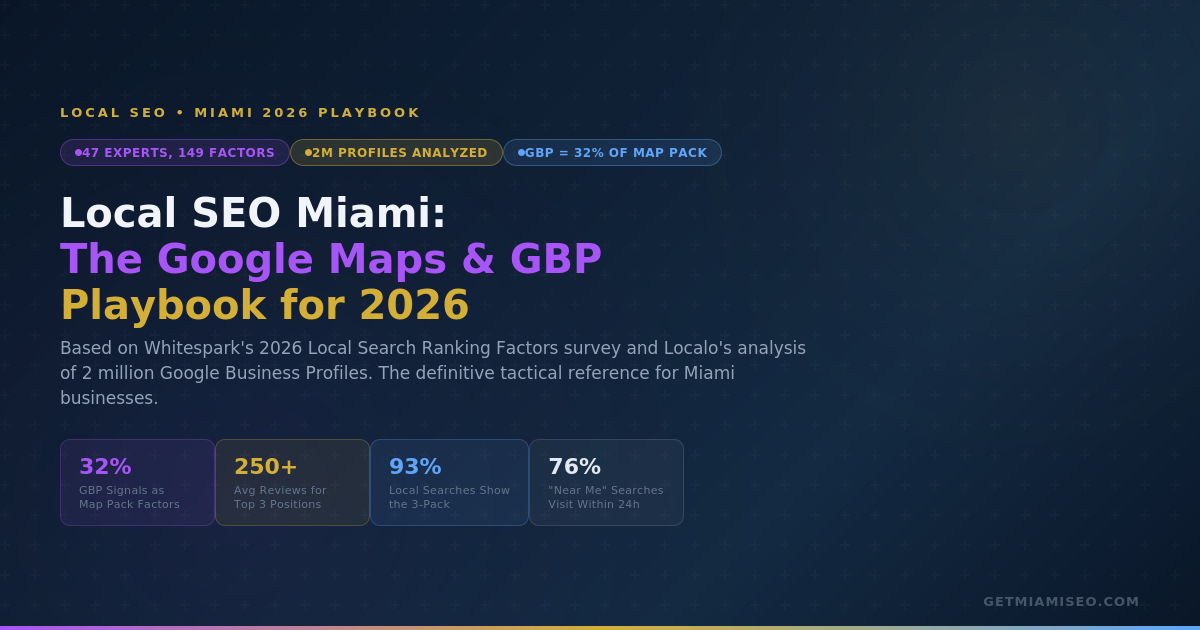
This guide is the tactical reference for executing local SEO in Miami. It is built on the most authoritative data source in the industry: the 2026 Whitespark Local Search Ranking Factors report, based on a comprehensive survey of 47 leading local SEO experts who scored 149 individual ranking factors across four categories (Map Pack, organic local, conversions, and the new AI search visibility category). It is supplemented by Localo's analysis of 2 million Google Business Profiles, BrightLocal's 2026 consumer survey data, and the real-world dynamics of operating in one of the most commercially dense and linguistically diverse markets in the United States.
How Google Decides Which Businesses Appear in the Map Pack
Google's local algorithm organizes its ranking decisions around three core pillars, documented in Google's own Business Profile Help documentation:
Relevance measures how well your business profile matches what a person is searching for. When someone searches "personal injury lawyer Miami," Google needs to determine which businesses are actually personal injury lawyers, not general practitioners or corporate attorneys. The primary signal of relevance is your Google Business Profile category. Secondary signals include your business description, your listed services, and the content on your website.
Proximity (Distance) measures how far your business is from the searcher or from the location mentioned in their search. For "near me" searches, Google uses the searcher's exact GPS coordinates from their phone. For location-specific searches like "dentist Coral Gables," Google uses the geographic center of that area. Proximity is a factor you cannot directly control (you cannot move your office), but you can influence it indirectly through content that references specific neighborhoods, streets, and landmarks, and through comprehensive service area settings in your GBP.
Prominence measures how well-known your business is online. Google evaluates prominence through the quantity, quality, and velocity of your reviews, the number and authority of websites linking to yours, how often your business is mentioned in directories, news articles, and blog posts, and increasingly, how users interact with your listing (clicks, calls, direction requests, time spent viewing your profile).
These three pillars have been consistent for years, but the relative weight of specific signals within each pillar changes constantly. That is what the Whitespark 2026 report reveals in granular detail.
The 2026 Ranking Factors: What 47 Experts and 149 Factors Tell Us
The 2026 Whitespark Local Search Ranking Factors survey is the most comprehensive study of its kind. It has been running since 2008 (originally by David Mihm, continued by Darren Shaw since 2017). The 2026 edition, released November 2025, surveyed 47 of the world's leading local SEO experts who scored 149 individual factors plus 47 new potential ranking factors, including for the first time an AI search visibility category.
Map Pack / Google Maps ranking factor categories (by weight):
Google Business Profile signals: 32%. This is the most influential category for determining which businesses appear in the Map Pack. It includes your primary and secondary categories, business name, description, services, photos, posts, attributes, Q&A, and profile completeness. 8 of the top 10 individual Map Pack ranking factors come directly from GBP.
Review signals: 20%. Up from 16% in the 2023 edition. This increase reflects Google's growing reliance on reviews as a trust and quality indicator. Review signals include quantity, velocity (how consistently new reviews arrive), recency, rating, sentiment, keywords in review text, and whether the business responds to reviews.
On-page signals: 16%. These are signals from your website: relevant content, local keywords in titles and headers, dedicated service pages, NAP (name, address, phone) on the website, and schema markup.
Link signals: 13%. The quality and quantity of websites linking to yours. Local links from Miami-based organizations, chambers of commerce, news outlets, and industry directories carry more weight than random backlinks from unrelated sites.
Behavioral signals: 8%. This is the category that has grown the most in the last cycle. It includes click-through rate from search results, calls from your GBP listing, direction requests, time spent viewing your profile, and mobile clicks. Google is increasingly using real user behavior to determine which businesses deserve to rank.
Citation signals: 7%. Mentions of your business name, address, and phone number on other websites. Consistency and accuracy matter more than raw volume. Quality directories outperform mass submission.
Personalization: 4%. Signals specific to the individual searcher, including their search history, location history, and preferences.
Organic local ranking factor categories (by weight):
For the organic results below the Map Pack, the distribution shifts. On-page signals lead at 36%, followed by link signals at 26%, GBP signals at 9%, and behavioral signals at 7%.
The key takeaway: for the Map Pack, optimize your Google Business Profile. For organic local results, optimize your website. For the strongest overall local presence, do both.
The top individual ranking factors for the Map Pack
Based on the expert scoring in the 2026 Whitespark survey:
- Primary GBP category (score: 193). The single most influential factor. Choosing the right primary category determines which searches your listing appears for.
- Keywords in GBP business title (score: 181). Businesses with relevant keywords naturally in their legal business name have an advantage. However, keyword-stuffing your business name violates Google's guidelines and can result in listing suspension.
- Proximity of address to the point of search (score: 176). How close you are to the searcher. Largely outside your control.
- Physical address in the city of search (score: 170). Being physically located within the city the searcher is searching for provides a baseline ranking advantage.
- Business is open at time of search (score: new top 5 entry). This is a new factor that entered the top 5 in 2026, originally identified by SEO expert Joy Hawkins. Businesses with accurate, up-to-date hours that show as "Open" when someone searches perform measurably better than those with missing or incorrect hours.
- Quantity of native Google reviews (high score). More reviews correlate directly with higher Map Pack positions.
- High numerical Google ratings (high score). 4-star and above ratings strengthen your visibility and conversion rate.
- Additional/secondary GBP categories (high score). Using up to 9 secondary categories captures additional search queries.
The top individual ranking factor for organic local
Dedicated page for each service (score: 163, #1 out of 149 organic local factors). This is the most actionable finding in the entire report. Every service your business offers should have its own page on your website, not a single "Services" page listing everything.
Google Business Profile: The 32% Factor
Your Google Business Profile is not a listing. It is the most important ranking asset your business owns. It represents 32% of all Map Pack ranking factors, and 8 of the top 10 individual factors come from it. For many Miami businesses, especially those in service industries, more customer interactions happen through GBP than through their website: calls, direction requests, messages, website clicks, and now AI-generated answers through "Ask Maps."
Primary category: get this right or nothing else matters
Your primary category is the #1 ranking factor for the Map Pack, and choosing the wrong primary category is the #1 negative ranking factor (Whitespark 2026, negative factor score of 176). This one decision affects your visibility more than any other single action you can take.
The rule: choose the most specific category that accurately describes your core business activity. "Personal Injury Attorney" outranks "Attorney" for personal injury searches. "Cuban Restaurant" outranks "Restaurant" for Cuban food searches. "Orthodontist" outranks "Dentist" for orthodontic searches. Specificity is the mechanism through which Google matches your business to the right queries.
Then add up to 9 secondary categories that reflect your additional services. A dental practice might have "Dentist" as primary, with "Cosmetic Dentist," "Pediatric Dentist," "Dental Implants Provider," and "Emergency Dental Service" as secondaries. Each secondary category opens visibility for a different set of searches.
Services section: your long-tail keyword engine
Every service you offer should be listed individually in the Services section of your GBP, with a description of 2 to 4 sentences. Keywords within GBP services carry confirmed ranking weight in the 2026 Whitespark data. A law firm listing "Estate Planning," "Business Litigation," "Immigration Law," "Family Law," and "Real Estate Closings" as separate services, each with descriptions containing naturally relevant keywords, creates relevance signals for dozens of potential search queries.
Description: 750 characters, make every one count
Your GBP description is 750 characters. Use the first 400 in English with your primary keywords and location. Use the remaining 350 in Spanish if you serve the Hispanic community, which in Miami-Dade's 69% Hispanic market, most businesses should. Localo's analysis of 2 million profiles found that businesses in the top 3 positions use an average of 70 words in their descriptions, while businesses in positions 11 through 20 use fewer than 50. 75% of top-3 businesses have completed their description fields, compared to under 40% for positions 11 through 20.
Photos: 250+ for top positions
Localo's 2 million profile analysis revealed that businesses ranking in the top 3 positions have an average of 250+ photos on their profiles. Businesses in positions 4 to 10 have fewer than 200. Positions 11 to 20 have around 170. Google Business Profiles with photos receive 45% more direction requests and 31% more website clicks than those without (Google).
Upload new photos monthly. Focus on real images of your business, your team, your work, and your space. Not stock photos. Google can identify stock imagery and it does not help your ranking. For restaurants in Miami Beach, dish photos drive the most engagement. For professional services in Coral Gables, office and team photos build trust. For retail in Brickell, product and storefront photos attract foot traffic.
Google Posts: weekly minimum
Google Posts signal freshness and activity. Profiles that have not been updated in 30+ days are experiencing impression drops in 2026 (AgencyJet). The algorithm has what experts call a "decay rate" for visibility: stop posting, and your impressions decline. Post at least once per week. During major events (Art Basel, FIFA World Cup, Miami Spice), increase to daily. Alternate between offers, updates, event announcements, and photos.
Attributes: the signals most businesses ignore
Select every attribute that honestly describes your business. "Se habla español" is especially valuable in Miami. "Wheelchair accessible," "Free WiFi," "Outdoor seating," "LGBTQ+ friendly," "Women-owned," "Veteran-owned" each serve as both ranking signals and conversion factors. Conversion rates increase 15% to 20% when businesses fully utilize attributes.
Hours: accuracy is now a top-5 factor
"Business is open at time of search" entered the top 5 ranking factors for the Map Pack in 2026 (Whitespark). If your hours are wrong, missing, or not updated for holidays, you are actively losing visibility every time someone searches while you are open but your profile says otherwise. Update hours for every holiday. Add special hours for events. If you have different hours for different services (e.g., a restaurant with different lunch and dinner hours), use the structured hours feature.
"Ask Maps" and the Gemini AI replacement for Q&A
In late 2025, Google began replacing the traditional Q&A feature on business profiles with "Ask Maps," powered by Gemini AI. Instead of waiting for a business owner to answer a question, Google's AI now generates instant answers by scanning your profile, your website, and your reviews. If a user asks "Does this restaurant have outdoor seating?" the AI will formulate an answer from whatever data it can find.
This makes GBP completeness more critical than ever. If your profile is missing information, the AI will either give an incorrect answer or no answer at all, and the user will move on to a competitor whose profile provides what they need.
Reviews: The 20% Factor That Keeps Growing
Review signals now represent 20% of all Map Pack ranking factors, up from 16% in the 2023 Whitespark study. This growth reflects a reality that Google has been moving toward for years: real customer feedback is the most reliable indicator of business quality, and the algorithm is weighting it accordingly.
The benchmarks from 2 million profiles
Localo's analysis of 2 million Google Business Profiles provides the most granular review benchmarks available:
Businesses in the top 3 positions average approximately 250 reviews. Businesses in positions 4 to 10 average fewer than 200. Positions 11 to 20 average just over 150.
Businesses in the top 3 write review responses averaging 140 words. Positions 4 to 10 average 100 to 120 words. Positions 11 to 20 average just over 100 words.
Businesses in the top 3 receive reviews that are longer and more detailed (averaging nearly 350 words). This suggests that businesses with higher engagement generate more thoughtful customer feedback, which in turn reinforces their ranking position.
What Google evaluates in reviews
Quantity: More reviews signal more customer activity and social proof. Velocity: A steady stream of new reviews (consistency over time) matters more than a burst followed by silence. One new review per week outperforms 50 reviews in January and none for the rest of the year.
Recency: Fresh reviews rank higher. Review recency is now a top-10 conversion factor in the 2026 Whitespark data. Rating: 4-star and above ratings strengthen visibility. A 4.8-star average is the unofficial competitive threshold for serious Map Pack competition.
Sentiment: Google's AI reads review text. Positive sentiment about specific services reinforces relevance for those service keywords. Keywords in review text: Naturally occurring mentions of services or locations in reviews strengthen relevance signals. Never incentivize customers to include specific keywords.
Owner responses: Responding to reviews signals an active, customer-focused business. In Miami, respond in the language the review was written in.
Building a review system for Miami businesses
Create a direct review link using Google's Place ID finder. Share it through WhatsApp (the dominant messaging platform in Miami's Hispanic community), text message, email follow-ups, printed QR codes at your counter or reception, and in your email signature. Ask immediately after a positive service experience when satisfaction is highest. Make it easy: one tap to the review form, not a multi-step process.
Respond to every review. Positive reviews get specific, genuine thanks that mention what the customer appreciated. Negative reviews get professional acknowledgment, a concise explanation if appropriate, and a concrete offer to resolve the issue. 89% of consumers are more likely to choose a business that responds to reviews (BrightLocal).
Your Website: The On-Page Foundation That Supports Everything
For organic local rankings (the results below the Map Pack), on-page signals from your website represent the largest single factor category at 36% (Whitespark 2026). And even for Map Pack rankings, Google cross-references your GBP information with your website to verify accuracy and expertise.
Dedicated pages for each service: the #1 organic local factor
The most impactful finding from the 2026 Whitespark report for website optimization: "Dedicated page for each service" is the #1 organic local ranking factor, with a score of 163 out of 149 factors evaluated. This finding alone should reshape how every Miami business structures their website.
A real estate agent should have separate pages for "Luxury Home Sales in Coral Gables," "Condo Sales in Brickell," "Commercial Real Estate Miami," "Property Management Services," and "Relocation Services for International Buyers." A plumber should have separate pages for "Emergency Plumbing Miami," "Water Heater Installation," "Drain Cleaning," "Bathroom Remodeling," and "Pipe Repair." Each page with 800+ words of original, substantive content.
Local keyword integration
Include your city, neighborhood, and relevant geographic terms naturally in your title tags, H1 headers, body content, and meta descriptions. "Personal injury attorney in Brickell" in your title tag signals relevance for that specific geographic query. Avoid keyword stuffing. Use the location where it reads naturally within the context of genuinely useful information.
NAP consistency
Your business name, address, and phone number must be identical on your website, your GBP, and every directory listing. Display your NAP prominently on every page of your website, typically in the header or footer. Use LocalBusiness schema markup to make this information machine-readable.
Mobile performance
63% of all Google searches happen on mobile. In Miami, where tourists search on their phones while walking Ocean Drive and residents search while commuting, mobile performance is critical. Core Web Vitals targets: LCP under 2.5 seconds, CLS under 0.1, INP under 200 milliseconds. Test at pagespeed.web.dev.
Schema markup
Implement LocalBusiness schema (with the most specific subtype: LegalService, MedicalBusiness, Restaurant, RealEstateAgent, etc.) on your website. Include your business name, address, phone, hours, geographic coordinates, and service areas. Schema markup is one of the signals Google uses for AI-generated local answers, making it increasingly important as AI Overviews expand.
Citations in 2026: Quality Over Quantity, and Why AI Changed the Game
Citation signals represent 7% of Map Pack ranking factors in the 2026 Whitespark data, a relatively modest percentage. But a finding from the new AI search visibility category has elevated their strategic importance: 3 of the top 5 AI search visibility factors are citation-based (Whitespark 2026).
These include mentions on expert-curated "best of" or "top local" lists, unstructured mentions in news articles or blog posts, and overall volume of mentions across the web. AI systems like ChatGPT, Perplexity, and Google's own Gemini are now mining directories, news sites, blogs, and aggregators to determine which businesses to recommend. If your business is consistently mentioned across trusted sources, AI systems treat you as a credible recommendation.
The quality-over-quantity shift
The Whitespark analysis shows that 10 citations from authoritative, industry-relevant directories provide more ranking benefit than 50 from low-quality directories. For Miami businesses, the priority directories include Google Business Profile (obviously), Yelp, Apple Maps, Bing Places, Facebook, Better Business Bureau, your industry-specific directories (Avvo for attorneys, Healthgrades for doctors, OpenTable for restaurants, Zillow for real estate), and local directories like the Miami-Dade Chamber of Commerce and neighborhood-specific chambers.
NAP consistency across all citations
Every mention must use exactly the same business name, address, and phone number. "123 Brickell Ave, Suite 500, Miami, FL 33131" on one directory and "123 Brickell Avenue #500, Miami, Florida 33131" on another creates an inconsistency that weakens your citation signal. Audit your existing citations quarterly and correct any discrepancies.
Link Building for Local Miami Businesses
Link signals represent 13% of Map Pack ranking factors and 26% of organic local ranking factors (Whitespark 2026). The quality, relevance, and geographic locality of your backlinks matter far more than the quantity.
For Miami businesses, the most valuable link sources include: local news outlets (Miami Herald, Miami New Times, South Florida Business Journal), neighborhood publications (Brickell Magazine, Coral Gables Magazine), industry associations (Florida Bar for attorneys, Florida Medical Association for doctors), chambers of commerce (Greater Miami Chamber, Coral Gables Chamber with its 1,600 members, Miami Beach Chamber), local business directories, community organizations, event sponsorships, and partnerships with complementary local businesses.
A link from the Miami Herald or South Florida Business Journal carries more local ranking weight than a link from a national blog with higher domain authority, because Google uses the geographic relevance of linking sites as a signal.
Behavioral Signals: The New Frontier of Local Ranking
Behavioral signals represent 8% of Map Pack ranking factors (Whitespark 2026), and this category has grown more than any other in recent years. Google is tracking how real people interact with your business listing and your website, and using that interaction data to determine your ranking.
The signals Google monitors include: click-through rate from search results to your listing, calls placed directly from your GBP, direction requests through Google Maps, website visits from your listing, time spent viewing your profile, and mobile clicks and interactions.
This creates a virtuous cycle: businesses that rank higher get more clicks, which generates more behavioral signals, which reinforces their ranking. But the reverse is also true: if your listing gets impressions but low engagement (people see it but do not click), Google interprets that as a relevance mismatch and may lower your position.
The practical implication: everything about your listing should encourage action. Compelling photos, a complete description, recent reviews, current hours, and clear service listings all increase the likelihood that someone who sees your listing will interact with it.
The Miami-Specific Playbook: Bilingual, Dense, and Tourist-Heavy
National local SEO advice misses three factors that fundamentally shape the Miami market.
Bilingual optimization is not optional
Miami-Dade is 69% Hispanic. 1.9 million residents speak Spanish at home. 35% of local searches happen in Spanish. Spanish keywords carry 75% to 85% lower difficulty. Google's AI Overviews are rolling out in English first, meaning Spanish searches still produce traditional organic results more frequently.
For GBP specifically: include Spanish in your description, post in both languages, respond to Spanish reviews in Spanish, and select the "Se habla español" attribute. For your website: create Spanish-language service pages with proper hreflang implementation. For reviews: encourage Spanish-speaking clients to leave reviews in Spanish. This builds a body of Spanish-language review content that strengthens your relevance for Spanish queries.
Market density creates proximity competition
Coral Gables has 10,000 businesses in 13 square miles. Brickell packs thousands of professional services firms into a few blocks. Miami Beach has a 120-to-1 visitor-to-resident ratio. This density means the proximity factor in Google's algorithm creates extremely tight competitive zones. A law firm on Brickell Avenue competes against dozens of other firms within a one-mile radius for the same "near me" searches.
The workaround: create content that references specific streets, landmarks, and sub-neighborhoods. "Estate planning attorney near the University of Miami campus" creates geographic relevance that pure proximity cannot override.
Tourist search patterns are different
28.2 million visitors create massive seasonal search demand spikes around Art Basel ($565M economic impact), the F1 Miami Grand Prix ($1B+ in three years), the upcoming FIFA World Cup ($550M projected Miami impact), and the December through April winter tourism season. Businesses that are already ranking before these events capture the surge at no additional cost. Businesses that rely on Google Ads face CPC spikes during high-demand periods.
Negative Ranking Factors: What Actively Hurts Your Visibility
The 2026 Whitespark survey also asked experts to score negative factors, things that actively harm your local ranking. Knowing what to avoid is as important as knowing what to do.
Incorrect primary category is the #1 negative ranking factor (score 176 in the Whitespark negative factor analysis). Choosing the wrong category does not just reduce your visibility. It actively pushes you down in results because Google matches you to the wrong searches and then penalizes the poor engagement metrics that follow.
Listing marked as permanently or temporarily closed severely impacts visibility. If your business underwent a temporary closure for renovation and you forgot to update the status back to "Open," you may be invisible in local results.
Presence of other profiles in the same category at the same address (score 142). If multiple businesses in the same category share an address (common in co-working spaces and shared office buildings), Google may suppress some or all of them.
Duplicate listings split your authority and confuse the algorithm. If you have two Google Business Profiles for the same business (perhaps one from a previous owner or a legacy Google+ page), merge or remove the duplicate.
Keyword stuffing in business name violates Google's guidelines and can result in listing suspension. Your business name in GBP should be your actual legal or DBA name, nothing more.
Inconsistent NAP information across directories weakens your citation signals and can cause Google to doubt the accuracy of your business data.
AI Search Visibility: How to Show Up in ChatGPT, Perplexity, and Google AI Overviews
For the first time, the 2026 Whitespark survey included an AI search visibility category, recognizing that consumers are increasingly discovering local businesses through AI-powered platforms, not just traditional Google search.
The top AI search visibility factors reveal what matters for being recommended by AI systems:
Mentions on expert-curated "best of" or "top local" lists. When a local publication, a respected blog, or a curated directory includes your business on a "best restaurants in Miami" or "top lawyers in Coral Gables" list, AI systems use that as a trust signal.
Unstructured mentions in news articles or blog posts. AI systems read and synthesize content from across the web. Being mentioned in a Miami Herald article, a neighborhood blog, or an industry publication builds the kind of authority that AI systems value.
Overall volume of mentions across the web. Citation quantity matters more for AI visibility than it does for traditional Google ranking. The more places your business is mentioned (accurately), the more confident AI systems are in recommending you.
Structured content on your website and GBP. Schema markup, complete GBP fields, and clearly organized website content give AI systems the structured data they need to generate accurate answers about your business.
Review sentiment. AI systems analyze the sentiment of your reviews, not just the star rating. Consistently positive review sentiment, especially mentions of specific services or qualities, directly shapes how AI summarizes and recommends your business.
The practical implication for Miami businesses: the signals that drive AI visibility are largely the same signals that drive traditional local SEO (reviews, citations, content quality, structured data), but with a heavier emphasis on being mentioned and cited across trusted third-party sources. Brands cited in AI Overviews see 35% higher organic CTR and 91% higher paid CTR (Seer Interactive).
Measuring Local SEO Success: The Metrics That Actually Matter
In a zero-click environment where 58% to 69% of searches end without a click, traditional traffic metrics tell an incomplete story. For local SEO, the metrics that matter are the ones that represent real business activity.
GBP actions: Calls placed from your profile, direction requests, website clicks, message inquiries. These are direct indicators of customers taking action.
Map Pack position for target keywords: Track your position for "[your service] + [your city/neighborhood]" searches from locations within your target area. A geo-grid rank tracker (like Whitespark's Local Ranking Grids) shows your visibility from multiple points across your service area.
Review velocity and rating: Are you receiving new reviews consistently? Is your average rating stable or improving? Are you responding to all reviews?
Branded search volume: Are more people searching for your business by name? Rising branded searches indicate growing awareness and word-of-mouth effect.
Lead quality and source: Track which leads come from organic search versus paid, social, or referral. For most local businesses, organic leads have higher conversion rates and higher lifetime value.
Citation accuracy: Quarterly audit of your NAP information across major directories. Tools like Whitespark's Local Citation Finder or Moz Local can automate this.
FAQ: Local SEO for Miami Businesses
What is the most important local SEO ranking factor in 2026?
Primary GBP category (Whitespark 2026, score 193/193). GBP signals overall represent 32% of Map Pack factors. 8 of the top 10 individual factors come from GBP.
How many reviews does a Miami business need to rank in the Map Pack?
Businesses in the top 3 average approximately 250 reviews (Localo, 2M profile analysis). They also average 250+ photos, 70-word descriptions, and 140-word review responses. Review signals represent 20% of Map Pack factors, up from 16% in 2023.
How does Google rank local businesses?
Three pillars: Relevance (how well your profile matches the query), Proximity (how close you are to the searcher), and Prominence (how well-known and trusted you are online). In 2026, "business is open at time of search" entered the top 5 factors.
How much does local SEO cost in Miami?
$1,500 to $6,500 per month depending on industry and competition. 75% of local businesses say local SEO brings more qualified leads than paid ads. SEO returns $22 per $1 spent vs Google Ads' $2.
What percentage of Google searches have local intent?
46% of all searches. 98% of consumers search online for local businesses. 80% search weekly. 76% of "near me" searches result in a visit within 24 hours. The Local 3-Pack appears in 93% of local-intent searches.
Is GBP more important than a website?
For Map Pack: GBP signals = 32%. For organic local: on-page signals = 36%. Both matter. Google cross-references them to verify accuracy and expertise. The strongest strategy optimizes both.
How important are citations in 2026?
Quality over quantity. 10 authoritative citations outperform 50 low-quality ones. But for AI search visibility, citations are critical: 3 of the top 5 AI visibility factors are citation-based (Whitespark 2026).
How does bilingual optimization affect local SEO in Miami?
69% Hispanic population. 35% of searches in Spanish. 75-85% lower keyword difficulty. Include Spanish in GBP descriptions, respond to Spanish reviews in Spanish, select "Se habla español" attribute, and create Spanish service pages with hreflang tags.