In January 2026, a med spa in Coral Gables posted a lip filler before-and-after photo on Instagram that reached 43,000 accounts. Three hundred and twelve women saved the post. Forty-seven sent direct messages asking about pricing and availability. The post was, by every social media metric, a success.
But here is what happened next. Thirty-one of those forty-seven women did not book through Instagram. They opened Google. They searched "lip filler Coral Gables" and "best lip filler near me" before making an appointment. The med spa that posted the viral content did not appear on page one for either search. A competitor two blocks away, with 900 Instagram followers but a detailed "Lip Filler in Coral Gables" service page, five-star Google Reviews mentioning lip filler by name, proper schema markup, and pricing transparency on the website, held position one. That competitor captured the bookings.
This is the Instagram-to-Google gap. And in Miami's beauty market, it costs businesses thousands of dollars in lost revenue every month.
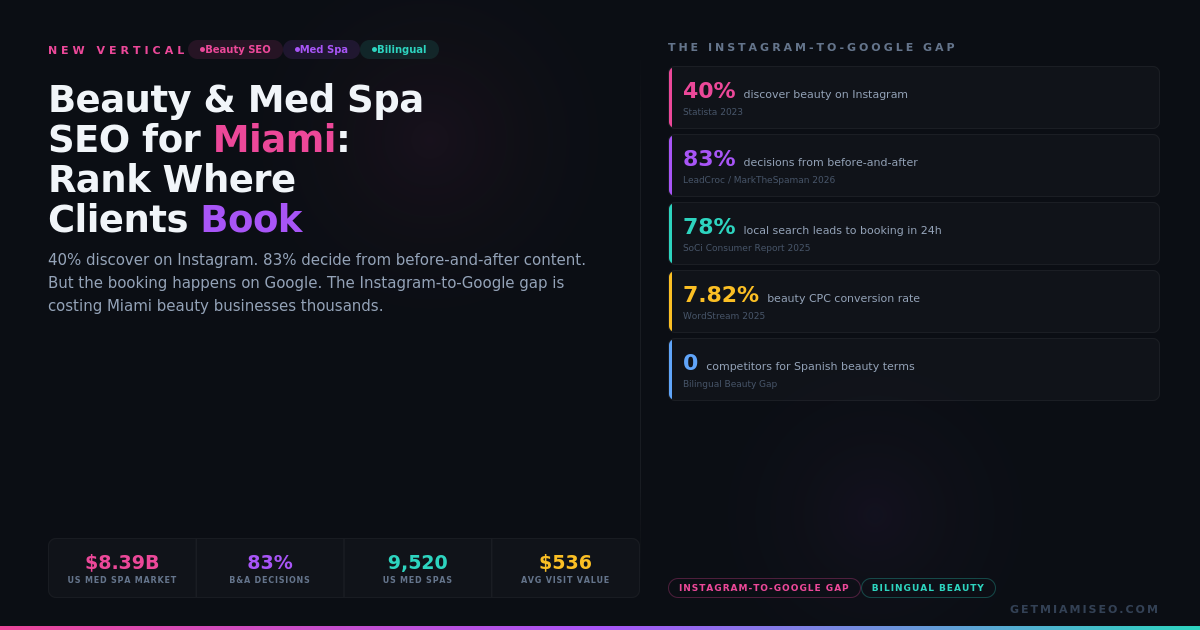
The dynamic is not complicated. 40% of consumers discover beauty and wellness businesses through Instagram (Statista, 2023). Instagram is where awareness happens. It's where the scroll pauses on a striking transformation photo. But 83% of cosmetic treatment decisions are driven by before-and-after content found through search, and 78% of local mobile searches for beauty services lead to an appointment within 24 hours (LeadCroc/MarkTheSpaman 2026, SoCi 2025). The decision to book happens on Google. The provider who ranks on Google captures the client. The provider who only invests in Instagram generates awareness for a competitor to convert.
This is an $8.39 billion market in the US alone (Expert Market Research, 2025), growing at 14% annually. In Miami, where beauty is woven into the cultural and economic fabric, the stakes are even higher. The businesses that understand where clients discover and where they decide are the ones filling their appointment books. The ones that treat Instagram as their entire marketing strategy are generating content that makes someone else money.
Miami's Beauty Economy by the Numbers
Miami is not just a beauty market. It is one of the largest and most diverse beauty markets in the United States.
The US med spa industry was valued at $8.39 billion in 2025, with the number of med spas nationwide growing from 1,600 in 2010 to 9,520 in 2024 (Pinch Med Spa/Expert Market Research). The average med spa visit generates $536 in revenue (Medica Depot). Women comprise approximately 86% of med spa clientele, though male clients are growing at roughly 5% annually (Grand View Research, Brenton Way). And 33% of med spa clients report household incomes exceeding $100,000 (Brenton Way).
Miami-Dade adds three layers that no other US beauty market matches. First, the sheer density of providers. Coral Gables alone has dozens of med spas and aesthetic practices competing for a population with a median household income above $130,000. Brickell caters to young professionals willing to spend on preventive aesthetics. Miami Beach draws medical tourism from Latin America and Europe.
Second, the bilingual dimension. 1.9 million Spanish speakers search for beauty services in their language. "Botox labios Miami," "limpieza facial profunda Doral," "depilacion laser Hialeah" are all queries with real volume and almost no SEO competition in Spanish.
Third, the tourism and seasonal resident layer. 28.2 million annual visitors search for beauty treatments during their trips. Medical tourism is a specific driver: clients from Latin America and the Caribbean travel to Miami for aesthetic procedures because the quality of care is high and prices are lower than comparable treatments in their home countries. "Botox Miami medical tourism" and "lip filler Miami vacation" are real search patterns.
Snowbird residents returning in December through March reactivate their beauty routines. Events like Art Basel and the FIFA World Cup drive spikes in beauty demand from visitors wanting to look their best.
The US Health and Wellness Spas industry reached $22.9 billion in 2026 across 19,970 businesses (IBISWorld). Within that market, beauty and personal care Google Ads carry a CPC of approximately $5.70 per click, but convert at 7.82%, one of the highest conversion rates of any industry (WordStream, 2025). That conversion rate tells you something important: when someone searches for a beauty treatment, they are close to booking. The intent is high. The search is the final step before the decision. The business that appears for that search captures a client whose lifetime value, at $536 per visit and 4 to 6 visits per year, can exceed $2,500 annually.
The "Before and After" Search: The Highest-Converting Content in Beauty SEO
In most industries, the highest-converting content is a pricing page or a product comparison. In the beauty industry, the highest-converting content is the before-and-after gallery.
Before-and-after content drives 83% of cosmetic treatment decisions (LeadCroc/MarkTheSpaman 2026). When a potential client searches "microneedling results" or "Botox before and after," she is past the awareness stage. She knows what the treatment is. She is evaluating whether to book. A gallery showing real results on real faces (with patient consent) answers the only question left: "Will this work for me?"
Most beauty businesses in Miami post before-and-after photos exclusively on Instagram. The photos perform well there. They generate likes, saves, and comments. But Instagram content is not indexed by Google. A before-and-after posted on Instagram is invisible to the person who searches "lip filler before and after Coral Gables" on Google. The business that hosts the same photos on a dedicated website gallery page, with alt text, treatment descriptions, and structured data, captures that search traffic.
The SEO approach to before-and-after content is specific. Each gallery entry should include: the treatment name, the area treated, the patient's concern (wrinkles, volume loss, acne scarring), the number of sessions, and a brief description of the results. The alt text on the image should describe what it shows: "Lip filler before and after, 1 mL hyaluronic acid, Coral Gables med spa." This gives Google context that a standalone image cannot provide.
For AI search, before-and-after galleries are citation-generating assets. When someone asks ChatGPT "Where can I see lip filler results in Miami?", the AI searches for pages with specific treatment information and descriptions. A gallery page with treatment details is citable. An Instagram feed is not. Only 25% of sources cited in AI-generated answers come from brand-owned websites (Search Engine Land/OtterlyAI 2026), which means your Google Reviews and RealSelf profile matter as much as your website. But a website gallery with detailed descriptions gives the AI the structured content it needs to recommend you over a competitor with identical reviews but no web content.
The practical execution: take every before-and-after photo you've ever posted on Instagram and re-host it on a dedicated gallery page on your website. Add the treatment name, the patient concern, and the results description. The 30 minutes of work per photo creates a page that ranks for searches your Instagram never reached.
Service Page Architecture for Salons and Med Spas
A single "Our Services" page listing every treatment in bullet points is the most common website mistake in the beauty industry. It tells Google nothing specific, ranks for nothing specific, and helps no searcher find what she is looking for.
Every treatment your business offers should have its own dedicated page. "Lip Filler Miami," "Microneedling Coral Gables," "Botox Brickell," "Chemical Peel Miami Beach." Each page targets a specific keyword, answers specific questions, and gives Google a clear signal about what the page covers.
Each treatment page should contain: a clear H1 with the treatment name and location, a direct answer paragraph explaining what the treatment does (40 to 60 words, featured-snippet-ready), the specific concerns the treatment addresses, expected results and timeline, recovery information, pricing range (if possible), before-and-after photos, FAQs specific to that treatment, and a booking CTA.
The featured snippet opportunity is significant. When someone searches "what is microneedling," Google pulls a direct-answer box from the page that answers the question most clearly and concisely in the first 40 to 60 words after the relevant heading. A treatment page that opens with "Microneedling is a minimally invasive skin treatment that uses fine needles to create micro-injuries in the skin, stimulating collagen and elastin production. Most patients see improved skin texture and reduced acne scarring after 3 to 6 sessions spaced 4 to 6 weeks apart" is structured to capture that snippet. A page that opens with "Welcome to our microneedling services! We offer the best microneedling in Miami!" captures nothing.
For Google's algorithm updates in 2026, individual treatment pages also generate more AI Overview citations than consolidated service pages. AI Overviews appear on 40% of Google queries, and they preferentially cite pages that answer one specific question thoroughly rather than pages that mention many topics briefly.
Pricing transparency deserves its own discussion. Many beauty businesses resist publishing prices because they vary by provider, treatment area, and patient. The concern is valid. But "how much does Botox cost in Miami" is one of the highest-volume beauty search queries in the region. A page that answers "Botox in Miami typically costs $10 to $15 per unit, with most patients requiring 20 to 60 units depending on treatment area, for a total cost of $200 to $900 per session" captures that search. A business that hides pricing entirely loses the click to a competitor who is transparent.
The honest counter-argument. Some luxury med spas deliberately avoid publishing pricing because their positioning depends on a consultation-first model. This is a legitimate business strategy. For these businesses, the page should still exist, but the answer should be: "Botox pricing is customized during your consultation because every patient's anatomy and goals are different. Schedule a complimentary consultation to receive a personalized treatment plan." This still captures the search. It still provides an answer. It funnels the client into the consultation instead of giving a number that may not reflect her specific case.
Google Business Profile for Beauty: The Booking Shortcut
For beauty businesses, the Google Business Profile functions as a direct booking channel. A client searching "med spa near me" at 9 PM is not going to browse five websites. She is scanning the Map Pack, checking star ratings, looking at photos, and tapping the call button or booking link.
GBP signals account for 32% of Map Pack ranking factors (Whitespark 2026). For beauty businesses, the GBP elements that matter most are:
Primary category selection. "Medical Spa" is not "Day Spa" is not "Hair Salon" is not "Skin Care Clinic." Google matches the primary category to the search query. A med spa categorized as "Day Spa" will not appear for "medical spa near me." Choose the most specific category and add relevant secondary categories.
Treatment photos. Not stock photos. Real treatment room photos, real results, real staff. Listings with photos receive 42% more direction requests and 35% more clicks (Google data, via SeoProfy 2026). For beauty, photos of your space and team build the trust that makes a client choose you over a faceless competitor.
Booking link. Google allows a direct booking link in your GBP. 71% of med spa clients abandon bookings if the process is difficult or slow (Zenoti 2025 Survey). A one-click booking link eliminates the friction between search and appointment.
Review volume and recency. 83% of consumers use Google to read reviews (BrightLocal 2025). 89% expect owners to respond to all reviews. For beauty businesses, reviews mentioning specific treatments by name ("I got Botox here and my results lasted 4 months") give Google more context to match your profile to treatment-specific searches.
Bilingual Beauty SEO: "Botox Labios Miami" vs. "Lip Filler Miami"
35% of all Miami searches happen in Spanish. For beauty services, that percentage is likely higher because beauty searches concentrate in neighborhoods with large Hispanic populations: Doral (85% Hispanic), Hialeah (96% Hispanic), Kendall, Homestead, and Sweetwater.
The Spanish beauty keyword landscape in Miami is virtually uncontested. "Botox labios Miami" has real search volume and almost no SEO competition. "Limpieza facial profunda cerca de mi" is a high-intent query returning thin results. "Depilacion laser Hialeah" targets a specific service in a specific city in a specific language with virtually no competitor page built for it.
Spanish keywords carry 75-85% lower difficulty than English equivalents. For beauty services, the gap is wider because the English-language beauty SEO space is crowded while the Spanish-language space is essentially empty.
The implementation: create Spanish versions of your highest-traffic treatment pages, add Spanish service descriptions to your GBP, respond to Spanish reviews in Spanish, and build FAQ content in Spanish answering common questions ("Cuanto cuesta el botox en Miami?", "Es seguro el acido hialuronico?").
And the AI search layer compounds this. When someone asks ChatGPT in Spanish "Cual es el mejor medspa para botox en Miami?", the AI prioritizes Spanish-language content. A med spa with bilingual treatment pages is citable in both languages. A med spa with English-only content is invisible to every Spanish-language AI query. In a county where 1.9 million people search in Spanish, that's a large audience to forfeit.
The neighborhoods where this matters most: Hialeah (96.3% Hispanic), where "depilacion laser Hialeah" has zero SEO competition. Doral (85% Hispanic), where "tratamiento facial Doral" captures a market no competitor targets. Kendall, Sweetwater, and Homestead, where beauty businesses serving predominantly Hispanic communities have Google profiles entirely in English. The mismatch between the language of the business's customers and the language of the business's website is a revenue leak that costs nothing to fix.
Reviews That Sell: What Beauty Clients Write and What Google Extracts
Not all reviews carry equal SEO weight. "Great experience, loved it!" is positive but tells Google nothing about what service was provided. "I got a hydrafacial at this Coral Gables location and my skin looked noticeably clearer for two weeks. The aesthetician Maria was incredible" gives Google three indexable signals: the treatment (hydrafacial), the location (Coral Gables), and the provider (Maria).
For beauty businesses, review content directly influences which searches your profile appears for. Google's algorithm extracts keywords from reviews. A med spa with 50 reviews mentioning "Botox" by name will outperform a competitor with 200 generic reviews that never mention specific treatments.
The strategy: after each treatment, ask the client to mention the specific treatment and results. Not by scripting the review, but by asking: "Would you mind sharing what treatment you had and how you liked the results? It helps other clients researching." Most clients are happy to be specific.
Bilingual reviews double this effect in Miami. A Spanish review mentioning "relleno de labios" helps your profile appear for Spanish lip filler searches. An English review mentioning "lip filler" covers the English side. Two independent trust and ranking pipelines working simultaneously.
Med Spa SEO vs. Salon SEO: Why the Strategies Differ
Med spas and salons compete in overlapping markets but operate under different rules.
A salon offers services without medical oversight: haircuts, color, manicures, non-medical facials, waxing. The SEO strategy is predominantly local: neighborhood-specific pages, review generation, GBP optimization, and service pages. Competition is high but keyword difficulty is moderate because most salons do not invest in SEO.
A med spa operates under a licensed medical director and offers medical-grade treatments: Botox, dermal fillers, laser treatments, chemical peels, IV therapy, body contouring, PRP. The SEO strategy includes everything a salon needs plus three additional requirements.
Compliance. Med spa marketing must comply with FTC advertising guidelines and state medical board regulations. "Botox eliminates wrinkles" could trigger regulatory scrutiny. "Botox temporarily reduces the appearance of fine lines and wrinkles" is medically accurate. This affects every service page, meta description, and ad.
E-E-A-T weight. Medical SEO carries higher E-E-A-T requirements. Google's quality raters evaluate whether the content creator is qualified to give medical advice. Med spa content should identify the medical director by name, list credentials, and demonstrate clinical authority.
RealSelf and third-party platforms. For med spas, RealSelf is a significant discovery and citation platform. A strong RealSelf profile with verified reviews functions like a second GBP specifically for aesthetic procedures. Google indexes RealSelf content, so a med spa's RealSelf presence contributes to overall search visibility.
The Compliance Factor: What Med Spas Can and Cannot Say
This section matters because non-compliant claims risk regulatory penalties and Google's E-E-A-T assessment. Content with unsupported medical claims can be flagged.
The core rules: avoid absolute outcome claims ("This treatment will make you look 10 years younger"), use medically accurate language ("may reduce the appearance of fine lines"), attribute claims to clinical data when available ("In clinical trials, patients reported 70% improvement in skin texture after three sessions"), include appropriate disclaimers ("Individual results may vary"), and ensure marketing content is reviewed by the medical director.
For AI search, compliant language is an advantage. AI engines prefer medically accurate, well-sourced claims. A page saying "Botox typically lasts 3 to 4 months based on clinical data" is more citable than "Our Botox gives you the best results in Miami!"
Common Mistakes Beauty Businesses Make With SEO
Treating Instagram as the only marketing channel. Instagram is discovery. Google is conversion. A business that invests $3,000 per month in social media management and $0 in SEO is building awareness that competitors monetize.
Having one "Services" page instead of individual treatment pages. A single page listing 15 treatments in a paragraph each ranks for nothing specific. Every treatment needs its own URL.
Not responding to reviews or responding with copy-paste templates. Google detects templated responses. Personalized replies mentioning the specific treatment, the client's name, and the outcome signal active engagement to both Google and future clients.
Ignoring Spanish-language searches entirely. In Miami-Dade, this means ignoring 35% of the market. Spanish beauty keywords have virtually zero competition. The cost of building one Spanish treatment page is a few hours of work. The cost of not building it is an open field for a competitor.
No before-and-after content on the website. If your before-and-after photos exist only on Instagram, they are invisible to Google, invisible to AI search, and invisible to the 83% of clients whose treatment decisions are driven by visual proof.
No schema markup. A med spa without LocalBusiness, FAQPage, and Service schema is invisible to AI search engines. Schema improves GPT-4 accuracy from 16% to 54%. Without it, AI cites the competitor who has it.
Using stock photos instead of real treatment photos on the GBP. Clients searching for beauty services are visual decision-makers. Stock photos of models do not build trust. Real photos of your treatment rooms, your team, and your actual results do.
What Miami Beauty Businesses Should Build This Month
Week 1. Complete your Google Business Profile. Select the correct primary category. Upload 15+ photos of your treatment rooms, staff, and results. Add every treatment as a service. Add a direct booking link. The SEO audit checklist covers the full technical requirements.
Week 2. Build your three highest-volume treatment pages. Create dedicated pages for each top treatment with location-specific titles ("Botox in Coral Gables"). Add schema markup. Add FAQ sections answering consultation questions.
Week 3. Create a before-and-after gallery on your website. Start with 10 best results. Include treatment descriptions, session counts, and concerns addressed. Add descriptive alt text. This page can rank for dozens of "[treatment] before and after Miami" queries.
Week 4. Build one Spanish-language treatment page. Choose the treatment with highest Spanish demand. Write in native Spanish targeting the specific query. Add Spanish descriptions to your GBP. Respond to Spanish reviews in Spanish.
FAQs: Beauty and Med Spa SEO in Miami
How long does SEO take for a beauty business? GBP improvements show in 2 to 4 weeks. Treatment-specific pages for lower-competition terms rank in 2 to 3 months. Competitive terms like "med spa Miami" take 6 to 12 months. Spanish beauty terms can rank in 30 to 60 days. The timeline guide covers expectations.
Should I invest in Instagram or Google first? Both serve different functions. Google delivers higher-intent clients ready to book. Instagram builds awareness. If your Google presence is weak, fixing it delivers revenue faster.
Do before-and-after photos matter for SEO? Yes. Before-and-after galleries drive 83% of cosmetic treatment decisions. On your website, they rank for "[treatment] results" and "[treatment] before and after [city]."
How do I get more Google Reviews? Ask every client after their appointment. Send a text or email within 2 hours with a direct link to your Google Review page. Ask them to mention the specific treatment.
What is the most important page on a beauty business website? Your most-searched treatment page. For most med spas, Botox. For salons, haircut/color or facials. This page needs its own URL, not a section on a general services page.
Can I rank in both English and Spanish? Yes. Bilingual SEO allows ranking for treatment queries in both languages. Spanish beauty keywords have significantly lower competition.
Do I need to worry about compliance? If you offer medical-grade treatments under a medical director, yes. Use medically accurate language. Include disclaimers. The medical SEO guide covers compliance.
How do I choose an SEO agency for beauty? Look for beauty or med spa client experience. Ask for case studies. Verify bilingual capability. The agency guide covers full criteria.
The Gap That Costs the Most
That Coral Gables med spa with the viral lip filler post is not unusual. Across Miami, beauty businesses pour thousands of dollars monthly into Instagram content, influencer partnerships, and social media management. The content is often stunning. The engagement is often strong. And the bookings often go to someone else.
The gap between where beauty businesses invest and where clients decide is the most expensive mistake in Miami's beauty market. Instagram creates the desire. Google fulfills it. A beauty business without Google visibility is running a marketing engine where someone else collects the output.
The US med spa market will grow from $8.39 billion to over $31 billion by 2035 (Expert Market Research). The number of med spas grew from 1,600 in 2010 to over 9,500 in 2024. Supply is increasing. Competition is intensifying. The businesses that survive and grow are the ones that own the search results for their treatments in their neighborhoods, in both languages.
The next client who discovers your work on Instagram and then searches Google before booking will either find you or find your competitor. The difference is whether you built the page that answers her search.
70% of med spa bookings are influenced by digital channels (FreeYourself/Growth Data 2025). 81% of med spas are single-location businesses (Pinch Med Spa). 40% identify staff shortages as a major challenge (Brenton Way). In this environment, SEO is not just a marketing channel. It's the most efficient one. A ranking that delivers 20 organic inquiries per month at zero per-click cost lets a single-location med spa grow without proportionally increasing its marketing team.
The viral Instagram post was not wasted. It did exactly what Instagram does: it created desire. The missing piece was the Google page that fulfilled it.