Table of Contents
- Why Medical SEO in Miami Operates by Different Rules
- The Miami Healthcare Market in 2026: A Competitive Snapshot
- HIPAA and Your Website: The Compliance Minefield Most Practices Ignore
- Google's YMYL Classification: Why Medical Sites Face Stricter Standards
- E-E-A-T for Healthcare: The Trust Signals That Actually Move Rankings
- Local SEO for Medical Practices: Owning "Doctor Near Me" in Miami
- The Bilingual Advantage: Reaching the 70% of Miami That Speaks Spanish
- Content Strategy for Medical Practices That Stays HIPAA Compliant
- Technical SEO for Healthcare Websites
- Specialty Strategies: Dental, Med Spa, Plastic Surgery, and Primary Care
- Measuring Medical SEO ROI: The Metrics That Matter
- FAQ: Medical SEO in Miami
Why Medical SEO in Miami Operates by Different Rules
Every business benefits from ranking on Google. But if you run a medical practice, a dental office, a med spa, or a plastic surgery clinic in Miami, the rules that govern your search visibility are fundamentally different from those that apply to a restaurant or a real estate brokerage.
Three forces shape medical SEO in Miami in ways that no other vertical experiences simultaneously. First, federal HIPAA regulations restrict how you collect, store, and transmit patient data on your website, meaning that standard marketing tools like Google Analytics, Meta Pixel, and live chat widgets can expose your practice to penalties that reached $100 million in combined settlements between 2023 and 2025. Second, Google classifies all health-related content under its YMYL (Your Money or Your Life) framework, which means the search engine applies far stricter quality thresholds to your pages than it does to nearly any other industry. Third, Miami's healthcare market is enormous, multilingual, and growing rapidly, creating both intense competition and significant opportunity for practices that approach SEO with precision.
The result is that generic SEO advice fails medical practices. The tactics that work for a Brickell accounting firm or a Wynwood boutique hotel will not produce results for a Coral Gables dental practice or a Miami Beach med spa. Medical SEO requires a specialized approach that balances patient acquisition with regulatory compliance, clinical authority with search engine optimization, and English-language visibility with the 35% of Miami searches that happen in Spanish.
This guide covers exactly how to build that approach. Every recommendation is tailored to the Miami market, backed by current data, and designed for implementation in 2026.
The Miami Healthcare Market in 2026: A Competitive Snapshot
Before discussing strategy, it helps to understand the scale of the market you are competing in.
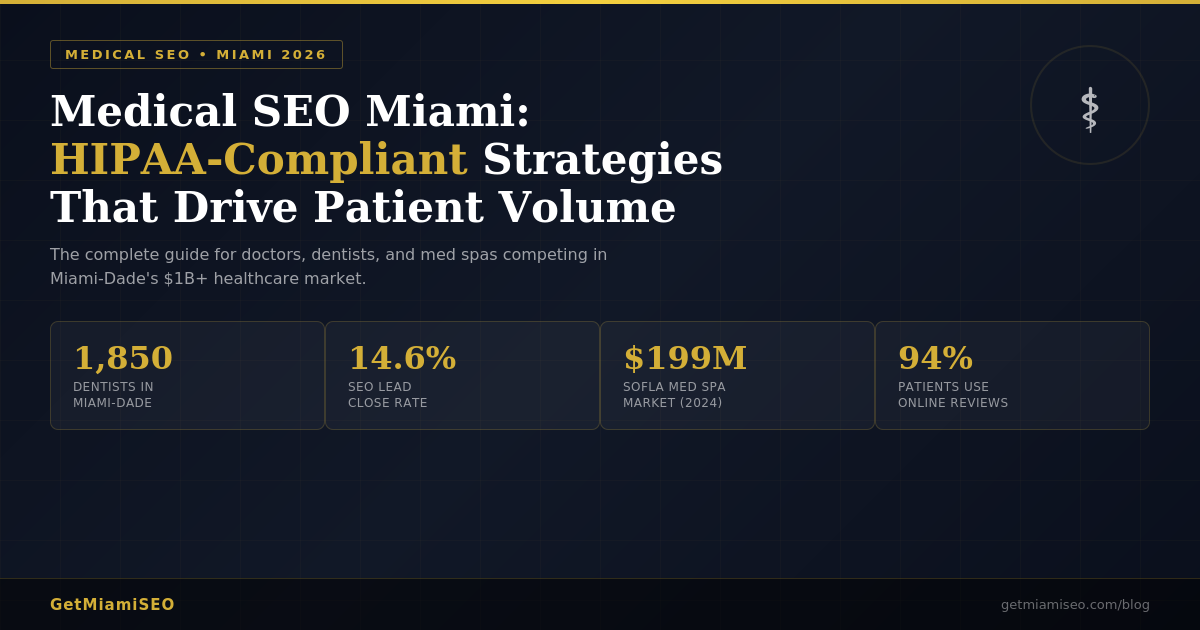
Miami-Dade County has approximately 1,850 practicing dentists, making it the most concentrated dental market in Florida. There are roughly 1,544 licensed primary care doctors serving the county, along with hundreds of specialists, surgeons, and allied health professionals. The South Florida medical spa market alone was valued at $199.51 million in 2024 and is projected to reach $1.09 billion by 2033, growing at a compound annual rate of 20.69% (Grand View Research). Miami-Dade accounts for 43.33% of that market.
The healthcare infrastructure is expanding in parallel. The University of Miami Health System opened the UHealth SoLé Mia Medical Center in North Miami-Dade, a seven-story, 363,000 square foot ambulatory care facility that is the largest in the UM Health System (Capital Analytics Associates). Mount Sinai Medical Center is expanding into Westchester with a new freestanding emergency department slated for 2026, evolving into a full hospital campus by 2027. Care Resource doubled capacity at its Little Havana Health Center to 45,000 square feet, aiming to serve 20,000 patients annually. Medical office demand is surging in Coral Gables and across "medtail" retail healthcare locations throughout the county.
The competitive implication is straightforward: more providers are entering the market, physical capacity is increasing, and the practices that capture search visibility will capture patient volume. The practices that do not will become invisible to the 77% of patients who begin their healthcare journey with a search engine.
For context, SEO leads in healthcare close at 14.6%, compared to 1.7% for outbound methods like direct mail and cold calling (ClickVision). That gap between digital and traditional patient acquisition is why medical SEO is not a marketing luxury in Miami. It is an operational requirement.
HIPAA and Your Website: The Compliance Minefield Most Practices Ignore
Here is the uncomfortable reality: most medical practice websites in Miami are not HIPAA compliant, and the owners do not know it.
HIPAA's four core rules (the Privacy Rule, Security Rule, Breach Notification Rule, and Enforcement Rule) apply to your website just as they apply to your electronic health records system. If your site collects, transmits, or processes Protected Health Information (PHI) in any form, it falls under federal regulation. And "any form" is broader than most practice owners realize.
The Tracking Pixel Problem
The Office for Civil Rights (OCR) began issuing guidance on tracking technology in late 2022, with updates in 2024 and intensified scrutiny in 2025 (HIPAA Journal). The core issue: standard marketing tools like Google Analytics, Meta Pixel, session replay software, and chatbot widgets often capture data from patient-facing pages and transmit it to third parties without Business Associate Agreements (BAAs).
Google does not sign BAAs for Google Analytics. Meta does not sign BAAs for the Facebook Pixel. This means that running these tools on any page where a patient submits health information, schedules an appointment, or even browses condition-specific content can constitute a HIPAA violation under OCR's current interpretation.
Industry reporting estimates $100 million or more in penalties and settlements tied to pixel-tracking violations between 2023 and 2025 (Feroot Security). The per-violation cap sits at roughly $2.13 million, and OCR now classifies failure to monitor website tracking scripts as potential "willful neglect" under its most severe penalty tier (Tier 4). In 2024 alone, 22 enforcement actions resulted in settlements or civil monetary penalties, making it one of the most active enforcement years to date.
What HIPAA-Compliant Medical SEO Looks Like
A HIPAA-compliant SEO strategy addresses this head on:
Analytics Configuration. Use server-side analytics or HIPAA-compliant analytics platforms that either sign BAAs or process data in ways that strip PHI before transmission. If you use Google Analytics, configure it to exclude all patient-facing pages with forms, scheduling tools, or condition-specific content.
Form and Scheduling Security. Every appointment request form, contact form, and patient intake form must transmit data over encrypted connections (TLS 1.2 or higher) to HIPAA-compliant servers. Third-party scheduling widgets require executed BAAs.
Chat and Communication Tools. If your website includes live chat, chatbot, or messaging features, the vendor must have a signed BAA covering that specific product. Many vendors offer HIPAA-compliant versions at higher price points.
Cookie Consent and Tracking Governance. Implement a tag management process that requires compliance review before any new script is added to your website. This prevents marketing teams from inadvertently creating HIPAA violations by installing tracking pixels.
The February 16, 2026 deadline requires all covered entities to update their Notices of Privacy Practices (NPPs), and OCR has confirmed that the third phase of HIPAA compliance audits is underway, initially covering 50 covered entities and business associates (HIPAA Journal). This is not theoretical risk. It is active enforcement.
Google's YMYL Classification: Why Medical Sites Face Stricter Standards
Beyond HIPAA, Google itself imposes elevated standards on healthcare websites. The YMYL (Your Money or Your Life) classification applies to any content that could impact a person's health, financial stability, or safety. Medical content sits at the very top of this classification.
In practical terms, this means Google's quality raters evaluate medical websites against stricter criteria than they apply to almost any other category. A page about the best coffee shops in Brickell is judged differently from a page about laser skin resurfacing options in Brickell. The medical page must demonstrate that the content was created or reviewed by qualified professionals, that the information is factually accurate and current, that the website itself is trustworthy and well maintained, and that the organization behind the site has legitimate credentials.
This is why many medical practices see their content underperform despite technically competent SEO. They publish pages that target the right keywords, have proper title tags and meta descriptions, load quickly on mobile, yet still rank below competitors. The missing element is almost always trust and authority signals that satisfy YMYL requirements.
A survey of 1,700 American adults found that 52% worry most about false or misleading health information online (SeoProfy). Google's algorithm reflects that anxiety. It systematically demotes health content that lacks clear authorship, clinical accuracy, and institutional credibility.
For Miami medical practices, this creates both a barrier and an opportunity. The barrier: you cannot shortcut your way to rankings with generic content or thin service pages. The opportunity: the practices that invest in genuine E-E-A-T signals build a moat that generic SEO competitors cannot easily replicate.
E-E-A-T for Healthcare: The Trust Signals That Actually Move Rankings
E-E-A-T stands for Experience, Expertise, Authoritativeness, and Trustworthiness. For medical websites, it is the single most important ranking framework.
Experience. Google wants evidence that the content creators have firsthand experience with the topics they cover. For a medical practice, this means content written or reviewed by your actual physicians, dentists, or clinical staff. A blog post about Invisalign written by your practice's orthodontist carries more weight than generic copy produced by a freelance writer with no clinical background.
Expertise. Author credentials must be visible and verifiable. Every piece of clinical content should include an author byline with the provider's name, title, license number or board certification, and a link to their full bio page. Schema markup (Person schema with relevant credentials) helps Google understand these signals programmatically.
Authoritativeness. Your practice's broader reputation matters. Backlinks from medical journals, hospital networks, health publications, and authoritative local directories (Miami-Dade Medical Association, Florida Medical Association, specialty boards) build domain authority that signals credibility to Google. Being cited in local health news, university health system directories, or medical professional organizations compounds this authority over time.
Trustworthiness. This is the foundation. A secure site (HTTPS), clear privacy policy, accurate contact information, physical address verification, transparent pricing or insurance information, and proper HIPAA compliance all contribute to trust. For local SEO in Miami, consistent NAP (Name, Address, Phone) data across every directory and citation source reinforces trust at the technical level.
The practices that score well across all four E-E-A-T dimensions consistently outrank those that only focus on keywords and link building. In healthcare, trust is not a soft metric. It is the foundation of ranking authority.
Local SEO for Medical Practices: Owning "Doctor Near Me" in Miami
Research shows that 76% of "near me" mobile searches lead to an in-person visit within 24 hours (WiserReview). For medical practices, this statistic is even more powerful because healthcare searches are among the highest-intent local queries on Google.
When someone searches "dentist near me" or "doctor cerca de mi," they are not browsing. They are looking to book an appointment. The practices that appear in Google's Local Pack (the map with three results that appears above organic listings) capture the majority of those patients. Businesses in the Google 3-Pack receive 126% more traffic and 93% more actions (calls, website clicks, direction requests) than those ranked between positions 4 and 10 (SeoProfy).
Google Business Profile Optimization for Medical Practices
Your Google Business Profile (GBP) is the single most impactful asset for local medical SEO. Customers are 2.7 times more likely to trust a business with a complete GBP. Here is what optimization looks like for healthcare:
Primary Category Selection. Choose the most specific category available. "Dentist" is better than "Health." "Oral Surgeon" is better than "Dentist" if that is your primary specialty. You can add up to 10 secondary categories.
Complete Service Listings. Add every service you offer as a GBP service with descriptions. "Teeth Whitening," "Dental Implants," "Emergency Dental Care," "Invisalign" as individual services, not bundled into one description.
Photos and Virtual Tours. Upload high-quality photos of your facility, treatment rooms, equipment, and team. Google prioritizes profiles with recent, high-quality images.
Review Management. This is where many Miami practices fall short. A practice with 47 reviews averaging 4.8 stars will typically outperform one with 12 reviews at a perfect 5.0 (Connect Media Agency). Volume, recency, and response rate all factor into local rankings. Respond to every review within 24 to 48 hours. Research shows 89% of consumers are more likely to choose a business that responds to all reviews (BrightLocal). And 94% of patients use online reviews to evaluate healthcare providers.
Posts and Updates. Publish GBP posts weekly. Share health tips, seasonal reminders (flu season, allergy season), new service announcements, and provider spotlights. Active profiles signal relevance to Google.
Multi-Location Strategy for Miami Practices
If your practice operates across multiple Miami neighborhoods, each location needs its own GBP listing linked to a dedicated location page on your website. A dental group with offices in Brickell, Coral Gables, and Doral should have three separate GBP profiles, three separate location pages (each with unique content, directions, neighborhood-specific information), and three separate local citation profiles.
The biggest mistake multi-location practices make is duplicating the same content across location pages. Google penalizes thin, duplicated location pages. Each page needs genuinely unique content: neighborhood demographics, nearby landmarks for navigation, parking information specific to that location, providers who work at that office, and services particularly relevant to that community. This is the same hyperlocal approach that works for any Miami business, amplified by the specific requirements of medical search.
The Bilingual Advantage: Reaching the 70% of Miami That Speaks Spanish
This is where Miami medical SEO separates from medical SEO in any other U.S. city.
Miami-Dade County's population is 70% Hispanic. Approximately 35% of all local searches happen in Spanish. Yet 90% of SEO agencies (and by extension, 90% of medical practices) completely ignore Spanish-language optimization. The practices that do optimize in Spanish typically use machine translation, which Google can detect and devalue.
For medical practices, the bilingual opportunity is particularly significant. Health information is deeply personal. Patients searching for medical providers often prefer to research in their native language, especially for sensitive conditions or procedures. A patient searching for "cirujano plástico en miami" or "dentista para niños cerca de mi" is looking for a provider they can communicate with in Spanish, and they are highly likely to book if they find one.
Spanish medical keywords have difficulty scores that are 75% to 85% lower than their English equivalents. This means a well-optimized Spanish page can reach page one in weeks rather than months, capturing patient searches that competitors are not even attempting to rank for.
Implementation for Medical Practices
True bilingual medical SEO requires more than translation. It requires cultural transcreation: original Spanish content that resonates with the way Miami's Hispanic community actually searches for and evaluates healthcare providers.
Separate Spanish Service Pages. Create dedicated Spanish-language versions of your key service pages, not just translated copies. Include Spanish-specific keyword targeting, culturally relevant language, and local references.
Hreflang Implementation. Proper hreflang tags tell Google which pages serve which language audiences, preventing duplicate content issues and ensuring the right page appears for the right searcher.
Google Business Profile in Spanish. GBP allows you to add a second language. Include Spanish descriptions, services, and posts to appear in Spanish-language map searches.
Bilingual Reviews. Encourage satisfied Spanish-speaking patients to leave reviews in Spanish. Google displays reviews in the searcher's language preference.
For practices in neighborhoods like Little Havana, Doral, Hialeah, Kendall, and Homestead, where Hispanic populations exceed 80%, Spanish-language SEO is not a growth strategy. It is a patient retention requirement. As Miami's small business ecosystem continues to expand, the practices that capture both language markets will dominate their local areas.
Content Strategy for Medical Practices That Stays HIPAA Compliant
Content is the engine of medical SEO, but healthcare content operates within boundaries that do not exist in other industries. You cannot share patient stories without proper authorization. You cannot make unsubstantiated claims about treatment outcomes. You cannot publish health information that contradicts established medical consensus without risking YMYL penalties.
Condition-Based Content
The highest-performing medical content in 2026 targets the questions patients actually ask before booking an appointment. These are condition-based queries: "what causes tooth sensitivity," "how long does Botox last," "when to see a doctor for back pain." This type of content captures patients at the research phase of their healthcare journey, building trust and familiarity before they ever pick up the phone.
For each condition or treatment you want to rank for, create a comprehensive page that covers symptoms, causes, treatment options your practice offers, what to expect during treatment, recovery timelines, and a clear call to action. These pages should be medically reviewed by a licensed provider on your team, with their name, credentials, and photo displayed prominently.
Provider Profiles as SEO Assets
Every physician, dentist, or clinical provider in your practice should have a detailed bio page that functions as both a trust signal and a keyword target. Include their education, board certifications, years of experience, specialties, languages spoken, and professional memberships. Add Person schema markup with their credentials. Link to any published research, media appearances, or professional association profiles.
These pages rank for name-based searches ("Dr. [Name] Miami") and serve as the authorship foundation for all clinical content on your site.
Blog Content Calendar for Medical Practices
A medical practice blog should publish at minimum two to four times per month, covering:
Seasonal Health Content. Allergy season guides, flu prevention, summer skin protection, holiday wellness tips. These topics have predictable search volume spikes that align with patient need.
Treatment Education. Deep explanations of procedures, technologies, and treatment options. "What Is PRP Therapy and How Does It Work" or "Dental Implants vs. Bridges: Which Is Right for You."
Local Health Topics. Miami-specific health concerns, community health events, partnerships with local organizations. This builds local relevance signals.
FAQ Expansions. Turn your most common patient questions into standalone articles. These capture long-tail search queries and often appear in Google's featured snippets and AI Overviews.
Every piece of content must be reviewed by a qualified provider, include accurate citations to medical literature or professional guidelines, and avoid making specific outcome promises.
Technical SEO for Healthcare Websites
Medical websites face technical SEO challenges that compound the general requirements. Beyond the standard Core Web Vitals optimization (page speed under 3 seconds, mobile-first design, clean code structure), healthcare sites must navigate additional technical considerations.
Schema Markup for Medical Practices
Implement MedicalBusiness or Physician schema on your homepage and provider pages. This structured data helps Google understand your practice type, specialties, accepted insurance, hours, and location. Add MedicalCondition and MedicalProcedure schema to condition and treatment pages. FAQ schema on educational content. LocalBusiness schema for each physical location.
Site Architecture for Multi-Specialty Practices
Organize your site around service categories, not around internal department structures. Patients search for "teeth whitening miami," not "Department of Cosmetic Dentistry." Your URL structure should reflect patient-facing language: /services/teeth-whitening/ not /departments/cosmetic/whitening-services/.
Each service page should target a specific keyword cluster, include unique content (not boilerplate descriptions), link to relevant providers, and include clear calls to action.
Page Speed and Mobile Optimization
Nearly 70% of healthcare searches happen on mobile devices. Google's mobile-first indexing means the mobile version of your site is the version that determines your rankings. Medical sites often suffer from slow load times due to high-resolution images, heavy appointment scheduling widgets, and poorly optimized third-party scripts.
Aim for a Largest Contentful Paint (LCP) under 2.5 seconds, a First Input Delay (FID) under 100 milliseconds, and a Cumulative Layout Shift (CLS) under 0.1. Compress images, defer non-critical JavaScript, and use lazy loading for below-the-fold content.
Specialty Strategies: Dental, Med Spa, Plastic Surgery, and Primary Care
Each medical specialty has unique SEO dynamics in Miami. Here is what matters for the four highest-opportunity verticals.
Dental SEO in Miami
With 1,850 dentists in Miami-Dade, dental is the most competitive medical SEO vertical in the county. "Dentist seo miami" carries a search volume of 140/month with a keyword difficulty of 50 and a CPC of $30. The key differentiators for dental SEO are insurance page optimization (patients frequently search by insurance accepted), emergency dental content (high-intent, time-sensitive queries), and cosmetic dentistry content targeting high-value procedures like veneers, implants, and Invisalign.
The bilingual angle is especially strong for dental. "Dentista miami" and "dentista cerca de mi" have minimal competition, and dental care is one of the most commonly searched healthcare services in Spanish.
Med Spa SEO in Miami
The South Florida med spa market is projected to grow at 20.69% CAGR through 2033, and Miami-Dade holds a 43.33% market share (Grand View Research). "Med spa seo miami" has a search volume of 110/month with a keyword difficulty of 45 and CPC of $28. Med spas face unique SEO challenges because many treatments have significant visual components. High-quality before and after photography (with proper patient consent documentation) is both a ranking signal and a conversion driver. Video content featuring providers explaining procedures performs exceptionally well in both search and social.
Med spa SEO also benefits from competitive keyword gaps in procedure-specific terms. "Hydrafacial miami," "CoolSculpting miami," and "microneedling miami" all represent long-tail opportunities with strong commercial intent. Florida's 143 million visitors in 2024 also creates a medical tourism angle, as aesthetic seekers plan treatments around travel.
Plastic Surgery SEO in Miami
"Plastic surgery seo miami" carries a keyword difficulty of 55 and CPC of $48, reflecting the high lifetime value of surgical patients. Plastic surgery SEO requires the strongest E-E-A-T signals of any medical vertical. Board certification (ABPS certification specifically), published research, media appearances, and high-authority backlinks are essential. Before and after galleries (with HIPAA-compliant consent processes) are the most important conversion asset.
Primary Care SEO in Miami
Primary care SEO targets high-volume, moderate-competition keywords: "doctor near me," "family doctor miami," "walk-in clinic miami." The focus is heavily on local SEO, GBP optimization, and insurance-related content. Miami has roughly 1,544 primary care doctors, and the competition is more localized, meaning neighborhood-level targeting produces outsized results.
Measuring Medical SEO ROI: The Metrics That Matter
Medical SEO ROI should be measured in patients and revenue, not just rankings and traffic. Here is a framework built for healthcare practices, similar to the ROI methodology we outlined for Miami businesses broadly.
Patient Acquisition Cost (PAC). Divide your total SEO investment by the number of new patients attributed to organic search. Compare this to your PPC patient acquisition cost and your offline marketing costs. The average healthcare cost per lead through paid search ranges from $162 to $320, with Miami markets often exceeding $400 (ClickVision). SEO typically reduces this cost by 40% to 70% over 12 months.
Organic Traffic to Key Pages. Track traffic to your service pages, location pages, and provider pages separately. Overall site traffic is a vanity metric. Traffic to pages that drive appointments is a business metric.
Google Business Profile Insights. GBP provides data on search appearances, direction requests, phone calls, and website clicks. For local medical practices, GBP metrics often correlate more directly with patient acquisition than website analytics.
Phone Call Tracking. Healthcare still converts heavily by phone. Research indicates that 85% of patients prefer scheduling by phone, and inbound calls convert at 25% to 40% versus roughly 2% for web forms (ClickVision). Implement call tracking with dynamic number insertion to attribute phone leads to specific organic landing pages.
Review Velocity and Rating. Track the number of new reviews per month, average rating, and response time. These are both ranking inputs and patient conversion factors.
Revenue Per Patient by Acquisition Channel. The ultimate metric. If SEO-acquired patients have a higher lifetime value than PPC-acquired patients (they typically do, because organic searchers tend to be more informed and more committed), then the ROI calculation favors increased SEO investment.
FAQ: Medical SEO in Miami
How much does medical SEO cost in Miami?
Medical SEO in Miami typically costs between $2,500 and $6,500 per month for a comprehensive strategy. Dental practices may start closer to $2,000/month, while competitive specialties like plastic surgery or med spas often require $5,000 to $8,000/month. The investment reflects the complexity of HIPAA compliance, YMYL content requirements, and the competitive Miami healthcare market with over 1,850 dentists and 1,544 primary care doctors in Miami-Dade alone.
Is my medical practice website HIPAA compliant for SEO purposes?
Most medical practice websites are not fully HIPAA compliant for SEO purposes. Common violations include running Google Analytics or Meta Pixel on patient-facing pages without Business Associate Agreements, using chat widgets that capture patient information, and displaying appointment forms without proper encryption. The OCR has imposed over $100 million in penalties related to website tracking violations between 2023 and 2025.
How long does it take to see results from medical SEO in Miami?
Medical SEO in Miami typically shows initial improvements in local visibility within 60 to 90 days, with significant ranking gains appearing between months 4 and 6. Competitive keywords like "best dentist miami" or "plastic surgeon miami" may take 8 to 12 months. Google Business Profile optimization often delivers faster results, with some practices seeing increased calls within 30 days.
Why does Google treat medical websites differently from other businesses?
Google classifies medical websites under YMYL (Your Money or Your Life), applying significantly higher content and trust standards. Health-related content can directly impact physical wellbeing, so Google requires stronger E-E-A-T signals: content by licensed professionals, accurate medical information with citations, clear credentials, and secure websites.
Should my Miami medical practice have a Spanish-language website?
Yes. With 70% of Miami-Dade being Hispanic and 35% of searches in Spanish, bilingual SEO is a competitive advantage. Spanish medical keywords have difficulty scores 75% to 85% lower than English equivalents, meaning faster rankings and access to patients that 90% of competitors miss.
What is the ROI of SEO for medical practices compared to paid ads?
SEO leads in healthcare close at 14.6%, compared to 1.7% for outbound methods. The average healthcare cost per lead through paid search runs $162 to $320, with Miami often exceeding $400. Organic SEO reduces this cost over time. Most Miami medical practices see 300% to 500% ROI from SEO within 12 months.
How important are online reviews for medical SEO in Miami?
Critical. 94% of patients use online reviews to evaluate providers, and 84% trust reviews as much as personal recommendations. Review volume, recency, and response rate all factor into local pack rankings.