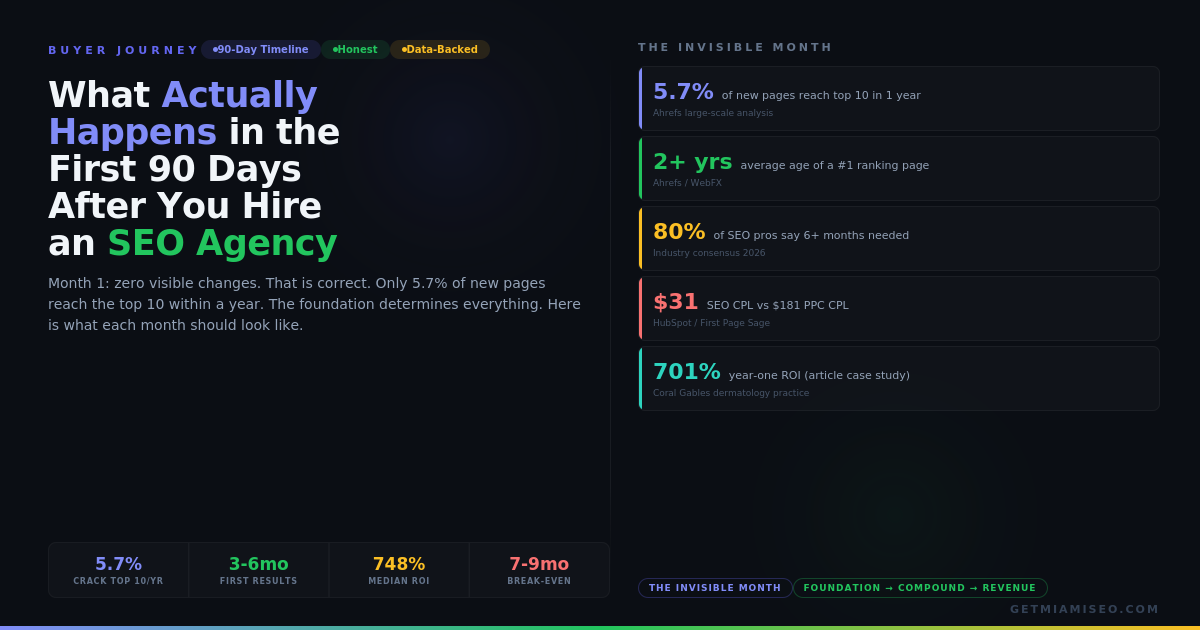
In March 2026, a dermatology practice in Coral Gables signed a $3,500-per-month SEO contract after comparing three agency proposals across six weeks. The practice had done its homework. It read the agency evaluation guide. It checked the pricing benchmarks. It verified that the selected agency provided a clear strategy document, not just a promise.
At the end of month one, the practice owner opened Google on her phone, typed "dermatologist Coral Gables," and found her website exactly where it had been before she signed the contract: page three, position 27. She checked the Map Pack. Same position. She checked Google Search Console. Traffic had not changed. She checked her phone logs. No increase in calls.
She called the agency on April 2. "What am I paying for?"
The question was fair. The agency had charged $3,500 for the first month. Nothing visible had changed. From the outside, month one of good SEO and month one of bad SEO look identical: nothing happens.
But the answer the agency gave her across a 45-minute call changed how she understood the investment. Month one was not empty. It was full. It was the most important month of the entire campaign. And the work done in those 30 days would determine whether months three, six, and twelve produced results or silence.
This article is the answer to that call. It covers what actually happens in months one, two, and three of a properly executed SEO campaign, what you should see, what you should not see, what red flags mean your agency is failing, and how to measure whether the investment is working before the revenue arrives.
Month One: The Foundation Nobody Sees
The first month of competent SEO produces zero visible changes to the business owner. No rankings move. No calls increase. The website looks the same to every customer who visits it. From the outside, nothing happened.
From the inside, everything happened.
Technical audit and crawl fix. The agency audits the website for every issue that prevents Google from properly crawling, indexing, and understanding the site. Broken links, duplicate content, missing meta tags, crawl errors, slow page speed, mobile usability issues, missing XML sitemap, robots.txt misconfiguration. These are invisible to customers but visible to Google, and each one suppresses ranking potential. Fixing them costs the first 40-60% of month-one time.
Schema markup implementation. LocalBusiness, FAQPage, Service, and Organization schema tell Google what the business is, what it does, where it is, and how it relates to other entities. This is not decorative. It is an entity declaration that determines whether Google's AI systems can recognize the business as a distinct entity worth recommending.
Google Business Profile optimization. Category correction, service descriptions, photo uploads, Q&A population, booking link activation. GBP signals account for 32% of Map Pack ranking. This work can show results faster than any other SEO activity, sometimes within 2-4 weeks, but the impact is measured in Map Pack visibility and call volume, not organic website ranking.
Keyword research and content mapping. The agency identifies which queries to target, in which order, with which pages. This includes analyzing competitors, mapping search intent, identifying bilingual keyword opportunities (in Miami, Spanish keywords carry 75-85% lower difficulty), and planning the content calendar against the seasonal demand map.
NAP audit and citation cleanup. Verifying that the business name, address, and phone number match exactly across every directory, platform, and listing. Inconsistencies confuse Google's entity matching and suppress local rankings.
None of this work changes where the website appears on Google today. All of it determines where the website appears on Google in three to six months.
This is the Invisible Month. It is the hardest month for business owners because the invoice is real and the progress is invisible. But the Invisible Month is also the most valuable month because every ranking improvement that follows is built on the foundation laid here. An agency that skips this work and jumps straight to content production is building on sand.
Month Two: The First Signals Show Up in Search Console
Month two is where the work becomes measurable, but only to someone who knows where to look. The business owner checking her Google ranking for her primary keyword will still see minimal change. The person checking Google Search Console will see the first signs of movement.
Impressions climb. Google Search Console shows how many times your pages appeared in search results, even if no one clicked. In month two of a well-executed campaign, impressions should be climbing because Google is indexing new and updated pages, recognizing schema markup, and beginning to test the site's relevance for more queries. Rising impressions without rising clicks is normal and expected at this stage. It means Google is noticing but not yet ranking.
New pages indexed. The first content pieces published in late month one or early month two should appear in Google's index. Check the "Pages" report in Search Console. If new pages are not being indexed within 1-2 weeks of publication, there is a technical issue the agency should address immediately.
First link building signals. If the agency is running a link building strategy, the first outreach results should begin arriving: chamber of commerce listings, directory submissions, initial media outreach responses. Each link takes 2-8 weeks to impact rankings, so links acquired in month two show their effect in months three and four.
GBP improvements may already be visible. Because GBP optimization can produce faster results than organic website SEO, Map Pack visibility and call volume may show early improvement. GBP listings with 100+ photos receive 520% more calls. If the agency uploaded 50+ photos in month one, the GBP may already be generating more visibility and calls.
Review generation begins. A systematic review generation strategy should be active by month two. Each new review strengthens both Map Pack ranking and the trust signal that influences conversion.
What you should NOT see in month two: dramatic ranking improvements for competitive keywords, significant traffic increases, or a flood of new leads. If your agency is promising these in month two, either your site had zero prior optimization (meaning the low-hanging fruit is genuine) or the claims are not grounded in the data.
Month Three: The Inflection Where Patience Meets Data
Month three is where the trajectory of the campaign becomes visible. For most local businesses targeting neighborhood-specific and long-tail keywords, this is when the first ranking movements appear for lower-competition terms.
First page-one rankings for long-tail queries. A Hialeah dentist targeting "dentista en Hialeah" (low competition, high local intent) may see page-one rankings by month three. A Coral Gables law firm targeting "personal injury lawyer Miami" (high competition) will not. The timeline depends on keyword difficulty, and a competent agency targets the winnable keywords first to build momentum.
Search Console clicks begin. As rankings improve for long-tail queries, the first organic clicks arrive. These are not yet a flood. They are the first trickle that proves the foundation is working. Track these clicks by landing page to understand which content is performing and which needs adjustment.
First organic leads. For local service businesses with high-intent queries ("emergency plumber near me," "CPA near me"), the first organic leads may arrive in month three. For businesses with longer decision cycles (hotels, construction, real estate), leads may not arrive until months four through six.
Spanish-language rankings may arrive first. In Miami, Spanish keywords rank faster because competition is 75-85% lower. A bilingual campaign often sees its first rankings in Spanish before English. This is not a sign that the English strategy is failing. It is a sign that the bilingual strategy is working as designed: capture the low-competition market first, then compound into the competitive one.
The conversation changes. At the end of month three, the agency should be able to show: which keywords have moved, which pages are indexing, how impressions and clicks are trending, and what the content plan is for months four through six. If the agency cannot show any of this data, the campaign has a problem.
What You Should Receive From Your Agency Each Month
Every month, your agency should deliver a report that answers the question the Coral Gables dermatologist asked: "What am I paying for?" The report should include:
Work completed. Technical fixes, content published, links acquired, GBP updates, schema implementations. This is the activity log that shows what was done.
Performance data. Keyword ranking changes, Search Console impressions and clicks, GBP insights (calls, direction requests, profile views), and organic traffic from Google Analytics. This is the evidence that the activity is producing results.
Business metrics. How many organic leads were generated (calls, form submissions, bookings from organic search). What is the cost per organic lead this month. How does it compare to paid channels. This is the dashboard that tells you whether the investment is producing money, not just activity.
Next month's plan. What content will be published, which keywords will be targeted, what link building is planned, and what the expected outcomes are.
If your agency delivers only rankings and traffic charts without lead counts and cost-per-lead comparisons, they are measuring their own performance, not your business performance. The SEO ROI framework covers how to bridge this gap.
The Red Flags That Mean Your Agency Is Actually Failing
Not all slow starts are normal. Some are signs that the campaign is off track.
No technical audit or strategy document delivered in month one. If the agency went straight to content production without auditing the site, they are building on an unexamined foundation. This almost always leads to wasted effort.
No content published by the end of month two. If two months of payments have produced zero published pages, the campaign is either understaffed or poorly managed. Content is the fuel that rankings are built on.
No Search Console access shared with you. If you cannot see your own Search Console data, you cannot verify any claims the agency makes. Transparency is non-negotiable.
Ranking improvements only for branded terms. If the agency reports that you now rank #1 for your own business name, that is not an achievement. Most businesses rank for their own name without SEO. The value is ranking for non-branded category queries.
Purchased links from foreign or irrelevant sites. This is the most dangerous shortcut in SEO. Cheap link packages from irrelevant sources can trigger Google penalties that cost months of recovery and thousands of dollars in cleanup.
No answer to "How many leads came from organic search?" If the agency cannot answer this question at any point in the engagement, the measurement infrastructure does not exist. Fix the tracking before evaluating the strategy.
Guarantees of specific rankings by specific dates. No legitimate agency guarantees a #1 ranking by a specific date because Google's algorithm is not within anyone's control. Guarantees are a red flag, not a selling point.
How Bilingual SEO Changes the Timeline in Miami
In Miami, the SEO timeline has a dimension that no national guide discusses: language.
35% of Miami searches happen in Spanish. Spanish keywords in Miami carry 75-85% lower difficulty than English equivalents. This means Spanish-language pages rank faster, often reaching page one within 30-90 days for Hialeah and Doral queries where competition is near zero.
A well-designed bilingual campaign delivers results in two waves. Wave one (months 2-3): Spanish-language pages begin ranking for low-competition queries, generating the first organic leads from the Hispanic market. Wave two (months 4-8): English-language pages begin ranking for higher-competition queries as the domain authority built by Spanish content and overall optimization compounds.
The business owner who sees Spanish rankings first and English rankings later is not seeing a broken campaign. They are seeing a correctly prioritized one. The low-competition wins build momentum, generate early ROI, and strengthen the domain authority that English pages need to compete in a crowded field.
The Metrics That Matter vs. The Metrics That Only Sound Good
Metrics that matter: organic leads per month (calls + forms + bookings from organic), cost per organic lead, Search Console clicks from non-branded queries, conversion rate from organic traffic, and revenue attributable to organic search.
Metrics that sound good but can mislead: total traffic (includes irrelevant visits), domain authority (a third-party estimate, not a Google metric), total backlinks (quality matters more than quantity), total impressions (can rise without producing leads), and keyword rankings for low-value terms.
The distinction is simple. Business metrics tell you whether the investment is producing money. Activity metrics tell you whether the agency is doing work. Both matter. But one pays the bills and the other fills a report.
When to Stay Patient and When to Fire Your Agency
Stay patient when: impressions are climbing even though clicks have not arrived yet, rankings are improving for long-tail terms even though head terms have not moved, the agency can explain what they are doing and why, the measurement infrastructure is in place and showing a positive trajectory, and it has been less than 6 months since the campaign started.
Start asking harder questions when: impressions are flat after 3 months, no content has been published in the last 60 days, the agency cannot show specific work completed each month, there is no tracking infrastructure for organic leads, or the monthly reports contain only traffic charts and ranking screenshots without lead data.
Consider replacing your agency when: it has been 9+ months with no measurable increase in organic leads over your pre-campaign baseline, the agency has been unable to articulate why results are delayed, you have requested ROI reporting and it has not been implemented, or the agency purchased links from low-quality sources that triggered ranking declines.
The 7-9 month break-even timeline (First Page Sage 2026 data) means patience is warranted for the first year. Beyond that, the data should speak for itself. A campaign that is working will show clear positive trends by month 9. One that is not will show flat or declining metrics.
The Counter-Argument: Why Some Campaigns Genuinely Take Longer
The honest counter-argument. Not every campaign fits the 90-day framework neatly. Several legitimate scenarios extend the timeline.
New websites with zero authority start from a position where Google has no historical data. John Mueller, Google's Search Advocate, has stated that new websites typically need 4 months to a year before seeing significant SEO results. This is not because Google is slow. It is because trust signals require time to accumulate.
Highly competitive industries like personal injury law, luxury real estate, and elective medical procedures may take 12-18 months to see page-one rankings for head terms because the competitors already holding those positions have years of authority, thousands of backlinks, and hundreds of reviews.
Businesses with prior SEO damage (toxic backlinks, Google penalties, duplicate content across multiple domains) need to spend the first 2-3 months on cleanup before forward progress can begin. The timeline starts after the foundation is clean, not before.
In each of these cases, the 90-day framework still applies as a leading-indicator check: impressions should be climbing, long-tail rankings should be appearing, and the trajectory should be positive. The timeline for competitive terms extends, but the direction of the data should still be upward.
Common Mistakes Business Owners Make During the First 90 Days
Checking rankings daily. Rankings fluctuate naturally. Checking daily creates anxiety that does not match the reality of how Google's algorithm works. Check weekly or monthly.
Comparing to paid ad timelines. Google Ads produces clicks immediately because you pay per click from day one. SEO compounds over months. Comparing them at 30 days is comparing a seed to a harvest.
Changing strategy before it has time to work. Switching keywords, changing agencies, or overhauling the website at month two destroys whatever foundation was being built. Give the original strategy at least 4-6 months before evaluating.
Not setting up conversion tracking before the campaign starts. Without GA4 conversion events for calls, forms, and bookings, there is no way to measure organic leads when they arrive. Set this up before month one ends.
Expecting every keyword to rank simultaneously. A proper campaign targets lower-competition keywords first and builds toward harder terms over time. Ranking #1 for "personal injury lawyer Miami" in month three is not a reasonable expectation. Ranking #3 for "personal injury lawyer Coral Gables" by month six might be.
Canceling at month three because "nothing happened." The median SEO campaign breaks even at 7-9 months (First Page Sage). Canceling at month three means paying for the foundation and walking away before the building goes up.
The 90-Day Measurement Framework
Month 1: Did the foundation get built? Checklist: technical audit completed, schema markup implemented, GBP optimized, keyword research delivered, content calendar planned, GA4 conversion tracking set up, baseline metrics recorded. If all items are checked, the month was productive regardless of what Google shows.
Month 2: Are the leading indicators moving? Checklist: Search Console impressions climbing, new pages indexed, first content pieces live, link outreach started, review generation active. If impressions are rising and content is publishing, the campaign is on track.
Month 3: Is there a trajectory? Checklist: at least some keyword ranking improvements visible, Search Console clicks beginning, first organic leads arriving for lower-competition terms, GBP generating increased visibility. If the trajectory is upward, stay the course. If all indicators are flat, the strategy needs examination.
FAQs: The First 90 Days of SEO
What percentage of new pages reach page one within a year? Only 5.7% (Ahrefs). The average page ranking in position 1 is over 2 years old. This is why SEO is a compound investment, not an immediate one.
Can local SEO be faster than national SEO? Yes. Local SEO for Miami businesses often shows results in 2-4 months because local queries have lower competition and Google Business Profile optimization produces faster visibility gains than organic website ranking.
What does "measurable results" mean at 3 months? Ranking improvements for some keywords, Search Console impression and click growth, and potentially the first organic leads for lower-competition terms. It does not mean page-one rankings for your highest-competition keyword.
Should I run ads during the first 90 days? Yes. Google Ads captures immediate demand while SEO builds. Reduce ad spend as organic rankings stabilize, typically after months 6-9.
How do AI Overviews affect the timeline? AI Overviews add a new visibility layer. Content optimized with schema, FAQ structures, and direct-answer paragraphs can appear in AI Overviews before it ranks #1 organically. This can accelerate visible results for some query types.
What if my agency does not provide the reports listed above? Ask for them. If the agency cannot or will not report business metrics (organic leads, CPL), the ROI measurement infrastructure needs to be built. This is a fixable problem, not necessarily a reason to switch agencies.
How do I know if my agency is doing good work? Good agencies in month one: deliver an audit, implement schema, optimize GBP, and share a keyword strategy. Good agencies in month two: publish content, show Search Console data, and begin link outreach. Good agencies in month three: show keyword movement, early lead signals, and a plan for months four through six. The evaluation guide covers what to look for.
What is the ROI of waiting 90 days? The median SEO ROI is 748% (First Page Sage 2026). SEO generates leads at $31 per lead vs $181 for PPC. The first 90 days are the investment period. The return begins in months 4-9 and compounds from there. Canceling at day 90 is the equivalent of planting a crop and leaving before the harvest.
Position 27 to Position 3: What Happened After the Call
The Coral Gables dermatologist did not cancel after month one. She stayed after the 45-minute call because the agency walked her through the audit findings, the schema implementation, the GBP optimization, the keyword map, and the content calendar. The agency also set up GA4 conversion tracking and call tracking during month one, which meant that by month three, the practice could see exactly how many calls came from organic search.
By month three, the practice's primary keyword had moved from position 27 to position 14. Not page one. Not yet. But the trajectory was clear and measurable. By month six, it reached position 7. By month nine, position 3. The practice was generating 31 organic leads per month at a cost per lead of $113, compared to $290 from Google Ads. The organic channel was 2.5 times more efficient.
The ROI calculation at month 12: the practice had invested $42,000 in SEO over the year. It had acquired 187 new patients through organic search at an average first-year value of $1,800 per patient. Year-one organic revenue: $336,600. Year-one ROI: 701%.
Month one looked like nothing. Month twelve looked like the best marketing decision the practice had ever made. The difference between the two was not luck. It was patience informed by data.
Every business that hires an SEO agency will face the Invisible Month. The question is whether you understand what that month is building, whether you have the measurement infrastructure to track progress as it emerges, and whether you have the patience to let a compound investment do what compound investments do: grow slowly until they grow fast.
Talk to GetMiamiSEO about what the first 90 days should look like for your business ->