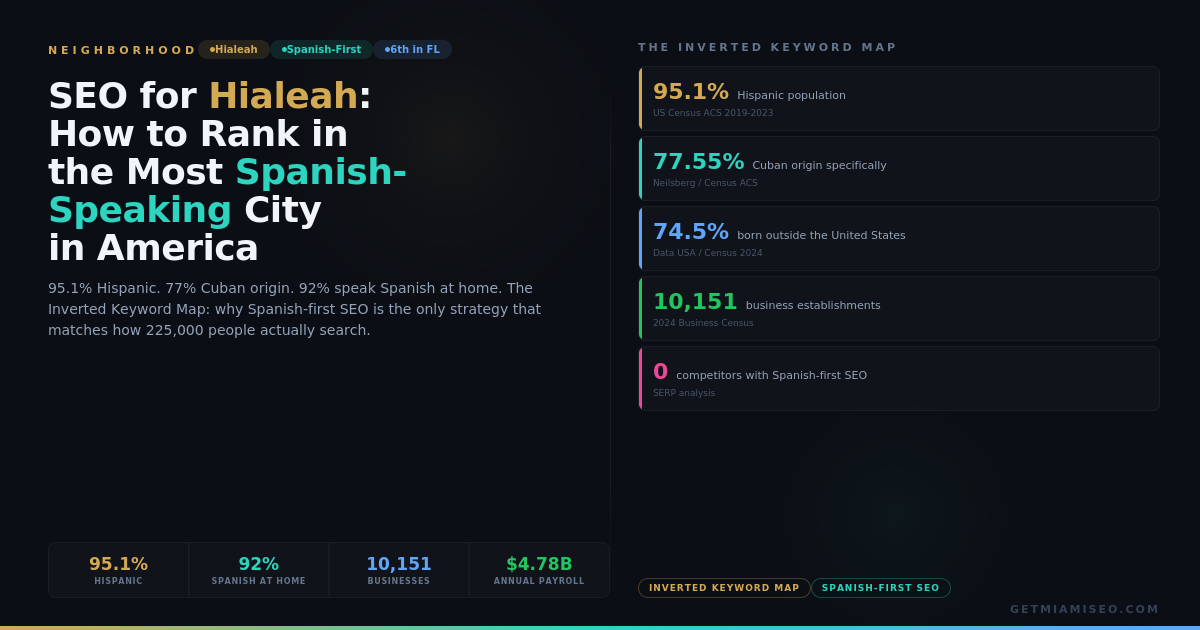
On April 1, 2020, the US Census Bureau published population data that would surprise almost everyone outside South Florida. Hialeah, Florida, reported 222,418 residents, of whom 95.1% identified as Hispanic or Latino. 77.55% were of Cuban origin specifically. Over 92% spoke Spanish at home. 74.5% were born outside the United States, primarily in Latin America.
No other city in the United States with a population above 100,000 came close to those numbers. Hialeah is not just a Hispanic-majority city. It is the most Hispanic city in America by a wide margin.
For the thousands of small businesses lining Palm Avenue and West 49th Street, the Census did not report surprising news. It reported a customer base that had always searched, called, and bought in Spanish first. The mechanic on East 4th Avenue whose phone rings in Spanish all day long. The pediatric dentist on West 49th whose intake forms are in Spanish by default. The insurance agent on Palm Avenue whose website has an English translation button that almost nobody clicks.
And yet when those same businesses hired SEO agencies, nearly every one received a strategy built for English keywords first. "Plumber Hialeah" as the primary target. "Dentist Hialeah" as the main page title. "Insurance agent Hialeah" as the homepage H1. The agencies were applying the same strategy they would use in Fort Lauderdale or Orlando or Jacksonville, cities where English is the dominant search language. In Hialeah, that strategy is optimizing against the search behavior of 95 out of every 100 potential customers.
This article maps the alternative: how search actually works in the most Spanish-speaking city in America, what the Inverted Keyword Map means for every business category, and what Hialeah businesses should build to match the language their customers already search in.
Hialeah by the Numbers: Population, Businesses, and Daily Search Volume
Hialeah is not a neighborhood. It is an incorporated city, the 6th largest in Florida, with its own government, police force, fire department, and economic infrastructure. Understanding its scale matters because the search opportunity is proportional to the population.
The city's 10,151 business establishments employ approximately 95,845 people and generate an annual payroll of $4.78 billion (2024 Business Census). The median household income is $55,594, lower than the Miami-Dade average of approximately $60,000, which means the Hialeah consumer is price-sensitive and searches for value, deals, and cost comparisons more aggressively than wealthier neighborhoods like Coral Gables or Brickell.
The demographic profile shapes search behavior in ways that no generic SEO guide accounts for. 74.5% of residents were born outside the United States, primarily in Cuba and other Latin American countries. This means a large share of the population learned to search the internet in Spanish and continues to do so regardless of their English proficiency. A bilingual Hialeah resident who speaks both English and Spanish at work may still default to Spanish when searching on their phone at home. Google knows this and adjusts results accordingly.
The city spans five ZIP codes (33010, 33012, 33013, 33016, 33018) and borders Hialeah Gardens (22,286 population), Miami Lakes (31,238), Miami Springs (13,325), and Medley. The population density is 12,233 people per square mile, among the highest in Florida. This means foot traffic, walk-in customers, and "near me" searches all concentrate within a dense geographic area where ranking in the Local Pack captures customers who are physically minutes away from your door.
The Inverted Keyword Map: Why Spanish Comes First Here
In every other Miami neighborhood covered in the GetMiamiSEO library, the keyword strategy follows the same pattern: English keywords are the primary targets because they carry the highest search volume. Spanish keywords are the secondary opportunity because they carry lower volume but also lower competition. The recommendation is always: build your English pages first, then add Spanish.
In Hialeah, this pattern inverts.
When a Hialeah resident needs a dentist, the search is more likely to be "dentista en Hialeah" or "dentista cerca de mi" than "dentist Hialeah" or "dentist near me." When a car breaks down, the search is "mecanico Hialeah" before "mechanic Hialeah." When someone needs a lawyer, "abogado Hialeah" before "lawyer Hialeah." When a homeowner needs plumbing, "plomero Hialeah" before "plumber Hialeah."
This is not a hypothesis. It is the mathematical outcome of a city where 92% of the population speaks Spanish at home and 74.5% were born in Latin America. Google Trends data consistently shows that Spanish-language service queries match or exceed English equivalents in Hialeah's ZIP codes for most local service categories.
The strategic implication: a Hialeah business should build its Spanish-language service pages first. "Dentista en Hialeah" should be the primary page. "Dentist in Hialeah" should be the secondary page. The Google Business Profile description should be written in Spanish first. The FAQ content should answer questions in Spanish first. The reviews should be solicited in Spanish first.
This does not mean abandoning English. English still matters because Google Maps sometimes serves English results to bilingual searchers, because some Hialeah searches are conducted in English by younger bilingual residents, and because tourists and visitors from other parts of Miami search in English when looking for Hialeah businesses. But the priority is reversed. Spanish first, English second. Build the Spanish foundation, then layer English on top.
75-85% lower keyword difficulty on Spanish terms is the library-wide data point. In Hialeah specifically, the gap is even wider because Spanish is the primary language, meaning more businesses serve Spanish-speaking customers but fewer have built Spanish-language websites. The supply of Spanish-language SEO content in Hialeah is dramatically lower than the demand for it. Every Spanish-language page a Hialeah business builds today occupies territory that most competitors have not even begun to claim.
Palm Avenue and West 49th Street: Where Hialeah Businesses Actually Compete
Hialeah's commercial geography is structured around corridors, not neighborhoods in the way Wynwood or Miami Beach are. Understanding these corridors is important for content strategy because the search queries that drive business to each corridor are different.
Palm Avenue runs from the Palmetto Expressway east through the commercial heart of the city. It is Hialeah's primary commercial corridor, home to auto dealerships, medical offices, dental practices, restaurants, quinceañera supply shops, and retail of every kind. A business on Palm Avenue competes for queries like "dentista Palm Avenue Hialeah" and "restaurante cubano Palm Avenue." These hyper-local queries have very low competition but very high intent because the searcher already knows the street.
West 49th Street is the second major commercial artery, running east-west through the city's northern section. It connects to Hialeah Gardens and Miami Lakes, which means businesses on this corridor can capture cross-boundary search traffic. A medical office on West 49th near the Hialeah Gardens border appears in "near me" searches from both cities.
The Leah Arts District is an emerging cultural and dining corridor centered around East 1st Avenue and Hialeah Drive. This is where new restaurants, galleries, and creative businesses are opening, attracting visitors from outside Hialeah. For these businesses, the SEO strategy is different from the rest of the city: they need to rank for both the Hialeah audience (Spanish-first) and the visiting audience from Greater Miami (often English-first).
East 4th Avenue and East 9th Street serve as neighborhood-level commercial streets with a mix of small retail, beauty salons, barber shops, and food vendors. These streets are served by walk-in traffic and "near me" mobile searches within a very tight radius.
For each corridor, the content strategy should include a dedicated landing page mentioning the corridor by name. "Dentista en Palm Avenue, Hialeah" is a page that no competitor has built but that matches a real search pattern. The same is true for "mecanico West 49th Street Hialeah" and "restaurante en Leah Arts District." These hyper-local pages cost almost nothing to build and face virtually zero competition.
Google Business Profile in a 96% Hispanic Market
GBP signals account for 32% of Map Pack ranking factors (Whitespark 2026). In Hialeah, the GBP is even more important than in other Miami neighborhoods because the Local Pack is the primary discovery channel for a population that searches on mobile, searches in Spanish, and makes decisions based on proximity and reviews rather than website browsing.
The specific adjustments for Hialeah GBP optimization:
Business description in Spanish first. Write the full 750-character description in Spanish. Most Hialeah competitors have English-only descriptions. A Spanish description surfaces for the 92% of the population searching in Spanish and immediately signals "this business speaks my language."
Service descriptions in Spanish. Every service listed on your GBP should have a Spanish-language description. "Limpieza dental profesional" not just "Professional dental cleaning." "Reparacion de aire acondicionado" not just "AC repair." These descriptions are indexed by Google and matched to Spanish search queries.
Q&A section in Spanish. Populate the Q&A section with common customer questions and answers in Spanish. "Cuanto cuesta una limpieza dental?" "Aceptan seguro de salud?" "Cual es el horario de atencion?" These Q&A entries function as mini FAQ pages that Google indexes and serves to Spanish-language searchers.
Photos with Spanish context. Google cannot read text in photos directly, but the alt text and captions you add should be in Spanish for Hialeah-serving businesses. A photo captioned "Sala de espera en nuestra clinica dental en Hialeah" gives Google Spanish-language context for the image.
Review solicitation in Spanish. Ask every satisfied customer to leave a Google Review in their preferred language. In Hialeah, that language will be Spanish for the vast majority. Each Spanish review mentioning a specific service builds a ranking signal for that service in Spanish search.
Reviews in Hialeah: Language, Volume, and What Google and AI Extract
Google's algorithm extracts keywords from reviews and uses them to match business profiles to relevant queries. This extraction works in every language Google supports, including Spanish. A review that says "Excelente dentista, me hizo una limpieza profunda y la doctora Maria fue muy atenta" gives Google four indexable signals in Spanish: the service (dentista), the treatment (limpieza profunda), the provider (doctora Maria), and a quality assessment (excelente, muy atenta).
In Hialeah, where 92% of the population speaks Spanish at home, the review pipeline is naturally bilingual, leaning heavily Spanish. This is an advantage, not a limitation. Spanish-language reviews build ranking signals for Spanish search queries that are the primary demand in this market. A Hialeah dental practice with 100 Spanish-language reviews mentioning specific treatments will outperform a competitor with 200 English-only reviews for every Spanish dental search query.
The strategy: after every appointment or service, ask in Spanish: "Le agradeceria si pudiera dejarnos una resena en Google mencionando el servicio que recibio." (We would appreciate a Google review mentioning the service you received.) This natural request generates specific, service-mentioning reviews in the language that drives Hialeah search traffic.
For AI search, Spanish-language reviews function as citation signals. When someone asks ChatGPT in Spanish "Cual es el mejor dentista en Hialeah?", the AI prioritizes businesses with abundant Spanish-language reviews and Spanish content. A business with English-only reviews is less likely to appear in a Spanish AI response because the entity signals in Spanish are thinner.
How Hialeah Search Connects to Greater Miami-Dade
Hialeah does not exist in a search vacuum. The city shares borders and overlapping search demand with several adjacent municipalities, and understanding these connections expands the total addressable search market for any Hialeah business.
Hialeah Gardens (population 22,286, 89% Hispanic) sits directly west of Hialeah. Many residents use Hialeah businesses for medical, dental, and commercial services. A business in western Hialeah near the city line appears in "near me" searches from both cities. Content that mentions "Hialeah y Hialeah Gardens" in its service area captures both audiences.
Miami Lakes (population 31,238) borders Hialeah to the northwest. Miami Lakes has a higher median income ($73,000 vs $55,594) and a mixed English-Spanish search profile. A Hialeah business targeting Miami Lakes customers should build pages in both languages for this adjacent market.
Miami Springs (population 13,325) sits directly south of Hialeah near Miami International Airport. The proximity to the airport drives some commercial and logistics search traffic. Medical and dental offices on Hialeah's southern boundary capture Miami Springs residents searching for nearby providers.
Doral (population 79,359, 85% Hispanic) is accessible from western Hialeah. Doral's Hispanic population is more pan-Latin American (Colombian, Venezuelan, Brazilian) compared to Hialeah's predominantly Cuban population. The search language is similar (Spanish-first), but the cultural references and business categories differ.
For SEO, this geographic context means a Hialeah business can build service pages mentioning adjacent cities without needing physical locations there. A page titled "Dentista para Residentes de Hialeah, Hialeah Gardens y Miami Lakes" targets three populations from a single location.
Content Strategy for a Market That Reads in Spanish First
The content strategy for a Hialeah business should follow the Inverted Keyword Map: build Spanish content first, layer English content second.
Service pages. Each service should have its own page in Spanish with a clear, keyword-rich title. "Ortodoncia en Hialeah" not "Our Orthodontics Services." "Reparacion de Aire Acondicionado en Hialeah" not "AC Repair." The opening paragraph should answer the primary question a searcher would have in 40-60 words, optimized for featured snippet extraction.
FAQ content in Spanish. Build FAQ pages answering the questions customers actually ask on the phone and in consultations. In Hialeah, these questions are asked in Spanish: "Cuanto cuesta una corona dental?", "Aceptan pagos en efectivo?", "Necesito cita previa?", "Tienen estacionamiento?" Each FAQ pair should be marked up with FAQPage schema for AI citation eligibility.
Blog content. If your business publishes blog content, the Hialeah-specific articles should be in Spanish. "5 Senales de que Necesitas un Plomero de Emergencia" (5 Signs You Need an Emergency Plumber). "Como Elegir el Mejor Mecanico en Hialeah" (How to Choose the Best Mechanic in Hialeah). These articles target Spanish long-tail queries that no competitor in Hialeah has built content for.
Pricing content. Hialeah's median household income of $55,594 means price-sensitivity is higher than in wealthier Miami neighborhoods. Pages answering "cuanto cuesta" (how much does it cost) queries perform exceptionally well. "Cuanto cuesta un tratamiento de conducto en Hialeah?" is a real question people type into Google. A page answering it with a genuine price range, in Spanish, with your business's contact information, is the highest-converting content type in this market.
The AI Search Layer in Spanish
AI Overviews appear on approximately 7% of local navigational queries but trigger more frequently on comparison and recommendation queries. In Hialeah, the Spanish-language AI landscape is significantly less developed than the English-language one. This means:
Fewer businesses have built the structured Spanish content that AI systems need to generate Spanish-language recommendations. The competition for Spanish AI citations in Hialeah is almost nonexistent. A business that builds Spanish FAQ content, Spanish schema markup with inLanguage properties, and solicits Spanish reviews is positioned to dominate Spanish-language AI responses for its category in Hialeah before any competitor catches up.
The entity-based search dimension compounds this. Google's Knowledge Graph recognizes entities through signals in specific languages. A Hialeah business with Spanish-language schema, Spanish GBP content, Spanish reviews, and mentions in Spanish-language publications (Diario las Americas, El Nuevo Herald, MiamiDiario) builds entity authority specifically in the Spanish-language Knowledge Graph. This is the bilingual entity gap that most SEO agencies do not account for.
The Counter-Argument: Why English Still Matters in Hialeah
The honest counter-argument. Spanish-first does not mean Spanish-only. English still matters in Hialeah for several reasons that a responsible SEO strategy must account for.
First, Google Maps results sometimes default to English for bilingual users whose phone language is set to English, even when the user is a Spanish-dominant speaker. This means English GBP content is still served to some Hialeah searchers. Second, younger Hialeah residents (18-35) are more likely to search in English or code-switch between languages. Third, some service categories in Hialeah have meaningful English search volume from residents of adjacent non-Hispanic areas who cross into Hialeah for specific businesses (auto dealerships on Palm Avenue draw buyers from across Miami-Dade).
The resolution: build Spanish content first, but build English content second. Every Spanish page should have an English equivalent. The Spanish version should be the canonical priority. The English version should exist for the minority of searches that happen in English. Both should have proper hreflang tags so Google serves the correct language version to each user.
For businesses in the Leah Arts District that specifically target visitors from outside Hialeah, the balance may shift closer to 50/50 or even English-first because the visiting audience is more likely English-speaking. But for the typical Hialeah business serving Hialeah residents (the majority of the 10,151 businesses in the city), Spanish-first is the correct strategic default.
Common Mistakes Hialeah Businesses Make With SEO
Applying an English-first SEO strategy from an agency that does not understand Hialeah. The most expensive mistake. English-first SEO works in Fort Lauderdale and Orlando. It works against you in Hialeah.
Using Google Translate for Spanish content instead of native Spanish. Machine-translated content reads awkwardly, misses regional idioms, and fails to match how Hialeah's Cuban-American population actually speaks and searches. "Limpieza dental" is the search term. "Dental cleansing" translated literally back to "limpieza dental" might become something awkward in machine translation. Native speakers write content that matches search patterns.
Not having a website at all. A significant percentage of Hialeah small businesses operate without a website, relying entirely on word-of-mouth and GBP. In a market where competitors also lack websites, having even a basic 5-page site in Spanish with proper schema puts a business ahead of most of the field.
English-only Google Business Profile. The GBP description, services, and Q&A should all be in Spanish for Hialeah businesses serving Hialeah customers. An English-only GBP is invisible to every Spanish search query.
Ignoring adjacent cities. Hialeah businesses that do not mention Hialeah Gardens, Miami Lakes, or Miami Springs in their service area pages are leaving cross-boundary traffic uncaptured.
Not building link signals from Spanish-language publications. El Nuevo Herald, Diario las Americas, and MiamiDiario are authoritative Spanish-language sources that most Hialeah businesses have never pitched for coverage. These publications build link authority and entity recognition in the Spanish search ecosystem.
What Hialeah Business Owners Should Do This Month
Week 1. Audit your Google Business Profile. Is the description in Spanish? Are service descriptions in Spanish? Is the Q&A section populated in Spanish? If any of these are English-only, rewrite them in Spanish first. This is the single highest-impact action for a Hialeah business.
Week 2. Build or rewrite your top 3 service pages in Spanish. Use the inverted keyword priority: "Dentista en Hialeah" as the H1, not "Dentist in Hialeah." Include pricing information if possible ("cuanto cuesta" queries convert well in this market). Add schema markup in Spanish with inLanguage: "es".
Week 3. Start your Spanish review campaign. After every satisfied customer interaction, ask in Spanish for a Google Review mentioning the specific service. Provide a direct link to your Google Review page. Respond to every review in the language the customer wrote it in.
Week 4. Build one page targeting an adjacent city. "Servicios de [your category] para Residentes de Hialeah Gardens y Miami Lakes." This single page expands your geographic footprint to capture cross-boundary searches that most competitors ignore.
FAQs: SEO for Hialeah Businesses
How long does SEO take in Hialeah? Spanish-language keywords in Hialeah can rank in 30-60 days because competition is extremely low. English keywords take longer because they compete against businesses from across Miami-Dade. GBP improvements show within 2-4 weeks. The cost and timeline guide covers full expectations.
Do I need a website if I already have a Google Business Profile? A GBP alone limits your ranking potential. A website with Spanish-language service pages, schema markup, and FAQ content gives Google the structured information it needs to rank you for dozens of queries that a GBP alone cannot target.
Can I rank for searches in both Hialeah and Greater Miami? Yes. Build Hialeah-specific pages for local demand and broader Miami pages for wider reach. A bilingual SEO strategy covering both Spanish and English captures both markets simultaneously.
How much does SEO cost for a Hialeah business? SEO costs in Miami typically range from $2,000 to $6,000 per month depending on competition and scope. For Hialeah businesses where Spanish keyword competition is lower, the timeline to results is shorter, which means the cost-per-result is often lower than in English-dominated markets.
Should I hire a bilingual SEO agency? In Hialeah, yes. An agency that cannot write native Spanish content, understand Cuban-American search patterns, and optimize for Spanish keywords is applying the wrong playbook. The agency selection guide covers what to look for.
What about social media marketing vs SEO? Social media drives brand awareness. SEO drives search traffic from people actively looking for a service. In Hialeah, Facebook and Instagram are used heavily in Spanish. But when a resident needs a plumber at 10 PM, they search Google, not Facebook. SEO captures that high-intent moment. SEO vs paid advertising covers the comparison.
How do events in Miami affect Hialeah search demand? Hialeah itself does not host major tourism events like Art Basel or F1. But the Miami SEO calendar affects Hialeah indirectly: during major events, some Miami visitors seeking affordable dining or services search outward from event venues and discover Hialeah businesses. The Calle Ocho Festival (March) in Little Havana drives adjacent interest in Cuban culture that extends to Hialeah.
Can AI search help my Hialeah business? Yes, and earlier than your competitors. Spanish AI search coverage is less developed than English. A Hialeah business that builds Spanish FAQ content and schema markup today captures AI citations in a landscape with almost zero competition.
The City That Always Searched in Spanish
The Census data from 2020 confirmed what every Hialeah business owner already knew. Their customers speak Spanish. Their customers search in Spanish. Their customers read reviews in Spanish. Their customers ask questions in Spanish. The phone rings in Spanish. The forms are filled out in Spanish. The conversations happen in Spanish.
The only thing that did not happen in Spanish, for most Hialeah businesses, was the SEO strategy.
The Inverted Keyword Map is not a theory. It is a description of how search actually works in a city where 95% of the population shares a language and 74.5% were born in a country where that language was the only way to find anything online. The businesses that will rank in Hialeah over the next several years are the ones that built their search presence in the language their customers actually use.
In Doral, Spanish is a strong secondary opportunity. In Miami Beach, it is a tourism niche. In Brickell, it is a bilingual complement. In Hialeah, Spanish is the primary language of commerce, search, and trust. The SEO strategy should reflect that.
The Census did not reveal a gap. It confirmed one. The question is how long Hialeah businesses will continue applying English-first strategies in a city that has never searched in English first.