In October 2025, a personal injury law firm in Coral Gables asked ChatGPT a question. "What are the top personal injury law firms in Coral Gables?" The AI produced a list of five firms. The questioner's own firm was not among them.
He checked Google. His firm ranked #3 organically for "personal injury lawyer Coral Gables." Strong reviews. Detailed service pages. A healthy backlink profile from local directories and one piece of earned coverage in the Daily Business Review. By every traditional SEO measure, the firm was winning. But to ChatGPT, the firm was essentially invisible.
He tried Gemini. Same five firms, none of them his. Perplexity returned a similar list. Google's own AI Overview for the query, when he forced it by adding "best" to his search, cited three of the five firms ChatGPT had named. His firm, the one ranking #3 in the blue links directly below the AI Overview, was not cited.
The traditional ranking position was not a lie. The AI invisibility was not a glitch. The firm existed in Google's index as a collection of web pages. But it did not yet exist in Google's Knowledge Graph as a recognized entity. And because every major AI system in 2026 relies heavily on entity graphs to generate recommendations, a business without entity recognition can rank well for keywords while being essentially invisible to the systems travelers, patients, and clients are increasingly using to make decisions.
This is the shift that matters more than any algorithm update, any AI Overview rollout, or any 2026 ranking factor report. Google stopped treating search queries as strings of keywords years ago. It now treats them as expressions of entities and the relationships between them. A business that is an entity in Google's understanding competes on an entirely different field than a business that is just a website ranking for words. And most Miami businesses, even the ones ranking well today, have not done the work to become entities.
The rest of this article explains what an entity actually is, how Google decides what is and is not one, why Miami's bilingual market creates a specific entity gap that no national SEO guide addresses, and what Miami businesses should build to cross the line from "ranking on Google" to "existing in the Knowledge Graph."
What an Entity Actually Is (And Why Keywords Are Secondary Now)
The word "entity" sounds abstract. The concept is not. An entity is any unique, identifiable thing that Google has decided is a distinct item worth tracking: a person, a business, a place, a product, a concept, an event. Albert Einstein is an entity. Miami is an entity. The Florida Panthers are an entity. Art Basel Miami Beach is an entity. Your dental practice on Miracle Mile may or may not be an entity depending on whether Google has built enough confidence in its existence and attributes to add it to the Knowledge Graph.
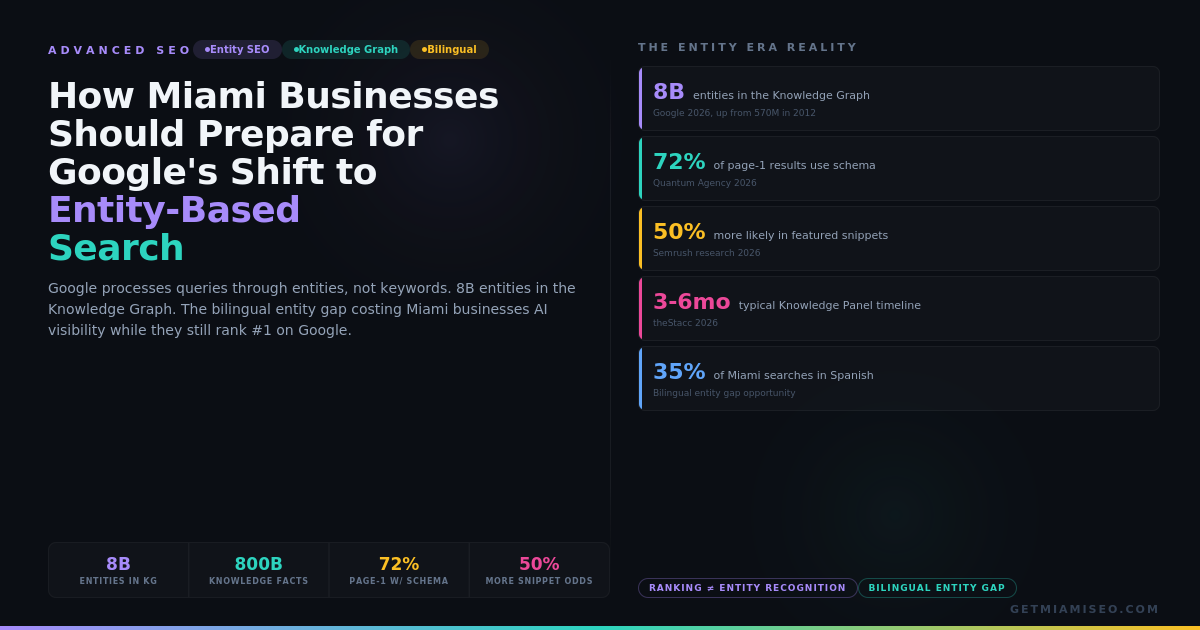
The Knowledge Graph is Google's database of entities and the facts about them. When it launched in 2012, it contained 570 million entities. As of 2026, it contains over 8 billion entities and 800 billion facts about them. Every time you search anything on Google, the query is first run through the Knowledge Graph to identify which entities the query relates to. Only then does Google begin ranking web pages.
This is the fundamental shift. In the keyword era, Google matched the words in your query to words on web pages and ranked the pages by relevance and authority. In the entity era, Google first figures out which entities your query is about. Then it ranks pages based on how well they cover those entities, how authoritatively they discuss them, and how clearly they establish relationships between related entities.
A page about "schema markup" that also discusses JSON-LD, Google Search Console, rich results, and the Knowledge Graph itself signals deeper entity coverage than a page that mentions "schema" in isolation. The first page demonstrates that its author understands the entity landscape around the topic. The second page demonstrates that a writer used a keyword.
For local businesses, the practical translation is this: a law firm is an entity, the city it serves is an entity, the legal specialty is an entity, and the connections between them determine whether Google recognizes the firm as a legitimate authority in that specialty for that city. Keywords still matter. But they sit on top of an entity layer that determines whether you are eligible to rank for those keywords in the first place.
The Three Questions Google Asks About Every Business
When Google processes a query like "personal injury lawyer Coral Gables" and tries to decide which businesses to surface, it asks three questions about each candidate.
Is this an entity we recognize? The Knowledge Graph maintains unique IDs for every entity it tracks. Businesses with Knowledge Panels, Wikidata entries, or consistent structured data across enough authoritative sources have passed this test. Businesses that exist only as a website, even a well-optimized website, may not have crossed this threshold yet. For the Coral Gables firm, the answer to this first question was borderline: Google had some signals but had not assigned the firm a clear entity status.
What type of entity is this? Google needs to classify the entity correctly. A personal injury law firm is specifically a LegalService entity, which inherits from Organization and LocalBusiness. A med spa is a MedicalBusiness, which is distinct from a Day Spa. A boutique hotel is an Accommodation, distinct from both Restaurant and Attraction. The more specific the classification, the more accurately Google can match the entity to queries about it. Schema markup is the primary way businesses declare their type explicitly.
How does this entity relate to other entities? Google wants to understand the relationships: Who founded this business? Which professional associations is it a member of? Which neighborhood does it serve? Which events has it sponsored? Which publications have covered it? Each relationship is a connection in the Knowledge Graph, and the density of those connections determines how confidently Google places the entity in context.
These three questions matter because every AI search engine asks similar questions when generating recommendations. ChatGPT, Gemini, and Perplexity all draw on structured entity understanding to produce their answers. A business that answers all three questions clearly is eligible for citation. A business that answers them ambiguously is eligible to be ignored in favor of one that does not.
How Google's Knowledge Graph Makes Entity Decisions
The Knowledge Graph is not populated by hand. It is populated through automated ingestion from sources Google treats as authoritative, weighted by each source's trust level. Understanding this hierarchy explains why some businesses become entities quickly while others take years.
Tier 1: Wikipedia and Wikidata. The most authoritative entity sources Google uses. If your business has a Wikipedia article or a Wikidata entry, Google treats the entity as verified with minimal additional signal required. Most local Miami businesses do not qualify for Wikipedia because they do not meet notability standards, but Wikidata is more permissive and many businesses can establish Wikidata entries.
Tier 2: Schema markup on your own website. When your website declares itself as an Organization or LocalBusiness entity using valid schema markup, Google treats this as a primary declaration. The @id property gives the entity a unique identifier. The sameAs property links your entity to your authoritative profiles elsewhere (LinkedIn, social media, Wikidata, professional directories). This is the single most controllable entity signal.
Tier 3: Google Business Profile. Your GBP is a structured entity declaration that Google trusts because it verifies the business exists at the claimed location. For local businesses, a complete Google Business Profile is the most important non-website entity signal available.
Tier 4: Authoritative publications and directories. Mentions in the Miami Herald, South Florida Business Journal, El Nuevo Herald, industry-specific directories (Avvo for lawyers, RealSelf for med spas, Healthgrades for medical) all contribute to entity confidence. The link building strategy that strengthens domain authority also builds entity recognition.
Tier 5: Consistent NAP data across the web. Citations with identical Name, Address, and Phone Number on hundreds of directories, even low-authority ones, contribute to entity confidence when consistent. Conflicting NAP data across platforms is one of the fastest ways to undermine entity recognition.
Tier 6: Social media profiles. LinkedIn company pages, Facebook business pages, verified X accounts, and professional profiles all contribute signals. They matter less than the higher tiers but cost nothing to maintain consistently.
The pattern is clear. Entity recognition is not a single action. It is the accumulation of consistent signals across multiple trusted sources, linked together through sameAs references and matching NAP data, resolving to a single coherent identity that Google can confidently track.
The Bilingual Entity Gap in Miami
This is the insight that makes entity-based SEO fundamentally different in Miami than in any other US market.
Google maintains overlapping but distinct entity understandings in different languages. Wikipedia has separate English and Spanish versions. Wikidata has multilingual labels, but the richness of information varies by language. News publications, trade directories, and community sites operate in one primary language. The entity signals that strengthen recognition in English search may contribute little to recognition in Spanish search.
For Miami businesses, this creates an asymmetric entity profile. A Coral Gables law firm with English-only schema markup, press coverage only in the Miami Herald and Daily Business Review, and a Wikidata entry only in English may be a strong entity in English search while being essentially unrecognized in Spanish search. When a Spanish-speaking user asks ChatGPT "¿Cuáles son los mejores abogados de lesiones personales en Coral Gables?", the firm is less likely to be cited because the AI's entity understanding in Spanish is thinner.
35% of Miami searches happen in Spanish. 1.9 million Spanish speakers live in Miami-Dade. Doral is 85% Hispanic. Hialeah is 96% Hispanic. A business optimizing for entity recognition in English only is optimizing for slightly more than half the market and missing the audience with the lowest competition because most competitors are also English-only.
The practical correction is to build entity signals in both languages simultaneously. Schema markup with multilingual inLanguage properties. Press mentions in El Nuevo Herald, Diario las Americas, and MiamiDiario alongside English coverage. A Wikidata entry with Spanish labels and descriptions. LinkedIn and Facebook pages with Spanish translations. Google Business Profile listings with Spanish service descriptions.
The opportunity window is real but limited. Spanish-language entity signals in Miami face less competition today than English signals because most businesses have not yet built them. This will not last. As more Miami businesses begin investing in entity recognition in both languages, the gap will close. The businesses that start now lock in entity authority before the field fills in.
The Citations and References That Build Entity Authority
Schema declarations are your side of the conversation. Entity authority is built when external authoritative sources corroborate what your schema says.
Wikipedia. The gold standard for entity verification. Most local Miami businesses will not qualify under Wikipedia's notability standards, which require substantial coverage in multiple independent reliable sources. But businesses that have received consistent media coverage over years, won industry awards, or founded notable movements may qualify. A Wikipedia article is the single strongest entity signal available.
Wikidata. More permissive than Wikipedia. Businesses with a notable history, documented founding, and verifiable information can often establish Wikidata entries. Wikidata entries feed directly into the Knowledge Graph and are a practical step for many mid-sized Miami businesses.
Local media. Miami Herald, Miami New Times, South Florida Business Journal, El Nuevo Herald, Daily Business Review, Miami Today. Coverage in these publications contributes to entity authority even when it does not include a link back to the business's website. The mention itself, if specific and accurate, strengthens Google's entity record.
Industry publications and directories. Avvo and Super Lawyers for attorneys. RealSelf for aesthetic practices. Healthgrades and Zocdoc for medical. AIA Florida for architects. These industry-specific sources contribute domain-specific entity authority that generic directories cannot match.
Professional associations. Chambers of commerce, Bar associations, medical associations, industry-specific guilds. Membership directories on these organizations' websites contribute both backlinks and entity signals.
Structured data ecosystems. LinkedIn company pages with verified industry classifications. Crunchbase entries for funded companies. Better Business Bureau profiles. Each is a consistent entity declaration that reinforces the others when NAP data matches exactly.
The common thread across all of these is consistency. An entity with 15 authoritative mentions that all agree on the business's name, address, phone, founding date, and services is a strong entity. An entity with 100 mentions that conflict on these basic facts is a confused one. Google prefers coherence over volume.
The Counter-Argument: When Entity Optimization Is Premature
The honest counter-argument. Entity-based SEO is not the first thing most Miami businesses should work on. For a business without basic on-page SEO, an incomplete Google Business Profile, or inconsistent NAP data across directories, jumping to advanced entity strategy is like installing a turbocharger on a car without an engine.
The sequence matters. First, get the fundamentals right: complete GBP, consistent NAP, basic LocalBusiness schema, clear service pages, quality content, reviews. Then build out the link and citation layer. Only after those foundations are solid does advanced entity work (Wikidata entries, multilingual schema, Person schema for principals, Service schema hierarchies) deliver meaningful returns.
For a brand-new business with zero digital presence, the path to entity recognition starts with the basics, not with advanced schema. For a business already ranking on page two of Google with a decent GBP and some reviews, entity work can be the differentiator that pushes them to page one and into AI citations. The honest answer to "should I work on entity SEO?" is "after you've done the first three things, yes."
Common Mistakes Miami Businesses Make With Entity SEO
Treating schema markup as a one-time implementation. Schema needs to match visible content. When services change, prices change, or staff change, the schema must update. Outdated schema signals inconsistency and weakens entity recognition.
Implementing schema but ignoring sameAs. The connections between your business and your authoritative profiles elsewhere are how Google builds confidence in your entity identity. Schema without sameAs links is a declaration that does not reference any corroborating source.
Building English-only entity signals in a bilingual market. 35% of Miami searches are in Spanish. A business investing in entity recognition only in English is building half the signal it could.
Inconsistent NAP data across platforms. A business name listed as "Miller Law Firm" on one directory and "Miller Law, P.A." on another confuses entity matching. Consistent naming, addresses, and phone numbers across every platform is the floor, not a bonus.
Assuming Wikidata is only for famous entities. Wikidata is more permissive than Wikipedia. Many established Miami businesses with documented history qualify for Wikidata entries that directly feed the Knowledge Graph.
Ignoring Person schema for business principals. For professional services (law, medical, financial advisory), the expertise of the principals is often the primary reason clients hire the firm. Person schema with credentials, publications, and affiliations establishes those principals as expert entities that strengthen the parent organization's authority.
Not monitoring entity status. The Knowledge Graph changes. Entities get added, merged, split, or deprecated. A business that implements schema and never checks whether a Knowledge Panel has appeared is not actually monitoring the outcome of the work.
How to Audit Your Business's Entity Status in 30 Minutes
Step 1: Search your business name on Google. Look for a Knowledge Panel on the right side of the desktop results. If one appears, your business is recognized as an entity. Note what information Google has, what it got wrong, and what is missing.
Step 2: Check for a Wikidata entry. Go to wikidata.org and search your business name. If an entry exists, review it for accuracy. If no entry exists and your business has substantial documented history, consider creating one (or having someone with Wikidata experience do it).
Step 3: Validate your schema markup. Use Google's Rich Results Test (search.google.com/test/rich-results) on your homepage, service pages, and contact page. Look for valid Organization, LocalBusiness, or appropriate subtype schema. Check whether @id and sameAs properties are present.
Step 4: Check NAP consistency. Search your business name in quotes on Google. Review the first 30 results for your name, address, and phone. Any inconsistency is a signal to correct immediately.
Step 5: Review your Google Business Profile completeness. Every empty field is a missing entity attribute. Categories, attributes, services, photos, Q&A, and description all contribute signals.
Step 6: Audit your sameAs links. List every authoritative profile your business has: LinkedIn, Facebook, industry directories, professional associations. Each one should be linked via sameAs in your Organization schema.
Step 7: Check bilingual coverage. If you serve a bilingual market, verify that your schema includes inLanguage properties where appropriate, that you have Spanish-language descriptions on your GBP, and that your presence in Spanish-language directories and publications matches your English presence.
What Miami Businesses Should Build to Become Recognizable Entities
Week 1: Foundation. Implement full Organization or LocalBusiness schema on your homepage with complete properties: name, legalName, url, logo, telephone, address, founding date, number of employees, areas served, contact points, and sameAs links to every authoritative profile you maintain.
Week 2: Service architecture. Add Service schema for every distinct service you offer. Each service as its own entity, connected to the parent Organization via provider relationships. This is especially important for professional services businesses where the specialty is the core of the offering.
Week 3: Person entities. Implement Person schema for the principals of your business. For professional services, this means the senior attorneys, physicians, directors, or owners. Include credentials, education, memberships, and publications. Link back to the Organization via worksFor.
Week 4: External reinforcement. Audit and correct your NAP across the top 30 directories where your business appears. Create or update LinkedIn, Facebook, and industry-specific profiles. Check Wikidata eligibility. If you serve a bilingual market, duplicate this work in Spanish through bilingual directories and publications.
Ongoing. Monitor your Knowledge Panel status monthly. Track whether your business appears in AI Overviews and in ChatGPT, Gemini, and Perplexity responses for your target queries. Adjust your entity signals based on what is being recognized and what is being missed.
FAQs: Entity-Based SEO in Miami
How long does it take to get a Google Knowledge Panel? Typically 3 to 6 months of consistent entity signals. This includes complete schema markup, NAP consistency, authoritative mentions, and connections to other recognized entities. Some businesses get panels faster with existing press coverage; others take longer if the signals are thin.
Does schema markup alone create a Knowledge Graph entry? No. Schema markup improves Google's ability to understand what you are claiming, but Google validates that claim against external sources. Entity recognition requires both structured declaration (schema) and authoritative corroboration (mentions, citations, consistent NAP across trusted sources).
Can I create my own Wikidata entry? Yes. Wikidata is collaboratively edited, and any authenticated user can create or edit entries. The quality standards are lower than Wikipedia's, but entries should include reliable sources and accurate information. Creating a Wikidata entry for your business, if the business has verifiable history, is one of the most direct ways to feed the Knowledge Graph.
How does entity SEO relate to AI Overviews? AI Overviews draw heavily on entity graphs to generate summaries. A business recognized as an entity is more likely to be cited inside an AI Overview than one that only ranks as a web page. The same pattern applies to ChatGPT, Gemini, and Perplexity citations.
Is entity SEO worth the effort for a small local business? For a new single-location business without basic SEO in place, no. For an established business that already has fundamentals working, yes. Entity signals compound over time and create durable competitive moats that are harder to replicate than keyword rankings.
How does this affect link building? Links from authoritative sources contribute to entity recognition because each link is a mention, a citation, and often a reinforcement of NAP data. The best entity-building backlinks come from publications, associations, and directories that are themselves trusted entities.
Do reviews affect entity authority? Yes, indirectly. High review volume and quality contribute to Google's confidence in the business as an operational, active entity. Reviews that mention specific services, locations, and staff by name also strengthen the entity's attribute signals.
How is this different from bilingual SEO? Bilingual SEO focuses on ranking for keywords in both languages. Entity SEO focuses on whether Google recognizes your business as an entity in both language contexts. These overlap significantly but are not the same. A business can rank for Spanish keywords without being recognized as a Spanish-language entity, which limits its visibility in Spanish AI responses.
The Gap Between Ranking and Existing
That Coral Gables law firm is still working on the entity gap today. The firm implemented full Organization and LegalService schema in November 2025. It added Person schema for each partner with credentials and publications. It coordinated with its PR firm to earn coverage in both the Daily Business Review and El Nuevo Herald. It created a Wikidata entry in February 2026 listing the firm's founding date, specialties, and key people. By April 2026, a Knowledge Panel appeared. The firm's AI visibility has improved but is not yet complete. The work continues.
What changed was not the firm's ranking. The firm still ranks #3 for its primary keyword. What changed was that the firm now exists in Google's understanding of the Coral Gables legal market as a distinct, recognized entity. Before the entity work, the firm was a website that ranked well. After the work, the firm is a business Google knows about.
This is the distinction that will separate Miami businesses over the next several years. Ranking on Google gets you found by the users who type queries matching your pages. Existing in the Knowledge Graph gets you cited by the AI systems that are increasingly answering queries without sending users to web pages at all. The first layer is necessary but no longer sufficient. The second layer is where the durable visibility of the next decade will be won.
Most Miami businesses have not started this work yet. The ones who start now enter a field with much less competition than the keyword battlefield they have been fighting on for years. The bilingual entity gap compounds that advantage for businesses willing to build in both languages.
The firm asked ChatGPT a question and got a list that did not include it. That was the moment the gap became visible. The work since then has been closing it. The question every Miami business should ask is the same one: search your category on ChatGPT, Gemini, and Perplexity. Does your business appear? If not, the ranking you have today is not the visibility you will need tomorrow.
Get a free entity audit for your Miami business →