Something significant shifted in the past twelve months. The BrightLocal Local Consumer Review Survey, published in February 2026 and based on survey data from thousands of US consumers, shows a consumer population that is pickier, faster to judge, and more reliant on reviews than at any point in the past decade.
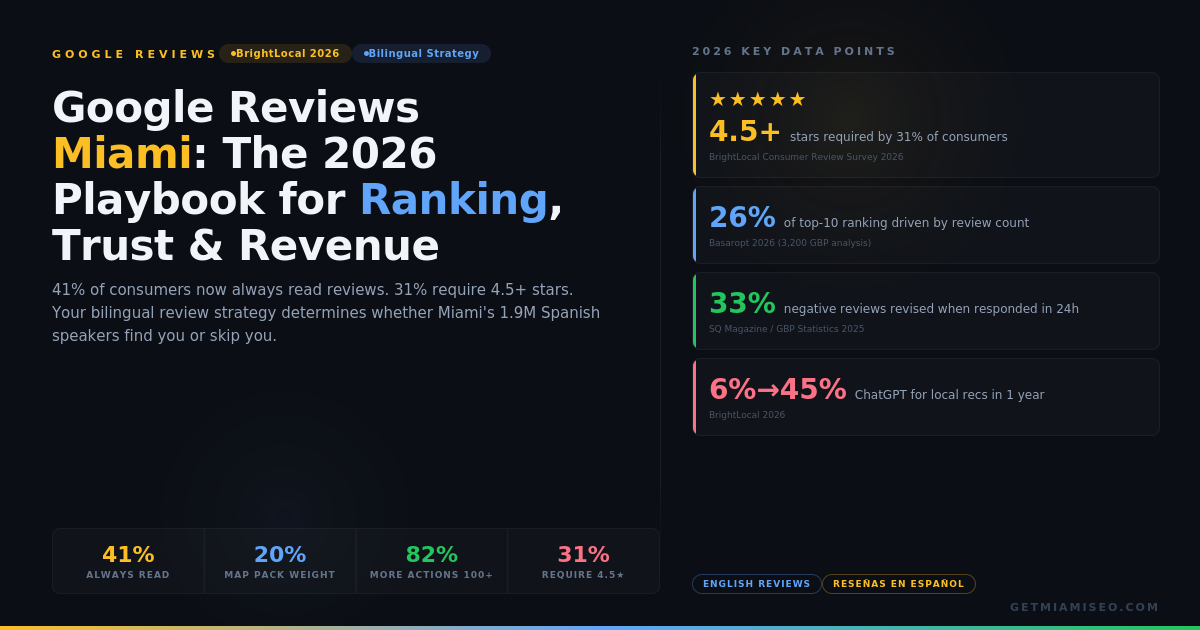
In 2025, 29% of consumers said they "always" read reviews when looking at a business. In 2026, that number jumped to 41% (BrightLocal Consumer Review Survey 2026). That is not a gradual trend. That is a behavioral shift that happened in a single year.
The likely explanation: inflation pressures, declining product quality in some sectors, and a general rise in consumer skepticism have made people do more homework before spending money. When every purchase feels more consequential, the crowd's opinion carries more weight.
For Miami businesses, this shift lands differently than it does in other cities. Miami-Dade has 300,000+ businesses competing for attention from 2.7 million residents and 28.2 million annual visitors (GMCVB 2024). In a market this dense, your Google Reviews are often the single factor that determines whether a customer picks you or the business next door.
And here is the part that almost no one in this market is thinking about: 69% of Miami-Dade's population is Hispanic, and 35% of local searches happen in Spanish. Your English-language reviews are invisible to a significant portion of your potential customers. We will get to that in detail. But first, the data.
What the 2026 Consumer Review Data Actually Says
These statistics come from three primary sources: the BrightLocal Local Consumer Review Survey 2026 (published February 2026, the industry's most cited annual study), the Whitespark 2026 Local Search Ranking Factors survey (47 local SEO practitioners), and an independent analysis of 3,200 Google Business Profiles by Basaropt (published February 2026). Together they paint a clear picture of where reviews stand right now.
Consumer behavior: - 41% of consumers "always" read reviews when browsing for businesses, up from 29% in 2025 (BrightLocal 2026) - 31% will only use a business with 4.5 stars or more, up from 17% last year (BrightLocal 2026) - 68% require 4 or more stars, up from 55% in 2025 (BrightLocal 2026) - 73% only trust reviews written in the last 30 days (Sixth City Marketing) - Consumers use an average of 6 review sites in 2026, up significantly from prior years (BrightLocal 2026) - 98% of consumers read online reviews at least occasionally before choosing a local business (BrightLocal 2026)
Trust and expectations: - 88% of consumers prefer businesses that respond to ALL reviews (BrightLocal) - 19% now expect a response the SAME DAY they post a review, up from 6% last year (BrightLocal 2026) - 32% expect a response by the following day (BrightLocal 2026) - 97% of consumers read business responses to reviews (LocaliQ) - 74% trust businesses more when they see positive Google reviews (WiserReview/SocialPilot) - 84% trust verified reviews almost as much as personal recommendations (SQ Magazine/GBP Statistics 2025)
Revenue impact: - Positive reviews increase customer spending by 31% (Podium) - Businesses with 100+ reviews generate 82% more user actions than those with fewer than 10 (SQ Magazine/GBP Statistics) - Reviews can lift conversion rates 15-20% (SocialPilot/WiserNotify) - Businesses with 4.8+ star ratings see a 52% boost in direction requests compared to those below 4.0 (SQ Magazine) - 58% of customers say a Google Business Profile increases their physical visits (WiserReview) - Negative reviews responded to within 24 hours are 33% more likely to be revised positively (SQ Magazine)
Read those last two lines again. A 33% chance that a negative review gets revised just because you responded quickly. And a 52% difference in direction requests between a 4.8 and a sub-4.0 rating. These are not marginal differences. They are the gap between a busy restaurant and an empty one.
How Google Reviews Affect Map Pack Rankings (The Real Weight)
The Whitespark 2026 Local Search Ranking Factors study ranks the signals that determine which businesses appear in Google's local Map Pack. Review signals account for approximately 20% of the total ranking weight, making reviews the second most important category behind Google Business Profile signals (32%).
But the headline number understates the real impact. A February 2026 analysis of approximately 3,200 Google Business Profiles across various industries (Basaropt) broke down ranking factors by position tier and found something that should get your attention:
In positions 1 through 21, proximity (how close the business is to the searcher) accounted for about 55% of ranking variability. That makes sense. Google shows nearby businesses first. But in the top 10 results, proximity's influence dropped to 36%, while review count jumped to 26% and review text relevance accounted for 22%.
The researchers' conclusion: "If you cannot change your location, focus on the inputs you can control." Reviews are the input you can control.
This has specific implications for Miami businesses. If you operate in a dense neighborhood like Brickell or Coral Gables, where dozens of competitors share the same geographic proximity to any given searcher, reviews become the differentiator. Two dentists in the same Coral Gables office building with identical proximity scores will be ranked differently based on review signals: count, velocity, rating, keywords in review text, and owner responses.
The five review signals Google uses: 1. Review count. More reviews signal more customer interactions. The threshold for credibility keeps rising. 2. Review velocity. How frequently new reviews appear. One review per week consistently outperforms 50 reviews that all appeared six months ago (SQ Magazine: businesses with consistent review velocity of 1+ per week rank 25% higher in local searches). 3. Average star rating. The 4.2-4.5 range is the trust sweet spot. Below 4.0 and you lose 71% of potential customers who will not consider you (multiple industry sources). Above 4.9 and some consumers become skeptical of authenticity. 4. Review text content. Reviews that mention specific services, products, or experiences provide keyword signals to Google. A review that says "best immigration lawyer in Brickell" is worth more to your SEO than a review that says "great service." 5. Owner responses. Google has confirmed that responding to reviews improves local visibility. It signals that the business is active, engaged, and values customer feedback. 90% of marketers believe reviews directly impact Map Pack rankings (Moz).
The complete local SEO playbook covers all Map Pack ranking factors. Reviews are the factor where most Miami businesses have the most room for improvement and the most control.
The Bilingual Review Flywheel: What No One Else Is Telling You
Here is the insight that justifies reading this article instead of any of the hundred other "how to get Google reviews" posts on the internet:
Google surfaces reviews to searchers based on language matching.
When a Spanish-speaking user with their device set to Spanish searches for "restaurantes cerca de mí" and pulls up your Google Business Profile, Google prioritizes displaying Spanish-language reviews. If you have 200 English reviews and zero Spanish reviews, that user sees an empty review section, or at best, machine-translated snippets that feel impersonal and untrustworthy.
In Miami-Dade, where 1.9 million people speak Spanish and 35% of searches happen in Spanish, this is not an edge case. It is a structural blind spot affecting hundreds of thousands of potential customer interactions every month.
How the bilingual review flywheel works:
Step 1: You generate reviews from both English-speaking and Spanish-speaking customers. Not by asking in different languages randomly, but by matching the ask to the customer's language. If the customer spoke Spanish during their visit or service, follow up in Spanish. If they spoke English, follow up in English.
Step 2: You respond to every review in the language it was written in. Spanish reviews get Spanish responses. English reviews get English responses. This is not just courtesy. It is a signal to Google about the languages your business operates in, and it builds trust with prospective customers reading those responses.
Step 3: Over time, you build two independent review pipelines. English-speaking searchers see a rich profile of English reviews with English owner responses. Spanish-speaking searchers see a rich profile of Spanish reviews with Spanish owner responses. Each pipeline builds trust with its respective audience.
Step 4: The flywheel compounds. Customers who feel seen in their language are more likely to leave reviews themselves (68% of consumers leave a Google review when asked, per WiserReview). Your bilingual review profile attracts bilingual customers, who leave bilingual reviews, which attract more bilingual customers.
No other Miami business is running this playbook. The restaurants in Doral (85.5% Hispanic) that have 300 English reviews and 5 Spanish reviews are leaving the majority of their local market unaddressed. The medical practices in Coral Gables that respond to every review in English, even when the review was written in Spanish, are sending a signal that they do not fully serve the Spanish-speaking community.
The competitive advantage here is enormous precisely because so few businesses are doing it. Spanish-language keywords carry 75-85% lower difficulty than English equivalents. The same principle applies to reviews: Spanish-language review competition is virtually nonexistent for most Miami businesses.
How to Get More Google Reviews (Without Being Annoying)
The data says 68% of consumers will leave a Google review when asked (WiserReview). The problem is not willingness. It is that most businesses either never ask, ask at the wrong time, or make the process too complicated.
Timing is everything. Ask for a review at the moment of peak satisfaction. For a restaurant, that is when the customer compliments the meal, not when they are paying the bill and thinking about the tip. For a medical practice, that is after a successful treatment outcome, not during the initial consultation. For a law firm, that is after a case resolution or positive milestone.
Make it frictionless. Google Business Profile has a direct review link feature. Generate your short URL (search for your business on Google, click "Ask for reviews" in your GBP dashboard, copy the link). Print this as a QR code. Include it on receipts, business cards, follow-up emails, and in-store signage. Every extra click or search step between the ask and the review form costs you completions.
Ask in the customer's language. If a customer interacted with you in Spanish, send a follow-up in Spanish. "¡Gracias por su visita! ¿Podría dejarnos una reseña en Google? Su opinión nos ayuda mucho." If they interacted in English: "Thanks for choosing us! Would you mind leaving us a quick Google review? It really helps." Matching the language of the ask to the language of the relationship increases response rates.
Use SMS and WhatsApp, not just email. Miami's population skews mobile-first. WhatsApp is the dominant messaging platform in Hispanic communities. A WhatsApp message with your Google review link has a higher open rate than email. Keep the message personal and short.
Do not incentivize reviews. Google prohibits review gating (selectively asking happy customers) and offering incentives for reviews. Violating this can result in your reviews being removed or your listing penalized. Ask everyone, equally, and let the quality of your service determine the results.
Automate without losing the personal touch. Tools like Podium, Birdeye, and GatherUp ($99-$299/month) can automate review request sequences triggered by appointments, invoices, or checkout. They send timed follow-ups and let customers click directly to your Google review page. The automation handles the logistics. The personal relationship handles the motivation.
How to Respond to Reviews: Frameworks for Every Scenario
97% of consumers read business responses to reviews (LocaliQ). Your responses are not private conversations with the reviewer. They are public statements that every prospective customer reads when deciding whether to trust you.
For positive reviews (5 stars):
Thank the reviewer by name. Reference something specific about their experience (this shows you actually read the review, and it adds keyword-rich content to your profile). Include a subtle call-back. Keep it under 3 sentences.
Example: "Thank you, Maria! We are glad the bilingual consultation helped clarify your immigration options. Our Brickell team looks forward to working with you on the next steps."
This response does three things: it is personal (uses the name), it is specific (references the consultation), and it naturally includes keywords ("bilingual consultation," "immigration," "Brickell") that Google can index.
For negative reviews (1-2 stars):
Respond within 24 hours (33% more likely to be revised, per SQ Magazine). Do not be defensive. Acknowledge the experience. Offer to resolve offline. Keep it professional and brief.
Example: "We appreciate your feedback, Carlos, and we are sorry your experience did not meet your expectations. We take this seriously and would like to understand what happened. Please reach out to us directly at [phone] or [email] so we can make it right."
Never argue in a review response. You are not writing to the unhappy customer. You are writing to every future customer who will read this exchange and judge how you handle criticism.
For neutral reviews (3 stars):
These are opportunities. The customer was not unhappy enough to leave a scathing review, which means something went partially right. Thank them, acknowledge the mixed experience, and ask what could be improved.
Example: "Thanks for the feedback, David. We are glad the dental cleaning went smoothly. We hear your point about the wait time and are working on reducing it. We hope to give you a 5-star experience next time."
For reviews with no text (just a star rating):
Still respond. A simple "Thank you for taking the time to rate us! We would love to hear more about your experience if you have a moment" encourages the reviewer to come back and add text, which provides Google with more indexable content.
Responding in Spanish: Why It Matters and How to Do It Right
When a customer writes a Google review in Spanish, your response should be in Spanish. This is not about being polite (though it is). It is about sending two critical signals:
Signal 1 (to Google): This business operates in Spanish. Google uses language signals from reviews and responses to determine which language queries a business is relevant for. A profile full of Spanish reviews with Spanish responses is more likely to appear for Spanish-language searches.
Signal 2 (to prospective customers): This business genuinely serves the Spanish-speaking community. A prospective customer reading a Spanish review followed by an English-only response receives a mixed message. A Spanish review followed by a thoughtful Spanish response builds confidence.
Spanish response framework for positive reviews: "¡Gracias, [Nombre]! Nos alegra saber que [reference specific positive aspect]. Para nuestro equipo en [neighborhood], su opinión es muy valiosa. ¡Esperamos verle pronto!"
Spanish response framework for negative reviews: "Lamentamos mucho su experiencia, [Nombre]. Nos tomamos esto muy en serio. Por favor contáctenos directamente al [teléfono] para que podamos resolver esta situación. Queremos asegurarnos de que su próxima visita sea diferente."
Critical cultural note: Hispanic consumers are not a monolithic group. The Spanish spoken and understood in Miami's Cuban community differs from the Venezuelan, Colombian, and Mexican communities that have grown significantly in recent years. Keep your responses in standard, professional Spanish that reads naturally across all Latin American communities. Avoid regional slang. Keep the tone warm and personal, which aligns with the relational, community-oriented values that Hispanic consumers across backgrounds share. Choosing an agency that understands these nuances matters.
Google Reviews and AI Search: The New Frontier
The single most dramatic shift in the 2026 BrightLocal data is this: ChatGPT usage for local business recommendations grew from 6% to 45% in a single year (BrightLocal Consumer Review Survey 2026). That means nearly half of consumers now use AI tools to find local businesses, and those AI tools pull from Google Reviews as a primary data source.
When someone asks ChatGPT "What is the best dermatologist in Coral Gables?" or "best Cuban restaurant near Brickell," the AI is synthesizing information from Google Business Profiles, review content, and website data. Businesses with detailed, keyword-rich reviews that mention specific services, conditions, neighborhoods, and experiences are more likely to be cited in AI-generated recommendations.
This connects directly to the GEO (Generative Engine Optimization) and AEO (Answer Engine Optimization) strategies that are reshaping how businesses get found. Reviews are now an input to AI recommendation engines, not just a trust signal for human readers.
What this means for your review strategy: encourage customers to mention specific details in their reviews. Not "great dentist" but "Dr. Martinez fixed my crown in one visit at his Coral Gables office." Not "good restaurant" but "the ropa vieja at lunch was incredible, and the outdoor seating on Giralda Plaza was perfect." These details give AI models the structured information they need to recommend your business for specific queries.
The Google algorithm updates for 2026 show that AI Overviews now appear in 40.16% of local business queries (SeoProfy, 2026). Reviews with service-specific language feed directly into these AI summaries.
Industry-Specific Review Strategies for Miami
Restaurants and hospitality. Miami's 28.2 million annual visitors rely heavily on Google Reviews to choose dining options. 90% of diners check reviews before choosing a restaurant. Photo reviews receive double the visibility of text-only reviews on Google (SQ Magazine). Encourage customers to include food photos with their reviews. For restaurants in tourist-heavy areas like Miami Beach, multilingual reviews (English, Spanish, and Portuguese for Brazilian tourists) signal international appeal.
Medical and healthcare. Patient reviews are the most trusted form of social proof for healthcare decisions. HIPAA-compliant SEO requires careful review management: never reference patient diagnoses or treatments in your responses, even if the patient mentioned them in their review. Keep responses focused on the experience (wait time, staff friendliness, office environment) rather than clinical details. Medical practices with reviews mentioning specific procedures ("teeth whitening," "botox," "physical therapy") rank better for those service-specific keywords.
Law firms. High-value legal keywords in Miami can cost $300+ per click on Google Ads. Reviews are the organic alternative. Clients describing their experience with immigration, personal injury, or corporate law cases provide keyword signals that help the firm rank for those practice areas. Attorney responses should be professional and avoid any language that could be construed as legal advice in a public forum.
Real estate. Real estate SEO in Miami benefits from reviews that mention neighborhoods. "Helped us find our dream condo in Brickell" or "Best Coral Gables realtor for luxury homes" provide hyper-local keyword signals. Encourage clients to mention the neighborhood and property type in their reviews.
Home services. Plumbers, electricians, and HVAC technicians thrive on review velocity because their customers make urgent decisions. A homeowner with a burst pipe at midnight is searching "emergency plumber near me" and picking the highest-rated, most-reviewed option within 30 seconds. Fast review accumulation and high ratings are the difference between getting the call and being invisible.
The 7 Mistakes Miami Businesses Make with Google Reviews
Mistake 1: Never asking for reviews. 68% of customers will leave a review when asked. If you are not asking, you are relying on the small percentage of customers who are motivated enough to review on their own, and those tend to be either thrilled or furious. Asking normalizes the behavior and produces a more representative profile.
Mistake 2: Responding only to negative reviews. 88% of consumers prefer businesses that respond to ALL reviews (BrightLocal). Responding only to negative reviews sends a signal that positive feedback does not matter to you. Respond to everything.
Mistake 3: Using the same response template for every review. Consumers notice generic responses. BrightLocal's 2026 survey explicitly notes that "generic or templated responses have a negative impact." Personalize every response with the reviewer's name and a detail from their experience.
Mistake 4: Ignoring Spanish-language reviews. In a city where 69% of the population is Hispanic, ignoring Spanish reviews is ignoring the majority of your market. Respond in Spanish to Spanish reviews. Build a bilingual review profile.
Mistake 5: Buying fake reviews. Google's detection algorithms are aggressive and getting better. Fake reviews get removed. Your account can be flagged. Consumer trust in reviews is already declining (from 79% trusting reviews as much as personal recommendations in 2020 to about 42% in 2025, per Basaropt). Authenticity is the strategy, not volume.
Mistake 6: Not including reviews in your SEO strategy. Reviews are not separate from SEO. They are 20% of your Map Pack ranking factors. Treat review generation and response as part of your monthly SEO work, not as a separate customer service task.
Mistake 7: Waiting to respond. 19% of consumers expect same-day responses. 81% expect to hear back within a week. Every day you wait to respond is a day that prospective customers see an unanswered review and question whether you care.
FAQs: Google Reviews for Miami Businesses
How do reviews affect local SEO rankings? Reviews account for approximately 20% of Map Pack ranking factors (Whitespark 2026). In the top 10 local results, review count accounts for 26% of ranking variability (Basaropt, 3,200 GBP analysis). Signals include count, velocity, rating, keywords in review text, and owner responses.
How many reviews does my business need? Businesses with 100+ reviews generate 82% more user actions (SQ Magazine). But recency matters more than volume: 73% of consumers only trust reviews from the last 30 days. Target at least 1 new review per week for consistent velocity.
What star rating do I need? 31% of consumers now require 4.5+ stars, double last year. 68% require 4+ stars (BrightLocal 2026). A 4.8 rating produces 52% more direction requests than sub-4.0 (SQ Magazine).
Should I respond to every review? Yes. 88% of consumers prefer businesses that respond to all reviews. 97% read owner responses. Every response is a public statement to prospective customers.
How fast should I respond? Same day is the new standard for 19% of consumers. Negative reviews responded to within 24 hours are 33% more likely to be revised positively. 81% expect a response within a week.
Should I respond in Spanish to Spanish reviews? Absolutely. It signals to Google and to customers that your business serves the Spanish-speaking community. In Miami-Dade (69% Hispanic), this is a competitive advantage almost no one is using.
Do reviews affect AI search results? Yes. ChatGPT usage for local recommendations grew from 6% to 45% in one year (BrightLocal 2026). Reviews with specific details about services, neighborhoods, and experiences are more likely to be cited by AI recommendation engines.
Can I ask customers for reviews? Yes. 68% will leave one when asked. Use your Google review link or QR code. Ask at the moment of peak satisfaction. Do not incentivize or selectively gate reviews.
How do I handle a fake or fraudulent review? Flag it through Google Business Profile. Google reviews must be from real customers with real experiences. Provide evidence in your flag. If the review violates Google's content policy (spam, fake engagement, off-topic), it can be removed. While waiting, post a professional response noting the discrepancy.
How much does review management cost? DIY is $0 beyond your time. Automated tools (Podium, Birdeye, GatherUp) cost $99-$299/month. Full-service review management through an SEO agency typically runs $500-$1,500/month as part of a broader local SEO package.
Your Reviews Are Your Reputation. Build Them Bilingually.
In 2026, your Google Reviews are not just feedback. They are a ranking factor. A trust signal. An AI citation source. A bilingual marketing channel. And for most Miami businesses, they are the single biggest untapped opportunity sitting right on their Google Business Profile.
The SEO audit most Miami businesses need to run starts with three questions: How many reviews do you have? How recent are they? And are any of them in Spanish?
If the answers are "not enough," "not recent," and "no," you now know exactly what to do about it.
Talk to GetMiamiSEO about your review and reputation strategy →