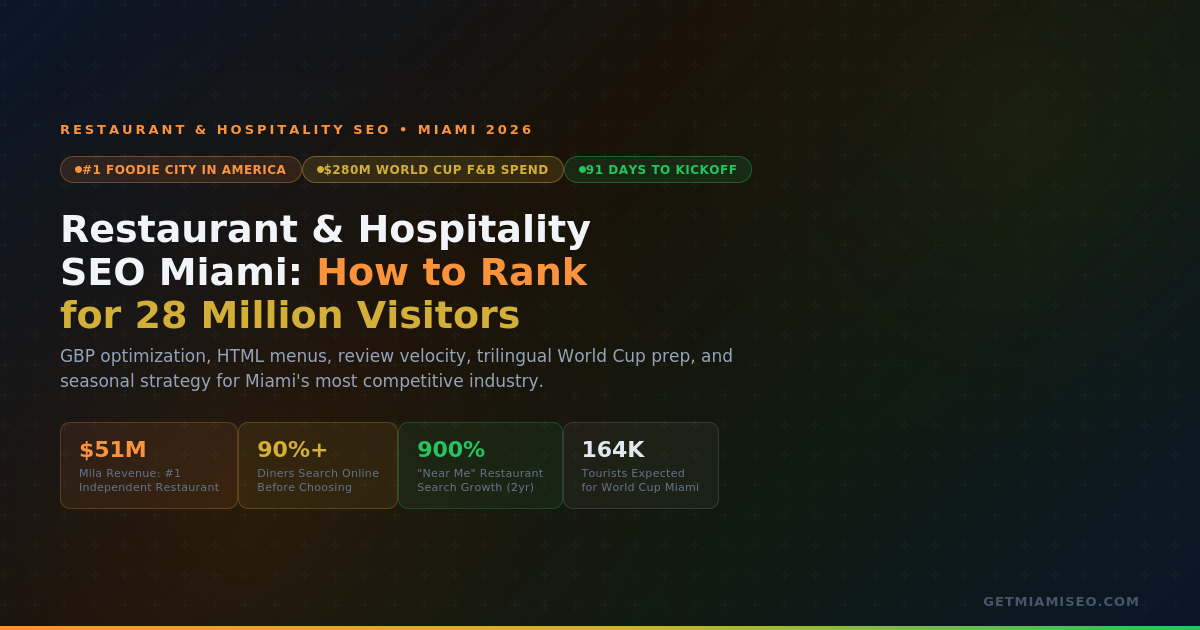
America's #1 Foodie City Has a Visibility Problem
Miami was named the #1 best foodie destination in America by WalletHub, based on factors including the highest number of restaurants per capita in the country. The city holds the nation's highest restaurant quality rating at 6.94 out of 10 (Current Backyard, 2025 City Food Culture Study). Mila, a Mediterranean-Asian fusion restaurant opened by Miami-based Riviera Dining Group, generated $51 million in gross sales in 2024, claiming the #1 spot among independent US restaurants (Restaurant Business 2025). Joe's Stone Crab, the 113-year-old Miami Beach institution, hit $47.7 million, ranking #3 nationally. Major Food Group now operates nine locations in Miami, up from five two years ago, making it their second-largest market after New York (CoStar).
And yet.
Ortanique on the Mile closed after more than 20 years in Coral Gables. Sugarcane in Midtown shut down after a 15-year run. Cafe Vialetto, another two-decade Coral Gables fixture, gone. Black Tap Craft Burgers opened in Brickell City Centre in 2024 and closed eight months later. Jeepney, the Filipino hotspot that moved from New York's East Village to Wynwood, closed at the start of 2026 (CoStar). Five years after the pandemic boom, Miami's restaurant scene is showing strain as oversaturation, rising labor costs (Florida's minimum wage is reaching $15/hour in 2026), and stiff competition from well-capitalized corporate operators squeeze independent restaurants on both ends.
The difference between the restaurants thriving and the restaurants closing is not always the food. It is often the visibility. The restaurant with 350 Google reviews, a fully optimized Google Business Profile, an HTML menu that Google can read, and a review response strategy that builds trust is the one whose phone rings on a Tuesday night. The restaurant with a PDF menu, 40 reviews from 2023, and no Google Posts since last November is the one whose dining room echoes.
This guide is for every restaurant owner, hotel operator, and hospitality group in Miami-Dade. It covers exactly how Google decides which restaurants to show, what the data says about the factors that matter most, and the specific actions that produce results in Miami's uniquely competitive, bilingual, tourist-heavy market. And it arrives with a clock ticking: the FIFA World Cup opens in Miami on June 11, bringing an estimated 164,000 tourists and $280 million in food and beverage spending.
How Diners Find Restaurants in 2026: The Search Behavior That Matters
The restaurant discovery funnel has fragmented across more platforms than ever, but Google remains the entry point for the majority of dining decisions.
Over 90% of diners search online before choosing where to eat (Chowly/Restroworks 2026). 62% use Google specifically as their primary restaurant discovery tool (Restroworks). 76% of people who search for something nearby visit a business within 24 hours. Hyperlocal "near me" restaurant searches have increased 900% over the past two years (Restroworks). "Restaurants near me" and "food open now" remain among the highest-volume local intent queries on Google.
74% of diners use social media to decide where to eat, and 68% check a restaurant's social media account before visiting (OysterLink 2026). 22% of customers return specifically because of a restaurant's social media presence. TikTok and Instagram have become primary discovery channels for Gen Z and Millennials, with 71% of Gen Z and 68% of Millennials planning to increase dining out in 2025 versus the previous year (OpenTable). "Experiential dining" bookings on platforms like OpenTable rose 27% year-over-year.
But here is the critical point for SEO strategy: social media creates awareness, but Google converts that awareness into action. A diner sees a restaurant on TikTok, then searches the name on Google to check the rating, read reviews, see the menu, and get directions. If your Google Business Profile is incomplete, your reviews are stale, or your website does not load on mobile, you lose that customer at the point of conversion, not at the point of discovery.
58% to 69% of Google searches now end without a click, meaning the information on your Google Business Profile is often the only thing a potential diner sees before making their decision. Your GBP is not a listing. For many restaurants, it is the entire customer-facing presence.
Google Business Profile for Restaurants: The 32% Factor Applied to Food
GBP signals represent 32% of all Map Pack ranking factors (Whitespark 2026), and restaurants are among the most GBP-dependent businesses in any industry because most discovery and decision-making happens inside the profile itself, not on your website.
Primary category: be specific about your cuisine
The primary GBP category is the #1 ranking factor for the Map Pack (score 193/193, Whitespark 2026). "Cuban Restaurant" will outrank "Restaurant" for Cuban food searches. "Sushi Restaurant" will outrank "Japanese Restaurant" for sushi-specific queries. Choose the category that most precisely describes your primary cuisine.
Then add secondary categories for every additional offering: "Bar," "Brunch Restaurant," "Delivery Restaurant," "Catering Service," "Outdoor Seating Restaurant," "Late Night Restaurant." Each secondary category opens visibility for a different set of searches. A Miami Beach seafood restaurant with outdoor seating and a brunch service should have "Seafood Restaurant" as primary, plus "Outdoor Seating Restaurant," "Brunch Restaurant," "Bar," and "Delivery Restaurant" as secondaries.
Hours: "open now" is a top-5 factor
"Business is open at time of search" entered the top 5 Map Pack ranking factors in 2026 (Whitespark). For restaurants, this is especially critical. "Food open now" and "restaurants open late" are high-intent queries that depend entirely on accurate hours. If your GBP shows you close at 10 PM but you actually serve until midnight, you are invisible to every late-night diner searching between 10 PM and midnight.
Update hours for every holiday. Add special hours for events. For World Cup match days (June 11 through July 19), extend hours to capture post-match dining demand. Google allows you to set temporary "more hours" for specific services (brunch hours, happy hour, kitchen hours), and each one creates a relevance signal.
Services and attributes: the signals most restaurants ignore
Select every attribute that honestly describes your restaurant: "Outdoor seating," "Wheelchair accessible," "Free WiFi," "Se habla español," "Serves alcohol," "Good for groups," "Good for kids," "Live music," "Reservations recommended," "Accepts credit cards." For Miami's 69% Hispanic market, "Se habla español" is especially valuable. Each attribute serves as both a ranking signal and a conversion factor for filter-based searches.
Google Posts: weekly minimum, daily during events
Post at least once per week with photos of new dishes, seasonal specials, events, and behind-the-scenes kitchen content. Profiles that have not been updated in 30+ days experience impression drops (AgencyJet). During major events like Art Basel ($565M economic impact), the F1 Miami Grand Prix, and the upcoming World Cup, post daily. Each post reinforces freshness signals.
The Menu Problem: Why PDF Menus Are Killing Your Rankings
This is the single most impactful fix most Miami restaurants can make, and it costs almost nothing.
Google cannot reliably crawl, index, or understand the contents of a PDF menu. When your menu exists only as a PDF, your dishes, ingredients, cuisine descriptions, prices, and dietary information are invisible to search engines and AI systems. A diner searching "gluten-free restaurant Wynwood" or "best ceviche Brickell" will never find your restaurant through Google if the only place those terms appear is inside a PDF.
The solution is an HTML menu on your website with each dish listed as crawlable text. For every menu item, include the dish name as a heading or bold text, a 1 to 2 sentence description with key ingredients, the price, and dietary indicators (vegan, gluten-free, halal, dairy-free, nut-free). Structure the menu with proper heading hierarchy: H2 for each course section (Appetizers, Entrees, Desserts), H3 for individual dishes if appropriate.
This does not mean you cannot also have a PDF available for download. Many diners prefer the visual layout of a designed PDF. But the primary menu on your website should be HTML text that Google can read, index, and match to relevant searches.
AI systems including Google AI Overviews, ChatGPT, and Perplexity increasingly reference structured menu data when generating restaurant recommendations. A restaurant whose menu is crawlable text has a significant advantage over one whose menu is locked inside a PDF when a user asks an AI assistant "What are the best seafood restaurants in Brickell with outdoor seating?"
Photos: The Ranking Signal That Works Harder for Restaurants Than Any Other Industry
Businesses ranking in the top 3 positions have an average of 250+ photos (Localo, 2 million profile analysis). Google Business Profiles with photos receive 45% more direction requests and 31% more website clicks than those without (Google). For restaurants, the visual element is not a bonus. It is often the deciding factor.
The photos that drive the most engagement for restaurants: signature dish close-ups with natural lighting and minimal styling, interior ambiance shots that convey the dining experience (candlelight, table settings, design elements), outdoor seating and patio areas (critical for Miami's year-round outdoor dining culture), kitchen preparation and plating (especially effective for open-kitchen concepts), staff and team photos that humanize the brand, and seasonal or event-specific imagery (Miami Spice specials, holiday decorations, World Cup viewing setup).
Upload new photos monthly at minimum. Google tracks engagement on photos (views, saves, shares), and higher engagement strengthens your visibility. Encourage customers to upload their own photos by creating photogenic moments: an Instagram-worthy cocktail presentation, a striking dessert, or a branded wall in your interior. User-generated photos carry additional weight because they represent third-party validation.
Reviews: The Factor That Makes or Breaks a Restaurant on Google
Review signals represent 20% of all Map Pack ranking factors, up from 16% in 2023 (Whitespark 2026). For restaurants, the impact of reviews is amplified because dining is inherently a trust-based, experience-driven decision. A 4.2-star restaurant with 500 reviews will almost always outperform a 4.8-star restaurant with 30 reviews, both in ranking and in customer conversion.
The benchmarks
Restaurants in the top 3 Map Pack positions average approximately 250 reviews (Localo). They respond to reviews with an average of 140 words per response. They receive reviews consistently (at least weekly), not in bursts followed by silence. And their reviews contain naturally occurring mentions of specific dishes, service qualities, and location terms that reinforce relevance for those searches.
Building a review system
Create a direct review link using Google's Place ID tool. Share it through QR codes on receipts and table tents, WhatsApp follow-ups (the dominant messaging platform in Miami's Hispanic community), email follow-ups after OpenTable or Resy reservations, and a thank-you card with the QR code included with the check. Ask when satisfaction is highest: immediately after a compliment, after a positive dessert experience, or after a server receives verbal praise.
Responding to every review
Positive reviews: thank the diner specifically, mention the dish or experience they highlighted, and invite them back. Negative reviews: acknowledge the concern professionally, explain what you have done or will do to address it, and offer to make it right. 89% of consumers are more likely to choose a business that responds to reviews (BrightLocal). In Miami, respond in the language the review was written in. A Spanish review deserves a Spanish response. A Portuguese review during the World Cup deserves a Portuguese response.
Your Restaurant Website: What Google Needs Beyond the Menu
For organic local rankings (the results below the Map Pack), on-page signals from your website represent 36% of ranking factors (Whitespark 2026). Your website does not need to be a design masterpiece. It needs to be fast, mobile-friendly, and filled with the right information.
Dedicated pages for each concept or service. The #1 organic local ranking factor is "dedicated page for each service" (Whitespark 2026). A restaurant with a brunch service, a private dining room, a catering program, and a happy hour should have separate pages for each. A hotel restaurant should have separate pages for the restaurant, the bar, room service, and event dining. Each page with substantive content, not just a sentence and a photo.
Mobile performance is non-negotiable. 63% of all Google searches happen on mobile. For restaurants, the percentage is likely even higher because diners search on their phones while walking, in rideshares, or waiting for friends. Core Web Vitals targets: LCP under 2.5 seconds, INP under 200 milliseconds, CLS under 0.1. Google research shows bounce probability increases 123% as load time goes from 1 to 10 seconds.
Reservation and ordering friction. The click-to-call button, reservation link, and address with directions should be visible within 5 seconds on mobile. If a customer cannot find booking information immediately, they choose another restaurant. Integrate OpenTable, Resy, or your direct booking system prominently.
Schema markup. Implement Restaurant schema (a subtype of LocalBusiness) with your name, address, phone, hours, cuisine type, price range, and geographic coordinates. Add Menu schema for your dishes. Add FAQPage schema for your FAQ section. Schema is critical for AI search visibility because AI systems use structured data to generate accurate recommendations.
Hotel and Hospitality SEO: The Broader Miami Playbook
Hotels, resorts, and hospitality businesses in Miami face a specific SEO challenge: they compete against OTAs (Online Travel Agencies) like Booking.com, Expedia, and TripAdvisor that dominate organic search for generic hotel queries. The path to visibility is local and specific.
Optimize your Google Business Profile with "Hotel" or the most specific subcategory as primary. Add secondary categories for each on-site service: "Restaurant," "Bar," "Spa," "Event Venue," "Wedding Venue," "Conference Center." Each creates visibility for a different search category.
Create dedicated landing pages for each service and each audience segment: "Beachfront wedding venue Miami Beach," "Corporate event space Brickell," "Rooftop bar downtown Miami," "Hotel with pool near [stadium name]." During the World Cup, create a dedicated page targeting "hotel near Hard Rock Stadium" and "World Cup accommodation Miami."
Build content around specific experiences rather than generic hotel descriptions. "Where to stay for Art Basel Miami Beach," "Best hotels near the Design District," and "Family-friendly resorts in Key Biscayne" target long-tail searches that OTAs cannot personalize.
28.2 million visitors generated $21.3 billion in spending in 2024 (GMCVB). Hotels that rank for specific, intent-driven searches capture the highest-value bookings: travelers who already know what experience they want and are willing to pay for it.
The World Cup Is 91 Days Away: What to Do Right Now
The FIFA World Cup runs June 11 to July 19, 2026. Miami is one of 11 US host cities. The numbers are staggering.
An estimated 164,000 tourists will visit the Miami area during the tournament (Deloitte/Airbnb analysis, March 2026). Of the $550 million projected total economic impact for Miami, over 50% ($280 million) is expected from food and beverage spending (Data Appeal Company/Mabrian). Hotel room revenues are expected to increase 7% to 25% in June, with knockout round periods driving rates up over 46% (Oxford Economics). The AHLA compared the event's scale to "nearly 80 Super Bowls in a single month." FIFA expects 6.5 million total attendees across all host cities, with 1.24 million international visitors to the US, 742,000 of whom are incremental trips (Tourism Economics/Oxford Economics).
After a 6.3% decline in international visitors to the US in 2025, inbound tourism is expected to rebound 3.7% in 2026, with roughly a third of that recovery tied to World Cup attendance. The peak will be June, when 57 of the 78 US matches take place.
The action plan for restaurants and hotels
Optimize your GBP now. Not in May. Not in June. Now. Google needs time to crawl, index, and rank your updated profile. Restaurants that are already ranking when the search volume surge hits in June will capture that demand at zero additional cost. Restaurants that start optimizing in June will be invisible during the event.
Add trilingual content. The largest international fan bases traveling to the US include England, Germany, Brazil, Argentina, France, Colombia, Spain, and Mexico. Portuguese and Spanish content is essential. Add Portuguese translations to your GBP description, Google Posts, and key website pages. Brazilian tourists searching "restaurante perto de mim" or "melhor churrascaria Miami" are a massive opportunity that almost no Miami restaurant is targeting.
Create event-specific content. Build a dedicated page on your website for World Cup dining: "Watch the World Cup at [Your Restaurant]," "World Cup viewing schedule," "Post-match dining specials." Create Google Posts for each match day with your specials and viewing setup.
Extend and verify hours. Post-match dining demand will peak between 9 PM and 1 AM. If your kitchen typically closes at 10 PM, consider extending through July 19. Update your GBP hours immediately for the tournament period. Remember: "business is open at time of search" is now a top-5 ranking factor.
Prepare for review volume. International visitors leave reviews. A surge in positive reviews during June and July builds review velocity that continues to benefit your ranking long after the tournament ends. Have your QR codes ready. Have your WhatsApp follow-up ready. Make the review process frictionless.
Seasonal SEO: Miami Spice, Art Basel, and the Tourism Calendar
Miami's restaurant economy is seasonal in ways that most cities are not. Understanding and preparing for these seasonal demand spikes is the difference between riding the wave and watching it pass.
Miami Spice (August through September). Miami's annual prix fixe program drives enormous restaurant discovery. Create a dedicated page: "Miami Spice 2026 at [Your Restaurant]" with your menu, pricing, and reservation link. Target: "Miami Spice restaurants [neighborhood]." Uchi's $25 lunch prix fixe strategy in 2025 demonstrated that price-accessible offerings can drive significant mid-year traffic during Miami's slowest months.
Art Basel Miami Beach (December). $565 million economic impact projected for 2025. Art collectors, gallery owners, and international visitors flood Miami Beach, Wynwood, and the Design District. Content targeting "restaurants near Art Basel," "best dinner near Convention Center," and "late night dining Design District" captures this demand.
F1 Miami Grand Prix (May). $1 billion+ economic impact over three years. The race draws a high-spending international audience. Target "restaurants near Hard Rock Stadium" and post-race dining content.
Winter tourism season (December through April). Peak hotel occupancy, peak restaurant demand, peak search volume. The 93% peak occupancy during this period means restaurants already ranking capture enormous organic traffic.
The pattern is consistent across every seasonal event: the restaurants already ranking before the event capture the surge. The restaurants that start optimizing during the event are too late. Google Ads CPC spikes during high-demand periods. Organic SEO delivers the same traffic without per-click costs.
The Bilingual Advantage: Ranking in English, Spanish, and Portuguese
In a market where 35% of searches happen in Spanish and 69% of the population is Hispanic, a restaurant that only ranks in English is invisible to over a third of its local customer base.
Spanish keywords carry 75% to 85% lower difficulty than English equivalents. "Restaurante cubano Miami" competes against a fraction of the sites targeting "Cuban restaurant Miami." "Mejores restaurantes en Brickell" has dramatically less competition than "best restaurants in Brickell."
For your GBP: use the description field to include both English and Spanish (750 characters total). Post in both languages. Respond to Spanish reviews in Spanish. Select the "Se habla español" attribute. For your website: create Spanish-language pages for your most important content, with proper hreflang implementation.
During the World Cup, Portuguese becomes the third language of Miami's hospitality industry. Brazilian fans represent one of the largest traveling contingents. Adding Portuguese to your GBP description, your Google Posts, and a simple landing page ("Bem-vindos! Assista a Copa do Mundo no [Seu Restaurante]") creates visibility that virtually zero Miami restaurants are currently targeting.
AI Search and Restaurant Discovery: ChatGPT, TikTok, and the New Funnel
Restaurant discovery in 2026 happens across an ecosystem, not a single platform.
Google AI Overviews now appear in over 60% of search queries (Xponent21). When a user searches "best Italian restaurant Coral Gables," Google's AI may generate a summary that includes specific restaurant names, their ratings, and signature dishes pulled from reviews and structured data. Brands cited in AI Overviews see 35% higher organic CTR (Seer Interactive).
ChatGPT and Perplexity are increasingly used for restaurant recommendations. These AI systems pull from reviews, structured data, "best of" lists, and web content to generate their answers. A restaurant that appears on curated lists (Miami New Times "Best Of," Eater Miami, The Infatuation Hit List, Michelin Guide) is far more likely to be cited by AI systems.
TikTok has become a discovery engine. The Infatuation's Q1 2026 Miami trends report noted that Lincoln Road is being transformed into "an international food court of TikTok-famous restaurants," with viral imports like Osteria Da Fortunata from Rome and Andres Carne De Res from Colombia drawing crowds based on social media fame. Viral TikTok content creates branded search demand that feeds back into Google rankings.
The practical implication: restaurant SEO in 2026 is not just about Google. It is about creating a presence across Google, review platforms, curated editorial lists, social media, and AI-powered discovery tools that all feed the same ecosystem. A strong Google Business Profile with structured data, consistent reviews, and crawlable content is the foundation that makes visibility on every other platform possible.
Measuring What Matters: Restaurant SEO Metrics
The metrics that matter for restaurant SEO are the ones that represent real business activity, not vanity traffic numbers.
GBP actions. Calls, direction requests, website clicks, menu views, reservation clicks, and messages from your Google Business Profile. These are direct indicators of customers taking action.
Map Pack position. Track your ranking for "[cuisine type] + [neighborhood]" searches. "Cuban restaurant Little Havana," "sushi Brickell," "seafood Miami Beach." Use a geo-grid rank tracker to see your visibility from multiple locations across your service area.
Review velocity and rating. New reviews per week, average rating trend, response rate, and average response length.
Reservation and order volume from organic. Track how many reservations come through your website versus third-party platforms. Organic search reservations have higher margins because they do not carry per-cover fees.
Branded search volume. Are more people searching for your restaurant by name? Rising branded searches indicate growing awareness, which reinforces your ranking for non-branded searches.
FAQ: Restaurant and Hospitality SEO in Miami
How do I get my restaurant on Google Maps? Claim your Google Business Profile, select the most specific cuisine category, complete every field, upload 250+ photos, and build consistent citations. GBP signals = 32% of Map Pack factors.
How important are reviews? 20% of Map Pack factors, up from 16% in 2023. Top-3 restaurants average 250 reviews. Respond to every review in the language it was written.
PDF or HTML menu? HTML. PDFs are invisible to Google and AI. HTML menus get indexed and matched to food-specific searches.
How much does restaurant SEO cost? $1,500 to $4,500/month for single location. Multi-location groups: $5,000 to $10,000. SEO returns $22 per $1 vs Google Ads' $2.
How do I prepare for the World Cup? Optimize GBP now. Add trilingual content (EN/ES/PT). Create event-specific pages. Extend hours. Prepare for review volume. Restaurants already ranking capture the June surge at zero marginal cost.
What GBP category should I use? Most specific cuisine type as primary (score 193/193, #1 factor). Up to 9 secondaries for additional offerings.
How do photos affect rankings? Top-3 restaurants average 250+ photos. GBPs with photos receive 45% more direction requests. Upload monthly. Focus on signature dishes, ambiance, and outdoor seating.
Does TikTok affect restaurant SEO? Indirectly. TikTok creates branded search demand that feeds Google rankings. 74% of diners use social media to decide. AI systems also reference viral social content when recommending restaurants.