In October 2025, two dental practices opened within four blocks of each other on Miracle Mile in Coral Gables. Both had the same number of operatories. Both accepted the same insurance plans. Both offered the same core services. One generated 83 phone calls from Google in its first 90 days. The other generated 11.
The difference was not location, pricing, or clinical quality. It was Google Business Profile optimization.
The first practice had a verified GBP with "Pediatric Dentist" as its primary category (not "Dentist"), 47 photos of the office, treatment rooms, and staff, a complete services list in both English and Spanish, 23 Google Reviews mentioning specific treatments by name, weekly posts about dental health tips, and a Q&A section answering the ten questions parents most commonly ask. The second practice had a verified GBP with "Dentist" as its primary category, three stock photos, no services listed, four generic reviews, zero posts, and no Q&A entries.
Google treated the first listing as a complete, active, trustworthy entity. Google treated the second as a claimed but unfinished profile. The 83-to-11 call difference was the gap between optimization and existence.
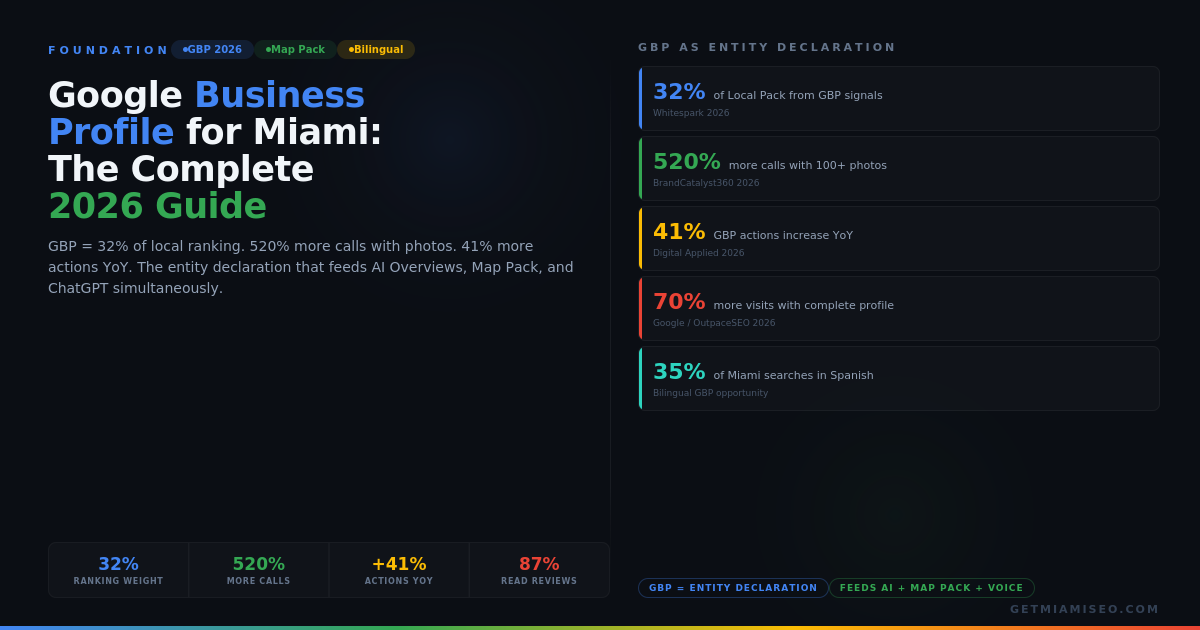
The data confirms this is not an isolated case. GBP listings with more than 100 photos receive 520% more calls and 2,717% more direction requests than listings with no photos (BrandCatalyst360 2026). GBP actions across all categories increased 41% year-over-year between 2025 and 2026 (Digital Applied 2026). Customers are 70% more likely to visit businesses with a complete profile and 50% more likely to consider purchasing from them.
Google Business Profile is not a directory listing you fill out once and forget. In 2026, it is a dynamic, AI-fed digital storefront that accounts for 32% of all Local Pack ranking signals (Whitespark 2026) and directly feeds AI Overviews, ChatGPT recommendations, and entity recognition in the Knowledge Graph.
This guide covers every field, every signal, and every tactic that determines whether your GBP works for you or sits idle while your competitor's generates the calls.
Why GBP Matters More in 2026 Than It Did in 2024
Two shifts have made GBP optimization more important than ever.
The AI integration shift. Google's AI Overviews now trigger on a significant percentage of local queries and pull information directly from GBP data: your services, reviews, Q&A responses, and business descriptions. When someone asks Google "What is the best dentist in Coral Gables for kids?", the AI Overview synthesizes information from GBP listings, not just websites. A GBP with "Pediatric Dentist" as its category, reviews mentioning "my kids loved it," and FAQ answers about children's dental care is citable by the AI. An empty GBP is not.
The behavioral signals shift. Google now weighs how users interact with your listing as a ranking factor. Click-through rate, calls initiated, direction requests, website visits, and dwell time on your profile all feed into your prominence score. Behavioral signals account for approximately 9-11% of Local Pack ranking (Moz 2026), and they have been increasing in weight each year. An active profile that generates engagement ranks better than an inactive profile with strong traditional signals. Businesses that have not posted or added photos in over 30 days have experienced measurable impression drops.
For Miami businesses specifically, these shifts compound with the bilingual dimension. Google processes Spanish-language interactions with your GBP as distinct signals. Spanish reviews, Spanish Q&A entries, and Spanish service descriptions strengthen your ranking for Spanish queries separately from your English signals. A bilingual GBP captures two independent ranking pipelines simultaneously.
The Three Ranking Pillars: Relevance, Proximity, and Prominence
Google's local search algorithm evaluates three factors for every local query.
Relevance measures how closely your GBP matches the search query. Your primary category, services, description, and review keywords all contribute to relevance. A plumber in Hialeah categorized as "Plumber" is more relevant to "plumber near me" than one categorized as "General Contractor." The more precisely your profile describes what you do, the more relevant Google considers you for matching searches.
Proximity measures the physical distance between your business and the searcher. Google uses GPS, IP address, and the location named in the query to calculate proximity. Since Google's 2021 Vicinity update, proximity has become a heavier-weighted factor, making it harder for distant businesses to outrank nearby competitors through optimization alone. You cannot change proximity, but you can ensure every other signal is strong enough to compete within your natural radius.
Prominence measures how well-known and trusted your business appears. Review volume, review quality, link signals, citation consistency, website authority, and GBP activity all feed prominence. Prominence is the pillar where optimization has the largest impact because you can directly control reviews, content, and profile completeness.
Primary Category: The #1 Ranking Factor
Your primary category is the single most impactful field in your entire GBP. The Whitespark 2026 survey ranked it as the #1 factor for Local Pack placement. Getting it wrong suppresses your visibility for the queries that matter most.
Google maintains a list of approximately 4,000 business categories. The primary category must be the most specific, most accurate description of your core service. "Family Dentist" is more specific than "Dentist." "Personal Injury Lawyer" is more specific than "Lawyer." "Medical Spa" is more specific than "Day Spa." "Mexican Restaurant" is more specific than "Restaurant."
For Miami businesses with multiple services, the primary category should match the service you want to rank highest for. A med spa that offers both Botox and facials should determine which drives more search demand and choose accordingly. Secondary categories cover the additional services: add up to 10 secondary categories that accurately describe your other offerings.
The test: search your primary category + your city on Google Maps. If your listing appears in the results, the category is correct. If it does not, the category is wrong or your profile lacks the supporting signals to compete.
Services, Descriptions, and Attributes: Filling Every Field
Google cannot rank you for services it does not know you offer. Every empty field is a missed signal.
Services. Add every service you provide with a clear description. Each service entry should include the service name, a 1-2 sentence description, and a price range if applicable. For Miami businesses, add services in both English and Spanish. A CPA should list "Tax Preparation," "Bookkeeping," "FBAR Filing," "Payroll Services" alongside "Preparacion de Impuestos," "Contabilidad," "Cumplimiento FBAR," "Servicios de Nomina."
Business description. 750 characters to describe what you do, who you serve, and what makes you different. Include your primary service, your city and neighborhood, and your key differentiator. For bilingual businesses, write the description in the primary language of your customer base and use natural keyword placement.
Attributes. Google provides category-specific attributes (e.g., "Women-led," "Veteran-owned," "Wheelchair accessible," "Free Wi-Fi," "Accepts credit cards," "Languages spoken: Spanish"). Each attribute is a structured entity signal. Complete every relevant attribute. For Miami, the "Languages spoken" attribute with Spanish explicitly listed strengthens your profile for Spanish-language searchers.
Photos: The Most Underestimated Ranking and Conversion Signal
The data on GBP photos is unambiguous. Listings with 100+ photos receive 520% more calls and 2,717% more direction requests than listings with no photos. Yet most Miami businesses have fewer than 20 photos on their profile.
What to upload: Exterior photos (help customers recognize your location), interior photos (build trust), team photos (humanize the business), product or service photos (show what you offer), project or results photos (for construction firms, med spas, and any visual industry).
How many: Aim for 100+ total and add 3-5 new photos every week. Regular photo uploads signal an active, operating business. Google's algorithm weighs photo recency alongside total count.
Technical optimization: Name photo files descriptively before uploading ("coral-gables-dental-office-waiting-room.jpg" not "IMG_4523.jpg"). Geotag photos with your business coordinates using a tool like GeoImgr or your phone's native GPS. Upload photos in high resolution (at least 720px wide).
What not to upload: Stock photos. Google can detect stock imagery and it damages trust with both the algorithm and potential customers. Every photo should be real, taken at your actual business location, showing your actual team and work.
Reviews: The Second Most Important Ranking Signal
Reviews account for approximately 16-20% of Local Pack ranking factors and are the primary trust signal for 87% of consumers who read reviews before choosing a local business (Digital Applied 2026).
In 2026, the review factors that matter most have shifted. Total review count still matters, but recency and velocity now outweigh volume. A business with 50 reviews that receives 3-4 new reviews per month outranks a business with 200 reviews that has not received a new review in 60 days. Google's algorithm rewards consistent, ongoing review generation over historical accumulation.
Review content matters for ranking. Google extracts keywords from review text. A restaurant with 30 reviews mentioning "Cuban food" will rank better for "Cuban restaurant near me" than one with 100 reviews that never mention cuisine type. Ask clients to mention the specific service, their neighborhood, and the outcome.
Response rate matters. 89% of consumers expect businesses to respond to all reviews. Google tracks your response rate and speed as engagement signals. Respond to every review within 24 hours. Reference the specific service or experience the reviewer mentions.
Bilingual reviews in Miami. Spanish-language reviews mentioning specific services strengthen ranking for Spanish queries. English reviews strengthen English queries. A Miami business generating reviews in both languages builds two independent trust pipelines. Ask Spanish-speaking clients to review in Spanish. Respond to Spanish reviews in Spanish.
Posts, Q&A, and Activity Signals
Google now treats profile activity as a top-tier ranking signal. An active profile signals a trustworthy, operating business. An inactive profile signals a neglected one.
Google Posts. Publish at least one post per week. Posts can be offers, events, product highlights, or updates. Each post is visible for 7 days on your profile. In Miami, alternate between English and Spanish posts to engage both audiences. Posts do not directly rank in search, but they increase click-through rates and on-profile engagement, both of which are behavioral signals that strengthen prominence.
Q&A. The Q&A section is publicly visible and indexable. Populate it proactively with questions your customers actually ask, then answer them yourself. A law firm should populate: "Do you offer free consultations?", "Do you handle cases on contingency?", "Se habla espanol?" A hotel should populate: "Is parking included?", "How far is the beach?", "Do you offer airport shuttle?" Q&A content feeds directly into AI Overviews and voice search answers.
Products. If your business sells products or offers packaged services, add them in the Products section with photos, descriptions, and prices. This section gives Google additional structured data about your offerings.
GBP as Entity Declaration: The 2026 Framework
Since the shift to entity-based search, GBP has become more than a listing. It is a Tier 3 entity declaration in Google's trust hierarchy, after Wikipedia/Wikidata and your website's schema markup.
Every field in your GBP is an entity attribute. Your category declares what type of entity you are. Your address declares where the entity exists. Your services declare what the entity does. Your photos verify the entity is real and operational. Your reviews endorse the entity's quality from independent third parties.
When Google's AI systems process a query like "best pediatric dentist in Coral Gables," they do not just search for web pages containing those keywords. They search for entities (businesses) that match the category (pediatric dentist), the location (Coral Gables), and the quality signal (reviews, ratings, authority). Your GBP is the primary structured data source for all three of these entity dimensions.
This means GBP optimization is entity optimization. Every field you complete, every photo you add, every review you generate, and every post you publish strengthens your entity profile in Google's Knowledge Graph. The businesses that understand this and treat GBP as an entity project, not a form to fill out, are the ones that dominate the Map Pack and appear in AI-generated recommendations.
The Bilingual GBP Strategy for Miami
In no other US city does bilingual GBP optimization matter as much as in Miami. 35% of all searches happen in Spanish. 1.9 million people speak Spanish at home. Hialeah is 95% Hispanic. Doral is 85% Hispanic.
The bilingual GBP checklist:
Add Spanish service descriptions alongside English. Post in Spanish at least every other week. Populate Q&A with Spanish questions and answers. Set the "Languages spoken" attribute to include Spanish (and Portuguese if applicable). Respond to Spanish reviews in Spanish. Upload photos with bilingual signage visible. Add your business to Spanish-language directories with matching NAP data.
Each of these actions generates a Spanish-language signal that strengthens your ranking for Spanish queries. Competitors with English-only profiles are invisible to these searches. The competitive advantage is immediate and significant.
The Counter-Argument: When GBP Optimization Is Not Enough
The honest counter-argument. A fully optimized GBP will not overcome fundamental business limitations. If your location is outside the primary search area for your target queries, no amount of GBP optimization will override Google's proximity weighting. If your industry is dominated by businesses with DR 70+ websites and thousands of backlinks, GBP optimization alone will not place you in the Map Pack above them.
GBP optimization is the highest-impact starting point for most local businesses because it is free, fast, and directly controls 32% of ranking signals. But it is one layer of a complete strategy that includes on-page SEO, link building, content, reviews, and schema markup. The businesses that win the Map Pack long-term are the ones investing across all layers, not just one.
Common GBP Mistakes Miami Businesses Make
Choosing a broad category instead of a specific one. "Dentist" loses to "Pediatric Dentist" for pediatric searches. "Contractor" loses to "Kitchen Remodeler" for kitchen searches. Be specific.
No photos, or only stock photos. The 520% call difference between photos and no photos is real. Stock photos are detected by Google and distrusted by consumers.
Not responding to reviews. 89% of consumers expect responses. Google tracks your response rate. Silence signals disengagement.
English-only in a bilingual market. In Miami, this leaves 35% of the search market uncaptured. Spanish GBP optimization costs nothing beyond time.
Setting it and forgetting it. Businesses that have not posted or added a photo in 30+ days see measurable impression drops. GBP is an ongoing activity, not a one-time setup.
Inconsistent NAP data. Your name, address, and phone number must be identical across your GBP, website, and every directory. "123 Main St" on one platform and "123 Main Street, Suite A" on another confuses entity matching.
Not using the Q&A section. If you do not populate it, random people will post questions that go unanswered, making your listing look neglected. Control the narrative by populating proactively.
What Miami Businesses Should Optimize This Week
Day 1: Category audit. Search your primary category + city on Google Maps. Does your listing appear? If not, your category is wrong. Change it to the most specific accurate option.
Day 2: Photo upload. Take 15 photos today: exterior, interior, team, products/services, and work in progress. Upload them all. Schedule 3-5 new photos weekly going forward.
Day 3: Services and description. List every service in both English and Spanish. Rewrite your description with your primary service, neighborhood, and differentiator.
Day 4: Review generation. Send a review request to your last 10 clients with a direct Google Review link. Ask them to mention the specific service. Follow up within 24 hours if no review is posted.
Day 5: Q&A population. Write the 10 questions your clients ask most during consultations. Post them in your Q&A section and answer them. Add 5 in Spanish if you serve bilingual clients.
Day 6: First Google Post. Publish a post about a current offer, a recent project, or a seasonal tip. Schedule weekly posts going forward, alternating English and Spanish.
Day 7: NAP audit. Search your business name in quotes on Google. Check that your name, address, and phone match exactly across the first 20 results. Fix any inconsistencies immediately.
How to Measure Whether Your GBP Is Working
GBP Insights provides the core metrics: profile views, search queries that triggered your listing, calls, direction requests, website clicks, and photo views. Track these monthly.
The business metrics that matter: calls from GBP (are they increasing month-over-month?), direction requests (are more people navigating to your location?), and website clicks from GBP (are they converting on your website?). These connect GBP optimization to the ROI framework that turns activity into revenue.
For bilingual tracking: GBP Insights shows which search queries triggered your listing. Filter for Spanish queries ("dentista," "cerca de mi," "restaurante") versus English queries to measure bilingual performance separately.
FAQs: Google Business Profile in 2026
How long does GBP optimization take to show results? Category changes and photo uploads can show impact within 2-4 weeks. Review generation builds over months. Full GBP optimization typically delivers measurable improvement within 30-60 days for Map Pack visibility.
Can I have multiple GBP listings for one business? Only if you have multiple physical locations. Each location gets its own GBP. A single-location business should have exactly one listing. Duplicate listings confuse Google and risk suspension.
What if I have negative reviews? Respond professionally within 24 hours. Address the specific complaint. AI now summarizes reviews for users, so addressing the issue in your response helps the AI present your business more favorably. Never argue or be defensive.
How do Google Ads interact with GBP? Google Ads can show above the Map Pack and within Google Maps. A well-optimized GBP with Google Ads creates a dual-visibility strategy: paid placement above the Pack and organic placement within it.
Does GBP affect AI search citations? Yes. AI Overviews, ChatGPT, and Gemini all use GBP data (services, reviews, Q&A) to generate local recommendations. A complete GBP is citable. An empty one is not.
Should I use a PO Box as my business address? No. Google requires a physical address where you conduct business or meet customers. PO Boxes violate GBP guidelines and risk suspension.
How often does Google update its GBP features? Regularly. Google has added booking links, products, messaging, video uploads, and AI-powered review summaries in recent years. Check your GBP dashboard monthly for new features and fields.
What happens if I do not optimize my GBP? Google suppresses incomplete and inactive listings in local search results. Your listing still exists, but it is ranked below competitors who have optimized. In a competitive Miami market, an unoptimized GBP is effectively invisible.
520% More Calls or 11 Per Quarter: The Choice Is Optimization
The two Coral Gables dental practices are still operating four blocks apart. The optimized practice continues generating 70-90 calls per month from Google. The unoptimized practice still generates 10-15. Both pay rent. Both employ staff. Both provide quality care. The difference in patient acquisition cost between them is the difference between a growing practice and one that relies entirely on referrals and insurance directories.
GBP optimization is not a technical exercise. It is a business decision. It takes approximately 4 to 6 hours to set up properly, then 30 minutes per week to maintain through posts, photos, and review responses. The cost is zero dollars. The return, according to the aggregate data, is a 520% increase in calls, a 2,717% increase in direction requests, a 70% increase in visits, and a 50% increase in purchase consideration.
In a market with 28.2 million annual visitors, 1.9 million Spanish speakers, and 12 industry verticals competing for local visibility, the businesses that treat their Google Business Profile as a dynamic storefront rather than a static listing are the ones the phone rings for. The ones that don't are the ones wondering why the phone stopped ringing.
Get a free GBP audit for your Miami business ->