In January 2026, a 22-room boutique hotel in the Miami Design District ran a simple analysis of its Q4 2025 booking data. Of 847 room bookings, 631 came through Booking.com or Expedia. The hotel paid an average of 18% commission on each OTA booking, totaling $34,100 in commissions for the quarter. The remaining 216 bookings came through the hotel's own website and phone line, commission-free.
The owner opened a spreadsheet and did the math. If she could shift just 15% of OTA bookings to direct bookings through organic search, she would save $5,115 per quarter. Over a year, that's $20,460 in commission fees she would not pay. That number would cover a full year of SEO services with enough left over for a content writer.
She had been thinking about SEO as a marketing expense. The spreadsheet showed it was a commission reduction strategy. Every direct booking driven by organic search was not just a customer acquired. It was a commission avoided. And the compounding math was straightforward: the more direct bookings organic search delivered, the lower the effective cost per booking became, while OTA commissions stayed fixed at 15-25% forever.
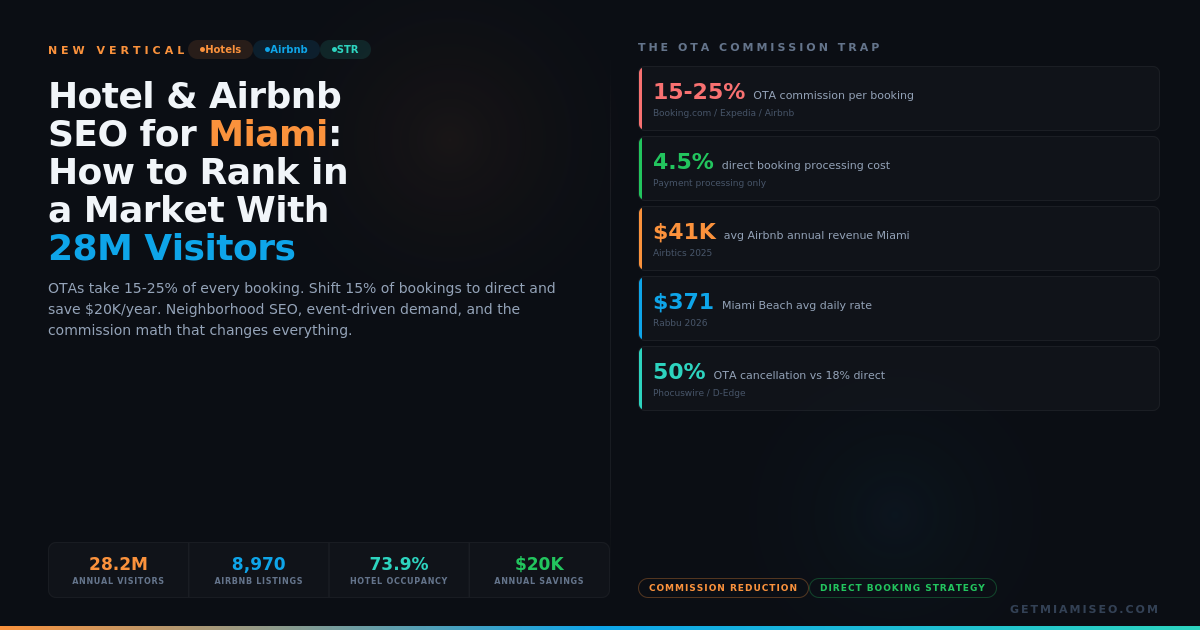
This is the economic reality that 28.2 million annual visitors create for Miami's accommodation businesses. The demand is enormous. The question is not whether travelers will book in Miami. It is whether they book through an OTA that takes 15-25% of the revenue or through a direct channel that costs 4-4.5% in payment processing. SEO determines which channel captures the booking.
How Travelers Search for Miami Hotels in 2026
Understanding where bookings originate changes how you invest. The traveler's search path is not a single step. It is a sequence, and each step is a different kind of search.
Step 1: Discovery on an OTA. Four out of five travelers visit an OTA at some point before making a hotel reservation (Smarter Travel 2026). They use Booking.com or Expedia to compare options, filter by price and location, and read reviews. This step is about narrowing the field. OTAs hold approximately 55% of the online booking market share (Prostay 2026).
Step 2: Validation on Google. After finding a hotel on an OTA, many travelers search the hotel name on Google to check the direct website, read Google Reviews, and look for a better rate. This is the "billboard effect": the OTA listing exposes the hotel to the traveler, but the booking may happen elsewhere. A hotel with a strong direct website and a visible Google presence captures the booking at this step instead of sending the traveler back to the OTA.
Step 3: Direct booking or return to OTA. If the hotel's website is clear, fast, mobile-friendly, and shows a rate that matches or beats the OTA, the traveler books direct. If the website is slow, confusing, or does not show real-time availability, the traveler returns to the OTA and the hotel pays the commission. Travel and hospitality websites have a conversion rate of just 2.7% (Contentsquare 2026), and mobile conversion lags at 2.1%. Every point of friction on your website costs you direct bookings and sends revenue to OTAs.
Step 4: Google Hotels. Google's hotel search vertical shows rates from multiple sources side-by-side, including the hotel's own website through Google's free booking links program. A hotel that has claimed its Google Business Profile and connected a booking engine to Google Hotels appears alongside OTAs in this comparison, with a "Book direct" option visible to the traveler. This is one of the highest-value free tools available to Miami hotels, and most independent properties have not activated it.
Google Hotel Ads, which operate separately from the free booking links, can drive up to 30% of a hotel's direct bookings (Mews 2024). Under current CPC bidding models, the effective cost remains significantly cheaper than 15-25% OTA commission. Google used 12% of booking value as its benchmark when commission-based hotel campaigns were still available. Even at CPC rates, the cost-per-acquisition through Google Hotels typically runs 8-12% of booking value, still well below OTA commission rates.
Reviews as Booking Signals for Hotels and Rentals
For accommodation businesses, reviews function differently than for other service businesses. A review for a plumber needs to confirm competence. A review for a hotel needs to confirm experience.
Hotel reviews that mention specific amenities ("the rooftop pool overlooking Biscayne Bay was stunning"), specific neighborhoods ("walking distance from Wynwood Walls"), and specific events ("perfect location for Art Basel, we walked to everything") give Google three kinds of indexable data: what the property offers, where it is, and when it is most relevant. Each review that mentions a neighborhood name strengthens the property's ranking for "[neighborhood] hotel" queries. Each review mentioning an event strengthens its ranking for event-related accommodation searches.
For Airbnb hosts, reviews on Google carry more ranking weight than reviews on Airbnb, because Google Reviews feed directly into Map Pack rankings and AI Overview citations. An Airbnb host who also has a direct booking website should encourage satisfied guests to leave a Google Review in addition to (not instead of) their Airbnb review. The Google Review builds the direct booking channel's authority. The Airbnb review protects the OTA listing.
In Miami's bilingual market, reviews in both English and Spanish compound this effect. A Spanish-language review mentioning "excelente ubicacion cerca de Wynwood" strengthens the property's ranking for Spanish-language accommodation searches. An English review mentioning "great location near Wynwood Walls" strengthens the English side. Two review pipelines, two ranking pipelines, covering 100% of Miami's search market.
The OTA Commission Trap and the Direct Booking Escape
OTA commissions are not a fixed cost of doing business. They are a variable cost that shrinks as direct booking volume grows.
Booking.com charges 15-18% commission depending on location and promotional participation (Preno 2025). Expedia charges independent hotels 15-30% (Mize 2026). Airbnb charges hosts 3-15% (Preno 2025). On a $300 room night, a 20% OTA commission costs the hotel $60. A direct booking through the hotel's own website costs approximately $13.50 in payment processing (4.5%). The difference is $46.50 per room night.
For the 22-room Design District boutique doing 847 bookings per quarter, shifting 15% of OTA bookings to direct saves $5,115 per quarter. Shifting 25% saves $8,525 per quarter, or $34,100 per year, which is exactly what the hotel was paying in total OTA commissions for Q4.
The direct booking also has a lower cancellation rate. Phocuswire found that Booking Holdings platforms had a 50% cancellation rate compared to 18.2% for direct bookings. This means direct bookings are not only cheaper to acquire. They are also more reliable to count on for revenue forecasting and staffing.
The escape path from OTA dependency runs through three channels: Google organic search (free traffic that converts on your website), Google Business Profile (free visibility that drives calls and direction requests), and Google Hotels free booking links (free rate comparison placement alongside OTAs). All three are powered by SEO.
Neighborhood SEO for Hotels: Why "Boutique Hotel Coral Gables" Beats "Hotel Miami"
The single most common mistake Miami hotels make with their websites is targeting "hotel Miami" as their primary keyword. This keyword is dominated by OTAs, aggregators, and chain brands with domain authorities above DR 80. An independent or boutique property competing for "hotel Miami" is fighting a war it cannot win.
The winnable battle is neighborhood-specific. "Boutique hotel Coral Gables," "hotel near Wynwood," "Airbnb Design District Miami," "vacation rental Brickell waterfront." These queries have lower competition, higher intent, and stronger conversion rates because the searcher already knows which area they want to stay in.
Each Miami neighborhood attracts a distinct traveler profile. Brickell draws business travelers and young professionals. Coral Gables draws luxury and cultural visitors. Wynwood draws art tourists and nightlife visitors. Miami Beach draws the broadest leisure and international audience. Doral draws Latin American business travelers.
Every accommodation property should have a dedicated landing page for its primary neighborhood, written with neighborhood-specific content that a generic "about us" page cannot replicate. "Our boutique hotel is located two blocks from the Wynwood Walls, walking distance from 70+ galleries, and 10 minutes from the Design District" is rankable content. "We are conveniently located in Miami" is not.
The ADR data proves the neighborhood premium. Miami Beach Airbnb listings average $371 per night (Rabbu 2026). South Miami listings average $256 per night. Miami Springs averages $230. The neighborhood determines the price, the guest profile, and the search queries that matter. A vacation rental in Miami Beach ranking for "beachfront rental South Beach" is targeting a $371/night searcher. The same property targeting generic "Miami rental" is competing against every $125/night listing across the metro area.
For hotels with physical locations in high-demand neighborhoods, the neighborhood landing page should include: the property's exact distance to major attractions, transit options (Metrorail, Metromover, rideshare zones), walkability to restaurants and nightlife, event venue proximity (Hard Rock Stadium for F1 and World Cup, Bayfront Park for Ultra, Miami Beach Convention Center for Art Basel), and honest assessments of noise levels, parking, and beach access. This level of specificity is what separates a page that ranks from a page that sits at position 40.
Airbnb SEO vs Google SEO: Where Short-Term Rental Hosts Should Focus
Miami has approximately 8,970 active Airbnb listings (Airbtics 2025), generating an average of $41,000 in annual revenue per listing with a 69% median occupancy rate and a $274 average daily rate. Miami Beach alone has over 2,700 active listings at $371 ADR. These numbers represent a market where visibility within the Airbnb platform is intensely competitive.
Airbnb SEO and Google SEO are two completely different games. Airbnb's internal search algorithm weights factors that Google does not care about: host response time, booking acceptance rate, calendar freshness, instant booking enablement, and Superhost status. Optimizing for these factors improves your visibility within Airbnb's marketplace.
Google SEO, by contrast, optimizes your own website or listing page to rank for search queries that travelers type into Google before they reach any OTA. "Vacation rental Miami Beach," "Airbnb alternative Wynwood," "family house rental Coconut Grove." A short-term rental host with a direct booking website ranking for these queries captures bookings without paying Airbnb's service fees.
The smart approach is both. Optimize your Airbnb listing for Airbnb's algorithm (response rate, reviews, photos, calendar management). Simultaneously, build a direct booking website with neighborhood-specific content, Google Reviews, and schema markup to capture Google traffic that bypasses the OTA entirely.
For hosts with multiple properties, a direct booking website becomes increasingly valuable. A host managing five Miami Beach properties who shifts just 20% of bookings from Airbnb to direct saves the host service fee on each booking, eliminates the guest service fee that inflates the visible price, and allows direct guest communication before arrival.
The direct booking website does not need to be complex. A clean, mobile-first site with property photos, neighborhood descriptions, an availability calendar, and a booking widget is sufficient. The critical elements for Google ranking: a unique title tag with the neighborhood name and property type ("2BR Oceanfront Condo Miami Beach" not "My Vacation Rental"), a Google Business Profile listing, LocalBusiness schema markup, and at least five Google Reviews. These elements cost nothing beyond the time to set them up.
The seasonal dimension matters. Miami's short-term rental market is highly seasonal (AirROI 2026): March is the peak revenue month and September is the slowest. During peak season (December through April), OTA competition is fierce and commission costs are highest. This is exactly when direct booking SEO delivers the most value, because each direct booking during peak season saves the highest absolute dollar amount in commissions. A $400/night December booking through Airbnb at 14% combined fees costs the host $56. The same booking direct costs $18. That is $38 per night during the months that matter most.
Event-Driven Hotel SEO: Art Basel, F1, World Cup, and the Booking Calendar
Miami's event calendar creates accommodation search spikes that are predictable, recurring, and capturable through advance content publishing.
Art Basel Miami Beach (early December, 83,000+ attendees) fills hotels across Miami Beach, Wynwood, the Design District, and Downtown. Searches for "hotel Art Basel Miami," "where to stay Art Basel," and "Miami Beach hotel December" begin climbing in October and peak in late November. A hotel with a dedicated Art Basel landing page published by mid-October ranks during the peak booking window.
The Formula 1 Miami Grand Prix (May, 250,000+ attendees over the weekend) drives hotel demand across Miami Gardens, North Miami, and the broader metro area. Ultra Music Festival (late March) fills Downtown and Brickell hotels. The Miami Open (March) fills Miami Gardens and Aventura properties. The FIFA World Cup 2026 brings 7 matches to Hard Rock Stadium with $550 million in projected economic impact.
The 6-to-8 week lead time rule applies to hotel content just as it does to every other Miami vertical. Publish event-specific content 6-8 weeks before the event. A page titled "Where to Stay for Art Basel Miami Beach 2026" published in October captures the search demand that builds throughout November. The same page published in December captures nothing because every relevant ranking position is already occupied.
For short-term rental hosts, event-driven pricing content doubles as SEO content. A blog post titled "Best Airbnb Rentals Near Hard Rock Stadium for F1 Weekend 2026" targets a specific search query while also serving as a pricing and availability page.
The Bilingual Guest: Why Your Hotel Needs Spanish Content
24.17% of Miami Airbnb guests are international, with visitors from Latin America constituting a significant share. For hotels, the international percentage is likely higher because Miami is the primary US gateway for travel from Brazil, Colombia, Argentina, Venezuela, and Mexico.
35% of Miami searches happen in Spanish. "Hotel boutique Miami Beach," "alojamiento cerca del Design District," "casa vacacional Miami." These Spanish-language queries have real search volume and dramatically less competition than their English equivalents. A hotel with bilingual content on its direct booking website captures a traveler segment that most English-only hotel websites are invisible to.
The implementation: translate your three highest-traffic pages into native Spanish (not Google Translate). Add Spanish descriptions to your Google Business Profile. Respond to Spanish reviews in Spanish. Build one Spanish-language blog post about your neighborhood for Spanish-speaking travelers. And add hreflang tags so Google serves the correct language version to each searcher.
What Hotels and Rental Hosts Should Build This Month
Week 1. Run the commission analysis. Export your last 90 days of booking data. Separate OTA bookings from direct bookings. Calculate total commissions paid. Then calculate what shifting 15% of OTA bookings to direct would save annually. This number is your SEO budget justification.
Week 2. Claim or fully complete your Google Business Profile. Select the correct primary category ("Hotel," "Boutique Hotel," "Vacation Rental," or "Bed and Breakfast"). Upload 20+ real photos. Add a direct booking link. Activate Google Hotels free booking links if you have a compatible booking engine.
Week 3. Build a neighborhood landing page on your website. Not a generic "location" page. A page with your neighborhood name in the title, specific attractions within walking distance, restaurant recommendations, transportation tips, and a direct booking widget. Run the SEO audit on this page to verify schema markup and technical health.
Week 4. Publish one event-specific page. Choose the next major Miami event that drives accommodation demand. Build a page titled "Where to Stay for [Event Name] 2026" with your property featured, neighborhood context, and a booking CTA. Publish it 6-8 weeks before the event.
Common Mistakes Miami Hotels Make With SEO
Targeting "hotel Miami" instead of neighborhood-specific terms. The broad term is dominated by OTAs with DR 80+. "Boutique hotel Design District" or "vacation rental Coconut Grove" are winnable.
Not having a direct booking website at all. Some small hotels and most Airbnb hosts rely entirely on OTA platforms. Without a direct website, there is no channel to capture organic Google traffic commission-free.
Ignoring Google Hotels free booking links. Google's free booking link program lets hotels appear in Google Hotels search results alongside OTAs at zero cost. Most independent Miami hotels have not activated this.
Publishing event content during the event instead of before it. Content for Art Basel published in December competes against content published in October. The earlier piece captures the demand.
Treating all bookings as equal regardless of channel. A $300 OTA booking generates $240-255 in net revenue after commission. A $300 direct booking generates $286.50 after processing. The direct booking is worth $31-46 more. Revenue management should account for this.
No Spanish-language content on the direct booking website. 24% of Miami Airbnb guests are international, and a significant share searches in Spanish. Hotels without Spanish content are invisible to this audience's searches.
FAQs: Hotel and Short-Term Rental SEO in Miami
How long does hotel SEO take to show results? Neighborhood-specific terms with lower competition can rank in 2-4 months. Competitive terms take 6-12 months. Event-specific content published 6-8 weeks before the event can rank within the publishing window. The cost and timeline guide covers expectations.
Should I invest in SEO or Google Ads for my hotel? Both serve different functions. Google Ads delivers immediate visibility at a cost per click. SEO delivers compounding organic visibility at zero per-click cost once ranked. For hotels, SEO vs Google Ads is not an either/or decision. Use Ads for immediate event-driven demand. Use SEO for long-term direct booking growth.
Do AI Overviews affect hotel searches? Yes. Travel queries saw a 381% increase in AI Overview coverage in 2025, making hotels one of the most AI-affected local categories. Hotels with structured content, FAQ pages, and strong review profiles are more likely to be cited inside AI Overview answers.
Can I compete with OTAs on Google? Not for broad terms like "hotels in Miami." But for neighborhood-specific, event-specific, and long-tail queries ("pet-friendly boutique hotel Coconut Grove," "family vacation rental near Wynwood Walls"), independent hotels and rental hosts can outrank OTAs because OTAs create generic city-level pages, not neighborhood-specific ones.
How do reviews affect hotel rankings? Review signals account for 16-20% of Map Pack ranking factors (Whitespark 2026). For hotels, reviews mentioning specific amenities, neighborhood names, and staff create indexable signals that strengthen search visibility.
What is the billboard effect? The billboard effect occurs when a traveler discovers a hotel on an OTA, then searches the hotel name on Google and books directly through the hotel's website. This happens frequently and is one reason a strong direct booking website is valuable even for hotels that maintain OTA listings.
How do backlinks help hotel SEO? Links from travel publications, local media, event websites, and tourism directories strengthen domain authority and improve organic rankings. For hotels, being featured in "best hotel" roundup articles also functions as an AI search citation signal.
Should I use the same content on my website and my OTA listing? No. Duplicate content across your website and OTA listings creates SEO issues. Your direct website should have unique, expanded content that goes beyond what OTAs display: neighborhood guides, event information, blog posts, and detailed amenity descriptions that OTAs do not support.
The Math That Changes Everything
That boutique hotel in the Design District did not need more bookings. She was running at 73% occupancy, in line with the Miami-Dade county average of 73.9% (STR 2024). Her rooms were filling. The question was not demand. It was margin.
Every booking that came through an OTA cost her 18% of the revenue. Every booking that came through her own website cost her 4.5%. The difference, multiplied across 847 quarterly bookings, was the difference between a profitable year and a break-even one.
SEO did not change how many people wanted to stay at her hotel. It changed where they booked. And in a market with 28.2 million annual visitors, where demand is not the problem and distribution cost is, that shift in booking channel is worth more than any other marketing investment she could make.
The OTA is not the enemy. It is a discovery channel that introduces travelers to properties they would not have found otherwise. The billboard effect is real: a guest discovers your property on Booking.com, searches your name on Google, and books directly if your website offers a comparable experience. Cutting OTA listings entirely would reduce discovery. The goal is not elimination. It is rebalancing.
The honest counter-argument. Some properties, particularly new hotels and rental hosts without a review base or brand recognition, need OTAs more than they need SEO in the early months. A new Airbnb listing with zero reviews and no Google presence will struggle to generate direct bookings regardless of how well its website ranks. For these properties, the first priority is building a review base on the OTA platforms, establishing a track record, and then gradually building a direct booking channel as the review count and brand recognition grow. SEO is a medium-to-long-term investment. OTAs serve the short-term need for visibility. The strategic path is: use OTAs to build the initial guest base, collect reviews and guest data, then invest in SEO to shift an increasing share of bookings to direct channels as the property matures.
For established properties with 50+ reviews and a functioning website, the calculus flips. At that point, every booking that comes through an OTA instead of direct is a missed margin opportunity. The SEO investment begins paying for itself the moment the first direct booking closes, and it compounds from there.
The spreadsheet was simple. The math was clear. The only question was whether she would build the pages to capture what was already searching for her.
Get a free hotel or short-term rental SEO audit for your Miami property ->