In February 2026, a pediatric dentist in Coconut Grove noticed something strange in her Google Business Profile insights dashboard. Her profile impressions were up 18% compared to the same month in 2025. More people were seeing her listing than ever before. But her calls were down 27% over the same period, and her direction requests had dropped nearly 22%. The numbers did not make sense together. More visibility was supposed to produce more action, not less.
She thought she had a branding problem. Maybe her photos looked outdated. Maybe her category description needed rewriting. She spent two weeks updating her profile, adding new treatment room photos, and rewriting her service descriptions. The impressions stayed high. The calls stayed low. Something else was happening.
The answer showed up on her own phone. When she searched her primary keyword, "pediatric dentist Coconut Grove," on her mobile device, what appeared at the top of the screen was not her Google Business Profile. It was an AI Overview: a Google-generated summary naming three other pediatric practices in the area, answering the typical questions a parent might ask ("Do I need a referral?", "What ages do pediatric dentists treat?", "How often should children get checkups?"), and leaving her Local Pack listing to load below the fold. Her impressions were up because Google was still showing her listing. They just were not showing it first. Customers were getting the answers they came for before they ever scrolled down to her name.
This is what AI Overviews are doing to Miami local search in 2026. Not evenly. Not universally. But precisely, surgically, and in ways that most local business owners have not yet noticed because the metrics hide the impact behind numbers that look mixed rather than bad.
The rest of this article is the honest map: what AI Overviews are actually doing to local queries, which Miami businesses are affected and which are relatively safe, what the data from late 2025 and early 2026 actually shows (not the breathless headlines from a year ago), and what you should audit this week if you run a local business in Miami-Dade.
What AI Overviews Actually Look Like on Local Queries in 2026
Before diving into strategy, it helps to understand exactly what the search result page looks like today for different kinds of local queries in Miami. The answer depends on the query, and the differences matter.
Pure navigational local queries. When someone searches "Cleveland Clinic Weston" or "Publix Coral Gables" or "Joe's Stone Crab Miami Beach," the result is overwhelmingly a Knowledge Panel, a Local Pack, or a direct link to the business. AI Overviews rarely appear on these queries because the user's intent is already resolved: they know where they are going, they just need the information to get there.
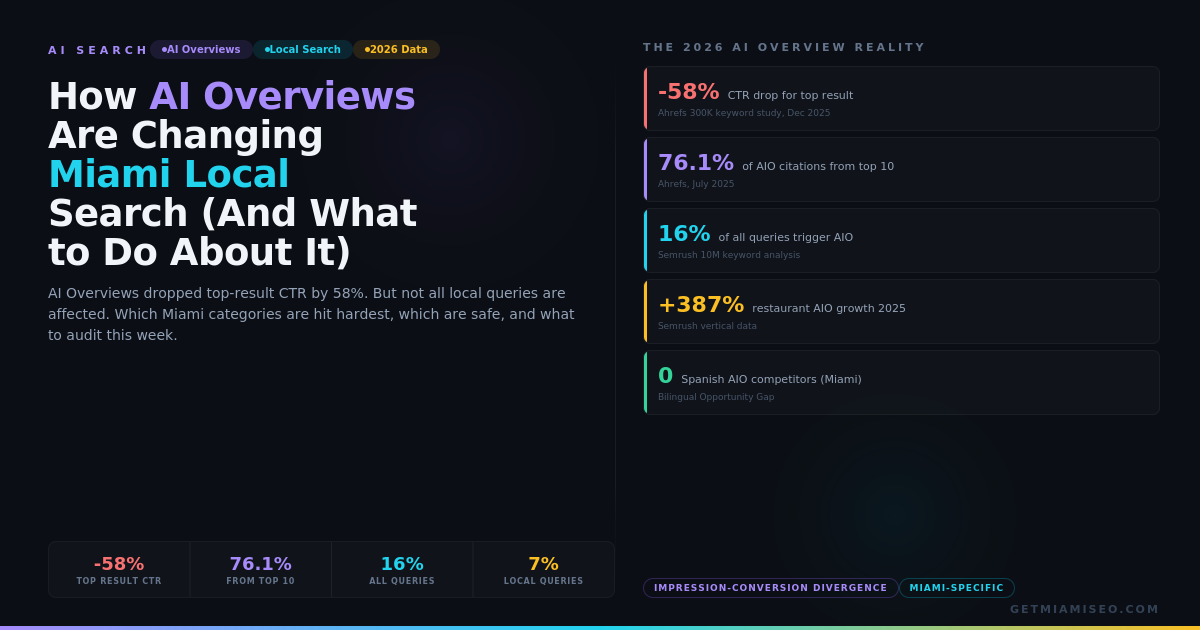
Category queries with action intent. When someone searches "dentist open now near me" or "emergency plumber 33137" or "24 hour pharmacy Brickell," the Local Pack remains the dominant feature. AI Overviews trigger on only about 7% of these searches according to Heroic Rankings data from early 2026. Google has figured out that someone searching for an open plumber at 11 PM doesn't want a paragraph explaining what plumbing is. They want a phone number.
Category comparison and recommendation queries. This is where AI Overviews are reshaping local search aggressively. When someone searches "best Cuban restaurant Miami," "top rated pediatric dentist Coral Gables," "best med spa for Botox Brickell," or "best family lawyer Miami-Dade," an AI Overview now frequently appears at the top of the page. It synthesizes information from the top organic results, reviews, and third-party listicles to produce a direct recommendation. The Local Pack still loads below it, but the user has already received an answer. Semrush's analysis of 10 million keywords showed restaurant-related searches saw a 387% increase in AI Overview appearance between early and late 2025. Travel-related queries saw 381% growth. Entertainment saw 528% growth.
"Near me" informational queries. When someone searches "what is the best neighborhood in Miami for families" or "how much does IVF cost in Miami" or "are there dog-friendly restaurants in Wynwood," the AI Overview is almost always present. These are informational queries with a local dimension, and Google's AI treats them like any other informational query: by summarizing and answering directly.
The distinction matters because the correct strategy is different for each type. A plumber worrying about AI Overviews is worrying about the wrong problem. A restaurant owner, a med spa operator, a specialty lawyer, and a real estate agent have every reason to worry about them, because their most valuable category comparison queries are exactly the ones AI Overviews target.
The Numbers That Actually Matter in 2026
The data on AI Overviews is changing fast, and the headlines from 2024 and early 2025 no longer reflect the reality of 2026. Here is what the latest data actually shows.
AI Overview coverage is lower than the early headlines suggested. Semrush's analysis of over 10 million keywords (published December 2025) found that approximately 16% of all Google queries trigger AI Overviews as of late 2025. This is a significant number but far below the "40% of all searches" claim that circulated in 2024. The difference matters because most local queries fall outside that 16%.
Click-through impact is severe where AI Overviews do appear. Ahrefs analyzed 300,000 keywords in December 2025 and found that the top-ranking result loses 58% of its click-through rate when an AI Overview is present. The second-ranked result loses 50.8%. The third loses 46.4%. Seer Interactive's separate study of 3,119 informational queries found organic CTR dropped from 1.76% to 0.61%, a 61% decline. These numbers are worse for informational queries than for local queries, but the queries where they overlap (comparison searches, "best of" searches) are exactly the ones most Miami businesses depend on.
Citation comes primarily from top organic rankings. Ahrefs found that 76.1% of URLs cited inside AI Overviews also rank in Google's top 10 for the same query. This is the most important number for Miami businesses to understand: AI Overviews do not bypass traditional SEO. They amplify it. The pages Google's AI chooses to cite are overwhelmingly the same pages Google's traditional ranking algorithm already favors. A business with strong organic rankings has a dramatically higher chance of being cited. A business with weak organic rankings is effectively invisible to the AI as well.
Zero-click rates are climbing but not evenly. Similarweb's 2026 data shows over 80% of all searches now end without a click. For searches that trigger AI Overviews specifically, the zero-click rate reaches approximately 83%. But transactional queries and local navigational queries retain much higher click rates because users need to take an action (call, visit, buy) that requires leaving Google.
Restaurants, travel, and entertainment are the hardest-hit local categories. Semrush's industry analysis from November 2025 showed the food vertical with the fastest growth in AI Overview coverage. Travel and entertainment followed closely. These three categories are the Miami economy. Restaurants alone serve 28.2 million annual visitors. Tourism and entertainment drive major event cycles all year long. These are also the verticals where "best of" and recommendation queries dominate search behavior.
Real estate and shopping are relatively protected. Semrush found AI Overview coverage below 3% for real estate and shopping queries. Google's explanation is that local packs, map interfaces, listings, and action buttons already serve these intents better than a text summary could. Real estate SEO in Miami is more protected from AI Overview disruption than most other verticals. Ecommerce is also less affected because product queries need to lead to a checkout, which AI summaries cannot provide.
Why the Pediatric Dentist's Metrics Were Actually Telling the Truth
Go back to the Coconut Grove dentist. Her impressions went up. Her conversions went down. This is not a branding problem. It is a specific pattern that appears in 2026 Google Business Profile data when AI Overviews intercept a meaningful share of category comparison queries.
Here is what is happening mechanically. A parent searches "best pediatric dentist Coconut Grove." Google's system recognizes this as a category comparison query with a location qualifier. It triggers an AI Overview that synthesizes information from the top organic results. The Local Pack still loads below the AI Overview. The dentist's GBP listing still appears. Google still counts the appearance as an impression.
But on a mobile screen (63% of local searches are mobile, per Similarweb), the AI Overview and its cited sources take up the entire visible area. The parent reads the AI's summary, sees three practices cited by name inside the overview, and taps directly on one of them. The dentist whose GBP was actually the top Local Pack result never received the tap because the parent never scrolled down. Her impression count rose. Her action count fell.
This explains why the dentist's metrics looked contradictory. Google was doing its job by showing her listing more often (her optimization work was paying off). But the AI layer above her listing was capturing the decision before her GBP ever got a chance to earn it.
The fix has two parts. First, the dentist needs to become one of the businesses cited inside the AI Overview, not just the one appearing below it. This requires content that the AI can extract from: structured FAQ content answering the exact questions parents ask, direct-answer paragraphs immediately after clear headings, and schema markup that gives Google explicit context about her services. Second, she needs to compete on the query types that AI Overviews do not trigger as heavily: action-intent queries ("pediatric dentist open Saturday," "pediatric dentist that takes my insurance," "emergency pediatric dentist Miami"), neighborhood-specific long-tail queries, and Spanish-language queries where AI Overview coverage is currently lower.
The Structured Content That Gets Cited
AI Overviews extract content from web pages using patterns that are partially predictable. Understanding these patterns does not guarantee citation, but it dramatically improves the odds.
Clear direct-answer paragraphs. When a page responds to a heading with a 40-to-60 word paragraph that answers the question directly, the AI can extract that paragraph and use it. A page that opens the answer with "Pediatric dentists typically see children starting at age one, with regular visits every six months, and treat concerns including tooth decay, alignment issues, and oral habits" is extractable. A page that opens with "At our practice, we welcome all ages and pride ourselves on exceptional care" is not extractable because it does not actually answer anything.
Schema markup. A Data World study found that GPT-4 accuracy improves from 16% to 54% when processing content with structured data. This applies to Google's Gemini model as well. LocalBusiness schema tells the AI what the business does and where. FAQPage schema exposes question-and-answer pairs in a format designed for direct extraction. Review and AggregateRating schema signal trust. Service schema describes specific offerings. A business without schema is invisible to the AI at the structured-data level. The SEO audit checklist includes schema as a critical checkpoint for this exact reason.
Question-based content structures. AI Overviews pull heavily from content that explicitly poses and answers questions. "What is the best time to visit Miami Beach?", "How much does laser hair removal cost in Miami?", "Do I need a permit for a pool fence in Miami-Dade?" These are question structures that match how people type queries into Google and speak to voice assistants. Pages with full FAQ sections are cited at disproportionate rates compared to pages that cover the same topics in prose alone.
Specific, sourced data points. Vague statements do not get cited. "Miami has many great restaurants" cites nothing. "Miami-Dade has 28.2 million annual visitors and over 5,000 restaurants" cites the Greater Miami CVB. The AI prefers content with specific numbers and attributable sources because specific claims are easier to validate and present as authoritative.
Content depth and topical authority. Individual blog posts rarely get cited in isolation. The AI tends to cite pages from sites that have built clear topical authority on a subject. A dedicated Miami SEO blog with multiple articles covering related topics is more likely to be cited for a local SEO query than a single post from a general marketing site. Topical clusters matter.
The Counter-Argument: Why AI Overviews Might Be Less Catastrophic Than They Look
The honest counter-argument. Most local businesses in Miami do not primarily depend on category comparison queries. A family dentist in Kendall gets most of her new patients through direct referrals, insurance provider directories, and "dentist near me" searches where the patient already knows she needs a dentist and just needs to find one open nearby. These are exactly the query types where AI Overviews trigger least often. For these businesses, the AI Overview panic is overblown.
Similarly, home services businesses operating in emergency or action-intent queries ("emergency plumber Miami," "AC repair Coral Gables," "roof repair after storm") are heavily protected. Google has correctly identified that someone searching these terms needs a phone number and a service call, not a paragraph. These businesses should continue optimizing for traditional Local Pack visibility, GBP completeness, and review volume, because that is still where their wins come from.
The businesses that should actively worry are those whose revenue depends on comparison and recommendation queries: restaurants, med spas, boutique hotels, experience-based tourism businesses, and any "best of" positioned service provider. For these businesses, AI Overviews are capturing decisions they used to own. For everyone else, the right move is to strengthen the traditional local SEO foundation and monitor whether their category begins shifting into AI Overview territory over the next twelve months.
How Miami's Bilingual Dimension Changes the AI Overview Calculus
There is a specific opportunity in Miami that most AI Overview analysis does not discuss: the Spanish-language layer. AI Overviews in Spanish are rolling out more slowly than the English version. Spanish-language local queries in Miami currently trigger AI Overviews at a lower rate than their English equivalents, and the content competing for those citations is dramatically thinner.
35% of Miami searches happen in Spanish. 1.9 million people in Miami-Dade speak Spanish at home. Category comparison queries in Spanish ("mejor restaurante cubano Miami," "mejor dentista pediátrico Coral Gables," "mejor med spa para botox Brickell") are valuable, have real search volume, and face significantly less AI Overview competition than their English counterparts.
For Miami businesses, this means the bilingual opportunity is not just about capturing Spanish-speaking customers. It is also about building content in a language where the AI Overview interference has not yet caught up to the English-language patterns. A med spa that builds detailed Spanish-language treatment pages today is competing for citation in a cleaner landscape than the English-language equivalent. The same applies to restaurants, law firms, medical practices, and every other category where comparison queries drive demand.
This is a time-limited advantage. Google's AI Overviews will eventually roll out equally to both languages. The businesses that build bilingual content now lock in citations before the landscape fills in.
What Miami Local Businesses Should Audit This Week
The following is a direct, prioritized checklist. Any Miami local business can complete this audit in under two hours and immediately understand their AI Overview exposure.
Step 1: Search your top three category comparison queries on a mobile device. Do not use desktop. Do not use incognito mode. Use your actual phone. Search "best [your category] [your neighborhood]" and "best [your category] Miami." Scroll through what appears. Note whether an AI Overview appears. If one does, note which businesses are cited inside it.
Step 2: Check your Google Business Profile insights for the last 90 days. Look specifically at the impression-to-action ratio. If impressions are up but calls, direction requests, or website clicks are down, you may have an AI Overview interception problem. If impressions are down and actions are down proportionally, you have a traditional ranking problem, which is a different fix.
Step 3: Audit your most important landing pages for schema markup. Use Google's Rich Results Test tool to check whether your homepage, primary service page, and FAQ page have valid LocalBusiness, FAQPage, and Service schema. If any of these are missing, add them. The SEO audit guide covers the specific implementations.
Step 4: Check whether your most important pages answer questions directly. Open your top 5 landing pages. Read the first 100 words of each. Does the page answer a specific question in a 40-to-60 word paragraph that could be extracted as a direct answer? If not, rewrite the opening of each page. This is the single highest-impact content change you can make for AI Overview citation.
Step 5: Build or expand your FAQ content. Add a dedicated FAQ page if you do not have one. If you have one, expand it to include at least 10 questions that real customers actually ask. Use FAQPage schema to mark up each question-and-answer pair. Focus on the questions you answer in your sales calls and consultations.
Step 6: Verify your Google Business Profile is fully complete. GBP signals still account for 32% of Local Pack ranking factors (Whitespark 2026). Every empty field is a signal missed. Business hours, categories, services, attributes, photos, Q&A section, and direct booking link all matter.
Step 7: If you serve a bilingual audience, audit your Spanish-language content. In Miami, this is not optional. Spanish AI Overview coverage is currently lower than English. Build or expand Spanish versions of your most important pages. Respond to Spanish reviews in Spanish. The bilingual SEO guide covers the full strategy.
Common Mistakes Miami Businesses Make When Reacting to AI Overviews
Panicking and abandoning traditional SEO. AI Overviews draw 76.1% of their citations from pages that already rank in the top 10 organically. Abandoning traditional SEO removes the foundation that AI Overview citations are built on.
Reacting to industry-wide statistics instead of their own data. A headline that says "AI Overviews reduce clicks by 61%" applies to informational query aggregates. Your specific local category may have 3% AI Overview coverage. The only data that matters is your own Google Business Profile insights and Search Console performance.
Writing "AI-optimized" content that reads like robots wrote it. AI Overviews cite content that is well-structured AND well-written. Content engineered purely for extraction, with no voice or depth, often fails to rank in the traditional top 10 to begin with, which means it never gets cited either.
Ignoring the bilingual opportunity. English AI Overview content is crowded. Spanish AI Overview content is wide open. Miami businesses with bilingual content have a time-limited advantage that most national competitors cannot match.
Treating AI Overviews as a single problem. They are not. Different query types (navigational, comparison, action-intent, informational) trigger AI Overviews at dramatically different rates. Your response should vary by the query types that matter to your business.
Not rechecking the data. AI Overview behavior is changing monthly. The data from early 2025 was different from late 2025, which is already different from early 2026. Any strategy built on a single data point becomes outdated within quarters.
FAQs: AI Overviews and Miami Local Search
Are AI Overviews showing for my business's target queries? You cannot know without checking on a mobile device in an incognito window, for your actual target queries, in your actual location. National and industry-wide statistics are useful context but not a substitute for checking your own queries.
How do I track whether I'm being cited in AI Overviews? Several tools now offer AI Overview tracking, including Semrush, Ahrefs, and specialized AI visibility platforms. Most will show you which queries in your keyword set trigger an AI Overview and whether your URLs appear as cited sources. If you don't have enterprise tools, manual monthly checks of your top 10 queries give you baseline visibility.
Do Google Ads appear above AI Overviews? Yes. Paid Google Ads, including Local Services Ads, still appear above AI Overviews in most configurations. This is one reason Local Services Ads adoption has accelerated since 2024. The paid layer is relatively protected from AI Overview interference.
Should I add FAQ sections to every page on my site? Not every page. Add FAQ content to pages where questions are genuinely relevant: service pages, pricing pages, neighborhood pages, and treatment pages. Adding empty or generic FAQ content to pages where it does not fit can hurt quality signals more than it helps citation odds.
How does this affect my SEO budget? For most Miami businesses, the answer is: do not change the budget, change the allocation inside it. Traditional SEO fundamentals (GBP optimization, review generation, content quality, schema markup) still deliver the majority of local visibility. Adding AI Overview optimization on top of that foundation does not require more spending, but it does require different content structures and a willingness to let some pages exist primarily to be extracted rather than to drive direct clicks.
Is there any data on Miami-specific AI Overview coverage? There is no Miami-specific published study on AI Overview trigger rates. National and global data on local queries gives a useful baseline, but every Miami business should check their own queries on their own phone to see the actual state of their category.
Will AI Overviews eventually affect every local query? Unlikely in the near term. Google has publicly acknowledged that local transactional queries are better served by the Local Pack, Maps integration, and action buttons than by AI summaries. Real estate, shopping, and direct-service navigational queries are likely to remain relatively protected. Comparison, recommendation, and informational queries with a local dimension will continue to see expansion.
How does this connect to ChatGPT and other AI search engines? ChatGPT, Perplexity, and other LLM-based search tools work differently from Google AI Overviews but overlap significantly in the content they prefer. Optimizing for Google AI Overview citation tends to also improve ChatGPT citation because both systems reward structured content, clear direct answers, FAQ formats, and authoritative sources. The complete AI search strategy covers all platforms together.
The Metrics Were Not Lying. They Were Telling a New Story.
The pediatric dentist in Coconut Grove did not have a branding problem. She had a map problem. The territory she was navigating had changed shape without a new map. Her old instruments (impressions as a proxy for visibility, rankings as a proxy for demand capture) kept pointing in the same direction, but the direction no longer led to the same destination.
This is the quiet shift that AI Overviews are making in Miami local search. The headlines from 2024 predicted catastrophe for every website. The reality of 2026 is more nuanced and in many ways more dangerous. Some businesses are untouched. Some are being silently eroded. The businesses being eroded look fine in their summary metrics because Google's visibility numbers are still climbing even as the actions those numbers used to predict are declining.
The businesses that will adapt are the ones who recognize the mismatch early, audit their own queries on their own phones, and respond by building the structured, extractable, AI-citable content that lets them appear inside the Overview rather than below it. The ones who do not adapt will keep updating their photos and rewriting their category descriptions and wondering why the impressions keep climbing while the phone stays quiet.
The metrics were not lying. They were telling a new story. The question is whether you are listening.
Get a free audit of your Miami business's AI Overview exposure →