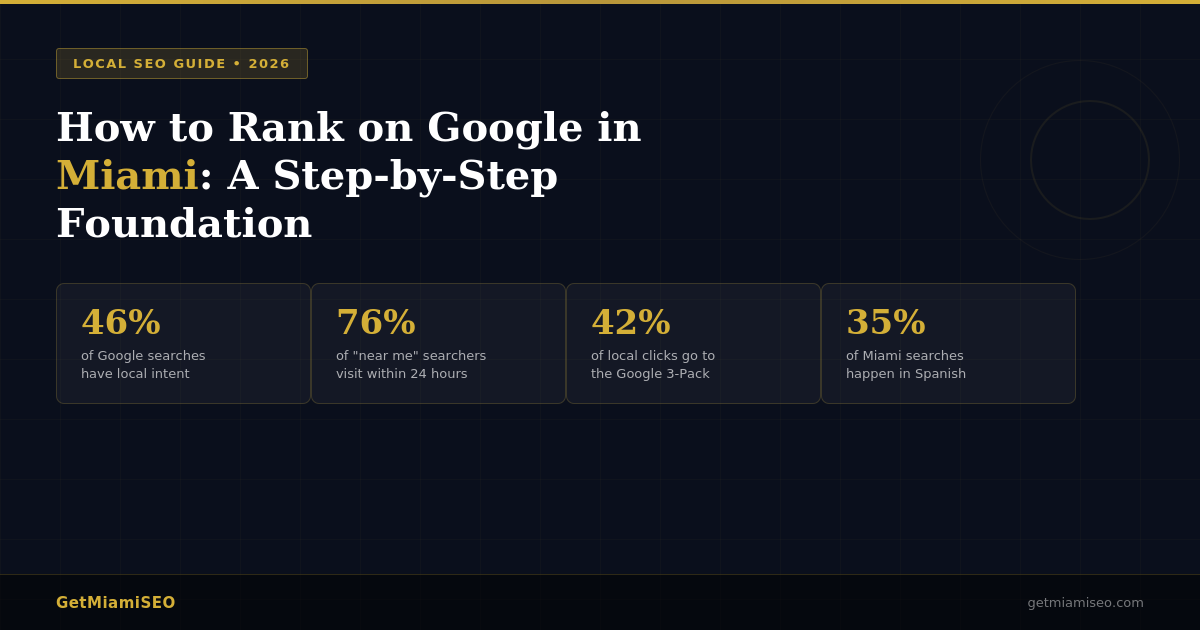
How to Rank on Google in Miami: A Step-by-Step Foundation for Any Local Business
Table of Contents
- What Actually Happens When Someone Searches for Your Business
- The Three Forces That Decide Who Shows Up First
- Your Website: The Foundation Google Needs
- Google Business Profile: Your Digital Storefront
- Content That Ranks: What Google Considers Helpful in 2026
- Reviews: The Ranking Fuel Most Miami Businesses Underuse
- Citations and Links: External Proof That Your Business Is Real
- The Bilingual Foundation Every Miami Business Needs
- Measuring What Matters (and Ignoring What Doesn't)
- The Three Mistakes That Keep Miami Businesses Off Page One
What Actually Happens When Someone Searches for Your Business
Open Google on your phone right now and type "plumber near me." Or "abogado en Miami." Or "best brunch in Brickell."
What shows up on your screen in the next 0.4 seconds is the result of a complex process that determines which businesses earn visibility and which stay invisible. Understanding this process is the first step toward controlling where your business appears.
Here is the simplified version of what Google does with every one of those searches.
Crawling. Google sends automated programs (called crawlers or spiders) across the internet to discover web pages. These crawlers follow links from one page to another, reading text, images, code, and metadata along the way. If your website exists but no links point to it and Google has never found it, your business effectively does not exist in search results.
Indexing. Once a crawler discovers your page, Google processes and stores the information in a massive database called the index. Think of this as a library catalog. Your page gets filed according to what it is about, where your business is located, what services you provide, and how credible your information appears. If your page has technical issues (slow loading, broken code, blocked crawlers), it may never make it into the index at all.
Ranking. When someone types a search query, Google does not search the entire internet in real time. It searches its index and applies over 200 ranking signals to determine which results best match what the person is looking for. For local searches in Miami, the algorithm applies additional factors related to geography, business information, and community trust signals like reviews.
For queries with local intent (and 46% of all Google searches fall into this category, according to Search Engine Roundtable), Google produces a special set of results called the Local Pack, sometimes called the Map Pack or the 3-Pack. This is the box at the top of the search results page showing three businesses on a map. According to Backlinko, 42% of people performing a local search click on results inside this Local Pack, making it the single most valuable piece of real estate in local search.
The rest of the page shows traditional organic results, which are the standard blue links that lead to websites.
Your goal as a Miami business owner is to show up in both: the Local Pack for immediate visibility and the organic results for long-term traffic. The steps that follow will show you how to build that foundation.
Why This Matters More in Miami Than Anywhere Else
Miami is not a typical local market. Several factors make ranking here both more competitive and more rewarding than most American cities.
The population of Miami-Dade County exceeds 2.7 million people, with 70% identifying as Hispanic. That means roughly 35% of searches in the Miami metro happen in Spanish, a detail that 90% of SEO agencies in South Florida completely ignore.
Miami also ranks first in the United States for small business formation, with approximately 4,900 new business applications per 100,000 residents. Every one of those new businesses competes for the same Google real estate. Meanwhile, 8 million annual tourists generate a surge of "near me" queries that no other Florida market matches.
Add the neighborhood density (Brickell, Wynwood, Coral Gables, Miami Beach, Doral, Little Havana, Aventura, Coconut Grove, Kendall, and Homestead all function as distinct micro-markets), and you have a city where generic SEO advice falls short. What works in Brickell's financial corridor does not work in Doral's bilingual business community. What ranks in Miami Beach's hospitality market requires a different approach than Coral Gables' professional services environment.
This guide accounts for those differences.
The Three Forces That Decide Who Shows Up First
Google's local algorithm evaluates every business through three primary lenses. Every ranking tactic you will learn in this guide maps back to one of these three forces.
Relevance
Relevance measures how well your business listing matches what someone is searching for. If a user types "immigration lawyer in Doral" and your Google Business Profile is categorized as a general law practice with no mention of immigration services or Doral, Google considers you a poor match regardless of how close your office is.
You control relevance through your Google Business Profile categories, your website content, the services you list, and the keywords that appear naturally across your online presence.
Proximity
Proximity measures how close your business is to the person searching. For someone standing in Brickell searching for "coffee shop," Google will prioritize coffee shops within walking distance over one in Kendall, even if the Kendall shop has better reviews.
You cannot change your physical location, but you can influence proximity signals through service area settings, neighborhood-specific content, and properly configured location data.
Prominence
Prominence measures how well known and trusted your business is across the internet. Google determines prominence through a combination of review quantity and quality, the number and quality of other websites that mention or link to yours, your business's presence in online directories, and the overall authority of your website.
Of these three forces, prominence is where the most effort pays off, because it is the factor you have the most control over through consistent SEO work.
Your Website: The Foundation Google Needs Before Anything Else Works
Before you optimize your Google Business Profile, before you chase reviews, before you build any links, your website needs to meet certain baseline requirements. A website that fails these fundamentals will undermine every other effort.
Title Tags and Meta Descriptions
Every page on your website has a title tag (the clickable blue text in search results) and a meta description (the summary text below it). These are the first things Google reads to understand what each page is about, and they are the first things a potential customer sees before deciding whether to click.
For a Miami business, every key service page should include the service name and a geographic qualifier. A divorce attorney in Coral Gables would want a title tag like "Divorce Attorney in Coral Gables | [Firm Name]" rather than just "Our Services."
Keep title tags under 60 characters so Google displays them fully. Write meta descriptions under 155 characters. Make both specific and honest about what the page offers.
Heading Structure
Google reads your page's heading structure (H1, H2, H3 tags) to understand the hierarchy of your content. Your H1 is your primary heading, and each page should have exactly one. H2 headings break the page into major sections. H3 headings break sections into subsections.
A service page for a Miami real estate brokerage might use an H1 like "Luxury Real Estate Services in Brickell" with H2 sections for "Residential Sales," "Commercial Leasing," and "Property Management," each containing more detailed H3 subsections.
Mobile Responsiveness
Over 63% of Google searches in the United States happen on mobile devices. In Miami, where tourists and commuters conduct searches on the go constantly, that percentage is likely higher. Google uses mobile-first indexing, meaning it evaluates the mobile version of your site before the desktop version.
If your website does not display properly on a smartphone, if text is too small to read, if buttons are too close together to tap accurately, or if content shifts around while loading, Google will rank you lower. Test your site on multiple devices regularly.
Page Speed
When someone searches for "emergency locksmith miami" at 11 PM, they are not waiting three seconds for your page to load. Google measures page speed through a set of metrics called Core Web Vitals, which evaluate how fast your page renders its main content, how quickly it becomes interactive, and how stable the layout is while loading.
You can check your Core Web Vitals for free at Google's PageSpeed Insights tool (pagespeed.web.dev). Aim for a Largest Contentful Paint under 2.5 seconds, a First Input Delay under 100 milliseconds, and a Cumulative Layout Shift under 0.1.
SSL Certificate (HTTPS)
If your website URL starts with "http://" instead of "https://," Google considers it insecure. Since 2018, Google Chrome has displayed a "Not Secure" warning on HTTP sites. Beyond the ranking impact, potential customers who see that warning will leave immediately. Most hosting providers offer free SSL certificates through Let's Encrypt. There is no reason to skip this step.
Location-Specific Pages
If your business serves multiple neighborhoods, create dedicated pages for each one. A home cleaning company serving both Brickell and Doral should not rely on a single generic service page. Instead, create separate pages like "Home Cleaning Services in Brickell" and "Servicios de Limpieza en Doral" with unique content about each area, the specific services offered there, and relevant local details.
This is where Miami's neighborhood structure becomes a strategic advantage. Each neighborhood page targets a different set of search queries, expands your geographic footprint in Google's index, and demonstrates to Google that you have genuine local expertise in those areas.
Google Business Profile: Your Digital Storefront on the Map
Your Google Business Profile (GBP) is arguably the single most important asset in local SEO. It is what appears in the Local Pack, on Google Maps, and in the knowledge panel when someone searches for your business by name. According to BrightLocal, GBP management is the most valued local SEO service among both marketers (76%) and business owners (52%).
Claiming and Verifying Your Profile
If you have not claimed your Google Business Profile, do it today. Go to business.google.com and search for your business. If it exists, claim it. If it does not, create it. Google will verify you own the business through one of several methods: a postcard mailed to your address, a phone call, a video walkthrough, or (for eligible businesses) email or instant verification.
A startling statistic: approximately 56% of local retailers have not claimed their Google Business Profile. If you are among them, claiming and optimizing your profile alone could produce visible results within weeks.
Primary Category Selection
The 2026 Local Search Ranking Factors survey conducted by BrightLocal and Whitespark confirmed that your primary GBP category is the most influential factor in Local Pack rankings. This is not a minor detail. Selecting the wrong primary category can make you invisible for your most important search terms.
Be as specific as possible. If you are a personal injury attorney, your primary category should be "Personal Injury Attorney," not "Lawyer" or "Law Firm." If you operate a med spa, choose "Medical Spa" rather than "Day Spa" or "Beauty Salon." Google offers hundreds of categories, and the right choice directly correlates with appearing for the right queries.
You can select one primary category and multiple additional categories. A BrightLocal study found that businesses using four additional categories had the highest average map ranking of 5.9. Add every category that accurately describes what you do, but never add categories for services you do not actually offer.
NAP Consistency
NAP stands for Name, Address, Phone Number. These three data points must be identical everywhere they appear online: your website, your GBP, Yelp, Yellow Pages, your local Chamber of Commerce listing, industry directories, social media profiles, and every other platform where your business is mentioned.
If your GBP says "123 Brickell Ave, Suite 400" but your website says "123 Brickell Avenue, Ste 400" and Yelp says "123 Brickell Ave #400," Google sees three slightly different businesses. That inconsistency erodes trust and weakens your local rankings. Research from SEMrush indicates that businesses with consistent NAP information across listings receive 70% more calls than those with inconsistencies.
Business Description and Services
Your GBP description has a 750-character limit. Use it to clearly explain what your business does, who you serve, and where you operate. Include your primary services and the neighborhoods you cover naturally within the text, but avoid stuffing keywords artificially.
Also populate the Services section of your profile with every service you offer, each with a brief description. This helps Google match your business to specific search queries. A law firm in Miami might list separate entries for "Personal Injury Law," "Workers' Compensation," "Auto Accident Claims," and "Wrongful Death Litigation."
Photos and Visual Content
Businesses that add photos to their Google Business Profiles receive 42% more requests for directions on Google Maps and 35% more website clicks than those without photos, according to Google's own data. Upload high-quality images of your storefront, interior, team, products, and completed work. Update your photos regularly to signal to Google that your business is active.
Geo-tag your photos before uploading. This means embedding your business's GPS coordinates into the image metadata. Free tools like GeoImgr can do this in seconds. Geo-tagged photos reinforce the connection between your business and your physical location.
Google Posts
Google Posts are short updates (up to 1,500 characters) that appear directly on your GBP. You can post about events, offers, news, and updates. According to Birdeye's 2025 research, businesses that post weekly to their GBP see 41% higher engagement rates than those posting monthly.
Treat Google Posts as a mini content channel. Post weekly with a mix of service highlights, seasonal promotions, and community involvement. For Miami businesses serving bilingual audiences, alternate between English and Spanish posts to expand your reach. A restaurant in Little Havana might post about a weekly special in Spanish one week and in English the next.
Content That Ranks: What Google Considers Helpful in 2026
Google's ranking algorithm in 2026 places heavy emphasis on what it calls "helpful content," meaning content that is created primarily for people rather than for search engines. For Miami businesses, this translates into specific content strategies.
E-E-A-T for Local Businesses
E-E-A-T stands for Experience, Expertise, Authoritativeness, and Trustworthiness. Google applies these criteria most stringently to what it calls YMYL (Your Money or Your Life) content, which includes topics related to health, finance, legal matters, and safety.
If you run a medical practice, a law firm, a financial advisory, or any business where your advice could significantly affect someone's wellbeing, Google holds your content to a higher standard. Content on these topics should be written or reviewed by qualified professionals, cite credible sources, and include clear author credentials.
Even for non-YMYL businesses like restaurants, retailers, and service providers, E-E-A-T signals help. An "About" page with real team bios and photos, a clear physical address, a privacy policy, and visible contact information all contribute to trustworthiness signals.
Service Pages Over Generic Descriptions
The most common website mistake among Miami businesses is relying on a single "Services" page that lists everything in brief bullet points. Google cannot rank one page for 15 different services. Each core service needs its own dedicated page with unique content.
A Miami real estate agency should have separate pages for "Luxury Condo Sales in Brickell," "Commercial Leasing in Downtown Miami," "Property Management in Miami Beach," and so on. Each page targets a distinct set of keywords and answers a distinct set of questions that potential clients are asking.
Neighborhood-Specific Content
This is where Miami businesses gain a structural advantage over competitors who use generic, one-size-fits-all content. Miami's distinct neighborhoods each have their own character, demographics, search behavior, and competitive dynamics.
Writing a blog post or creating a service page specifically about "Accounting Services for Brickell Startups" or "Plumbing Services in Coral Gables" tells Google two things: you actually serve that area, and you understand its specific needs. Generic content that says "we serve all of Miami" provides neither signal.
As your content library grows, these neighborhood pages form a web of geographic authority that makes it progressively harder for competitors to outrank you for local terms. GetMiamiSEO covers 11 distinct neighborhoods because we understand that Brickell is not Doral, and Wynwood is not Homestead.
Blog Content That Answers Real Questions
Blog content serves two purposes in local SEO: it captures informational search queries that your service pages cannot, and it builds topical authority that strengthens your entire site's ability to rank.
The key is answering questions your actual customers ask. A family law attorney in Miami should write about topics like "How does Florida's no-fault divorce process work," "What determines child custody in Miami-Dade County," and "How are assets divided in a Florida divorce." These are the questions potential clients type into Google before they are ready to hire someone.
A restaurant might publish neighborhood guides, highlight seasonal menu changes, or explain the story behind their culinary approach. A real estate team should publish market updates, neighborhood profiles, and buyer/seller guides specific to Miami's unique market dynamics (foreign buyer activity, condo regulations, flood insurance requirements).
Write at a minimum twice per month. Consistency matters more than volume. One high-quality, well-researched article published every two weeks will outperform ten thin articles published in a burst.
Reviews: The Ranking Fuel Most Miami Businesses Underuse
According to Rater8's 2025 national survey, 84% of patients and consumers check online reviews before choosing a provider, and 61% trust reviews more than personal referrals from friends or family. Tebra's 2025 survey found that 79% of patients read reviews before choosing a provider, with 56% using Google as their primary research tool.
Reviews are not optional. They are a ranking factor, a trust signal, and a conversion tool all at once.
How Reviews Affect Rankings
Google uses review quantity, review quality (star rating), review velocity (how frequently you receive new reviews), and review content (the actual words in the review text) as signals in its local ranking algorithm. A business with 200 reviews at a 4.7 average will generally outrank a competitor with 15 reviews at a 5.0 average because volume and velocity signal ongoing customer engagement.
BrightLocal's research shows that 71% of consumers will not consider using a business with an average rating below three stars, and 88% of consumers say they would use a business that responds to both positive and negative reviews. Only 47% would consider using a business that does not respond to reviews at all.
Building a Review Engine
The reason most Miami businesses have too few reviews is simple: they do not ask. Research from Rater8 shows that 57% of patients said they rarely or never leave reviews, but nearly three quarters said they are at least somewhat likely to leave one when directly asked.
Build a systematic review request process. After every completed service, transaction, or appointment, send a follow-up text or email with a direct link to your Google review page. Time this within 24 hours; Rater8's data shows that nearly half of respondents would be most likely to leave a review within 24 hours of their experience.
For bilingual Miami businesses, send review requests in the language your client used. A Spanish-speaking review not only helps your ranking but also signals to future Spanish-speaking customers that your business genuinely serves their community.
Responding to Every Review
Respond to every review, positive and negative. Thank positive reviewers by name when possible, mention the specific service they received, and naturally reference your location or neighborhood. This adds keyword-rich content to your GBP listing and signals ongoing engagement.
For negative reviews, respond calmly, acknowledge the concern, and offer to resolve the issue offline. Never argue publicly. A thoughtful response to a negative review can actually increase trust: nearly half (45%) of consumers value providers who actively engage with feedback.
Citations and Links: External Proof That Your Business Is Real
Citations and backlinks are the external signals Google uses to validate that your business is legitimate, established, and trusted within your community.
Citations
A citation is any online mention of your business's name, address, and phone number. Citations appear in business directories (Yelp, Yellow Pages, BBB), industry-specific directories (Avvo for lawyers, Healthgrades for doctors, TripAdvisor for restaurants), local directories (Miami-Dade Chamber of Commerce, Beacon Council, MIAMI Association of Realtors), and social media platforms.
The goal is twofold: build citations in as many high-quality, relevant directories as possible, and ensure every single one has identical NAP information.
Start with the major platforms: Google Business Profile, Yelp, Facebook, Apple Maps, Bing Places, and your industry's top directories. Then expand to Miami-specific directories and organizations. If you serve the Hispanic business community, register with Spanish-language directories and the local Hispanic Chamber of Commerce chapters.
Backlinks
A backlink is a link from another website to yours. Google treats each backlink as a vote of confidence. A link from the Miami Herald carries more weight than a link from an obscure blog, because the Herald has higher domain authority.
For Miami businesses, practical link building starts locally. Sponsor a community event and get listed on the event's website. Join the Coral Gables Chamber of Commerce and receive a member directory link. Contribute a guest article to a local publication. Partner with complementary businesses for cross-promotion.
The quality of links matters far more than quantity. Ten links from reputable Miami businesses, local media, and industry organizations will outperform 100 links from irrelevant or low-quality sites.
The Bilingual Foundation Every Miami Business Needs
This section is not about becoming a bilingual company overnight. It is about capturing search traffic that 90% of your competitors ignore.
35% of Miami searches happen in Spanish. When someone types "abogado de accidentes en Miami" or "mejor restaurante en Brickell" or "dentista cerca de mí," they are looking for the same services English searchers want. But the competitive field is almost empty.
The keyword data tells the story clearly. English keywords in Miami's most competitive verticals carry keyword difficulty scores of 50 to 75. The Spanish equivalents for the same services typically range from 10 to 25. That means a Miami business can often rank on page one for Spanish terms in a fraction of the time and investment required for English terms.
Where to Start
You do not need to translate your entire website on day one. Start with these three steps.
One: create a Spanish-language service page for your primary offering. If you are a personal injury attorney, build a page targeting "abogado de lesiones personales en Miami." If you run a restaurant, create a page in Spanish describing your menu, location, and hours. Write this content from scratch in Spanish, do not simply run your English page through Google Translate. Cultural transcreation (adapting the message for the audience, not just the language) produces dramatically better results than literal translation.
Two: add Spanish-language content to your Google Business Profile. Post in Spanish regularly. Answer Q&A questions in both languages. Encourage Spanish-speaking clients to leave reviews in Spanish.
Three: implement basic hreflang tags. Hreflang is a piece of HTML code that tells Google "this page is in English, and here is the Spanish equivalent." This ensures Google shows the right language version to the right searcher. Even a minimal implementation covering your homepage and top service pages creates a bilingual SEO foundation you can expand over time.
GetMiamiSEO specializes in this exact approach: building bilingual content strategies that capture both language markets in Miami without doubling your workload.
Measuring What Matters (and Ignoring What Doesn't)
SEO generates enormous amounts of data. The temptation is to track everything. The reality is that most metrics are noise. Focus on these.
Metrics That Matter
Google Business Profile Insights. Track how many people found your listing through search versus maps, how many requested directions, how many called directly from your listing, and how many clicked through to your website. These numbers directly reflect whether your local SEO work is producing real-world actions.
Organic Traffic by Landing Page. Use Google Analytics to see which pages on your website receive organic search traffic. If your "Personal Injury Attorney in Miami" page is getting 500 visits per month and your "Estate Planning" page is getting 12, you know where to focus next.
Keyword Rankings for Target Terms. Track your position for the 10 to 20 keywords that matter most to your business. Use a tool like Google Search Console (free), SEMrush, or Ahrefs. Focus on movement over time rather than daily fluctuations.
Phone Calls, Form Submissions, and Leads. This is the metric that pays the bills. Set up call tracking and form submission tracking so you can tie leads directly back to your SEO efforts. If organic search generates 40 qualified leads per month at an average customer lifetime value of $2,000, your SEO delivers $80,000 in potential revenue monthly.
Metrics to Ignore
Keyword rankings for terms nobody searches. Ranking #1 for a keyword with zero monthly search volume produces zero results.
Total website traffic without context. A spike in traffic from an irrelevant blog post that attracts no local customers is worthless. Quality and intent matter more than volume.
Domain authority as an end goal. Domain authority (DA) is a metric created by SEO tool companies, not by Google. It is useful as a relative benchmark but means nothing in isolation. A DA of 25 with strong local signals will outperform a DA of 60 with no local relevance for Miami-specific searches.
Realistic Timelines
Months 1 to 3: technical fixes, GBP optimization, citation building, content creation begins. You may see some movement for low-competition keywords, especially in Spanish.
Months 3 to 6: consistent content publishing and link building start producing measurable ranking improvements. Local Pack visibility increases for your primary service terms.
Months 6 to 12: compounding effects take hold. Pages that have been indexed for several months gain authority. Review velocity builds momentum. You should see significant organic traffic growth and a steady flow of leads.
Months 12 and beyond: SEO becomes your most cost-effective customer acquisition channel. The investment made in months 1 through 6 continues to produce returns without the recurring per-click costs of paid advertising.
The Three Mistakes That Keep Miami Businesses Off Page One
After working with businesses across every major industry in Miami, we see three mistakes repeated more often than any others.
Mistake 1: Paying for "Guaranteed Rankings"
No agency can guarantee a #1 ranking on Google. Google's own documentation states: "No one can guarantee a #1 ranking on Google." Any agency that makes this promise is either misleading you, targeting keywords that nobody searches for, or using tactics that will eventually result in a Google penalty.
Legitimate SEO produces measurable, sustainable results over time. It does not come with a guarantee of a specific position on a specific date.
Mistake 2: Ignoring Spanish Entirely
This is the most expensive mistake a Miami business can make. With 70% of the county identifying as Hispanic and 35% of searches happening in Spanish, ignoring the Spanish-language market is like locking the front door during business hours and hoping customers come through the back.
The data from our keyword research consistently shows that Spanish keywords have keyword difficulty scores 50% to 75% lower than their English equivalents. A bilingual approach does not just expand your audience; it produces faster results for lower investment.
Mistake 3: Treating SEO as a One-Time Project
SEO is not a website redesign. It is not something you "do" and then stop. Google's algorithm changes constantly (Google confirmed thousands of updates in 2025 alone), your competitors are actively working to outrank you, and the search behavior of Miami residents evolves with every new technology (voice search, AI overviews, visual search).
The businesses that dominate Google in Miami treat SEO as an ongoing system, not a checkbox. Monthly content creation, regular GBP updates, continuous review management, and periodic technical audits are the baseline for maintaining and improving rankings over time.
Frequently Asked Questions
How long does it take to rank on Google in Miami?
Most Miami businesses see measurable improvements in 3 to 6 months with consistent SEO work. Competitive verticals like personal injury law or luxury real estate may take 6 to 12 months. Less competitive niches and Spanish-language keywords can produce results in as little as 8 to 12 weeks due to lower keyword difficulty.
What is local SEO and why does it matter for Miami businesses?
Local SEO is the practice of optimizing your online presence so that your business appears when people search for products or services in a specific geographic area. In Miami, where 46% of Google searches have local intent and 76% of people who search "near me" visit a business within 24 hours, local SEO directly determines whether new customers find you or your competitor.
How much does SEO cost for a Miami business?
SEO services in Miami typically range from $1,500 to $10,000 or more per month depending on your industry, competition level, and whether you need bilingual optimization. Basic local SEO for a single location in a low-competition area starts around $1,500 per month, while comprehensive campaigns for competitive verticals like law or real estate typically run $5,000 to $8,000 per month.
Do I need a bilingual SEO strategy in Miami?
If your business serves the general Miami public, yes. Approximately 35% of searches in Miami happen in Spanish, and 70% of Miami-Dade's population is Hispanic. Spanish-language keywords typically have keyword difficulty scores of 10 to 25 compared to 50 to 75 for English equivalents, meaning you can rank faster and with less investment in Spanish.
What is the Google Local Pack and how do I get my business in it?
The Google Local Pack is the box of three business listings with a map that appears at the top of search results for queries with local intent. It captures roughly 42% of all clicks on local search results. To appear in the Local Pack, you need an optimized Google Business Profile with accurate categories, consistent name/address/phone information across the web, strong reviews, and a website with relevant local content.
What is the most important ranking factor for local SEO in Miami?
According to the 2026 Local Search Ranking Factors survey from BrightLocal, the single most important factor for Local Pack rankings is your primary Google Business Profile category. Beyond that, proximity to the searcher, review quantity and quality, NAP consistency, and on-page optimization all play significant roles.
Can I do SEO for my Miami business myself or do I need an agency?
You can handle foundational SEO tasks yourself: claiming your Google Business Profile, ensuring your business information is consistent online, asking customers for reviews, and creating basic location-specific content. However, competitive industries in Miami typically require professional help with technical SEO, link building, content strategy, and bilingual optimization to achieve and maintain strong rankings.