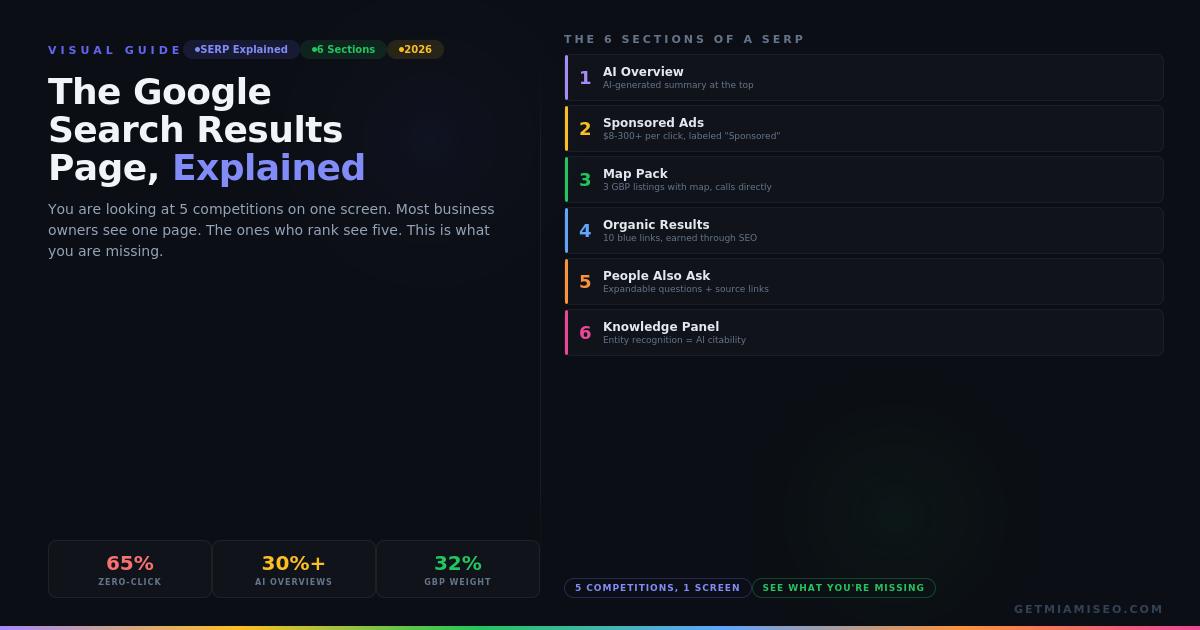
Five Competitions on One Screen
Open Google on your phone right now. Type "dentist Coral Gables." Look at the screen.
You are looking at five different competitions happening simultaneously, each with its own rules, its own costs, and its own winners. Most business owners see one page. The ones who rank see five.
The AI Overview at the top summarizes answers from three dental practices. The sponsored ads below it cost $8-15 per click. The Map Pack shows three Google Business Profile listings with a map. The organic blue links list ten websites. The People Also Ask box expands with questions people also typed. Each section is a separate battlefield. Winning one does not mean winning the others. Losing all five means you are invisible to the 65% of searches that now end without a single click to any website (SparkToro 2026).
This article walks through every section of that page, explains how businesses get into each one, and links to the specific guide in our library that covers how to win it. By the end, you will understand the full field you are competing on, not just the corner you have been staring at.
Section 1: The AI Overview (The Answer Above Everything)
Where it appears: The very top of the page, above ads, above the Map Pack, above everything.
What it is: An AI-generated summary that synthesizes information from multiple websites into a single answer. Google's AI reads dozens of pages, selects the most relevant and trustworthy, and produces a paragraph (sometimes with bullet points or a table) that answers the query directly. Sources are cited with small links on the right side.
How common it is: AI Overviews now appear on more than 30% of all Google searches (Semrush March 2026). For informational queries, that number jumps to 58% in markets where the feature is fully active. 88% of queries that trigger AI Overviews are informational intent.
Why it matters for Miami businesses: When someone searches "best dentist for kids in Coral Gables," the AI Overview may list three practices with a brief description of each. If your practice is not cited, the searcher may never scroll past the AI answer. They got what they needed without seeing your website, your ads, or your Map Pack listing.
The counterintuitive data: 40% of sources cited in AI Overviews come from pages ranking positions 11-20, not just the top 10 (Heroic Rankings 2026). This means a page on page two of Google can still be visible in the AI Overview at the top of page one. Traditional ranking position is no longer the only path to top-of-page visibility.
How to get cited: Entity recognition, FAQ schema markup, direct-answer paragraphs (40-60 words answering a specific question), and content that Google's AI can extract and synthesize. The full strategy: AI Overviews guide and AI search guide.
Section 2: Sponsored Ads (The Pay-Per-Click Layer)
Where they appear: Directly below the AI Overview (or at the very top if no AI Overview triggers). Labeled "Sponsored" in small text.
What they are: Google Ads placements. Businesses bid on keywords and pay every time someone clicks. The position is determined by bid amount, ad quality score, and relevance.
What they cost in Miami: For "dentist Coral Gables," expect $8-15 per click. For "personal injury lawyer Miami," expect $50-300+ per click. For "plumber near me," expect $15-40 per click. These costs recur every single click, every single day, forever, as long as you run ads.
The math compared to organic: SEO generates leads at $31 per lead. PPC generates leads at $181 per lead. PPC delivers instant visibility. SEO compounds over time. The businesses that run both strategically, using ads for immediate demand while organic builds, outperform those that choose only one.
What most business owners miss: 70-80% of users skip the ads entirely and scroll to organic results (AIOSEO 2026). Ads are effective for capturing high-intent searchers who are ready to act immediately, but the majority of clicks go to organic and Map Pack results. Running ads without organic presence means you are paying for the expensive minority while your competitor captures the free majority.
Section 3: The Map Pack (The Three Listings That Get the Calls)
Where it appears: Below the ads (or below the AI Overview if no ads trigger). Shows a map with three business listings: name, star rating, review count, address, phone number, hours, and a "Directions" button.
What it is: The three Google Business Profile listings that Google considers most relevant to the query. For "dentist Coral Gables," the Map Pack shows three dental practices near the searcher's location.
Why this is the most valuable real estate on the page for local businesses: The Map Pack generates calls directly. A searcher sees the listing, checks the star rating, and taps the phone number without ever visiting a website. For many local service businesses, 60-80% of organic leads come from the Map Pack, not from organic blue links.
What determines the three listings: GBP signals account for 32% of Map Pack ranking (Whitespark 2026). The three factors are relevance (does your GBP category match the query?), proximity (how close are you to the searcher?), and prominence (how complete, active, and well-reviewed is your profile?). You cannot control proximity, but you can fully control relevance and prominence.
The GBP scoring system you should run right now: The SEO Scorecard grades your GBP from 0-5 in two minutes. Businesses with 100+ photos get 520% more calls. Review recency outweighs review volume. Weekly posts signal an active business. These are the factors that separate the three listings that get calls from the hundreds that do not.
The bilingual dimension: In Miami, the Map Pack for Spanish queries ("dentista Coral Gables") shows different results than the English query. A GBP with Spanish service descriptions, Spanish Q&A, and Spanish reviews appears in both Map Packs. An English-only GBP appears in one. In a city where 35% of searches happen in Spanish, that is two Map Packs versus one.
Section 4: Organic Results (The Blue Links That Compound)
Where they appear: Below the Map Pack. Ten listings, each with a title, URL, and description.
What they are: The traditional search results. Earned through content quality, backlinks, schema markup, page speed, mobile optimization, and domain authority. No per-click cost. Once you rank, the traffic is free and compounds over time.
Why they still matter despite everything above: Organic results receive 28.74% of all search clicks (SparkToro 2026). That is more than ads (6.44%). For commercial queries where the searcher wants to compare, research, or evaluate before buying, the organic results are where the decision happens. The AI Overview provides a quick answer. The Map Pack provides a quick call. The organic results provide the depth that complex decisions require.
What determines the ten listings: On-page content quality, link signals (26% of local organic ranking), schema markup, page experience (speed, mobile, security), content depth and relevance, E-E-A-T signals, and click-through behavior.
The mistake most businesses make here: Having one "Services" page listing everything instead of individual pages for each service. A single services page competes for one position with one URL. Ten service pages compete for ten positions with ten URLs. The construction firm with 40 project pages has 40 organic ranking opportunities. The one with a portfolio gallery has one.
Section 5: People Also Ask (The Questions Google Thinks You Should Also Be Answering)
Where it appears: Usually between organic results 3 and 4, though the position varies. Shows 3-4 expandable questions that Google considers related to the original query.
What it is: A dynamic list of follow-up questions. When you click one, the answer expands and Google adds more questions below it. The answers are pulled from websites that have structured their content to answer specific questions clearly.
How common it is: PAA appears in 8.5% of all searches and in 81% of searches that also show an AI Overview (Heroic Rankings 2026). When an AI Overview appears, PAA almost always appears with it.
Why it matters: Each PAA answer links to a source website. If your website is the source for one of those answers, you gain visibility without ranking in the top 10. The PAA box is visible above many organic results, giving your content a prominent position for a query you may not rank highly for otherwise.
How to get your content into PAA: Structure your pages with question-format headings (H2 or H3 tags phrased as questions) followed by concise 40-60 word answers. Add FAQPage schema. Answer the specific questions that appear in PAA for your target queries. The SEO audit identifies which of your pages are structured for PAA capture and which are not.
Section 6: Knowledge Panel (The Entity Box)
Where it appears: Right side of desktop results (or at the top on mobile) for queries about recognized entities: businesses, people, places, organizations.
What it is: A structured information box showing Google's understanding of a specific entity. For a business, it typically shows: name, category, address, hours, phone, website, reviews summary, photos, and sometimes Q&A or popular times.
What it means: If your business has a Knowledge Panel, Google has recognized it as a distinct entity in the Knowledge Graph. This is a higher level of recognition than simply ranking as a web page. Entity recognition feeds AI Overviews, ChatGPT recommendations, and voice search answers.
How to earn one: Complete Google Business Profile, consistent NAP across all platforms, schema markup with sameAs links to authoritative profiles, Wikidata entry if eligible, press coverage in trusted publications, and consistent entity signals over 3-6 months.
The Number That Changes Everything: 65%
65% of all Google searches in 2026 end without a click on any external result (SparkToro/Datos 2026). On mobile, it is 77%.
That means for every 100 people who search "dentist Coral Gables," approximately 65 of them get what they need directly from the search results page: from the AI Overview, the Map Pack listing, the Knowledge Panel, or the People Also Ask answers. They never click a website.
This is not a failure of the system. It is the design of the system. Google wants to answer questions on the results page itself. The businesses that thrive in this environment are the ones whose information is present in every section of the page, not just the organic links at the bottom.
A dental practice that is cited in the AI Overview, appears in the Map Pack, ranks in organic results, and has answers in the People Also Ask box captures visibility across four sections of the same page. A competitor that only ranks #7 in organic captures one section, and a smaller one at that.
The Scorecard measures your readiness across all these sections. The Cheat Sheet links to the guide for each one. This article is the map that shows you where they all sit on the page you look at every day but have never truly seen.
What Most Miami Businesses Get Wrong About This Page
They optimize for one section and ignore the other four. A business investing in Google Ads but ignoring GBP is winning one competition and losing three. A business with a strong website but no reviews, no GBP posts, and no schema markup is competitive in organic but invisible in the Map Pack and AI Overviews.
They do not realize the Map Pack and organic are controlled by different factors. GBP completeness, category, and reviews drive the Map Pack. Content, links, and schema drive organic. Working on one does not automatically improve the other. The businesses that dominate work on both simultaneously.
They measure success by a single metric. "We rank #5" is one dimension. Are you in the Map Pack? Are you cited in the AI Overview? Do your pages appear in People Also Ask? Does your Knowledge Panel exist? The ROI framework tracks organic leads across all of these sections combined, not just organic clicks.
They see the Spanish results page as the same competition. It is not. The Spanish SERP for "dentista Coral Gables" has different AI Overviews, different Map Pack listings, and different organic results than the English SERP. A bilingual business competes on two search results pages for every query. An English-only business competes on one.
The 5-Minute SERP Check You Should Run Right Now
Step 1: Search your primary service + your city on Google (example: "plumber Hialeah"). Note which sections appear: AI Overview? Ads? Map Pack? Organic? PAA?
Step 2: Check the AI Overview. Is your business cited? If not, who is? What did they do differently? (Usually: FAQ content, structured data, direct-answer formatting.)
Step 3: Check the Map Pack. Are you in the top three? If not, check your GBP completeness. Compare your photos, reviews, and category to the three businesses that made it.
Step 4: Check organic results. Where does your website appear? If you are on page two or beyond, what content do the page-one results have that you do not?
Step 5: Repeat the search in Spanish. "Plomero Hialeah." Is the entire SERP different? Are you visible in Spanish at all?
This takes five minutes. But the gap between what you see and what your competitors see on this same page is the gap between what your business earns from Google and what it leaves behind.
Want us to run the full SERP analysis for your business? ->