The Dashboard That Measured Everything Except What Mattered
In April 2026, a med spa owner in Coral Gables called her SEO agency and asked a question the agency could not answer. "What is my cost per lead from organic search?"
The agency could tell her that organic traffic was up 34%. That 12 keywords had improved positions. That Google impressions had grown 22% year-over-year. That her domain authority had increased from 18 to 24. The monthly report was 14 pages long, filled with charts and arrows pointing upward.
But it could not tell her the one number she needed: how many of the 47 new patients who walked through her door last month came from Google, and what each one cost to acquire compared to her Instagram ads and her Google Ads campaigns.
The agency was measuring its own performance. The owner was trying to measure her business's performance. They were looking at different dashboards, and neither realized the other's existed.
This is the Revenue Attribution Gap. It is the single largest source of frustration in agency-client relationships, and it exists because SEO has historically been measured in activity metrics (rankings, traffic, impressions) rather than business metrics (leads, revenue, cost-per-acquisition). The activity metrics tell the agency whether the work is producing technical results. The business metrics tell the owner whether the investment is producing money.
Every article in this library has made implicit ROI promises. The hotel that saves $20,460 per year by shifting 15% of OTA bookings to direct. The CPA whose Spanish page generated $14,950 in six months. The contractor whose project page generated a $340,000 inquiry. But none of those numbers mean anything if the business cannot track them. This article is the measurement framework that every other article in the library needs.
Why "More Traffic" Is Not a Business Metric
Traffic is to SEO what foot traffic is to a retail store. It matters. More is generally better than less. But if 500 people walk through your store every day and nobody buys anything, the foot traffic number is not the problem. The conversion is.
The same applies to organic search traffic. A Miami law firm that ranks for "what is personal injury law" gets traffic from law students, other lawyers, and people doing homework. None of them are clients. A law firm that ranks for "personal injury lawyer Coral Gables" gets traffic from injured people looking to hire a lawyer this week. Both are "organic traffic." One generates revenue. The other generates a line on a report.
The distinction between activity metrics and business metrics is not academic. It determines whether a business owner can answer the question that justifies or cancels every marketing investment: "Is this making me money?"
Activity metrics (what agencies typically report): keyword rankings, organic traffic volume, impressions, click-through rate, domain authority, backlink count, page speed score. These are valid technical indicators. They confirm whether the SEO work is producing the expected technical outputs. But none of them are money.
Business metrics (what business owners need to see): organic leads per month (calls, form submissions, bookings, purchases from organic search), cost per lead from organic vs other channels, revenue attributable to organic search, and client lifetime value by acquisition channel. These are money.
The gap between these two sets of metrics is where most SEO dissatisfaction lives. A business owner who sees traffic going up but cannot connect it to revenue eventually concludes that SEO is not working, even when it is. An agency that reports only traffic eventually loses a client who wanted leads, even when the campaign was technically performing well.
The Four Numbers Every Miami Business Should Track
These four metrics close the Revenue Attribution Gap. They are measurable using free tools (Google Analytics 4 and Google Search Console), they connect SEO activity to business outcomes, and they give both the business owner and the agency a shared language for evaluating performance.
1. Organic leads per month. This is the count of business-relevant actions taken by visitors who arrived through organic search. For a medical practice, it is appointment bookings and phone calls from organic. For a restaurant, it is online reservations and direction requests from organic. For a home services business, it is form submissions and phone calls from organic. GA4 tracks this through conversion events filtered by traffic source.
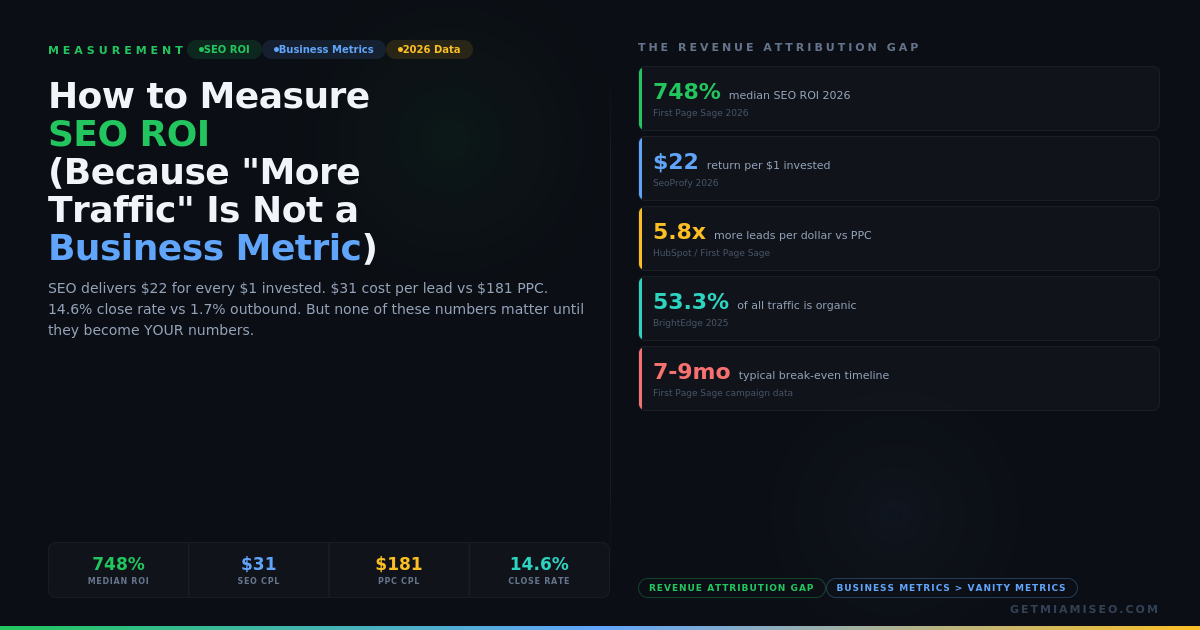
2. Cost per lead from organic. Divide your monthly SEO investment by the number of organic leads. If you spend $3,000 per month on SEO and generate 40 organic leads, your cost per lead is $75. The industry benchmark is illuminating: SEO generates leads at an average cost of $31 per lead, compared to $181 for PPC (HubSpot/First Page Sage 2025-2026). That is 5.8 times more cost-efficient. For Miami businesses running both SEO and Google Ads, comparing the CPL of each channel reveals where dollars work hardest.
3. Revenue attributable to organic search. Track which customers came from organic search and what they spent. For service businesses, this requires asking new clients "How did you find us?" and recording the answer. For ecommerce, GA4's attribution models track this automatically. For hotels, it is direct bookings from organic traffic versus OTA bookings. The median SEO ROI across industries is 748% (First Page Sage 2026), meaning businesses earn $7.48 for every $1 invested. But you cannot know your specific number without tracking organic revenue.
4. Client lifetime value by acquisition channel. A beauty client acquired through organic search who visits 6 times per year at $536 per visit generates $3,216 in annual revenue. The lifetime value of that client over 3 years is $9,648. Divide that by the cost to acquire her, and the ROI of the organic search that brought her in becomes clear. Businesses that track LTV by channel discover that organic clients often have higher retention and higher spending than paid-channel clients because organic searchers self-selected based on intent.
How to Calculate SEO ROI With a Single Spreadsheet
The formula: (Revenue from organic search - SEO investment) / SEO investment x 100 = ROI percentage.
A worked example for a Miami dental practice:
Monthly SEO investment: $3,000. Annual investment: $36,000. Organic leads per month: 35 new patient inquiries from organic search. Conversion rate (inquiry to patient): 60%. New patients from organic per month: 21. Average patient value per year: $1,200. Annual revenue from organic patients: 21 patients x $1,200 = $25,200 in year one. Patient retention over 3 years: 70%. 3-year revenue from year-one organic patients: approximately $50,400.
Year-one ROI: ($25,200 - $36,000) / $36,000 = -30%. Negative in year one. 3-year ROI: ($50,400 - $36,000) / $36,000 = +40%. Positive. Including year 2 and 3 organic patient acquisition: ROI compounds to 300-500%+ because the SEO investment in year one generates patients in years two and three as rankings hold.
This is why the break-even timeline matters. First Page Sage data shows SEO campaigns break even within 7-9 months on average. Local service businesses break even faster, in 5-6 months, because local queries convert with higher intent and shorter decision cycles. Judging SEO performance at 90 days, as many business owners instinctively do, evaluates a compound investment on a short-term timeline. It is the equivalent of planting a tree in January and complaining in March that there is no fruit.
The pricing guide covers what SEO costs. This framework shows what it returns.
What Your Agency Should Report Each Month (And What They Usually Report Instead)
What agencies typically report: keyword ranking changes, traffic graphs, impression counts, backlink acquisition, technical fixes completed, content published. These are valid deliverables and they confirm work is being done. They do not confirm the work is generating revenue.
What agencies should also report: organic lead count (calls + forms + bookings from organic), cost per organic lead for the month, revenue attributed to organic search (if trackable), conversion rate from organic traffic, and comparison to paid channels (organic CPL vs PPC CPL vs social CPL).
The second set of reports requires infrastructure that many agencies do not set up by default. Conversion tracking in GA4 (marking form submissions, calls, and bookings as conversion events), call tracking (using a dedicated phone number for organic traffic), and CRM tagging (marking leads by source) are the three systems that make revenue-based reporting possible.
If your agency does not currently report business metrics, the fix is a conversation, not a firing. Ask: "Can we set up GA4 conversion tracking for my top 3 lead actions? Can we implement call tracking to attribute phone leads to organic? Can you add a monthly CPL comparison to my report?" Most agencies will welcome the request because it gives them a framework to demonstrate value that rankings alone cannot prove.
The agency selection guide covers what to evaluate before hiring. This is what to evaluate after.
Benchmarks by Industry: What Good Looks Like for Miami Verticals
The numbers below represent aggregate industry benchmarks from 2025-2026 data (First Page Sage, SeoProfy, AllOutSEO). Your specific results will vary based on competition, investment level, and market.
Real estate achieves the highest measured SEO ROI at 1,389% (First Page Sage 2026). High transaction values and strong local search intent drive massive returns. A single closed real estate transaction from organic search can exceed the entire annual SEO investment.
Financial services and CPAs deliver approximately 1,031% ROI. High client lifetime values (multi-year retention) make every organic lead worth significantly more than its acquisition cost.
Legal services show SEO conversion rates 3.4 times higher than PPC (First Page Sage). Personal injury cases acquired through organic search can generate six-figure fees from a single client. Break-even is longer (13-14 months) because the sales cycle is complex.
Medical practices see strong ROI driven by patient lifetime value. A patient acquired through organic search who stays for 5+ years generates revenue that compounds far beyond the acquisition cost.
Home services and construction break even in 5-6 months (AllOutSEO 2025). High-intent local searches ("emergency plumber near me") convert quickly and reliably.
Hotels and short-term rentals measure ROI differently: commission savings from direct bookings. Each direct booking saves 15-25% in OTA commissions. The ROI of hotel SEO is not "revenue gained" but "commissions avoided."
Ecommerce achieves a more moderate 317% ROI but at high absolute volume. Organic search drives 53.3% of all website traffic (BrightEdge 2025), making it the single largest traffic and revenue source for online stores.
Bilingual ROI: Measuring Spanish vs English Revenue Separately
This is the measurement dimension that no national SEO ROI guide discusses, and it is specific to Miami.
35% of Miami searches happen in Spanish. A bilingual SEO strategy generates organic leads from both languages. But if you measure them as one combined number, you cannot know which language is delivering better ROI, which content needs more investment, or whether your Spanish pages are outperforming your English pages (which they frequently do in Miami because competition is dramatically lower).
The measurement setup: create separate GA4 landing page reports for English and Spanish pages. Track conversions by landing page language. Calculate the CPL for English organic leads and Spanish organic leads separately. In most Miami businesses implementing bilingual SEO, Spanish organic leads cost significantly less than English organic leads because Spanish keywords carry 75-85% lower difficulty.
A Hialeah dentist generating 15 leads per month from Spanish organic pages at a cost of $12 per lead is achieving dramatically better unit economics than the same dentist generating 20 leads per month from English pages at $60 per lead. Without separating the two, the combined CPL of $30 looks acceptable. With separation, the data shows where to invest more and where the returns are richest.
The AI Visibility Metric Nobody Is Tracking Yet
The four business metrics above measure traditional organic search. In 2026, a fifth metric is emerging that most businesses are not yet tracking: AI citation visibility.
AI Overviews now appear on approximately 16% of all Google queries. ChatGPT, Gemini, and Perplexity are generating local business recommendations that bypass Google entirely. 68% of consumers used ChatGPT to research local products and services in 2025 (Buried Agency 2026).
The measurement challenge: when a customer finds your business through an AI recommendation, there is no "organic search" referral tag in your analytics. The visit may appear as direct traffic, branded search, or a referral from the AI platform. This means AI-driven revenue is likely already happening but being attributed to other channels.
The interim measurement approach: track branded search volume in Google Search Console. If your entity-based SEO and content investments are resulting in AI citations, you should see branded search volume increasing as more people search your business name after seeing it recommended by an AI. Rising branded search volume without a corresponding increase in paid advertising is a strong indicator that AI citation is working.
Also track manually: search your business category on ChatGPT, Gemini, and Perplexity monthly. Record whether your business appears. This is a crude but directionally useful signal of AI visibility that complements the traditional GA4 metrics.
When SEO Is Not Working: The Honest Red Flags
The counter-argument and the honest assessment belong together, so here they are.
The honest counter-argument. Not every SEO campaign delivers positive ROI. Some businesses operate in categories where organic search is not the primary discovery channel (luxury goods where referrals dominate, highly regulated industries where advertising restrictions limit content, niche B2B where account-based marketing outperforms inbound). For these businesses, the 748% median ROI does not apply because their customer acquisition does not run through Google. If your customers do not search Google to find what you sell, SEO will not generate meaningful returns regardless of how well it is executed.
Red flags that indicate your SEO is genuinely underperforming:
Traffic is growing but leads are flat or declining. This means the campaign is attracting the wrong traffic, ranking for non-commercial queries, or the website has a conversion problem that SEO cannot fix.
Rankings are improving but only for low-value keywords. Ranking #1 for a question that generates 20 searches per month is not the same as ranking #5 for a keyword that generates 2,000.
Your agency cannot tell you how many leads came from organic search. If the tracking infrastructure does not exist, the ROI conversation cannot happen. This is a fixable problem, not a reason to cancel.
You have been investing for 12+ months with no measurable lead increase. The 7-9 month break-even benchmark means patience is warranted for the first year. Beyond that, either the strategy needs correction or the market is not responsive to search-based acquisition.
Cost per organic lead is rising over time instead of falling. SEO CPL should decrease as rankings strengthen and content compounds. If it is rising, something is wrong with the content quality, the keyword targeting, or the competitive landscape has shifted.
Common Mistakes Miami Businesses Make When Measuring SEO
Measuring rankings instead of leads. A #1 ranking for a keyword nobody searches is worth $0. Rankings are intermediate indicators, not outcomes.
Comparing SEO to PPC on a 30-day timeline. PPC generates immediate results because you pay per click from day one. SEO compounds over months. Comparing them at 30 days is comparing a seed to a harvest.
Not setting up conversion tracking before starting SEO. Without GA4 conversion events for calls, forms, and bookings, there is no way to measure organic leads. This must be set up before the campaign starts, not months later.
Counting all traffic as equal. 1,000 visits from "how to tie a tie" (informational, zero commercial intent) and 50 visits from "plumber Hialeah" (commercial, high intent) are not comparable. The 50 visits are worth more.
Not tracking bilingual revenue separately. In Miami, combined English + Spanish metrics mask the performance difference between languages. Separate them.
Judging a compound investment on a short-term timeline. The SEO Calendar shows that demand varies by month. Judging SEO performance during a slow month against a peak month produces false conclusions.
The 90-Day Measurement Framework
Day 1-30: Establish the infrastructure. Set up GA4 conversion tracking for your top 3 lead actions (phone calls, form submissions, bookings). Implement call tracking with a dedicated organic number. Create a simple spreadsheet tracking monthly organic leads, CPL, and revenue. Run a baseline: how many organic leads did you generate last month before the campaign?
Day 31-60: Establish the baseline. Record the first full month of tracked data. This is your starting point. Do not expect improvement yet. The SEO work in month one is foundational: audits, schema markup, GBP optimization, keyword mapping. The numbers may look identical to month zero.
Day 61-90: Watch the leading indicators. Impressions in Google Search Console should be climbing. Google Reviews should be accumulating. New content should be indexed. These are signs that the foundation is working even before leads increase. If impressions are flat and no new content has been published, ask your agency what the plan is.
Monthly thereafter: Track leads, CPL, and revenue from organic in the spreadsheet. Compare month-over-month and year-over-year. Expect gradual improvement from months 3-6 and meaningful business impact from months 6-12. If month 9 shows no lead improvement over the baseline, the campaign needs strategic review.
What Miami Businesses Should Do This Week
Step 1: Ask your agency one question. "How many leads did I get from organic search last month?" If they cannot answer, you have a measurement problem, not necessarily a performance problem. Fix the measurement first.
Step 2: Set up GA4 conversion tracking. Mark your top 3 lead actions as conversion events: phone call clicks, form submissions, and booking completions. Filter by organic search traffic source.
Step 3: Calculate your current organic CPL. Divide your monthly SEO spend by the number of organic leads. Compare this to your Google Ads CPL and your social media CPL. If you do not know any of these numbers, that is the problem to solve before changing anything about your SEO strategy.
Step 4: Start the spreadsheet. One row per month. Columns: organic leads, SEO spend, CPL, revenue attributed to organic, ROI percentage. This is the dashboard the med spa owner needed and did not have.
FAQs: Measuring SEO ROI
What if I cannot track which leads came from organic search? Start with GA4 conversion events filtered by organic traffic source. For phone leads, implement call tracking with a dedicated number displayed only to organic visitors. For walk-ins, ask every new client "How did you find us?" and record the answer. Imperfect tracking is better than no tracking.
Should I track Google Business Profile actions as SEO leads? Yes. GBP calls, direction requests, and website clicks from the Map Pack are organic search leads. Include them in your organic lead count. GBP Insights provides this data directly.
How do I account for SEO leads that close months later? Use a CRM or simple spreadsheet to track lead source and close date. Assign the revenue to the month the lead was acquired, not the month it closed. This prevents long-cycle businesses from undervaluing SEO during the months when leads are generated but not yet converted.
Is a 748% ROI realistic for a small Miami business? 748% is the median across industries and company sizes (First Page Sage 2026). Small local businesses often exceed this because local SEO competition is lower, local queries convert at higher rates, and client lifetime values for service businesses are high. The plumber example (68:1 return on a single acquired client) illustrates how local business economics amplify SEO returns.
How does link building affect ROI? Campaigns combining link building with content see 73% stronger ROI than content alone (AllOutSEO 2025). Links accelerate break-even because they speed up ranking improvements, which speeds up lead generation.
What is the minimum SEO investment to see measurable ROI? The pricing guide covers investment ranges. For local Miami businesses, meaningful ROI typically requires a minimum of $1,500-2,000 per month sustained over 6+ months. Investments below this threshold often underperform because the work cannot reach critical mass.
Should I stop Google Ads once SEO is working? Not necessarily. Google Ads captures immediate demand while SEO compounds. The optimal strategy is to reduce ad spend on keywords where you rank organically (reducing the cost without losing the traffic) and maintain ads on keywords where organic ranking is still building.
How do I measure the ROI of Spanish-language SEO specifically? Create separate GA4 landing page reports for Spanish and English pages. Track conversions by page language. Calculate CPL for each language. Spanish CPL in Miami is typically 40-60% lower than English CPL due to lower keyword competition.
The Number She Actually Needed
The med spa owner in Coral Gables eventually got her answer. After implementing GA4 conversion tracking, call tracking, and a simple monthly spreadsheet, the picture became clear within 60 days. Of the 47 new patients who walked in last month, 19 came from organic search (tracked through call tracking and form attribution). Her monthly SEO investment was $3,500. Her organic CPL was $184. Her Instagram CPL was $220. Her Google Ads CPL was $310.
Organic search was not just working. It was her most cost-efficient acquisition channel. She had been two months away from canceling it because the 14-page report full of ranking charts told her everything except the one number that mattered.
SEO delivers a median ROI of 748%. It generates leads at $31 per lead versus $181 for PPC. It closes at 14.6% versus 1.7% for outbound. Organic search accounts for 53.3% of all website traffic. These aggregate numbers are real and well-documented. But they mean nothing until they become your numbers, tracked in your spreadsheet, against your investment.
The med spa owner did not need a better agency. She needed a better dashboard. Once she built it, the conversation changed from "Is SEO working?" to "How do we invest more in the channel that is working best?"
That is the question every Miami business should be asking. And the only way to ask it is to measure.
Get a free SEO ROI audit for your Miami business ->