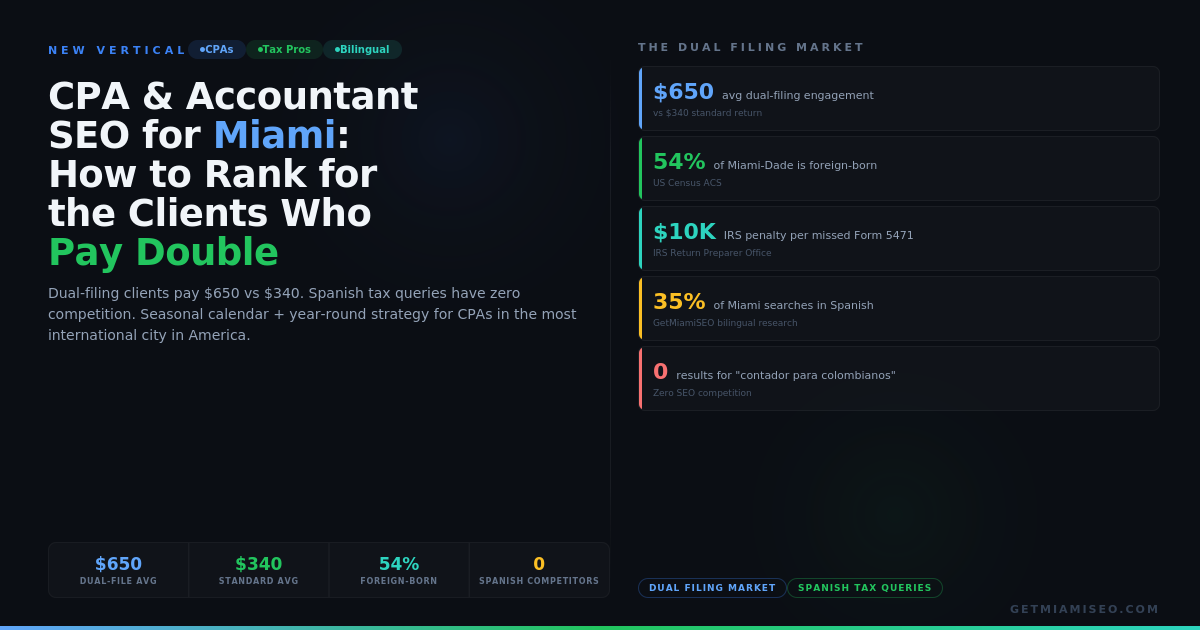
On January 15, 2026, a CPA with a small practice on Flagler Street in Downtown Miami opened his calendar and counted. He had 347 active tax clients. Of those, 212 filed US federal returns only (Florida has no state income tax). The remaining 135 filed US returns and also had tax obligations in Colombia, Venezuela, Brazil, Cuba, or Argentina. Those 135 dual-filing clients paid an average of $650 per engagement, nearly double the $340 average for US-only filers, because the work was more complex, involved FBAR and FATCA compliance, and fewer CPAs had the expertise to handle it.
The CPA's website ranked on page one for "CPA Miami." That ranking brought in new clients every month. But when he searched "contador para colombianos en Miami," the exact query his highest-value clients had used to find him through word-of-mouth referrals and WhatsApp group recommendations, his website did not appear anywhere in the first five pages of Google.
His most profitable market segment was finding him by accident. By referral. By chance. Not by search. And the search landscape for that query was essentially empty. No competitor had built a page for "contador para colombianos en Miami." No competitor had built a page for "declaracion de impuestos para venezolanos en Estados Unidos." No competitor had built a page for "obligaciones fiscales para argentinos con green card." Each of these queries had real search volume from real people willing to pay premium rates for specialized expertise. And each query returned thin, unoptimized results.
This is the opportunity that SEO opens for Miami CPAs, accountants, and tax professionals. The general market ("CPA Miami") is competitive. The specialized bilingual market ("contador + nationality + city") is wide open. And the economics of the second market are better than the first, because the clients who need dual-filing expertise pay more and stay longer.
Miami's Tax and Accounting Market
Miami-Dade County's accounting market is shaped by three forces that no other US metro combines at this intensity.
The foreign-born population. 74.5% of Hialeah residents were born outside the United States. Across Miami-Dade County, the foreign-born percentage is approximately 54% (US Census ACS). These residents come predominantly from Cuba (the largest group), Colombia, Venezuela, Brazil, Haiti, Argentina, and Nicaragua. Many maintain financial ties to their countries of origin: bank accounts, rental properties, business interests, pension benefits, and investment portfolios that trigger US reporting requirements including FBAR (FinCEN 114), FATCA (Form 8938), Form 5471, and Form 8865. The IRS imposes a $10,000 initial penalty for failing to file Form 5471 per tax year. The stakes are real and the demand for CPAs who understand cross-border compliance is year-round.
Florida's no-state-income-tax advantage. Florida is one of nine states with no individual income tax. This attracts high-net-worth individuals and business owners from states like New York, California, and Illinois who relocate to reduce their tax burden. These clients need CPAs who understand the domicile change process, the partial-year filing implications, and the ongoing compliance requirements. The migration wave to Miami that accelerated during and after 2020 brought tens of thousands of new tax clients who needed local CPAs for the first time.
The startup and corporate ecosystem. Miami's tech ecosystem attracted $4.6 billion in VC funding. New businesses are forming at record rates, with 4,900 new businesses in a recent year. Each new business needs bookkeeping, payroll, sales tax compliance, and corporate tax preparation. The intersection of startup growth and international founder backgrounds creates demand for CPAs who can handle both US corporate tax and the international tax planning that foreign-born founders require.
The Seasonal Search Calendar for CPAs
Tax preparation demand is the most predictable seasonal pattern in professional services. The Miami SEO Calendar framework applies directly, with specific publishing windows for each phase of the tax year.
November through December: Pre-season preparation. This is the publishing window, not the demand window. Content about tax preparation, document checklists, year-end tax planning, and service pages should be live by mid-November to rank during the January spike. A CPA who publishes a "2026 Tax Preparation Guide for Miami Small Businesses" in November captures the search demand that builds throughout January.
January through April 15: Peak season. This is when 60%+ of annual tax-related search demand occurs. "CPA near me," "tax preparer Miami," "how to file taxes," and every variation spike from January through mid-April. The firms ranking during this window captured their positions months earlier. Content published in January competes against content that has been ranking since November.
April 16 through June 15: Extension season. A meaningful percentage of taxpayers file extensions. "Tax extension help Miami" and "late tax filing CPA" queries create a secondary demand window. CPAs who build content specifically for extension filers capture clients that competitors ignore because they are already winding down from peak season.
July through September: Quarterly and mid-year. Corporate quarterly estimated payments, mid-year tax planning for businesses, and payroll tax compliance create steady year-round demand. "Quarterly tax payment help," "estimated tax calculator," and "payroll tax compliance Miami" are year-round queries that most CPAs do not target.
October through November: Q4 planning and year-end. Corporate year-end tax planning, charitable giving optimization, and retirement contribution decisions drive search demand. "Year-end tax planning Miami" and "corporate tax strategy Q4" capture business clients preparing for the fiscal year close. This window loops back into the November publishing cycle for the next tax season.
The year-round dimension matters. Many CPAs mentally switch off their marketing after April 15 because "tax season is over." But corporate clients, bookkeeping clients, payroll clients, and international compliance clients generate demand every month of the year. A CPA who builds content only for tax season misses 8 months of year-round demand from businesses that need accounting services regardless of filing deadlines. The firms that rank year-round are the ones that built pages for bookkeeping, payroll, QuickBooks advisory, financial statements, and ongoing compliance, not just tax preparation.
For the Miami SEO Calendar specifically, CPA demand aligns with several Miami-specific events: new businesses forming after the new year (January), EB-5 and visa-related tax questions during immigration peaks, property tax assessments in the summer, and quarterly estimated payments for the growing base of self-employed and gig-economy workers in Miami's entrepreneurial economy.
The Dual Filing Market: Why Miami CPAs Serve Two Tax Systems
This is the commercial insight that separates Miami CPA marketing from every other US market.
Miami is the primary US gateway for Latin American immigration, investment, and business. The result is a large population of residents who have simultaneous tax obligations in the United States and their country of origin. A Colombian national with a US green card who owns rental property in Bogota. A Venezuelan asylum-seeker with a new work permit and a bank account in Caracas. A Brazilian entrepreneur who entered on an EB-5 investor visa and maintains a business in Sao Paulo. An Argentine investor who bought a condo in Brickell and needs to report rental income in both countries.
Each of these clients needs a CPA who understands FBAR filing requirements (foreign bank accounts exceeding $10,000), FATCA compliance (Form 8938 for specified foreign financial assets), Form 5471 (controlled foreign corporations), Form 8865 (foreign partnerships), FIRPTA withholding (for foreign sellers of US real estate), and the tax treaty implications between the US and the specific country involved.
These dual-filing engagements are more complex, take more hours, require specialized knowledge, and command higher fees. The CPA on Flagler Street charging $650 for a dual-filing engagement versus $340 for a standard return is not overcharging. He is pricing the expertise correctly. And these clients are more loyal because the switching cost is high: finding another CPA who understands both US and Colombian tax law takes months.
The SEO opportunity: build pages targeting the specific nationality and tax need. "Contador para colombianos en Miami," "impuestos para venezolanos en Estados Unidos," "CPA for Brazilian nationals Miami," "FBAR filing help Miami." Each page captures a high-value client segment that no competitor has built content for. The keyword difficulty on these queries is effectively zero because no one has tried.
Spanish-Language Tax Queries That No Competitor Has Built Pages For
35% of Miami searches happen in Spanish. For tax services, the percentage may be higher because tax preparation is one of the most language-dependent professional services. A client who speaks Spanish at home, thinks about money in Spanish, and asks financial questions in Spanish will search for a tax preparer in Spanish.
The competitive landscape for Spanish tax queries in Miami:
"Contador Miami" has moderate volume and virtually no optimized competition. "Preparador de impuestos Hialeah" has real volume and zero competition. "Declaracion de impuestos para colombianos en Miami" has specific volume and zero competition. "Cuanto cobra un contador en Miami" is a high-intent pricing query with zero competition. "Documentos necesarios para hacer los taxes" is an informational query that drives pre-season traffic with zero competition.
Each of these is a page that can be built in native Spanish, optimized with bilingual SEO best practices, and ranked within 30 to 90 days because the field is empty. The first CPA firm that builds these pages owns the Spanish-language tax search market in Miami for as long as it takes competitors to notice and respond.
Service Page Architecture for CPAs
A single "Our Services" page listing every service in a paragraph is the CPA equivalent of the one-page services mistake that every industry makes. Each service should have its own page.
Personal tax preparation. Targeting "tax preparation Miami," "personal tax return CPA Miami," "preparacion de impuestos Miami."
Corporate and business tax. Targeting "corporate tax CPA Miami," "small business tax preparer Miami," "LLC tax filing Miami."
International tax and cross-border compliance. Targeting "international tax CPA Miami," "FBAR filing Miami," "FATCA compliance CPA," "foreign business CPA Miami."
Bookkeeping and accounting. Targeting "bookkeeping services Miami," "small business accounting Miami," "QuickBooks accountant Miami."
Payroll services. Targeting "payroll service Miami," "payroll tax compliance," "nomina de empleados Miami."
IRS problem resolution. Targeting "IRS audit help Miami," "back taxes CPA Miami," "tax debt resolution Miami," "representacion ante el IRS Miami."
Each page should include: a clear H1 with the service and location, a direct-answer paragraph (40-60 words, featured-snippet ready), the specific situations the service addresses, what the client should expect, pricing range if possible, FAQ content answering real client questions, and a booking CTA.
The international tax page deserves special attention because it is the highest-value content a Miami CPA can build. This page should address: who needs to file FBAR (anyone with foreign financial accounts exceeding $10,000 in aggregate value), who needs to file FATCA Form 8938 (thresholds vary by filing status and residency), what happens if you have not filed (the IRS imposes $10,000 per form per year for willful non-compliance on Form 5471 alone), and which countries' tax treaties with the US affect Miami's primary immigration populations (Colombia, Venezuela, Brazil, Cuba, Argentina). This level of specificity is what converts a visitor into a client because it demonstrates the exact expertise the searcher is looking for.
For AI search visibility, each service page should answer a question that AI engines can extract: "How much does tax preparation cost in Miami?" "What documents do I need for my tax return?" "Do I need to file FBAR if I have a foreign bank account?" These direct-answer structures make the page citable by ChatGPT and Google's AI Overviews while also serving as featured-snippet targets in traditional search.
Google Business Profile for Accountants
GBP signals account for 32% of Map Pack ranking factors (Whitespark 2026). For CPAs, the GBP is the primary discovery channel during tax season because searchers are looking for a provider near them who can handle their return.
Primary category: "Certified Public Accountant" or "Tax Preparation Service" or "Accountant," depending on which best matches your primary service. Add secondary categories for all other services offered.
Services: List every service with descriptions. In Spanish alongside English for Miami practices. "Preparacion de impuestos personales," "Contabilidad para negocios," "Cumplimiento FBAR y FATCA."
Hours during tax season. Many CPAs extend hours January through April. Update your GBP hours to reflect this. Searchers who find a CPA listed as "Open until 8 PM" during tax season are more likely to call than one showing standard 9-to-5 hours.
Photos. Real office photos, not stock images. For CPAs, photos of the office, the team, and the waiting area build trust. A photo showing a bilingual sign or a Spanish-language welcome builds additional trust for the Hispanic market.
Reviews That Convert Tax Clients
Reviews mentioning specific services carry more ranking weight than generic praise. For CPAs, the reviews that matter most mention: the type of return filed (personal, corporate, international), the language of service (English, Spanish, Portuguese), the specific situation resolved (back taxes, FBAR filing, IRS audit), and the outcome.
"My CPA helped me file my Colombian and US tax returns together. She explained the FBAR requirements and made sure I was compliant. Everything in Spanish. Highly recommend for anyone who needs a bilingual tax professional" is a review that gives Google six indexable signals: the service (tax returns), the dual-filing specialty (Colombian and US), the compliance area (FBAR), the language (Spanish), the expertise (bilingual), and the recommendation.
The ask after each engagement: "Would you mind leaving a Google Review mentioning the specific service we helped you with? It helps other clients in similar situations find us."
The Counter-Argument: When Specialization Narrows the Market Too Much
The honest counter-argument. Not every CPA should specialize in dual-filing or international tax. A practice that narrows its focus exclusively to Colombian tax clients may find the addressable market too small to sustain growth. The resolution: specialize in your content and marketing while maintaining broad service capability. A CPA who builds pages for "contador para colombianos en Miami" and "tax preparation for Venezuelan nationals" does not have to refuse US-only clients. The specialized pages capture the high-value niche market. The general pages ("CPA Miami," "tax preparation Miami") capture the broader market. Both coexist on the same website.
The danger is the opposite: being so generic that you disappear into the competition. "CPA Miami" has dozens of optimized competitors. "Contador para colombianos en Miami" has zero. The specialized page is where the unfair advantage lives. The general page is the baseline.
Common Mistakes Miami CPAs Make With SEO
No website, only a GBP listing. A GBP alone cannot rank for informational or commercial queries like "how much does a CPA cost in Miami" or "do I need to file FBAR." A website with service pages, FAQ content, and blog posts captures demand that the GBP cannot.
Publishing tax season content in January. By January, the ranking positions for tax queries are already occupied by firms that published in November. The 6-to-8 week rule applies to tax content exactly as it does to every other seasonal demand.
No Spanish-language content in a 54% foreign-born market. Miami-Dade's foreign-born percentage is among the highest in the US. Most of these residents prefer professional services in Spanish. A CPA without Spanish content is invisible to more than half the market.
Generic service pages instead of specialty pages. "Our Services: tax preparation, bookkeeping, payroll" on one page ranks for nothing. Individual pages for each service, targeting specific queries, rank for everything.
Not claiming or optimizing the Google Business Profile. During tax season, the Map Pack is the first thing searchers see. An incomplete GBP with no reviews, no photos, and default hours loses to the competitor who invested 90 minutes in optimization.
Ignoring the dual-filing market. Miami's highest-value tax clients are the ones with the most complex returns. Building no content for international tax, FBAR compliance, or country-specific filing assistance leaves the most profitable market segment to word-of-mouth alone.
What Miami CPAs Should Build This Month
Week 1: Audit your GBP and website. Is your GBP category correct? Are services listed in both languages? Are your hours updated for current season? Does your website have individual pages for each service? Run the SEO audit checklist.
Week 2: Build your highest-value specialty page. If you serve dual-filing clients, build a page targeting "international tax CPA Miami" or "contador para [nationality] en Miami" for your largest client nationality. Add schema markup, FAQ content, and a booking CTA.
Week 3: Generate reviews from recent clients. Ask your last 20 clients to leave a Google Review mentioning the specific service they received. For bilingual clients, ask in their preferred language. Send the review link within 24 hours of engagement completion.
Week 4: Plan your tax season content calendar. Map the content you need live by November for next tax season: a tax preparation guide, a document checklist, a pricing page, and at least one specialty page for your highest-value client segment. The Miami SEO Calendar provides the full seasonal framework.
FAQs: SEO for Miami CPAs and Accountants
How long does it take for a CPA website to rank? Specialty pages with low competition (bilingual tax queries, country-specific filing) can rank in 30 to 90 days. Competitive terms like "CPA Miami" take 6 to 12 months. The pricing and timeline guide covers expectations by competition level.
Should I invest in Google Ads during tax season? Yes, as a complement to organic SEO. Tax season is a 4-month window where Google Ads can deliver immediate visibility while your organic rankings build. After tax season, reduce ad spend and let the organic rankings carry the year-round demand.
Do I need bilingual content even if I speak English only? If you serve only English-speaking clients, no. But if any of your clients or prospective clients speak Spanish, which in Miami is statistically likely, even one Spanish service page captures demand your English-only competitors miss.
How do AI search engines affect CPA visibility? When someone asks ChatGPT "What is the best CPA for international tax in Miami?", the AI generates recommendations based on entity recognition, reviews, and structured content. CPAs with complete schema markup and detailed service pages are more citable.
What link building works for CPAs? Professional association memberships (FICPA, AICPA, local chambers), guest columns in business publications, expert quotes in tax season articles, and listings on CPA directories (CPA Directory, FindaCPA). Each builds authority and citation signals.
Should I target "accountant" or "CPA" keywords? Both. "CPA" signals credential-based trust and tends to attract higher-value clients. "Accountant" has broader search volume and captures clients who do not distinguish between the terms. Build separate pages for each if your practice warrants it.
How do reviews compare to link building for CPA rankings? Reviews account for 16-20% of Map Pack ranking factors while links account for 26% of local organic. Both matter. Reviews are faster to generate and directly influence the Map Pack. Links compound over time and strengthen organic rankings.
What is the ROI of SEO for a CPA firm? A single corporate tax client acquired through organic search may generate $3,000 to $10,000 annually and stay for years. If SEO costs $3,000 per month and delivers two new corporate clients per month, the annual revenue from those clients exceeds the annual SEO investment within the first quarter.
The Clients Who Pay Double Are Searching in a Language Nobody Is Optimizing For
The CPA on Flagler Street eventually built three Spanish-language pages: one for Colombian dual-filers, one for Venezuelan nationals, and one general "contador bilingue Miami" page. Within four months, the Colombian page ranked position 2 for its target query. Within six months, it had generated 23 new dual-filing clients, each paying the $650 average engagement fee. Total new revenue from one page: $14,950 in its first half-year.
His "CPA Miami" page, which he had spent two years building authority for, was generating roughly the same number of new clients per month at the $340 engagement rate. One Spanish page, built in an afternoon, matched the client generation of his most competitive English page in half the time, at nearly double the revenue per client.
This is the math that changes how Miami CPAs think about SEO. The general market is competitive, expensive to rank in, and populated with clients paying standard rates. The specialized bilingual market is empty, fast to rank in, and populated with clients paying premium rates for expertise that fewer CPAs offer.
The 35% of Miami searches that happen in Spanish include tax searches. The 1.9 million Spanish speakers in Miami-Dade file taxes every year. Many have cross-border obligations that require specialized expertise. And the search results for their queries in their language are, as of this writing, essentially empty.
The parallel to other Miami verticals is exact. Med spas discovered that Instagram generates awareness but Google captures the booking. Hotels discovered that OTA commissions eat 15-25% of revenue and direct organic bookings cost 4.5%. Hialeah businesses discovered that Spanish keywords have zero competition while serving 95% of the local population. For CPAs, the pattern is the same: the most profitable clients are searching in a language nobody is optimizing for, and the first firm that builds the pages wins.
The clients who pay double are searching. Nobody is building the pages to be found.
Get a free SEO audit for your Miami CPA or accounting firm ->