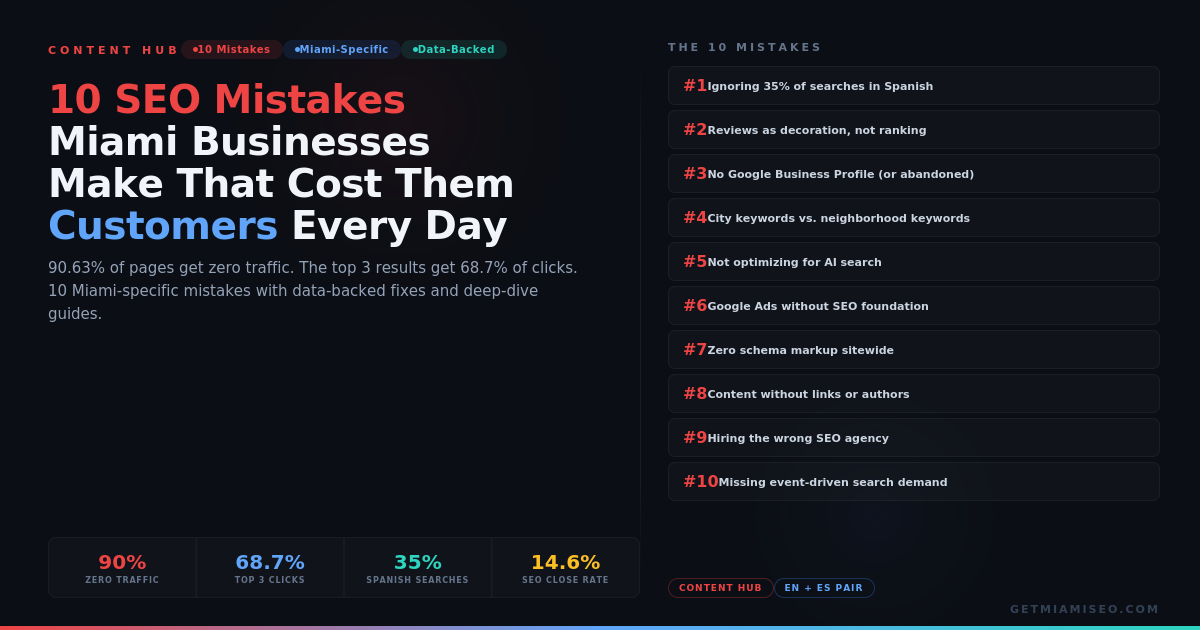
Here is a number that should bother every business owner in Miami-Dade: 90.63% of all web pages receive zero organic traffic from Google (Ahrefs, 2025). Not low traffic. Zero. As if they do not exist.
Meanwhile, the top 3 organic results capture 68.7% of all clicks (FirstPageSage, 2025). The first position alone gets roughly 39.8% of all clicks for a given search. Position 4 through 10? They split the remaining scraps. Page 2? Virtually invisible.
The distance between being found and being invisible on Google is not a question of budget or luck. It is a question of specific, identifiable mistakes that compound over time. And in Miami, a city where 300,000+ businesses compete for attention across 28.2 million annual visitors and a bilingual population of 2.7 million, those mistakes carry a cost that businesses in other cities simply do not face.
Yet only 39% of small businesses currently invest in SEO (WordStream, 2026). That means 61% of businesses have no organic search strategy at all. And the 39% that do are often making mistakes that cancel out their investment. For context: organic search drives 53% of all website traffic, more than paid search, social media, email, and display combined (BrightEdge). For every dollar spent on SEO, businesses earn an average of $22 in return (SmartInsights). The channel is not optional. The mistakes are.
These are the 10 mistakes we see over and over in Miami-Dade. They are ranked by how much revenue they cost, not by how technical they are. Every one of them has a fix. And for every mistake, the guide that walks you through the solution is linked.
This article is also available in Spanish.
Mistake 1: Ignoring That 35% of Miami Searches Happen in Spanish
This is the single most expensive SEO mistake in Miami, and it is the one that no national SEO guide will ever mention. In a county where 69% of residents are Hispanic and 1.9 million people speak Spanish at home, more than a third of all local searches happen in that language.
Think about what that means in practice. A dental practice in Kendall with an English-only website, English-only Google Business Profile, and English-only reviews is invisible to 35% of the people searching for a dentist within two miles of its front door. Those patients are not going without a dentist. They are finding the competitor who has a Spanish-language service page, Spanish Google Reviews, and a GBP description that says "Aceptamos seguros, hablamos español."
The competitive advantage is staggering: Spanish-language keywords carry 75-85% lower difficulty than their English equivalents. "Best dentist Miami" has a keyword difficulty in the 40s. "Mejor dentista en Miami" has a difficulty under 10. The purchase intent behind both searches is identical. The competition is not even close.
And this is not just about Google anymore. With 45% of consumers now using ChatGPT for local recommendations (BrightLocal 2026), the AI responds in the language of the query. A question asked in Spanish pulls answers from Spanish-language content. If you have no Spanish content, the AI has nothing from your business to cite.
The fix: Build authentic Spanish-language content (not Google Translate output, which Google's quality systems detect and downrank). Implement hreflang tags so Google serves the right language version to each user. Respond to Spanish reviews in Spanish. Add Spanish descriptions to your GBP. The bilingual SEO guide covers the full implementation, and the Spanish-language SEO overview is written natively for Hispanic business owners.
Deep dives: Why 35% of Miami Searches Happen in Spanish | Los 10 Errores de SEO (Spanish)
Mistake 2: Treating Google Reviews as Decoration Instead of a Ranking Factor
Most business owners think of reviews as testimonials. Something nice to screenshot for Instagram or print in a brochure. What they do not realize is that Google treats reviews as ranking signals, and those signals carry real weight in determining who appears when a customer searches.
Review signals represent approximately 20% of the factors that determine who shows up in Google's Map Pack (Whitespark Local Search Ranking Factors 2026). That makes reviews the second most influential category, behind only Google Business Profile signals at 32%. Businesses with more than 100 reviews generate 82% more user actions (clicks, calls, direction requests) than those with fewer than 10 (SQ Magazine). And 75% of consumers regularly read reviews before making any purchase decision, with 68% refusing to even consider businesses rated below 4 stars (SagaPixel/BrightLocal 2026).
In 2026, the bar kept rising. 41% of consumers always read reviews before choosing a business (BrightLocal 2026), up from 29% just one year earlier. 31% will only use businesses with 4.5 stars or higher, nearly double the 17% that demanded that threshold in 2025. 19% expect a response to their review the same day it was posted, up from 6% the year before.
The Miami-specific dimension makes this mistake even more costly: Google displays reviews in the searcher's language. When someone searches in Spanish, they see the Spanish-language reviews first. A business with 200 reviews in English and zero in Spanish appears empty to the Hispanic searcher. Meanwhile, a competitor down the block with 40 reviews in each language looks twice as established, twice as trustworthy, to the full bilingual market.
And in 2026, reviews feed AI engines too. Google's AI Overviews extract specific phrases from reviews to generate local recommendations. ChatGPT pulls review sentiment data to answer "best [service] in [location]" queries. Reviews that mention specific services, neighborhoods, and experiences give AI more material to cite your business.
The fix: Implement a systematic review generation process that asks every customer in their language, at the moment of highest satisfaction (right after service delivery). Respond to every review within 24 hours, always matching the language. The "bilingual review flywheel" builds two independent trust pipelines that compound independently.
Mistake 3: No Google Business Profile, or One That Looks Abandoned
A verified Google Business Profile receives approximately 200 clicks or interactions per month on average (SeoProfy 2026). Customers are 2.7 times more likely to trust a business that shows a complete profile on Google Search and Maps (Google data). And businesses appearing in the Local Pack receive 126% more traffic than those ranked 4 through 10 (SOCi research, via TryDecoding 2026).
Yet the number of Miami businesses operating without a claimed, verified, and actively managed GBP is staggering. Some created a profile in 2019 and never touched it again. Some have phone numbers from a previous office. Some list COVID-era hours that were never corrected. Google interprets all of these as signals that the business is either closed, unresponsive, or untrustworthy.
In 2026, the stakes are higher because GBP data feeds directly into Google's AI-powered local pack and Gemini's recommendations. GBP signals now account for 32% of Map Pack ranking factors, making it the single most influential ranking factor for local search (Whitespark 2026). An incomplete profile means the AI cannot recommend you. A complete one with weekly posts, current photos, accurate hours, and detailed service descriptions gets surfaced to every relevant query.
The math makes the urgency clear: 46% of all Google searches have local intent (Think with Google). 80% of US consumers search for local businesses at least once a week (SOCi Consumer Behavior Index). 42% of those local searchers click on results inside the Map Pack (Backlinko user behavior study). If your GBP is incomplete or absent, you are invisible to the largest, most purchase-ready segment of Google's entire user base. And 88% of consumers who conduct a local search on a smartphone visit or call a business within 24 hours (SeoProfy 2026). Every day without a complete profile is a day of missed calls.
The fix: Complete every single field: business description (in English and Spanish), hours (including holidays), services with descriptions, relevant attributes, products, and the Q&A section. Post updates weekly with photos. Respond to every review. Add your service area. Treat your GBP as your primary homepage, because for 42% of local searchers, it is. The complete GBP playbook walks through optimization step by step.
Mistake 4: Targeting "Miami Lawyer" Instead of "Immigration Lawyer Brickell"
Miami-Dade is not one market. It is a collection of neighborhoods with distinct identities, demographics, and search behaviors that function almost like separate cities. A business targeting "lawyer Miami" is competing against every law firm in the county for one impossibly broad keyword. The same firm targeting "immigration lawyer Brickell" faces a fraction of that competition and reaches clients with far higher purchase intent. The person searching for a lawyer in a specific neighborhood is usually ready to call. The person searching "lawyer Miami" is still browsing.
Each Miami neighborhood has a distinct search ecosystem. Brickell is the $25 billion financial district, dominated by young professionals in high-rise condos who search for corporate law, fintech, and premium fitness. Coral Gables has 10,000+ businesses and a median household income above $130,000; its search patterns revolve around luxury retail, medical specialists, and Latin American corporate headquarters. Wynwood draws 2.9 million visitors annually for art, dining, and nightlife, while a residential population that grew 500% simultaneously searches for dentists and gyms. Doral is Miami's Latin American business capital, where 85% of residents are Hispanic and search patterns skew heavily to Spanish. Miami Beach pulls 10 million annual visitors and generates searches driven by tourism, hospitality, and international nightlife.
A restaurant in Doral that optimizes for "restaurante colombiano Doral" captures a hyper-local audience with direct purchase intent. A real estate agent targeting "luxury condos Coral Gables" reaches affluent buyers actively shopping. A dermatologist ranking for "dermatologist Aventura" captures patients from the surrounding high-income residential towers. None of these businesses would benefit from targeting generic city-wide terms.
The fix: Research keywords by neighborhood, not by city. Create dedicated service pages for each area you serve with location-specific content, testimonials from clients in that neighborhood, and local context. The step-by-step guide to ranking on Google in Miami covers neighborhood keyword strategy in full detail.
Mistake 5: Not Optimizing for AI Search (ChatGPT, AI Overviews, Gemini)
In January 2025, only 6% of consumers used ChatGPT for local business recommendations. By January 2026, that number was 45% (BrightLocal Consumer Review Survey 2026). In the US specifically, nearly 1 in 4 consumers now prefer AI tools over traditional search for local business discovery (Uberall Consumer Search Behavior Report, via TryDecoding). That shift happened in twelve months and it is accelerating.
Meanwhile, Google's own AI is reshaping the results page. AI Overviews now appear on over 40% of Google queries, and specifically on 40.2% of local business queries (LocalFalcon, via SeoProfy 2026). When an AI Overview appears, 60% of searches end without a click (AIOSEO 2026). The user gets the answer directly from Google's AI and never visits any website.
Here is what this means for a Miami business: when someone asks ChatGPT "What is the best personal injury lawyer in Brickell?", the AI does not randomly select an answer. It searches for structured data, detailed reviews, authoritative content, and schema markup to generate a response. If your law firm has no FAQ content, no schema markup, sparse reviews, and a thin website, the AI cites your competitor. Not because the competitor is a better lawyer. Because the competitor gave the AI something to work with.
The bilingual dimension matters here too. When someone asks ChatGPT in Spanish, the AI prioritizes Spanish-language content for its response. A business with bilingual content is citable in both languages. A business with English-only content is invisible for every query asked in Spanish. In Miami, that is 35% of all queries.
The fix: Implement structured data (LocalBusiness, FAQPage, Review schema). Structure content with clear heading hierarchies that answer specific questions. Build FAQ sections that mirror how people ask AI full-sentence queries ("What is the best HIPAA-compliant dermatologist in Coral Gables?"). The complete AI search optimization guide covers GEO, AEO, and AIO with platform-specific strategies for ChatGPT, Google AI Overviews, Perplexity, and Gemini.
Mistake 6: Spending on Google Ads Without Building an SEO Foundation
Google Ads in Miami are expensive and they get more expensive every year as competition intensifies. A click for "personal injury lawyer Miami" costs $300 or more. A click for "dentist Miami" runs $15 to $45. A click for "AC repair Miami" costs $18 to $65. Every single one of those clicks costs the same amount whether the visitor calls you, compares prices across three tabs, or bounces after three seconds.
The fundamental problem with an Ads-only strategy is that it does not compound. When you stop paying, the traffic stops. Every month starts at zero. SEO works the opposite way: the content you publish today can drive traffic and revenue for years. Approximately 60% of the pages currently ranking in Google's top 10 were published three or more years ago (Ahrefs). Once a page ranks, it delivers clicks indefinitely at zero incremental cost per visitor.
The ROI differential between the two channels is stark. For every dollar spent on SEO, businesses earn an average of $22 in return (SmartInsights, via Click Vision 2026). A thought leadership SEO campaign can deliver a 748% ROI over time (WordStream 2026). SEO delivers a 14.6% close rate compared to 1.7% for outbound marketing methods (HubSpot, industry benchmarks). And B2B companies generate 2x more revenue from organic search than any other channel (BrightEdge, via WordStream). Seven out of 10 marketers say SEO is one of the most effective channels for driving sales (WordStream 2026).
This does not mean Google Ads are bad. It means they should complement SEO, not replace it. Ads cover the short-term gap while organic rankings build. The SEO vs. Google Ads analysis shows exactly how to distribute budget by industry: use Ads for high-competition keywords where you need immediate visibility, while building the organic foundation that reduces your paid dependency over time.
The fix: Build your organic presence first for the keywords that drive your business. Use Ads strategically for terms where you need immediate results while SEO builds. Track cost-per-acquisition from both channels separately and shift budget toward the one delivering lower CPA over time. That channel, consistently, is organic search.
Mistake 7: Zero Schema Markup on Your Entire Website
Schema markup is the language that translates your website from human-readable text into machine-readable data. Without it, Google has to infer what your business does, where it operates, what it charges, and what customers think of it. And when Google infers, it often gets things wrong or simply ignores you in favor of competitors who gave clear information.
The numbers are clear: pages with schema markup achieve 20-40% higher click-through rates than pages without (Sixth City Marketing). For AI search engines, structured data is the primary retrieval source. A study demonstrated that GPT-4 accuracy jumps from 16% to 54% when processing content with structured data (Data World, via Digidop 2026). And 52% of sources cited in Google AI Overviews already rank in the top 10 organic results (AIOSEO 2026), which means schema helps you rank organically AND get cited by AI simultaneously.
For local businesses in Miami, the most impactful schema types are LocalBusiness (your address, hours, services, phone number), FAQPage (questions in a format AI can extract directly), AggregateRating (your star rating and review count), and Service (your specific offerings). A plumber with Service schema listing "emergency pipe repair," "water heater installation," and "drain cleaning" is more likely to appear for those specific searches than a competitor whose services are only mentioned in generic paragraph text.
The fix: Implement at minimum: LocalBusiness schema on your homepage, FAQPage schema on question-rich pages, Review/AggregateRating schema for testimonials, and Article schema on every blog post. The SEO audit checklist includes schema as a critical checkpoint, and the algorithm updates guide explains why schema's importance grows with every update.
Mistake 8: Publishing Content Without Internal Links or Author Attribution
Every blog post published without links to other pages on your site is a dead end. It contributes nothing to the rest of your content ecosystem. It shares no authority. And it prevents Google from discovering and properly indexing your other pages. Google's own documentation confirms that internal links are one of its primary methods for discovering content and understanding the relationship between pages on a site.
The data reinforces why this matters: users spend 38% more time on sites with clear internal link structures (Semrush). Pages with strong internal link architecture consistently outrank orphaned pages (those with no internal links pointing to them). On-page signals, which include internal linking, account for 36% of local search ranking influence (Whitespark 2026). That makes internal links the single most influential on-page factor for local rankings.
The author attribution problem is equally damaging and more commonly overlooked. Google's E-E-A-T framework (Experience, Expertise, Authoritativeness, Trust) evaluates whether the person behind the content is qualified to write about the topic. An article about medical SEO in Miami published by an anonymous "admin" account with no photo, bio, or credentials signals to Google that the content may not be trustworthy. The same article attributed to a named SEO specialist with verifiable experience, a LinkedIn profile, and documented client results carries significantly more weight.
This matters even more for YMYL (Your Money or Your Life) topics. Content that covers legal advice, medical information, financial decisions, or business investment is held to a higher standard by Google's quality raters. Without clear author attribution and expertise signals, this content is unlikely to rank for competitive terms regardless of how well it is written.
The fix: Every page on your site should link to 3-5 related pages. Every blog post needs a named author with title, photo, and LinkedIn profile link. Build topic clusters where a pillar page links to supporting articles and vice versa. The foundational SEO guide covers content structure and clustering, and the SEO trends analysis explains how E-E-A-T signals are being weighted more heavily with each algorithm update.
Mistake 9: Hiring the Wrong SEO Agency
This mistake is uniquely painful because it costs money, time, and often the business owner's belief that SEO works at all. A bad agency experience does not just waste budget. It can actively damage your site through spammy backlinks, keyword stuffing, or duplicate content that takes months to clean up. The worst part: the business owner often does not realize the damage until they hire a competent agency and discover the mess that was left behind.
The warning signs are consistent: guaranteed page 1 rankings (Google explicitly states no one can guarantee specific rankings), long contracts with no transparent reporting, monthly reports filled with vanity metrics like impressions and "keywords tracked" without any conversion or revenue data, suspiciously low pricing that suggests outsourced offshore work, and zero familiarity with Miami's specific dynamics.
That last point separates Miami from any other US market. An agency that does not understand that 35% of Miami searches happen in Spanish cannot build an effective strategy for a Miami-Dade business. An agency that does not know each neighborhood has distinct search behavior, that event-driven demand creates capturable spikes, and that Miami's 69% Hispanic population requires authentic bilingual content will apply a generic playbook designed for a monolingual market. That playbook fails here.
A legitimate agency shows you real results from real clients: Google Search Console traffic data, Google Analytics conversion tracking, and specific examples of keywords ranked and business outcomes produced. If they cannot show this, they do not have results to show.
The fix: Look for transparent pricing (the honest pricing guide shows what SEO costs in Miami so you can spot overcharging or suspiciously cheap rates), verified case studies with real platform data, documented Miami market experience, and genuine bilingual capability. The complete evaluation framework is in English and Spanish.
Mistake 10: Not Preparing for Events That Create Predictable Search Demand
Miami is not a city of static search demand. It is a city of events that create massive, predictable, capturable surges. And the businesses that prepare for those surges before they happen capture revenue that unprepared competitors never even see.
The FIFA World Cup brings 7 matches to Hard Rock Stadium in June and July 2026, with $550 million in projected economic impact and 164,000 additional tourists. Searches for "restaurants near Hard Rock Stadium," "hotels Miami Gardens," and "que hacer en Miami" will spike weeks before the first whistle. The businesses that published World Cup content in April will rank. The businesses that scramble in June will find every relevant position already occupied by competitors who planned ahead.
Art Basel Miami Beach draws nearly 100,000 visitors to Wynwood and Miami Beach every December. Searches for "wynwood galleries art basel," "best restaurants art basel miami," and "things to do wynwood december" surge from late November through mid-December. Wynwood's monthly Second Saturday Art Walk creates smaller but consistent monthly spikes that businesses can prepare for on a rolling basis.
The Miami Grand Prix generates searches for dining, nightlife, and hospitality. Ultra Music Festival in March drives entertainment and hotel searches. Calle Ocho Festival concentrates searches around Little Havana. eMerge Americas brings 20,000+ tech professionals from 60+ countries. And hurricane season (June 1 through November 30) creates emergency service search spikes that home service businesses can prepare for with pre-season content about storm preparation, AC maintenance, and flood protection.
Each of these events follows a predictable calendar. The search demand starts weeks before the event, peaks during the event, and trails off after. Content published 6-8 weeks before the event has time to be indexed by Google, accumulate early traffic signals, and rank by the time the real volume hits.
The fix: Build an annual content calendar mapping Miami's major events. Publish event-specific content early enough for Google to index and rank it. Update your Google Business Profile with event-specific messaging and extended hours. Create event landing pages for any events your business participates in or benefits from. The World Cup SEO strategy and Wynwood's Art Basel section demonstrate this approach for two different event types and scales.
Every Mistake Has a Fix. Every Fix Opens a Revenue Channel.
If you recognized 3 or 4 of these mistakes in your own business, that is normal. The majority of Miami's 300,000+ businesses are making several of them simultaneously. And the compounding effect works in both directions: a missing GBP means fewer reviews, which means weaker AI citations, which means invisible across every search channel. Each mistake amplifies the damage of the others.
But the reverse is also true. Each fix reverses a piece of that cascade and makes the next fix more effective. A complete GBP generates more reviews. More reviews strengthen AI citations. AI citations drive more branded searches. Branded searches build domain authority. Authority helps every page on your site rank better. This is the compounding flywheel that separates businesses growing through search from businesses burning cash on ads to stay visible.
The businesses winning on Google in Miami right now are not the ones spending the most money. They are the ones making the fewest of these mistakes. They have complete, active Google Business Profiles. They generate reviews systematically in both languages. They target specific neighborhoods rather than generic city-wide terms. They publish content with proper structure, internal links, and author attribution. They prepare for events before the search demand spikes. And they have the schema markup and AI optimization that makes them citable by every search engine, traditional and AI-powered.
Organic search drives 53% of all website traffic (BrightEdge). It delivers $22 in return for every $1 invested (SmartInsights). 98% of consumers use it to find local businesses (WiserReview 2026). And 68% of all online experiences begin with a search engine (DemandSage 2026). The channel is not optional for any business that wants customers to find them.
Start with the mistake that is easiest for you to fix today. Then move to the next one. The compounding starts the moment you do.
Get a free SEO audit that identifies which of these mistakes your business is making →
FAQs
How many of these mistakes is the average Miami business making? Based on what we see across Miami-Dade: at least 4-5 of the 10. The most common combination is incomplete GBP + no Spanish content + no schema markup + no internal links + no event preparation. This combination ensures near-total invisibility on Google.
Which mistake should I fix first? If you do not have a Google Business Profile (or it is incomplete), start there. GBP signals account for 32% of local ranking factors. It is the single highest-impact fix.
How long does it take to recover from these mistakes? GBP improvements show within 2-4 weeks. Review generation builds over 1-3 months. Content and schema changes take 3-6 months to fully impact rankings. The SEO cost and timeline guide covers realistic expectations by industry.
Is this guide available in Spanish? Yes. Los 10 Errores de SEO que los Negocios en Miami Cometen Todos los Días covers the same errors written natively for Spanish-speaking business owners.
Can I fix these myself or do I need an agency? Several fixes (completing GBP, responding to reviews, basic content) can be done yourself. Technical fixes (schema markup, hreflang, site architecture) typically require professional help. How to choose the right agency covers what to look for and what to avoid.