Miami Beach Is Not a Neighborhood. It Is a Separate Economy.
Most SEO agencies treat Miami Beach as a subsection of Miami. A zip code. A neighborhood with palm trees and pastel buildings. That approach costs Miami Beach businesses visibility every day.
Miami Beach is an incorporated city with its own mayor, its own city commission, its own economic development department, its own resort tax structure, and its own commercial dynamics that bear almost no resemblance to mainland Miami. It occupies a barrier island separated from the rest of Miami-Dade County by Biscayne Bay. Its population of approximately 83,639 residents (World Population Review, 2026) is dwarfed by the roughly 10 million visitors that South Beach alone attracts annually (Hotelagio). Its median household income of $72,856 reflects a mix of long-term residents and the service economy that supports one of the most visited tourism destinations on the planet.
The search implications of this distinction are profound. When someone types "best restaurant Miami Beach" into Google, they are overwhelmingly likely to be a visitor, not a resident. When someone searches "hotel South Beach" or "things to do Ocean Drive" or "nightclub Collins Avenue," they are planning a trip, already on the island, or sitting in their hotel room deciding where to go next. The search intent, the timing, the language, and the conversion behavior are fundamentally different from what a business in Coral Gables or Brickell faces, where the majority of searchers are residents or local workers.
This guide covers what SEO looks like when your primary audience is people who are passing through.
The 120-to-1 Ratio: Why Tourist-Dominant Search Changes Everything
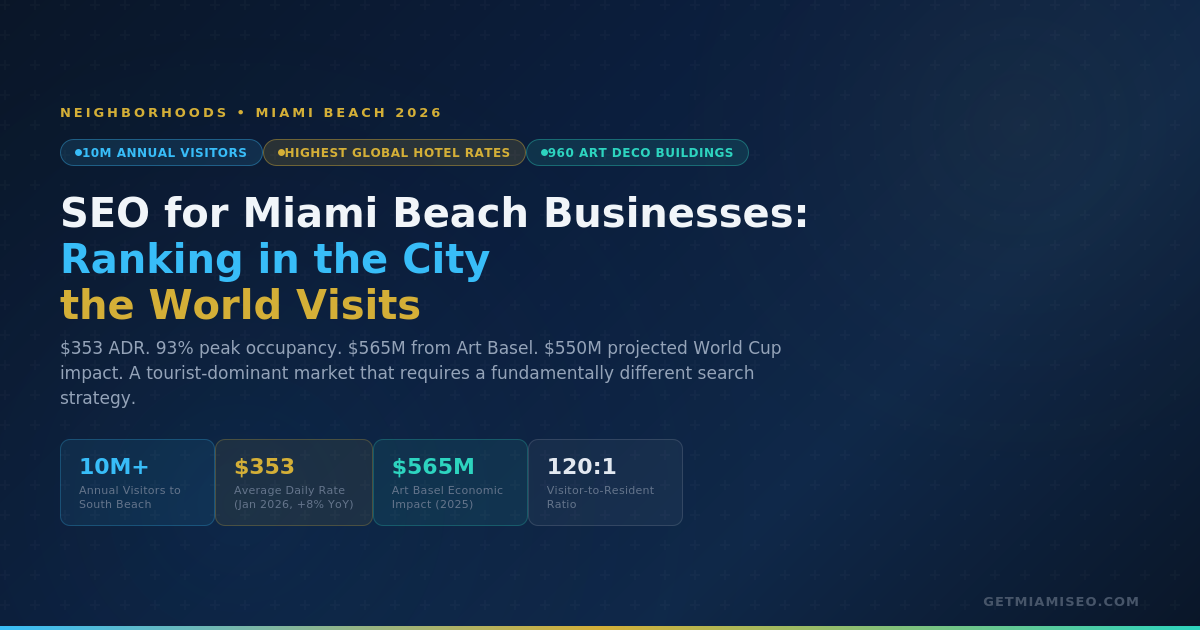
The math defines the strategy. Approximately 10 million visitors to South Beach per year, 83,639 permanent residents. That is a 120-to-1 visitor-to-resident ratio. During peak seasons like winter holidays and spring break, daily visitor counts can exceed 100,000 (Hotelagio). On those days, visitors outnumber residents by more than a full order of magnitude.
This ratio flips the standard local SEO playbook. In most cities, local SEO targets residents who search for services they need regularly: their dentist, their accountant, their mechanic. The customer lifetime value comes from repeat visits over months or years. In Miami Beach, the majority of searchers will visit once, spend 48 to 72 hours, and leave. They will never come back to your Google listing. But they will spend more per transaction than almost any local customer, because they are on vacation and spending at vacation levels.
Miami Beach had the highest hotel room rates on the planet for New Year's 2026 (Miami Beach Community News). In 2025, it was #2 in the entire nation for average daily room rate, behind only New York City. The January 2026 ADR hit $353, up 8% from the previous year, with occupancy reaching as high as 93% during peak travel seasons.
These numbers confirm what the search data shows: the money flowing through Miami Beach comes overwhelmingly from people who do not live there. And those people find businesses through Google.
What tourist-dominant search looks like
Tourist searches differ from resident searches in four measurable ways:
Timing: Tourist searches spike on Thursday through Sunday, with the heaviest volume on Friday and Saturday as visitors plan weekend activities. Resident-targeted businesses see more uniform weekly distribution. For Miami Beach, the Thursday evening and Friday morning window is critical: that is when incoming visitors are researching restaurants, attractions, and services for their stay.
Intent: Tourist searches skew heavily toward discovery and immediate action. "Best rooftop bar South Beach" is someone who wants to go tonight. "Happy hour Ocean Drive" is someone looking for a deal in the next two hours. "Brunch Lincoln Road" is someone making a decision for tomorrow morning. There is almost no research phase. The intent is transactional and time-compressed.
Language: Miami Beach attracts international visitors at rates far above any other part of Miami-Dade. 55.8% of residents are Hispanic (Florida Demographics). International visitors from Colombia grew 8%, Brazil grew 12%, and the UK grew 10% year-over-year in 2024 (Hotelagio/GMCVB). 35% of Miami searches happen in Spanish, and in Miami Beach, the international visitor concentration makes multilingual search even more prevalent.
Device: Tourist searches are overwhelmingly mobile. People search while walking Ocean Drive, sitting at a cafe on Lincoln Road, or lying on the beach. 63% of all Google searches globally happen on mobile (The World Data), but for tourist-heavy destinations, the percentage is almost certainly higher. Your website must be fast and flawless on a phone screen.
The Miami Beach Economy in 2026: Records, Reserves, and Resilience
The economic foundation of Miami Beach is not just strong. It is historically strong, and the data is current as of March 2026.
Miami Beach's resort tax collections increased year over year for three consecutive months: 5.1% in January, 7.0% in December, and 2.2% in November (Miami Beach Community News, March 2, 2026). Food and beverage spending surged even more dramatically, with resort tax collections in those categories increasing 6.8%, 12.9%, and 19.8% over the same period. These numbers represent real money flowing through restaurants, bars, hotels, and entertainment venues.
The city's General Fund reserves now stand at a record $120.6 million, equivalent to three months of operating expenses. The Resort Tax Fund reserves total $38.3 million, covering six months. The city lowered its millage rate and returned $7 million in surplus funds to residents (National Today, February 17, 2026). That is the profile of a city whose commercial engine is running at full capacity.
Art Basel Miami Beach generated an estimated $547 million in economic impact in 2024, with over 75,000 attendees flooding into hotels, restaurants, shops, and cultural venues (City of Miami Beach Economic Development). The 2025 edition featured 287 galleries from 44 countries, the largest and most diverse edition to date (City of Miami Beach). The projected 2025 impact exceeded $565 million (South Florida Business Journal).
The F1 Miami Grand Prix at Hard Rock Stadium has generated over $1 billion in economic impact in its first three years (Boardroom). Over 65 acclaimed restaurants are featured across the event campus each year.
And the FIFA World Cup is 93 days away, with Miami projected to receive $550 million in economic impact from 7 matches at Hard Rock Stadium (Bookies.com/Micronomics). Hotel reservations have already doubled compared to last June, and Airbnb bookings are up 5x (WUSF). Colombia vs. Portugal on June 27 is the single most-requested match globally (FIFA ticket demand data). South Beach will be the primary nightlife, dining, and beach destination for visiting fans.
Every dollar of that economic activity flows through businesses that customers found through search.
Three Commercial Corridors, Three Search Profiles
Miami Beach is not a monolithic market. It contains three distinct commercial corridors, each with its own search audience, competitive dynamics, and optimization priorities.
Ocean Drive (5th Street to 15th Street)
The most internationally recognized street in Miami Beach. The Art Deco Historic District runs through this corridor, containing 960 historic buildings, the largest collection of Art Deco architecture in the world, designated as a National Register District since 1979 (Wikipedia/MDPL). Ocean Drive is pure tourism: beachfront restaurants, bars, hotels, and the Versace Mansion anchor a strip that operates almost entirely on transient traffic.
Search profile: extremely high volume, extremely transient. "Ocean Drive restaurants," "Ocean Drive nightlife," "Art Deco hotels South Beach" are all tourist discovery queries. The businesses that rank for these terms capture foot traffic from visitors who are already on the island and ready to spend. Review volume and photo quality on Google Business Profile are the decisive factors, because tourists evaluate options visually and by social proof, not by reading detailed service descriptions.
Lincoln Road (Alton Road to Washington Avenue)
An 8-block pedestrian mall designed by Morris Lapidus, the architect of the Fontainebleau Hotel. Over 200 boutiques and restaurants line both sides (GMCVB). TripAdvisor named Lincoln Road a Top 10 attraction destination globally. The corridor hosts weekly farmers markets, monthly art walks, public art installations (including Gillie & Marc sculptures through summer 2026), and the Lincoln Road Antiques & Collectibles Market on Sundays from October through May.
Search profile: a mix of tourist and local. Lincoln Road draws both visitors exploring beyond the beach and residents who shop, dine, and attend events regularly. "Lincoln Road shopping," "Lincoln Road restaurants," "farmers market Miami Beach" serve both audiences. This dual audience means content strategy needs to balance tourist discovery content with local community content.
Collins Avenue (Full length of Miami Beach)
The arterial that runs the entire length of Miami Beach, from South Pointe to North Beach. Collins hosts the highest concentration of hotels (from boutique Art Deco properties to the Fontainebleau and Faena), mixed with retail, restaurants, medical offices, and residential buildings. As you move north of 44th Street into Mid-Beach and North Beach, the tourist density decreases and the resident density increases.
Search profile: varies dramatically by geography. South Collins (1st to 44th) operates like Ocean Drive: tourist-heavy, hospitality-dominated. North Collins (44th to 87th) shifts toward a more residential and local search profile, similar to what you would find in a mainland Miami neighborhood. Businesses on Collins need to understand which segment they serve and optimize accordingly.
Google Business Profile Optimization for a Transient Audience
The Google Business Profile is the single most important digital asset for any Miami Beach business. GBP signals represent 32% of all Map Pack ranking factors (Whitespark 2026). The primary category is the #1 ranking factor. But optimizing for a transient audience requires different emphasis than optimizing for a resident audience.
Photos matter more than descriptions
Tourists make faster decisions than residents. They scroll, they look at photos, they check the star rating, and they click "Directions" or "Call." Businesses in the top 3 positions on Google have an average of 250+ photos on their Google Business Profiles (Localo, 2 million profile analysis). For Miami Beach businesses specifically, photo quality is the conversion factor. Professional shots of your space, your food, your view, your atmosphere. Updated monthly. Tourists are visual decision makers.
Review volume and recency are everything
Tourists trust recent reviews from other tourists. A restaurant with 800 reviews and a 4.6 rating will outrank one with 150 reviews and a 4.8 rating in the Map Pack, because Google weights review volume and velocity heavily. Businesses in the top 3 positions average 250+ reviews (Localo). In Miami Beach, where visitors leave reviews tagged with their home city or country, a stream of reviews from "New York, NY" and "London, UK" and "São Paulo, Brazil" actually reinforces the cosmopolitan credibility that attracts the next wave of visitors.
Respond to every review. The 89% of consumers who are more likely to choose a business that responds to reviews (BrightLocal) are especially present in Miami Beach's tourist market, where the decision is being made in real time while standing on the sidewalk.
Attributes for tourists
Select every attribute that communicates tourist-friendly information: "Outdoor seating," "Accepts reservations," "Good for groups," "Live music," "LGBTQ+ friendly," "Wheelchair accessible," "Free WiFi," "Serves alcohol," and critically, "Se habla español." These attributes appear directly in search results and influence both ranking and conversion.
Google Posts for events and seasonal specials
Tourists search for "what's happening this weekend" content. Google Posts about Art Week activations, Miami Spice specials, World Cup watch parties, or rooftop sunset happy hours capture that intent. Post at least weekly, and increase to daily during major event periods (Art Basel week, spring break, World Cup match weeks).
Hotel and Vacation Rental SEO: Competing Against Booking.com and Airbnb
Hotels and vacation rentals in Miami Beach face a unique SEO challenge: the organic results for accommodation searches are dominated by Online Travel Agencies (OTAs) like Booking.com, Expedia, Hotels.com, and Airbnb. These platforms have domain authorities that individual hotels cannot match through traditional SEO.
The workaround is not to compete head-to-head for "hotels South Beach." It is to win where OTAs are weak.
Branded search optimization
Make sure that when someone who already knows your hotel name searches for it, they find your direct booking site, not an OTA listing. This means your website title tags, meta descriptions, and Google Business Profile must contain your exact hotel name and location. Branded search is where direct booking revenue lives.
Experience-based content
OTAs rank for "hotels in South Beach." They do not rank for "what to do near the Faena Hotel" or "best restaurants walking distance from Collins Avenue hotels" or "guide to Art Deco architecture on Ocean Drive." Creating content around the experience of staying at your property or in your neighborhood captures searchers who are in the planning phase and may book directly.
Direct booking incentives
Give searchers a reason to book through your site. "Best rate guaranteed," "free welcome cocktail for direct bookings," "late checkout for website reservations." Mention these incentives in your meta descriptions and GBP Posts so they are visible in search results.
For Airbnb and VRBO hosts, the same principles apply but the competitive landscape is even more fragmented. There are thousands of short-term rental listings in Miami Beach. The hosts who create their own websites with neighborhood content, local guides, and direct booking options capture repeat guests and referrals that the platforms cannot touch.
Restaurant and Nightlife SEO: Capturing Diners Who Are Already Walking the Strip
Miami Beach has one of the highest restaurant densities of any comparable area in the United States. Ocean Drive, Lincoln Road, Collins Avenue, and the surrounding blocks are saturated with dining options. For restaurants, the Google Maps visibility is the difference between a full house and empty tables.
90% of diners search online before choosing where to eat (multiple 2026 sources). 76% of "near me" searches result in a visit within 24 hours. 88% of consumers use Google Maps for local business discovery (SagaPixel). In Miami Beach, where the average diner is a tourist with no established restaurant preferences, these statistics are even more decisive.
Menu optimization
Publish your menu in HTML on your website, not as a PDF. Google can read, index, and rank HTML text. It struggles with PDFs. If someone searches "ceviche Lincoln Road" and your menu lists ceviche but it is buried in a PDF, Google cannot surface your restaurant for that query. An HTML menu with each dish described becomes a long-tail keyword engine.
Photo and review strategy
For restaurants, photos of actual dishes drive more engagement than photos of the exterior. Upload new dish photos weekly to your GBP. Encourage diners to leave photo reviews. A Google listing with 50 customer-uploaded food photos feels alive and trustworthy to the next potential diner scrolling through options.
TikTok and Instagram as secondary search
64% of Gen Z use TikTok as a search and discovery engine (Britopian). 71% of Gen Z and 68% of Millennials plan to increase dining out (OpenTable). For Miami Beach restaurants targeting younger visitors, social media SEO (hashtags, geo-tags, trending audio) is not a replacement for Google SEO, but it is a complementary discovery channel that drives branded Google searches. A viral TikTok video about your restaurant generates "restaurant name Miami Beach" searches that your GBP and website capture.
Event-Driven Search: Art Basel, F1, the World Cup, and the Calendar That Drives Miami Beach
Miami Beach runs on an event calendar that produces predictable, massive search demand spikes. Businesses that are already ranking organically before each event capture the surge at zero additional cost per click. Businesses that rely solely on Google Ads face CPC spikes during high-demand periods because more advertisers are bidding for the same inventory.
Art Basel Miami Beach (December)
$547 million economic impact in 2024. 75,000+ attendees. 287 galleries from 44 countries in 2025. The city itself publishes guidance encouraging businesses to collaborate with artists, extend hours, and engage digitally during Art Week (City of Miami Beach). Search demand for "Art Basel restaurants," "where to eat during Art Basel Miami Beach," "Art Basel parties" spikes weeks before the event and stays elevated through mid-December.
F1 Miami Grand Prix (May)
$1 billion+ in economic impact over three years. 65+ restaurants featured across the event campus. Search demand spans from race logistics ("how to get to Hard Rock Stadium") to hospitality ("best restaurants near F1 Miami").
FIFA World Cup 2026 (June 15 to July 18)
$550 million projected Miami impact. 7 matches at Hard Rock Stadium. Hotel reservations doubling. Airbnb up 5x. Colombia vs. Portugal is the most-requested match on earth. South Beach will be the primary base for visiting fans. Search demand will be trilingual: English, Spanish, and Portuguese, reflecting the nationalities of competing teams (Brazil, Colombia, Portugal, Uruguay). Businesses with bilingual and trilingual content will capture demand that English-only competitors miss entirely.
Seasonal baseline (December through April)
Even without specific events, Miami Beach experiences a sustained winter tourism season from December through April when northern visitors escape cold weather. This baseline demand generates consistent search volume for "things to do South Beach," "best brunch Miami Beach," "spa South Beach," and dozens of hospitality queries.
The strategic implication: Miami Beach businesses should create event-specific content months before each major event. A blog post about "Where to Eat During Art Basel Miami Beach 2026" published in September will be indexed and ranking by the time search demand spikes in November. A page about "World Cup Watch Parties South Beach" published in April will capture search demand when it peaks in June. This is where SEO's compounding advantage over Google Ads is most visible.
The Bilingual and Trilingual Opportunity in Miami Beach
Miami Beach is 55.8% Hispanic (Florida Demographics). International tourism from Latin America is a major revenue driver: Colombia +8%, Brazil +12% year-over-year in 2024 (GMCVB). 35% of Miami searches happen in Spanish, and Spanish keywords carry 75% to 85% lower difficulty than English equivalents.
For Miami Beach businesses, the multilingual opportunity extends beyond Spanish. The FIFA World Cup is bringing Brazilian (Portuguese-speaking), Colombian (Spanish-speaking), Portuguese, and Uruguayan (Spanish-speaking) fans to a city that will serve as their primary hospitality base. Restaurants, bars, and hotels that can surface in Portuguese-language searches will access a market segment that virtually no competitor is targeting.
Even outside the World Cup window, Miami Beach's international visitor base creates consistent demand for Spanish-language search results. "Restaurantes en South Beach," "hoteles baratos Miami Beach," "qué hacer en Miami Beach" are searched regularly by visitors from Mexico, Colombia, Venezuela, Argentina, and Spain. The businesses that rank for these queries face almost zero competition.
Nuestra guía de SEO en español covers the fundamentals. For Miami Beach specifically, the additional consideration is Portuguese content for the Brazilian market, which represents one of the fastest-growing international visitor segments.
Content Strategy: Writing for People Who Leave in 72 Hours
The typical Miami Beach visitor stays 2 to 4 nights. They arrive with limited knowledge of the area and need to make decisions quickly about where to eat, what to do, and where to go. Content that serves this audience looks very different from content that serves long-term residents.
Location-anchored guides
"Best restaurants within walking distance of Ocean Drive" is more useful to a tourist than "Best restaurants in Miami Beach." "What to do on Lincoln Road in 3 hours" is more useful than "Lincoln Road guide." Tourists think in proximity and time budgets, not in comprehensive overviews.
Event-specific landing pages
Create dedicated pages for each major event, refreshed annually. "Art Basel Dining Guide 2026," "F1 Miami Grand Prix Restaurant Recommendations," "World Cup 2026: Where to Watch in South Beach." These pages rank for event-specific queries and generate traffic during the predictable demand spikes.
"First time in Miami Beach" content
A surprising volume of search traffic comes from people who have never visited before. "First time Miami Beach tips," "what to know before visiting South Beach," "Miami Beach vs. Fort Lauderdale Beach" are discovery queries that drive awareness and capture potential customers before they arrive.
The Google algorithm updates of 2026 reinforce this approach. The February 2026 Discover update explicitly rewards locally relevant, original, expert-led content. Google Search Central specified that the update favors content from sites based in the user's country with demonstrated topic expertise. For Miami Beach businesses creating genuine local content about their neighborhoods, this is a direct ranking advantage over generic travel blogs and national publications.
Technical SEO for Miami Beach: Mobile, Speed, and Schema for Tourists
Mobile performance is non-negotiable
Tourist searches are phone searches. If your website does not load in under 2.5 seconds on a phone, pass all three Core Web Vitals (LCP under 2.5s, CLS under 0.1, INP under 200ms), and make it easy to call, get directions, or book from a mobile screen, you are losing the majority of potential customers before they see your content.
Test your site at pagespeed.web.dev. If your mobile score is below 50, treat it as an emergency. The technical requirements we covered in our SEO foundations guide apply here with extra urgency because the tourist audience has zero patience and infinite alternatives.
Schema markup for hospitality
Hotels: use Hotel schema with priceRange, starRating, amenityFeature, and checkinTime/checkoutTime. Restaurants: use Restaurant schema with servesCuisine, priceRange, and menu link. Events: use Event schema for recurring happenings like Art Walk or farmers markets. FAQPage schema for your most-asked tourist questions. LocalBusiness schema for every business with physical address.
In 2026, schema markup is especially valuable because Google's AI systems (Gemini, AI Overviews) use structured data as primary source material for generating answers. A hotel with complete Hotel schema is more likely to be cited in an AI-generated response to "best boutique hotels South Beach" than one without.
Hreflang for multilingual content
If you create content in English, Spanish, and Portuguese, implement hreflang tags so Google serves the correct language version to each user. Our bilingual SEO guide covers the implementation in detail.
FAQ: SEO for Miami Beach Businesses
Why is SEO different for Miami Beach businesses compared to the rest of Miami?
Miami Beach is a separate incorporated city with a 120-to-1 visitor-to-resident ratio. The majority of searches come from tourists, not locals. Tourist searches have different intent (immediate, transactional), timing (Thursday through Sunday spikes), language (multilingual), and device behavior (overwhelmingly mobile). The competitive landscape includes global hospitality brands. SEO strategy must account for this transient audience and seasonal demand patterns around Art Basel ($565M impact), F1 ($1B+), and the FIFA World Cup ($550M projected).
How many visitors does Miami Beach get per year?
South Beach alone draws approximately 10 million visitors annually (Hotelagio). Miami-Dade County welcomed 28.2 million total visitors in 2024. During peak seasons, daily visitor counts exceed 100,000 in Miami Beach. South Beach is consistently the most visited area in all of Miami-Dade.
What is the best SEO strategy for a hotel or vacation rental in Miami Beach?
Focus on branded search (your property name ranking above OTAs), Google Business Profile with 250+ photos and active review management, experience-based content (neighborhood guides, event content, local recommendations), and direct booking incentives visible in search results. Miami Beach ADR of $353 and the highest hotel rates globally for NYE 2026 justify significant SEO investment per booking.
How much does SEO cost for a Miami Beach business?
Typically $2,000 to $7,500 per month, slightly above the broader Miami range of $1,500 to $6,500, due to competitive intensity and the need for seasonal and event-driven content strategies. The return on investment is proportionally higher given the tourism revenue flowing through the market.
How do seasonal events affect search demand in Miami Beach?
Massively. Art Basel generated $547M in economic impact in 2024. The F1 Grand Prix has generated $1B+ in three years. The 2026 World Cup is projected at $550M for Miami. Businesses ranking organically before these events capture the demand surge at zero additional cost per click, while businesses relying on Google Ads face CPC spikes.
Do Miami Beach businesses need bilingual SEO?
Yes. 55.8% Hispanic population. International tourism from Latin America growing (Colombia +8%, Brazil +12%). World Cup bringing Brazilian, Colombian, Portuguese, and Uruguayan fans. Spanish keywords carry 75-85% lower competition. The trilingual opportunity (EN/ES/PT) is strongest in Miami Beach.
What are the main commercial corridors for local SEO in Miami Beach?
Ocean Drive (5th to 15th, pure tourism, Art Deco District with 960 buildings), Lincoln Road (8-block pedestrian mall, 200+ shops and restaurants, TripAdvisor Top 10 global attraction), and Collins Avenue (full length, mix of tourism in South Beach and residential in North Beach). Each has distinct search patterns and requires corridor-specific optimization.