The Question Every Miami Business Owner Asks
You have marketing budget to allocate. You know your business needs to show up when someone searches on Google. You have two options staring at you: invest in SEO to rank organically, or pay Google directly through Google Ads to appear at the top. Maybe both. Maybe neither feels right.
Every Miami business owner, from the personal injury attorney in Brickell to the restaurant owner in Wynwood to the dentist in Coral Gables, faces this exact decision. And the stakes are not small. A personal injury law firm that picks the wrong channel can burn through $10,000 a month with almost nothing to show for it. A restaurant that ignores local SEO entirely can lose thousands of potential diners every month to a competitor who simply has a better Google Business Profile.
The problem with most "SEO vs. Google Ads" advice is that it treats the question as an abstract debate. Generic pros and cons. Vague recommendations to "try both." No real numbers. No industry-specific guidance. No acknowledgment that a law firm in Miami faces a completely different calculation than a restaurant, a dental practice, or a real estate brokerage.
This article is different. We are going to run the actual numbers. Real cost-per-click data by industry. Real ROI benchmarks from published research. Real conversion rates. Real Miami-specific factors that change the equation. By the end, you will have a mathematical framework for deciding where your marketing dollars produce the highest return, not based on opinion, but on data.
The Numbers That Matter: SEO ROI vs. Google Ads ROI
Before we get into tactics, here is the headline comparison that sets the context for everything else.
SEO ROI
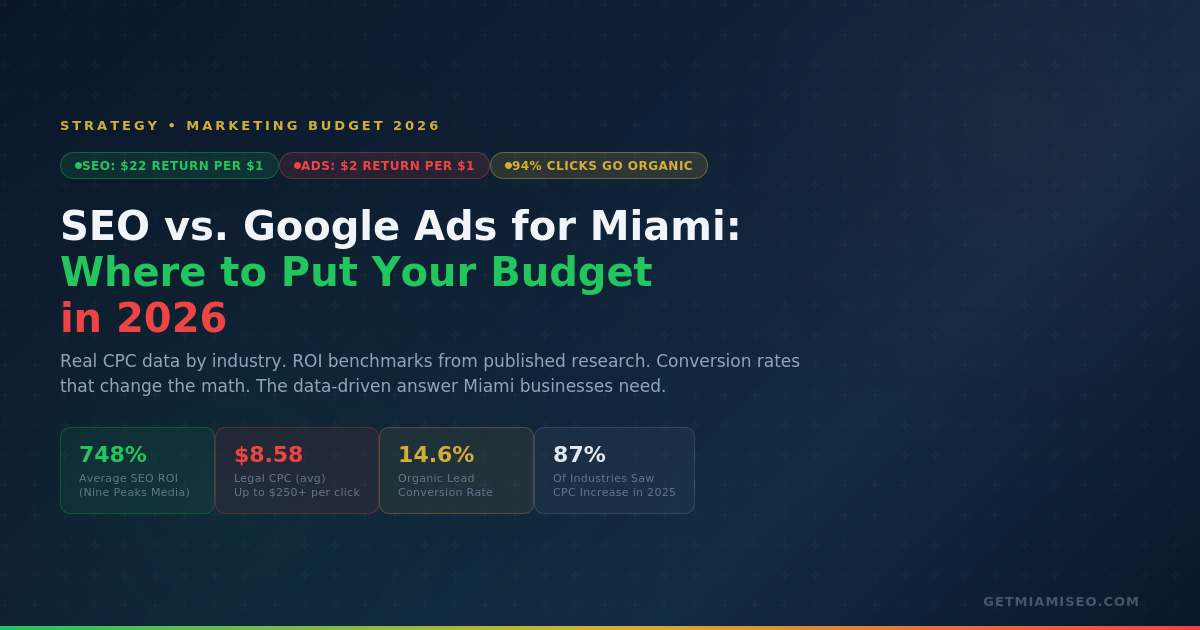
SEO delivers an average return of $22 for every $1 spent, according to Improvado's breakdown of ROI by channel. Nine Peaks Media's analysis puts the average SEO ROI at 748%, meaning $7.48 back for every dollar invested. FirstPageSage's industry-specific data shows even more dramatic returns: real estate SEO delivers 1,389% ROI, financial services delivers 1,031%, and legal services ranks among the highest conversion categories.
These numbers are not hypothetical. They come from tracking organic traffic, attributing leads and sales back to organic search, and calculating the cost of the SEO investment that generated those results. The reason the returns are so high is fundamental: once you rank, the traffic is free. You pay for the SEO work that gets you there, but every click from that point forward costs you nothing.
Organic SEO leads convert at 14.6%, compared to just 1.7% for traditional outbound methods (SeoProfy, citing Search Engine Journal). In financial services, SEO converts at 7.3 times the rate of PPC advertising. Real estate converts at 3.5 times the rate. Legal services at 3.4 times (Nine Peaks Media). The quality of the lead, not just the volume, is fundamentally different.
70% of marketers confirm that SEO generates more sales for them than PPC (Databox). 49% of respondents in a Search Engine Land poll identified organic search as the single highest ROI digital marketing channel. And 75% of local businesses say local SEO brings more qualified leads than paid ads (WiserReview, 2026).
Google Ads ROI
Google Ads delivers an average ROI of approximately 200%, meaning $2 for every $1 spent. That is a positive return, which is why over 80% of businesses still use Google Ads. 54% of businesses report satisfaction with their PPC ROI (WebFX survey).
But context matters. That 200% average masks enormous variation. Some businesses earn far more, particularly those with high customer lifetime values and efficient campaign management. Others waste the majority of their spend. Research cited by Nine Peaks Media found that companies waste 40% to 60% of their digital ad budgets due to bad analytics, poor targeting, and inefficient campaign structure.
Google Ads CPC has increased for 87% of industries in the past year alone (WordStream, 2025 Google Ads Benchmarks), with an average year-over-year increase of 10%. The year before that, CPC increased for 86% of industries with an average increase of 10% as well. This is a sustained, multi-year trend of rising costs that shows no sign of reversing.
The Critical Difference: Linear vs. Compounding Returns
Google Ads produces linear returns. You spend $5,000, you get a certain number of clicks and leads. Next month, you spend $5,000 again to get roughly the same results. The moment you stop paying, the traffic stops. The leads stop. The phone stops ringing.
SEO produces compounding returns. The first few months of investment produce modest results. Months 3 through 6 show acceleration. By month 12, the traffic and leads generated from your SEO investment are arriving without additional per-click costs. A blog post optimized for a valuable keyword can generate leads for years. A well-ranked Google Business Profile generates calls every day without paying for each one. Peak SEO results typically appear in year 2 or 3 of consistent investment (FirstPageSage).
This compounding nature is what creates the massive ROI gap between the two channels. It is also what makes SEO harder to sell: the returns are not immediate. But for any business with a time horizon longer than six months, the math overwhelmingly favors organic investment.
What Google Ads Actually Cost in Miami, by Industry
National CPC averages are useful for context, but they understate what Miami businesses actually pay. Miami is one of the most competitive advertising markets in the southeastern United States. Market density, high customer lifetime values, and aggressive competition from both local and national players push Miami CPCs above national averages in most categories.
Here are the 2025 national CPC benchmarks by industry from WordStream's annual Google Ads Benchmarks report, WebFX's analysis of 10,000+ keywords, and PPC Chief's 2026 data:
Attorneys and Legal Services: $8.58 average CPC nationally (WordStream). But that average conceals wild variation by practice area. Personal injury keywords in competitive markets reach $137.55 per click (WebFX), and personal injury CPC has increased 568% since 2021 (WebFX). Immigration lawyer, family law, criminal defense, and estate planning keywords range from $3 to $95+ per click depending on specificity and geography. A Miami law firm spending $10,000 per month on Google Ads at $200 per click for personal injury gets approximately 50 clicks. Not 50 clients. 50 clicks. At a typical legal search conversion rate of around 4% to 7%, that yields 2 to 3 actual client inquiries.
Dentists and Dental Services: $7.85 average CPC (WordStream). Dental keywords saw one of the lowest CTRs across all industries at 5.44% and one of the largest conversion rate decreases year over year (down 19.57%). For a dental practice in Coral Gables or Brickell spending $5,000/month at $7.85 per click, that is roughly 637 clicks generating approximately 44 leads at a 6.96% average conversion rate.
Home and Home Improvement: $7.85 average CPC (WordStream). Roofing services reach $10.25 per click in 2026 (PPC Chief). HVAC averages $9.12.
Real Estate: CPC increased 35.48% year over year, one of the largest jumps of any industry (WordStream 2024 benchmarks). National average around $7.20 (PPC Chief). For Miami real estate with median home values exceeding $600,000 countywide and $1.4 million in Coral Gables, the lifetime value of a single client can justify aggressive spending, but the rising CPC erodes margins.
Restaurants and Food: $2.05 average CPC (WordStream), one of the lowest across all industries. However, restaurants also saw one of the biggest CTR decreases year over year (down 12.67%). And the average check size for a restaurant diner is far lower than the client value for a law firm or medical practice, meaning the margin per click is thinner.
Travel: $2.12 average CPC, also saw a significant CTR decrease (down 14.07%).
The trend line is clear: CPC has increased for 87% of industries in 2025. The average cost per click across all industries is $5.26 (WordStream), up from $4.66 the year before. Google Ads is getting more expensive every year. For businesses in high-CPC industries like legal and dental, the compounding cost increase directly erodes profitability.
What SEO Actually Costs in Miami, and What You Get
SEO investment in Miami typically ranges from $1,500 to $6,500 per month for local businesses, depending on the industry, competition level, and scope of services. That range covers Google Business Profile optimization, on-site content creation, technical SEO, link building, citation management, review strategy, and ongoing monitoring.
Let's compare what that investment buys versus the equivalent Google Ads spend.
The $3,000/month comparison
A Miami business investing $3,000/month in Google Ads at the average CPC of $5.26 gets approximately 570 clicks per month. At the overall average conversion rate of 6.96% (WordStream 2025), that produces roughly 40 leads per month. The cost per lead is approximately $75. If they stop paying in month 7, they get zero leads in month 7.
A Miami business investing $3,000/month in SEO gets zero to minimal organic traffic in months 1 through 3 while the foundation is being built. By month 4 to 6, the business starts appearing in Google Maps and gaining organic visibility. By month 12, the business has a ranking asset that generates leads continuously. The blog posts, the optimized pages, the review profile, the citation network: all of it keeps working. If they pause SEO investment in month 13, the traffic does not drop to zero. The asset produces leads for months or years beyond the active investment period.
The math over 24 months
Google Ads at $3,000/month for 24 months: $72,000 total spend. Approximately 13,680 clicks. Approximately 952 leads at average conversion. Cost per lead: $75.63. When you stop: zero leads.
SEO at $3,000/month for 24 months: $72,000 total spend. Months 1 through 6 produce limited leads while building the foundation. Months 7 through 24 produce accelerating organic traffic and leads. By month 24, the business is generating organic leads at near-zero marginal cost. When you stop: traffic continues for months to years, gradually declining without maintenance but not disappearing overnight.
FirstPageSage data shows that positive ROI from SEO campaigns is typically achieved in 6 to 12 months, with peak results in year 2 or 3. The breakeven point is real and requires patience. But the compounding curve after that point is what creates the ROI gap.
This does not mean Google Ads is a waste. It means the two channels serve different purposes and different timelines, which we will address in the hybrid approach section.
Where the Clicks Actually Go: Organic vs. Paid in 2026
Here is a data point that reframes the entire conversation: 94% of all clicks on Google go to organic results. Only 6% go to paid ads (Digital Silk, citing aggregated research).
The #1 organic search result receives 18 times more clicks than the #1 paid ad result (First Page Sage). The top 3 organic results capture 68.7% of all clicks on the page (First Page Sage, 2026 CTR data). The #1 organic result alone captures more clicks than results #3 through #10 combined.
For comparison, the average CTR for Google Ads across all industries is 6.42% (WordStream, 2025). That means roughly 93 out of 100 people who see a Google Ad do not click on it.
Why? Research consistently shows the same answer: users trust organic results more than paid ads. They perceive that organic results earned their position through relevance, not money. The #1 organic result for "dentist in Coral Gables" feels like Google's recommendation. The ad at the top feels like someone paid to be there, and that distinction matters to how people evaluate trustworthiness.
This does not mean Google Ads are worthless. For businesses that cannot yet rank organically, ads provide the only path to the first page. For new businesses, time-sensitive promotions, and competitive keywords where organic ranking would take months, ads fill a real gap. But the data makes clear that organic visibility captures the overwhelming majority of search activity.
What happens below the fold
75% of users never scroll past the first page of search results. This means if your business is not in the top 10 organic results or the Map Pack, you are invisible to three out of four potential customers. The practical implication: partial SEO that lands you on page 2 is worth almost nothing. You either commit to ranking on page 1 or you use ads as a bridge while you get there.
The Compounding Effect: Why SEO Gets Cheaper Over Time and Ads Get More Expensive
This is the single most important economic principle for any business owner evaluating these two channels.
SEO: declining cost per acquisition
In month 1, your SEO investment of $3,000 generates zero leads. Your cost per lead is infinite. By month 6, you are generating 10 leads from organic search. Your cost per lead (calculated on cumulative investment) is $3,000. By month 12, you are generating 30 leads per month. Your cumulative investment is $36,000, and you have generated perhaps 180 leads total, bringing your cost per lead to $200. By month 24, you may be generating 50 leads per month, cumulative leads may exceed 700, and your cost per lead has dropped to $103. And it keeps dropping because the traffic keeps coming.
This is what "compounding" means in SEO context. The investment from month 1 is still producing returns in month 24. That blog post you published in March is still ranking in December. The Google Business Profile you optimized continues to generate calls and directions requests indefinitely.
Google Ads: stable to increasing cost per acquisition
In month 1, you spend $3,000 and get 40 leads. Cost per lead: $75. By month 12, CPC has increased approximately 10% (consistent with the WordStream trend data showing 10% average annual increases for 87% of industries). Your $3,000 now gets 518 clicks instead of 570. Your lead count drops slightly. Your effective cost per lead rises. By month 24, the same budget buys even fewer clicks. CPC increased for 87% of industries in 2025 and 86% in 2024. This is not cyclical. It is structural. More advertisers, more competition, more AI-driven auction dynamics, and Google's own revenue incentives all push CPCs upward.
A lack of SEO can increase your required ad spend by 400% (LyfeMarketing). Businesses without organic presence are entirely dependent on paid channels, which gives Google leverage over your acquisition costs.
How AI Overviews Are Changing the Math for Both Channels
Google's AI Overviews are disrupting both organic and paid search in ways that every Miami business owner needs to understand.
Seer Interactive's analysis of 3,119 queries across 42 organizations (June 2024 through September 2025) found that organic CTR dropped 61% on queries where AI Overviews appear, falling from 1.76% to 0.61%. Paid CTR dropped 68%, crashing from 19.70% to 6.34%.
AI Overviews now appear in 21.59% of US mobile searches, up from 8.61% in 2024 (Semrush). In some local verticals, Whitespark found AI Overviews appearing on 57% to 80% of queries tested.
But here is the critical nuance for Miami businesses: only 7% of local searches show AI Overviews (Heroic Rankings). When someone searches "dentist near me" or "personal injury lawyer Miami" or "best Cuban restaurant in Hialeah," Google still shows the Map Pack and traditional results the vast majority of the time. Local search remains relatively protected from the AI disruption that is devastating informational and national search visibility.
What does this mean for the SEO vs. Ads decision? It means that for local businesses specifically, SEO's value proposition remains strong because local searches still generate clicks. Meanwhile, the businesses most affected by AI Overviews are those spending on paid campaigns for informational queries, where paid CTR has cratered.
There is one exception worth noting: brands that get cited in AI Overviews see their organic CTR increase by 35% and their paid CTR increase by 91% compared to non-cited brands on the same queries (Seer Interactive). Being cited is not something you can buy. It is something you earn through content quality, domain authority, structured data, and E-E-A-T signals. In other words, it is earned through SEO, not through ad spend.
The Miami-Specific Factors That Tilt the Equation
Generic national comparisons miss factors that are unique to Miami and that materially change the budget calculation.
The bilingual advantage
35% of searches in Miami happen in Spanish. Spanish keywords carry 75% to 85% lower difficulty than their English equivalents. This means that a bilingual SEO strategy can rank for Spanish keywords at a fraction of the effort required for English, effectively doubling your addressable search market.
Google Ads in Spanish also tend to have lower CPCs than English equivalents, but the differential is not as dramatic as the organic difficulty gap. The competitive moat in SEO (ranking for Spanish keywords where nobody else is creating content) is wider than the competitive moat in paid (where any competitor can bid on the same Spanish keywords at any time).
For Miami businesses specifically, this makes SEO disproportionately valuable compared to national markets where the bilingual opportunity does not exist.
Market density and competition
Miami-Dade has over 300,000 businesses competing for 2.7 million residents. Coral Gables alone has 10,000 businesses in a city of 50,000. Brickell's financial district has some of the highest concentrations of professional services firms in Florida. This density means Google Ads auctions are competitive, which pushes CPCs higher than in less dense markets.
For the same reason, this density means that businesses with strong organic rankings have an outsized advantage. In a market where 50 law firms are bidding for the same keywords, the one that ranks organically at #1 captures 18 times more clicks than any of them paying for ads.
Tourism and seasonal demand
28.2 million visitors generate massive seasonal search spikes. During Art Basel, the Miami Grand Prix, spring break, and soon the FIFA World Cup, search demand surges across hospitality, dining, entertainment, and services. Businesses that are already ranking organically capture that surge at no additional cost. Businesses that rely solely on Google Ads face CPC spikes during high-demand periods because more advertisers are competing for the same inventory.
The AI Overview shield for Spanish searches
AI Overviews are rolling out in English first. Spanish searches in Miami are less affected by the zero-click disruption that is eroding English-language organic and paid traffic. This creates a temporary but significant advantage for businesses investing in Spanish SEO: you get traditional organic click behavior in a market where your competitors have no Spanish content.
Industry Breakdown: The Right Mix for Law Firms, Doctors, Restaurants, Real Estate, and More
Law firms
CPC reality: $8.58 average nationally, $137.55+ for personal injury, $3 to $250+ range depending on practice area (WordStream, WebFX). Personal injury CPC has increased 568% since 2021.
SEO advantage: Law firm SEO in Miami converts at 3.4 times the rate of PPC (Nine Peaks Media). Legal services SEO delivers among the highest conversion rates of any industry at 7.5% (FirstPageSage). The lifetime value of a personal injury case can exceed $100,000 in fees, making even a single organic lead worth more than months of ad spend.
Recommended mix: Start with Google Ads (including Local Service Ads for the "Google Verified" badge) to generate immediate case inquiries. Simultaneously invest heavily in SEO because the long-term economics are dramatically favorable. The Spanish keyword opportunity in immigration law is especially underexploited: "abogado de inmigración en Miami" has a fraction of the competition and cost of "immigration lawyer Miami."
Medical and dental practices
CPC reality: $7.85 for dental, approximately $5 for healthcare (WordStream, Quimby Digital). Dental CTR is the lowest of any industry at 5.44%, and dental conversion rates dropped 19.57% year over year.
SEO advantage: Medical SEO in Miami benefits from the local search protection against AI Overviews (only 7% of local searches show AI Overviews). 94% of patients use online reviews to evaluate healthcare providers. A well-optimized Google Business Profile with strong reviews and complete service listings generates patient inquiries at zero per-click cost.
Recommended mix: Google Ads for high-intent keywords like "emergency dentist near me" where speed matters. SEO as the primary long-term strategy, especially for practices with multiple specialties (each specialty gets its own landing page, each ranking independently). Bilingual GBP optimization is critical in Miami where many patients prefer Spanish-speaking providers.
Restaurants and hospitality
CPC reality: $2.05 average (WordStream), one of the lowest across industries. But the average check size is also lower, meaning cost per acquisition relative to revenue is not necessarily favorable.
SEO advantage: 90% of diners search online before choosing where to eat. 76% of "near me" searches result in a visit within 24 hours. Google Maps is the primary discovery tool (88% of consumers use Google Maps for local business discovery). For restaurants, the Map Pack is everything, and Map Pack visibility is driven by Google Business Profile optimization, reviews, and local SEO, not by ad spend.
Recommended mix: Focus heavily on local SEO and Google Business Profile optimization. Use Google Ads sparingly for specific events (catering promotion, private dining, seasonal specials). Review generation and response is the highest-ROI activity for restaurants. The FIFA World Cup arriving in Miami this summer makes pre-June SEO optimization especially urgent.
Real estate
CPC reality: $7.20 average nationally (PPC Chief), with CPC increasing 35.48% year over year (WordStream). Miami real estate is one of the most competitive paid search markets in the country.
SEO advantage: Real estate SEO delivers 1,389% ROI, the highest of any industry measured (FirstPageSage). Converts at 3.5 times the rate of PPC (Nine Peaks Media). The lifetime value of a single real estate client in Miami can be $15,000 to $50,000+ in commission, making organic lead acquisition extraordinarily valuable.
Recommended mix: Google Ads for specific luxury listings, open houses, and new development launches. SEO as the dominant long-term strategy, particularly for neighborhood-specific content and bilingual content targeting Latin American buyers.
Home services (HVAC, plumbing, electrical)
CPC reality: $7.85 average (WordStream), with roofing at $10.25 and HVAC at $9.12 (PPC Chief). Competitive and expensive.
SEO advantage: CI Web Group's 2025 analysis of real home service business data found that SEO delivered nearly 5x better return on ad spend than Google Ads, at a fraction of the cost per paying customer. Local Service Ads (pay-per-lead) can complement SEO effectively in this vertical.
Recommended mix: Google Local Service Ads for immediate lead generation (pay per lead rather than per click). SEO for "near me" dominance. The combination of LSAs plus organic Map Pack visibility creates a dominant presence that competitors using only one channel cannot match.
The Hybrid Approach: How to Use Both Without Wasting Money
The most effective strategy for most Miami businesses is not either/or. It is a sequenced combination that uses each channel for what it does best.
Phase 1: Google Ads for immediate lead flow (months 1 through 6)
While your SEO foundation is being built, Google Ads keeps the phone ringing. Use this phase to generate immediate leads, test which keywords convert best (this data feeds your SEO keyword strategy), and generate revenue to fund your ongoing SEO investment. Focus budget on high-intent, bottom-funnel keywords where the searcher is ready to act: "emergency plumber Miami," "personal injury lawyer free consultation Miami," "dentist accepting new patients Coral Gables."
Phase 2: SEO investment compounds (months 4 through 12)
As your organic rankings improve and your Google Business Profile starts appearing in the Map Pack, your organic lead volume increases. Each organic lead costs you nothing per click. As organic traffic grows, you can begin reducing paid spend on keywords where you now rank organically. Use the Google Ads data from Phase 1 to identify which keywords produce the highest quality leads, and prioritize those in your SEO strategy.
Phase 3: SEO as primary, Ads as supplement (month 12+)
By month 12 of a well-executed SEO campaign, organic traffic should be generating a meaningful percentage of your total leads. Your cost per lead from organic should be declining as the compounding effect takes hold. Google Ads shifts from primary lead source to strategic supplement: retargeting past website visitors, promoting time-sensitive offers, and filling gaps where you do not yet rank organically.
One critical data point for the hybrid approach: appearing in both paid and organic results on the same search page increases your total click-through rate by up to 90%. Dual visibility builds trust and dominates the search results for your target keyword. The combination is greater than the sum of its parts.
Additionally, strong SEO can directly reduce your Google Ads costs. A well-optimized website with relevant content and fast load times improves your Google Ads Quality Score, which can reduce your CPC by 20% to 40% (multiple sources). Your SEO investment literally makes your ads cheaper.
How to Calculate Your Own SEO vs. Google Ads ROI
Here is the framework to run your own numbers.
Step 1: Know your customer lifetime value (LTV)
What is one new customer worth to your business over the full relationship? A personal injury case might be worth $50,000 to $500,000 in fees. A dental patient who stays for 10 years of cleanings, fillings, and cosmetic work might be worth $5,000 to $20,000. A restaurant diner who returns weekly for a year is worth $2,000 to $5,000. A real estate client who buys a $600,000 property generates a $18,000 commission.
Step 2: Calculate Google Ads cost per customer
Take your monthly Google Ads spend. Divide by your actual number of new customers acquired through ads (not clicks, not leads, actual customers). That is your cost per acquisition through paid search. If you are spending $5,000/month and acquiring 5 new customers, your CPA is $1,000. Compare that to your LTV from Step 1.
Step 3: Calculate SEO cost per customer (at maturity)
Take your monthly SEO investment. Track how many leads and customers come from organic search (Google Analytics and Google Search Console data). In the first 6 months, this number will be low and the cost per customer will be high. By month 12, it should be declining. By month 24, it should be dramatically lower than your Google Ads CPA. The key metric: what is your cost per organic customer at month 12 versus month 1?
Step 4: Project 24-month total cost of ownership
Calculate the total spend for each channel over 24 months. Calculate total customers acquired from each channel. Divide total spend by total customers. For most local businesses, SEO's 24-month cost per customer will be 3x to 10x lower than Google Ads, because the compounding effect collapses the per-customer cost over time.
FAQ: SEO vs. Google Ads for Miami Businesses
Is SEO or Google Ads better for a small business in Miami?
For most local businesses in Miami, SEO delivers higher long-term ROI. SEO returns $22 for every $1 spent vs. Google Ads' $2 (Improvado). Organic leads convert at 14.6% vs. 1.7% for outbound (SeoProfy). 75% of local businesses report local SEO brings more qualified leads than paid ads (WiserReview). However, Google Ads provides immediate visibility that is valuable for new businesses. The strongest approach for most is SEO as foundation, Google Ads for speed.
How much do Google Ads cost in Miami by industry?
Legal services: $8.58 average nationally, $137 to $250+ for personal injury. Dental: $7.85. Home services: $7.85. Real estate: $7.20 (up 35.48% year-over-year). Restaurants: $2.05. Travel: $2.12 (WordStream, WebFX, PPC Chief). In competitive Miami markets, these can run 20-40% above national averages.
What is the average ROI of SEO compared to Google Ads?
SEO: average 748% ROI (Nine Peaks), up to 1,389% for real estate and 1,031% for financial services (FirstPageSage). Google Ads: approximately 200% average ROI. The difference is driven by SEO's compounding nature: organic traffic continues without per-click costs.
How long does SEO take to work compared to Google Ads?
Google Ads: traffic within hours. SEO: 3 to 6 months for Google Maps results, 6 to 12 months for competitive organic keywords. Peak SEO results in year 2 to 3 (FirstPageSage). But once rankings are achieved, traffic continues without ongoing per-click costs.
What percentage of Google clicks go to organic results vs. paid ads?
94% of clicks go to organic results, 6% to paid ads (Digital Silk). The #1 organic result gets 18x more clicks than the #1 paid result (First Page Sage). Top 3 organic results capture 68.7% of all clicks.
Are Google Ads getting more expensive?
Yes. CPC increased for 87% of industries in 2025 (WordStream), with 10% average year-over-year increase. Personal injury CPC has risen 568% since 2021. AI Overviews are also reducing paid CTR by 68% on affected queries (Seer Interactive). The trend is structural and multi-year.
Should Miami businesses do both SEO and Google Ads?
If budget allows, yes. Appearing in both paid and organic results increases CTR by up to 90%. Google Ads provides immediate leads while SEO builds. Strong SEO can reduce Google Ads CPC by 20-40% through Quality Score improvement. The optimal sequence: start Ads for immediate flow, invest in SEO simultaneously, shift budget toward organic as rankings grow.
How much should a Miami business spend on SEO per month?
Typically $1,500 to $6,500 per month depending on industry and competition. Legal, medical, and real estate invest at the higher end. Unlike Google Ads, SEO investment compounds over time with peak returns in year 2 to 3.