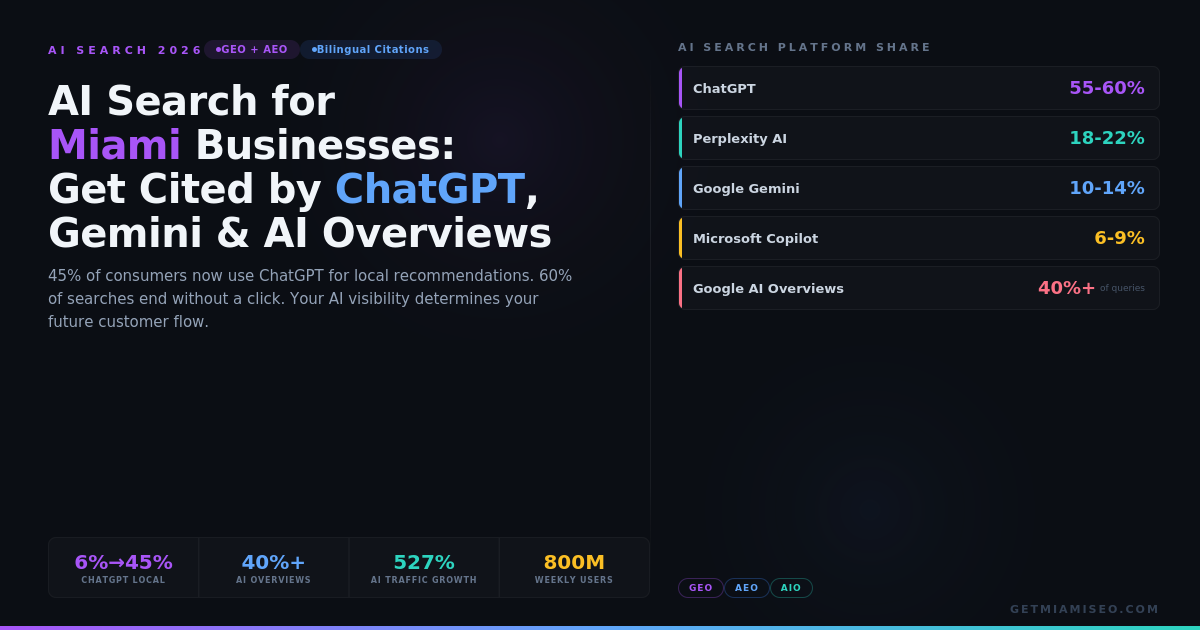
In 2025, 6% of consumers used ChatGPT for local business recommendations. In 2026, that number is 45% (BrightLocal Consumer Review Survey 2026). That is not a trend line. That is an inflection point that rewrites how local businesses get found.
To put that in practical terms: when a tourist in Miami Beach pulls out their phone and asks ChatGPT "best seafood restaurant near me," the AI generates an answer. It names specific restaurants. It cites reasons. The tourist walks into one of those named restaurants and never opens Google, never scrolls through a list of blue links, never sees your Google Ads.
If your business was not in that AI-generated answer, you did not exist for that customer.
This is happening right now. ChatGPT has over 800 million weekly users globally (Master of Code, Jan 2026). The platform handles approximately 2.5 billion prompts per day. And 59% of ChatGPT searches that trigger live web queries involve local intent (Bigeye Agency, 2026). People are asking AI where to eat, who to hire, where to stay, and which doctor to see.
Meanwhile, Google itself is shifting. AI Overviews now appear on over 40% of US search queries (SeoProfy 2026, multiple sources confirm). When they appear, organic click-through rates drop by approximately 61% (Seer Interactive). The first position in organic results sees its CTR collapse from 15% to just 2.6% when an AI Overview is present (Incremys 2026, citing Pew Research).
The businesses that appear in those AI Overviews capture the attention. The businesses that do not get pushed below the fold into a space that fewer and fewer people scroll to.
For Miami, with its 28.2 million annual visitors, 300,000+ businesses, and a bilingual population that searches in two languages, AI search is not a future concern. It is a present-tense reality that is already redirecting customer flow.
The AI Search Market in 2026: What Changed and Why It Matters
The SEO trends for 2026 covered AI Overviews as one of twelve shifts. This article goes deeper on the AI search ecosystem specifically, with verified data from Q1 2026.
The platforms:
ChatGPT dominates AI-native referrals with 55-60% market share among AI search platforms (upGrowth AI Traffic Share Report 2026). It grew from 100 million weekly users in November 2023 to 800+ million by late 2025. For local business queries, ChatGPT pulls from web content, directory listings, and review data to generate recommendations.
Google AI Overviews appear on over 40% of US queries (multiple sources, 2026). They sit above organic results and often answer the question directly, reducing the need to click through. 99% of AI Overview citations come from pages ranking in Google's organic top 10 (Incremys 2026). This means traditional SEO is the prerequisite: you need strong organic rankings to be cited in AI Overviews.
Perplexity AI handles 780 million monthly queries (GEOptie, 2026) and is especially popular among research-oriented users. It cites sources directly with links, making it more attribution-friendly than ChatGPT.
Google Gemini has expanded into Search, replacing some traditional results with AI-generated summaries. Its hallucination rate is reportedly just 0.7% (Incremys 2026), making it one of the most reliable AI search tools for factual local queries.
Microsoft Copilot accounts for 6-9% of AI-native referrals (upGrowth 2026) and integrates with Bing search results.
The traffic impact:
AI-powered search engines now account for an estimated 12-18% of total referral traffic, up from 5-8% in late 2024 (upGrowth 2026). AI-sourced traffic increased 527% between January and May 2025 (GEOptie/StubGroup). Traffic from AI chatbots to retailers exploded by 520% between 2024 and 2025 (Incremys 2026).
And critically: 60% of traditional Google searches now end without a click, rising to 65-70% in early 2026 (Bain, multiple confirmations). Zero-click searches have become the majority experience. The information is served directly, the question is answered, and the user never visits a website.
For local businesses, this means your visibility in AI-generated responses is becoming as important as your position in organic search results.
GEO, AEO, AIO: What These Mean and Why Miami Businesses Need All Three
Three acronyms define AI search optimization in 2026. They are not competing strategies. They reinforce each other.
GEO (Generative Engine Optimization) is the practice of optimizing content so AI platforms cite your business in their generated responses. When someone asks ChatGPT "best immigration lawyer in Miami" and the AI names your firm, that is GEO working. The Google algorithm updates for 2026 are accelerating this shift.
AEO (Answer Engine Optimization) focuses on structuring your content to be extracted as direct answers. This is about featured snippets, FAQ results, and the structured data that feeds voice assistants and AI answer boxes. When Google's AI Overview pulls your FAQ answer and displays it as part of a synthesized response, that is AEO.
AIO (AI Overview Optimization) targets Google's specific AI Overview feature. Since 99% of AI Overview citations come from the organic top 10, AIO is essentially advanced SEO with content structuring that makes your pages extractable by Google's AI systems.
The relationship to traditional SEO: GEO does not replace SEO. It builds on top of it. Research from Princeton, Georgia Tech, and the Allen Institute tested nine optimization methods and found that basic, unoptimized content scored 19.3 in AI visibility metrics. Adding authoritative citations, statistics, and improving content fluency increased scores above 40, representing performance gains exceeding 100% (GEOptie 2026, citing academic research). The recommended approach in 2026 is approximately 50% traditional SEO effort and 50% GEO effort (Bigeye Agency).
For Miami businesses already investing in local SEO, GEO is the next layer, not a replacement.
How AI Decides Which Miami Businesses to Recommend
AI platforms use Retrieval-Augmented Generation (RAG). When a user asks a question, the AI retrieves relevant documents from the web, evaluates them for authority and clarity, then synthesizes a response citing the most trustworthy sources.
The factors that increase AI citation probability:
Content depth and thoroughness. AI systems prefer sources that cover a topic thoroughly. A single service page that says "We offer plumbing services in Miami" will not be cited. A page that explains what specific plumbing services you offer, which neighborhoods you serve, your response times, pricing ranges, and includes customer testimonials with specific details is citation-worthy. Content depth (sentence and word counts) and readability matter most for AI citations, while traditional SEO metrics like raw traffic and backlink counts have less direct impact (Growth Memo, March 2025, via Position Digital 2026).
Structured data (schema markup). AI systems that use Retrieval-Augmented Generation extract structured data as a primary input. GPT-4 accuracy improves from 16% to 54% when content relies on structured data (Data World study, via Digidop 2026). Product schema, LocalBusiness schema, FAQ schema, and Review schema all help AI engines understand your business faster and more accurately.
Third-party presence and brand mentions. Brands mentioned frequently on Reddit, Quora, and LinkedIn receive approximately 4x more AI citations (Phoenix Online Media, 2026). Domains with profiles on platforms like Yelp, Google Business Profile, and industry directories have a 3x higher chance of being cited by ChatGPT (Phoenix Online Media). Your digital footprint across the entire web determines AI visibility, not just your own website.
Review signals. Google Reviews feed directly into AI recommendation engines. Reviews that mention specific services, neighborhoods, and experiences provide the contextual detail AI models need to make confident recommendations. ChatGPT for local recommendations grew from 6% to 45% in one year (BrightLocal 2026), and those recommendations are built on review data.
Content freshness. Pages with clearly visible "Last Updated" dates, current statistics, and timely examples consistently outperform stale content in AI citations (Bigeye Agency 2026). AI systems weight recency, particularly for queries about local businesses where information changes frequently (hours, menus, pricing, availability).
Clear content structure. Pages with proper H1-H2-H3 hierarchy receive 2.8x more AI citations than unstructured pages (Incremys 2026). 80% of AI-cited pages include list formatting. FAQ sections addressing common questions in conversational formats dramatically increase extractability.
The Bilingual AI Citation Advantage: Miami's Hidden Edge
Here is the insight that makes this article different from every AI search guide written for a national audience:
When someone asks ChatGPT in Spanish, "¿Cuál es el mejor dentista en Coral Gables?", the AI searches for and prioritizes Spanish-language content. It pulls from Spanish-language web pages, Spanish Google Reviews, Spanish directory listings, and Spanish structured data.
In Miami-Dade, where 35% of searches happen in Spanish and 1.9 million people speak Spanish, this creates a massive citation opportunity that virtually no business is addressing.
How it works:
A dental practice in Coral Gables with an English-only website, English-only reviews, and English-only schema markup is citable only when someone asks AI a question in English. When the same question is asked in Spanish, the AI has no Spanish-language content from that practice to draw from. It cites a competitor who does have Spanish content. Or it cites nothing at all.
A dental practice with bilingual content (English service pages + Spanish service pages with proper hreflang), bilingual Google Reviews (both English and Spanish, with responses in matching languages), and bilingual schema (LocalBusiness schema in both languages) is citable in both languages. It has double the citation surface area.
This is the same principle behind the bilingual review flywheel, applied to AI search. English content feeds English AI queries. Spanish content feeds Spanish AI queries. Both compound independently.
The competitive advantage is stark: Spanish-language keywords carry 75-85% lower difficulty than English equivalents. The same dynamic applies to AI citations. There is almost zero competition for Spanish-language AI citation in the Miami market. The first businesses to build bilingual AI-optimized content will own those citation positions as they calcify.
Industry analysis projects that by mid-2026, dominant citation positions will have solidified around early adopters (GEOptie 2026). Delayed implementation creates a compounding disadvantage as citation patterns become entrenched.
Structured Data: The Language AI Actually Reads
Humans read sentences. AI reads structured data. When you implement schema markup on your website, you are providing AI systems with machine-readable information about your business: what you do, where you are, what you charge, what your hours are, what your customers say about you.
Schema markup delivers 20-40% higher click-through rates in traditional search (Sixth City Marketing). For AI search, its impact is even more direct: AI systems use structured data as a primary retrieval source when generating responses.
The schema types that matter most for AI citation:
LocalBusiness schema tells AI engines exactly where your business is located, what services you offer, your operating hours, phone number, and accepted payment methods. This is the foundation. Without it, AI systems have to infer this information from unstructured text, which increases the chance of inaccuracies or omission.
FAQPage schema makes your FAQ content directly extractable by AI. When someone asks ChatGPT a question that matches one of your FAQ entries, properly structured FAQ schema increases the probability that your answer is cited.
Review/AggregateRating schema feeds your star rating, review count, and review content to AI systems. This provides the social proof signals that AI uses to assess trustworthiness when deciding which businesses to recommend.
Service schema describes your specific services with structured properties. An HVAC company with Service schema listing "AC repair," "furnace installation," and "duct cleaning" is more likely to be cited for those specific queries than a competitor whose services are only described in paragraph text.
Organization schema establishes your brand entity with name, logo, founding date, and social profiles. This helps AI systems recognize your brand as a trustworthy entity rather than just another website.
If your SEO audit reveals zero schema markup (as many Miami business sites show), implementing these five types is the single highest-impact technical action for AI visibility.
Google Reviews as AI Fuel
The connection between Google Reviews and AI search visibility is direct and measurable. AI platforms pull from review data when generating local recommendations. The more detailed, recent, and service-specific your reviews are, the more material AI has to work with when someone asks for recommendations in your category and location.
Consider what happens when someone asks ChatGPT "Who is the best personal injury lawyer in Brickell?" The AI searches for relevant information and finds:
Law Firm A has 150 Google reviews, many mentioning "personal injury," "car accident," "Brickell," with detailed descriptions of case outcomes and client experiences. The firm responds to every review professionally.
Law Firm B has 12 reviews, mostly generic ("great lawyer!"), with no responses from the firm.
AI will cite Law Firm A. Not because it has more reviews (though that helps), but because the review content contains the specific, extractable information that maps to the user's query: the practice area (personal injury), the location (Brickell), and the evidence of quality (detailed client experiences).
The bilingual dimension amplifies this. When someone asks in Spanish, "¿Quién es el mejor abogado de lesiones personales en Brickell?", the AI looks for Spanish-language review content. Law firms with bilingual review profiles and bilingual responses are citable in both languages. Most Miami law firms are citable in English only.
The Content Structure AI Engines Prefer
AI systems are pattern-recognition machines. The easier your content is to parse structurally, the more likely it gets extracted and cited accurately.
What AI engines look for in content (verified by research):
Clear heading hierarchy (H1, H2, H3) with descriptive, question-oriented headings. Pages with proper heading structure receive 2.8x more AI citations (Incremys 2026).
Extractable summary statements at the beginning of sections. When Zapier restructured its content to feature clear summaries at the beginning of each guide, its AI citations increased substantially within three months (GEOptie 2026).
Specific data points with sources. ChatGPT is more likely to cite content that uses definite language, has high entity density, contains a balanced mix of facts and opinions, and uses simple writing structures (Growth Memo, February 2026, via Position Digital).
FAQ sections that mirror how people actually ask AI questions. AI queries average 23 words compared to 4 words in traditional Google searches (Digidop 2026). People ask AI full questions: "What is the best HIPAA-compliant SEO agency in Miami that also works in Spanish?" Your FAQ should answer questions at this level of specificity.
Lists, tables, and comparison formats. 80% of AI-cited pages include list formatting. Tables that compare options, list features, or present data in structured formats are highly extractable.
Author attribution and E-E-A-T signals. Content with named authors, credentials, and expertise markers is cited more frequently. This is why adding author bios to blog posts matters beyond traditional SEO.
Platform-by-Platform Optimization: ChatGPT, Google AI Overviews, Perplexity
ChatGPT:
87% of ChatGPT citations correspond to top Bing results (Incremys 2026). This means Bing optimization matters for ChatGPT visibility. Most Miami businesses completely ignore Bing. Submit your site to Bing Webmaster Tools, claim your Bing Places listing, and ensure your content ranks on Bing as well as Google.
ChatGPT heavily weights third-party mentions. Profiles on Yelp, Google Business Profile, industry directories, and mentions on Reddit, Quora, and LinkedIn increase citation probability by 3-4x (Phoenix Online Media 2026).
75% of ChatGPT users searching for local services still use traditional keywords, not conversational prompts (ALM Corp, January 2026). Optimize for both keyword-based and conversational queries.
Google AI Overviews:
99% of AI Overview citations come from Google's organic top 10. If you do not rank on page 1 for a query, you will not be cited in the AI Overview for that query. Traditional SEO is the prerequisite.
81% of AI Overview queries occur on mobile (Bigeye Agency 2026). Mobile page speed is critical.
AI Overviews appear on over 40% of US queries. For local queries specifically, that number is 40.16% (SeoProfy 2026).
Perplexity:
Perplexity cites sources with direct links, making it the most transparent AI search platform. Content that is well-structured, factually dense, and properly attributed performs best.
Perplexity accounts for 18-22% of AI-native referrals (upGrowth 2026).
The cross-platform strategy: Focus on universal principles (thorough content, structured data, authority signals, review quality) rather than optimizing for any single platform. The fundamentals that make content citable by one AI engine make it citable by all of them.
What Miami Businesses Should Do This Month
Week 1: Audit your AI visibility.
Ask ChatGPT, Gemini, and Perplexity questions about your industry and location: "What is the best [your service] in [your neighborhood]?" See if your business appears. If it does not, you know the gap. If a competitor appears, study what they have that you do not.
Week 2: Implement structured data.
Add LocalBusiness, FAQPage, and Review schema to your website. This is the single highest-impact technical action for AI visibility. The SEO audit checklist covers the implementation process.
Week 3: Restructure your top pages for AI extraction.
Add clear summaries at the top of each service page. Add FAQ sections that mirror how people ask AI questions (long, specific queries). Ensure proper heading hierarchy (H1, H2, H3). Add specific data points, pricing ranges, and service details that AI can extract and cite.
Week 4: Activate your bilingual citation surface.
Create Spanish-language versions of your top 3-5 service pages with proper hreflang tags. Add Spanish descriptions to your Google Business Profile. Respond to Spanish reviews in Spanish. This gives AI engines Spanish-language content to cite when queries come in Spanish. The bilingual SEO guide covers the full strategy.
Ongoing: Build your third-party presence.
Claim and optimize profiles on Google Business Profile, Bing Places, Apple Business Connect, Yelp, and industry-specific directories. Post on LinkedIn. Engage on Reddit where relevant. Every mention of your brand across the web increases AI citation probability.
Ongoing: Generate detailed reviews.
Encourage customers to mention specific services, neighborhoods, and experiences in their Google Reviews. Review strategy is covered in depth here. These detailed reviews become the raw material AI uses to generate recommendations.
FAQs: AI Search for Miami Businesses
How do I show up in ChatGPT recommendations?
Build thorough, well-structured website content with schema markup. Maintain an active Google Business Profile with recent reviews. Claim directory listings across major platforms. Optimize for Bing (87% of ChatGPT citations match top Bing results). Create bilingual content if you serve Miami's Hispanic market.
What is GEO and how is it different from SEO?
GEO (Generative Engine Optimization) focuses on being cited in AI-generated responses. SEO focuses on ranking in traditional search results. They are complementary: 99% of AI Overview citations come from the organic top 10, so strong SEO is the foundation GEO builds on.
Do AI Overviews hurt my organic traffic?
They can reduce click-through rates by approximately 61% when present. But 40% of queries now trigger AI Overviews, and this number is growing. The strategy is not to avoid AI Overviews but to ensure your content is cited within them.
How does bilingual content help with AI search?
AI responds to queries in the language they are asked. Spanish queries get Spanish-sourced answers. Miami businesses with bilingual content are citable in both English and Spanish, doubling their citation surface in a market where 35% of searches happen in Spanish.
What is the most important thing I can do right now?
Implement schema markup (LocalBusiness, FAQPage, Review) on your website. This is the single highest-impact action because structured data is the primary language AI systems use to understand and cite businesses. The full audit checklist covers implementation.
How much does AI search optimization cost?
GEO builds on top of existing SEO work. Allocate 10-15% of your SEO budget to GEO-specific activities (upGrowth 2026). For businesses already investing in SEO services, the incremental cost is modest. The ROI data shows positive returns within 3-6 months.
The AI Train Has Left the Station. Your Business Needs to Be On It.
Gartner predicts traditional search engine volume will drop 25% by 2026. ChatGPT went from 100 million to 800 million weekly users in two years. 45% of consumers now use AI for local business recommendations. AI Overviews appear on 40%+ of Google queries.
These are not projections about the future. They are measurements of the present.
The Miami businesses that build AI-citable content now, in both English and Spanish, with proper structured data and strong review profiles, will own the citation positions that are being established today. The businesses that wait will compete for whatever positions remain after the early adopters have solidified their advantage.
Your SEO strategy for 2026 is not complete without an AI search component. Traditional SEO remains the foundation. GEO is the layer that determines whether your content gets cited by the AI systems that are increasingly mediating how customers find businesses.