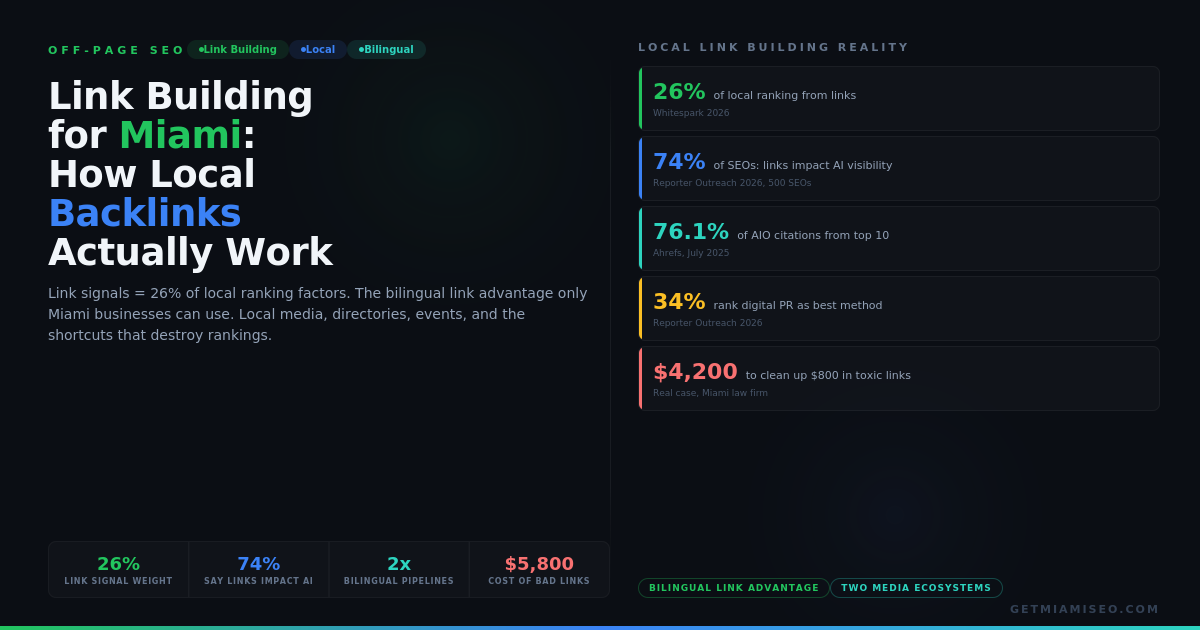
In November 2025, a personal injury law firm in Downtown Miami hired a link building service that promised 50 backlinks per month for $800. The pitch was compelling: more links, higher rankings, more cases. The firm's marketing manager signed the contract on a Friday afternoon. By January 2026, the firm had received 97 backlinks from websites registered in Pakistan, India, and Romania. The sites had names like "best-seo-tips-2025.xyz" and "florida-law-directory-online.net." None had any connection to Miami, law, or personal injury. None had real visitors. Most had been created within the prior 90 days specifically to sell links.
On February 14, 2026, the firm's primary landing page dropped from position 4 to position 38 for its highest-value keyword: "personal injury lawyer Miami." The firm's owner spent the next six weeks and $4,200 on a backlink audit, disavow file submission, and manual link cleanup. The ranking recovered to position 11 by April. It took another three months to return to page one. The original position 4 has not been recovered as of this writing.
This story is not unusual. It is the standard outcome of cheap link building. Google's SpamBrain algorithm, which specifically targets manipulative link patterns, has become significantly more precise since 2024. Links from irrelevant foreign sites, private blog networks, and link farms do not just fail to help. They actively harm the sites they link to. The firm paid $1,600 for two months of links and then $4,200 to undo the damage. The net cost of the cheap shortcut was $5,800 and eight months of lost revenue from a page-one position that took eighteen months to build.
This is the story that every Miami business owner needs to hear before they spend a dollar on link building. Because the difference between a backlink that helps your rankings and one that destroys them is not visible to anyone who does not know what to look for. And the businesses selling the harmful links are excellent at making them sound legitimate.
The rest of this article explains what actually works: how local backlinks function, which links move rankings for Miami businesses, where the opportunities are that most competitors miss, and how Miami's bilingual media landscape creates a link building advantage that no other US city can match.
What a Backlink Actually Does (And What It Doesn't)
A backlink is a link from another website to your website. Google's algorithm treats it as a vote of confidence. When a trusted website links to your page, Google interprets this as a signal that your content is worth referencing. More votes from more trusted sources generally correlate with higher rankings.
The Whitespark 2026 Local Search Ranking Factors survey, based on input from 47 top local SEO experts, found that link signals account for 26% of local organic ranking influence. This makes links the third most important ranking factor behind on-page signals (36%) and Google Business Profile signals (32%). Behavioral signals (click-through rate, time on page, calls from the listing) account for 9%.
But the word "backlink" is misleading because it implies all links are equal. They are not. A link from the Miami Herald is fundamentally different from a link from "best-seo-tips-2025.xyz." Google evaluates several dimensions of each link before assigning weight.
Editorial placement. Google distinguishes between links that appear naturally within content because a writer wanted to reference something useful, and links that were inserted artificially. Paid links, comment spam, and link exchanges all carry lower weight or negative weight. Google's documentation on link spam is explicit: "Any links that are intended to manipulate rankings in Google Search results may be considered link spam."
Domain authority and trust. A link from a high-authority domain (Miami Herald, DR 85+) carries more ranking power than a link from a low-authority domain (newly created blog, DR 5). The authority of the linking site determines how much "vote" power the link transfers.
Local relevance. For local businesses, links from locally relevant sources carry enhanced weight. A link from the Coral Gables Chamber of Commerce signals geographic relevance. A link from a generic national directory does not.
Topical relevance. A link from a medical publication to a medical practice's website carries more weight than a link from a sports blog to the same medical site. The topic of the linking page should relate to the topic of the page being linked to.
Referring domains vs total backlinks. The number of unique websites linking to you (referring domains) matters more than the total number of links. Five links from five different websites carry more weight than fifty links from the same website. Ahrefs' data consistently shows a strong correlation between referring domain count and organic search position.
The Five Types of Local Links That Move Rankings in Miami
Not every link is worth pursuing. For Miami businesses, five categories of local links deliver measurable ranking impact.
1. Local media coverage. The Miami Herald (DR 85+), Miami New Times (DR 75+), South Florida Business Journal (DR 70+), and their digital properties are the highest-authority local link sources available. A single editorial link from the Miami Herald is worth more than dozens of directory submissions combined. These links are earned through newsworthy activity: opening a new location, hosting a community event, publishing original research, or having a staff member serve as a quoted expert in a reporter's story.
2. Chamber of commerce and business association memberships. The Greater Miami Chamber of Commerce, the Coral Gables Chamber, the Doral Business Council, the Brickell Chamber, and similar neighborhood organizations all maintain online member directories that include a link to each member's website. These are high-trust, locally relevant links that Google values because they verify business legitimacy. The membership fee functions as the "cost" of the link, but the value extends beyond SEO into networking and referrals.
3. Local event sponsorships and partnerships. Sponsoring a local event, whether it's the Coconut Grove Arts Festival, a charity 5K, a school fundraiser, or a neighborhood cleanup, typically results in a link from the event's website. These links carry local relevance, community trust, and editorial validity because the event organizer is genuinely acknowledging a supporter. For businesses in event-dense Miami, where major events run every month of the year, this is a repeatable and reliable link source.
4. Industry-specific directories and platforms. For med spas, RealSelf is a high-authority platform that Google indexes and values. For lawyers, Avvo, FindLaw, and Justia carry authority. For medical practices, Healthgrades, Vitals, and Zocdoc provide both a link and a discovery platform. These industry directories send Google a strong topical relevance signal because they are exclusively focused on your category.
5. Local content partnerships and guest contributions. Writing an expert column for a local blog, contributing a quote to a journalist's article, or co-authoring a resource with a complementary business generates links that are editorially genuine and topically relevant. A restaurant owner contributing a recipe column to a Miami food blog earns a link that Google interprets as a real endorsement. A real estate agent writing a neighborhood guide for a local lifestyle publication earns the same.
Miami's Bilingual Link Advantage: Two Media Ecosystems, Two Authority Pipelines
This is the insight that makes Miami link building fundamentally different from link building in any other US city.
Miami has two parallel media ecosystems operating in two languages. The English ecosystem includes the Miami Herald, Miami New Times, South Florida Business Journal, Axios Miami, The Real Deal South Florida, and dozens of neighborhood blogs and lifestyle publications. The Spanish ecosystem includes El Nuevo Herald, Diario las Americas, MiamiDiario, AmericaEconomia, and dozens of Spanish-language community publications and neighborhood news sites.
Google treats these as distinct authority signals in their respective languages. A link from the Miami Herald builds authority for English search rankings. A link from El Nuevo Herald builds authority for Spanish search rankings. A Miami business that earns links from both ecosystems is building two separate authority pipelines simultaneously.
This matters because 35% of Miami searches happen in Spanish. A business ranking for "abogado accidentes Miami" needs Spanish-language authority signals to compete for that query. A link from an English-language publication does not help rank for a Spanish-language query. But a link from El Nuevo Herald, earned by being quoted in a Spanish-language article about your industry, directly strengthens your ranking for Spanish search terms.
The practical application: when you pitch a story to the Miami Herald, simultaneously pitch the same story to El Nuevo Herald. When you sponsor a community event, ask for a link on both the English and Spanish versions of the event website (many Miami organizations maintain both). When you write a guest article for a local publication, write a Spanish version for a Spanish-language outlet.
No other major US city offers this dual-language link building opportunity at this scale. A bilingual Miami business building links in both languages is doing something that competitors in Houston, Los Angeles, and New York cannot replicate with the same density of local Spanish-language media.
How to Get Featured in Local Publications Without Paying for It
Earning editorial media links is the highest-value link building activity. It is also the one that most businesses assume requires a PR agency or paid placement. It does not, if you understand what local journalists and editors actually need.
Become a quotable source. Local journalists are under constant deadline pressure. They need expert quotes to make their stories credible. A Miami dermatologist who tells reporters "I'm available for quotes on skin cancer prevention anytime, here's my cell" gets called every May when the sun safety articles start. A Miami accountant who emails the South Florida Business Journal every January offering commentary on tax law changes gets quoted in the annual tax season roundup. Each quote comes with a link back to the expert's website.
Register on platforms like HARO (Help a Reporter Out), Qwoted, and Connectively (formerly SourceBottle). These platforms send daily email digests of journalist requests. A Miami home services business owner who responds to a query about hurricane preparation tips in April will earn a link from a publication that may have a DR of 70+.
Create a linkable resource. Build something on your website that other websites want to reference. A detailed guide to Miami neighborhoods for homebuyers. A free calculator that estimates AC repair costs by square footage and system age. An annual salary survey for your industry in South Florida. A map of all farmers markets in Miami-Dade with hours and seasonal availability. These resources attract links naturally because they are useful, original, and not available anywhere else.
Host or sponsor something newsworthy. A charity event, a community cleanup, a free workshop, a scholarship for local students. These generate local press coverage and event page links. They also generate Google Review opportunities and social media mentions that compound the SEO value.
Respond to local news. When a hurricane hits, when a major development project is announced, when a new law affects your industry, write a response on your website and share it with local reporters. Timely expert commentary is the single most reliable way to earn media coverage without a PR budget.
Event-Based Link Building: Miami's Calendar as a Link Machine
Miami's event calendar creates link building opportunities that reset every year. Each major event produces a new batch of websites, blog posts, roundup articles, and directory pages that need content and are open to linking.
Art Basel Miami Beach (December, 83,000+ attendees) generates hundreds of "where to eat during Art Basel" and "best things to do during Art Basel" articles every November and December. A restaurant, a gallery, or a boutique that gets included in one of these roundup articles earns a locally relevant, editorially genuine link. The same pattern repeats for the FIFA World Cup (June-July 2026), Ultra Music Festival (March), the Miami Open (March), Formula 1 (May), SOBEWFF (February), and the Miami International Boat Show (February).
The approach: 8 weeks before each major event, reach out to the bloggers, lifestyle writers, and event guide publishers who have written about the event in prior years. Offer a quote, a discount for their readers, or simply your availability as a local expert. If your business genuinely connects to the event, the inclusion is editorial and the link is natural.
For event sponsors, the link is built into the sponsorship. Most event websites link to their sponsors by default. A $500 sponsorship of a local 5K run that generates a link from the event's DR 30-40 website is one of the most cost-effective link building investments available.
The Dangerous Shortcuts and How Google Catches Them
Google's SpamBrain system, which processes hundreds of billions of pages, has been specifically trained to identify manipulative link patterns. Here is what it catches and what the consequences look like.
Private blog networks (PBNs). A network of websites created solely to link to client sites. Google identifies PBNs through shared hosting, identical WHOIS registration patterns, similar site structures, and linking patterns that only go in one direction. The penalty: all links from the network are devalued, and sites that rely heavily on PBN links may see ranking drops.
Paid link schemes. Buying links from "guaranteed link building" services that promise specific numbers of links per month. Google's guidelines are explicit: links intended to manipulate rankings are considered link spam. The penalty ranges from individual link devaluation to manual actions that suppress the entire site.
Link exchanges at scale. "I'll link to you if you link to me" is a natural part of the internet when done occasionally between genuinely related sites. When done at scale as a systematic strategy, Google detects the reciprocal pattern and devalues both links.
Comment spam and forum links. Posting links in blog comments, forum signatures, and discussion threads solely for SEO value. These links are almost universally nofollowed and carry zero ranking weight in 2026. They also damage brand reputation because they look spammy to human readers.
The law firm from the opening of this article learned the expensive version of this lesson. The recovery path involved: identifying all toxic links through Ahrefs and Google Search Console, creating a disavow file listing every harmful domain, submitting the disavow through Search Console, and then waiting weeks for Google to reprocess the link profile. The total recovery cost ($4,200 plus months of lost revenue) exceeded what legitimate link building would have cost over the same period.
How Links Feed AI Search Citations
The connection between backlinks and AI search is not obvious, but it is real. According to the Reporter Outreach State of Link Building 2026 survey of 500 SEO professionals, 74% believe backlinks impact AI search visibility. And the mechanism makes sense once you understand how AI search engines select sources to cite.
AI Overviews draw 76.1% of their citations from pages ranking in Google's top 10. Pages reach the top 10 partially through strong backlink profiles. So backlinks feed AI Overview citations indirectly by strengthening organic rankings.
ChatGPT, Perplexity, and Gemini cite pages from authoritative sources. A page with backlinks from the Miami Herald, the South Florida Business Journal, and three local business directories has a stronger authority signal than a page with no backlinks. The AI engine is more likely to cite the well-linked page because its training data and real-time search results both point to it as a trusted source.
There is also a direct AI citation path: being featured in "best of" and roundup articles. When a local blogger publishes "Best 10 Med Spas in Coral Gables" and includes your business, that article is not just a backlink. It is a citation source that AI engines use to answer "What is the best med spa in Coral Gables?" The article functions as both a traditional link and an AI citation signal.
The Counter-Argument: When Link Building Is Not the Priority
The honest counter-argument. Link building is not always the right priority for a Miami business. If your website has fundamental on-page issues (no schema markup, thin content, broken internal links, duplicate title tags), building links to a broken site wastes the link equity. Fix the foundation first.
Similarly, if your Google Business Profile is incomplete (missing categories, no photos, few reviews), the 32% of ranking factors controlled by GBP optimization is a faster win than the 26% controlled by links. For a new business with zero online presence, GBP optimization and review generation deliver faster visible results than link building.
Link building is most impactful when the on-page foundation is already strong and the business is competing in a category where multiple competitors have solid fundamentals. In that scenario, links become the differentiator that separates position 7 from position 3. For a law firm competing against 200 other firms for "personal injury lawyer Miami," links are not optional. For a sole-proprietor plumber in Homestead competing against five other plumbers, GBP and reviews matter more.
Common Mistakes Miami Businesses Make With Link Building
Buying cheap link packages. Any service promising dozens of links for a few hundred dollars is selling links from sites that will harm your rankings. Legitimate link acquisition costs more per link but delivers positive ranking movement rather than penalties.
Ignoring the Spanish-language media ecosystem. English-only link building in Miami leaves half the authority pipeline untapped. Spanish-language links strengthen Spanish search rankings, which serve 1.9 million Spanish speakers in Miami-Dade.
Treating all directories as equal. A listing on the Coral Gables Chamber of Commerce website is a high-trust local signal. A listing on "florida-business-directory-2026.com" is worthless or harmful. Focus on directories with genuine authority and real visitors.
Not building linkable assets on their own website. A website with nothing worth linking to will not attract links no matter how much outreach is done. Build resources, tools, guides, and original data that other websites genuinely want to reference.
Measuring total backlinks instead of referring domains. Fifty links from one website count as one meaningful signal. Five links from five different locally relevant websites count as five. Referring domain count is the metric that matters.
Giving up after one failed outreach campaign. Cold email outreach has approximately an 8.5% response rate in the link building industry. That means 91.5% of emails get no reply. Persistence and relationship building over months, not single campaigns, is how successful link building works.
What to Build This Month Without Spending Money
Week 1: Audit your current backlink profile. Use the free version of Ahrefs Webmaster Tools or Google Search Console's Links report to see which websites currently link to you. Identify any toxic-looking links (foreign sites, irrelevant topics, obvious link farms). If you find harmful links, begin a disavow list.
Week 2: Join your nearest chamber of commerce or business association. The annual membership fee earns you a directory listing with a link, plus networking access that can lead to partnership-based links. If you are already a member, verify that your profile includes an active website link.
Week 3: Create one linkable resource on your website. A neighborhood guide, an industry FAQ, a free tool, a local salary report, a cost comparison. Something that answers a question no one else has answered in your market. Share it with your contacts and ask if they know anyone who might find it useful.
Week 4: Pitch one local journalist or blogger. Find a reporter who covers your industry at the Miami Herald, Miami New Times, or South Florida Business Journal. Send a concise email offering yourself as an expert source for future stories. Include your credentials, your availability, and one data point or insight that demonstrates your expertise. Do the same for a Spanish-language outlet if you serve a bilingual audience.
FAQs: Link Building for Miami Businesses
How long does it take for a new backlink to affect rankings? A single link from a high-authority site can impact rankings within 2 to 8 weeks. Lower-authority links take longer. The cumulative effect of multiple links builds over months. SEO results timelines are influenced by link acquisition among other factors.
Should I focus on link building or content creation? Both. Content marketing is the top link building method used by 40.7% of SEOs (Reporter Outreach 2026). The best approach is to create content worth linking to and then actively promote it to potential linkers. Content without promotion earns few links. Promotion without content has nothing to link to.
Are nofollow links worthless? Not entirely. Nofollow links do not pass direct ranking value, but they contribute to a natural-looking backlink profile and can drive referral traffic. A nofollow link from a DR 80 news site that sends 500 visitors per month is more valuable for business growth than a followed link from a DR 10 site with no visitors.
How do I check if my backlinks are helping or hurting? Use Ahrefs, Semrush, or Google Search Console. Look for links from foreign sites with no topical relevance, sites with extremely high spam scores, sites that exist only to sell links, and sites with names that include generic SEO terms. If you find these, add them to a disavow file.
Can I build links for my Google Business Profile directly? GBP listings cannot receive traditional backlinks. But links to your website strengthen the domain authority that supports your GBP ranking. Additionally, citations (consistent NAP mentions across directories) function as the GBP equivalent of backlinks.
Is digital PR better than guest posting for link building? In 2026, yes. According to the Reporter Outreach survey, 34% of SEOs rank digital PR as their best-performing link method versus 18% for guest posting. Digital PR generates links from higher-authority publications and carries stronger editorial signals because the content is genuinely newsworthy.
How does AI search change link building strategy? AI search engines prioritize sources that appear authoritative and well-cited. Building links from trusted sources strengthens your authority signal across both traditional Google search and AI engines. Being featured in roundup articles and "best of" lists is the AI citation equivalent of a backlink.
What should I ask an SEO agency about their link building approach? Ask where the links will come from (specific types of sites, not vague promises). Ask how many referring domains they have built for current clients. Ask whether they build links in both English and Spanish for Miami clients. Ask to see an example link report from a current client. If they promise specific numbers without specifying quality sources, consider other options.
The Firm That Paid Twice
The personal injury law firm from the opening of this article is still a client of a different agency today. The new agency builds approximately 3 to 5 links per month from locally relevant, editorially genuine sources: legal directories, local business publications, community organization sponsorships, and expert commentary in journalists' articles. The cost is higher per link than the $800 package that caused the damage. The results are stable and compounding rather than volatile and destructive.
The most expensive link building strategy is not the one that costs the most per link. It is the one that costs the least per link and then costs multiples more to fix. The firm paid $1,600 for the cheap links and $4,200 to remove them. The new agency's approach would have cost less over the same period and produced actual ranking improvement instead of a ranking crisis.
In Miami, where 10 industry verticals and 5 neighborhood markets compete for visibility across two languages, the businesses that build links properly are the ones that compound. The businesses that take shortcuts are the ones that pay twice.
The links that matter in Miami are local, editorial, bilingual, and earned. Everything else is noise. And noise, as the firm learned, is louder than it sounds.
Get a free backlink audit and link building strategy for your Miami business →