On October 16, 2025, the Miami Open tennis tournament announced its 2026 dates: March 18 through 29, at Hard Rock Stadium. Within 48 hours of the announcement, Google Trends data for "hotels near Hard Rock Stadium," "restaurants Miami Gardens," and "Miami Open tickets" began climbing. By December 2025, the search volume for those terms had doubled. By February 2026, it had quadrupled.
The hotels and restaurants ranking on page one of Google for those searches in March did not get there in March. They published the content in October, the day after the dates were announced. By the time the first ball was served on March 18, those businesses had been ranked for five months. They captured every search. The competitors who waited until the tournament was already underway found that every relevant position was occupied.
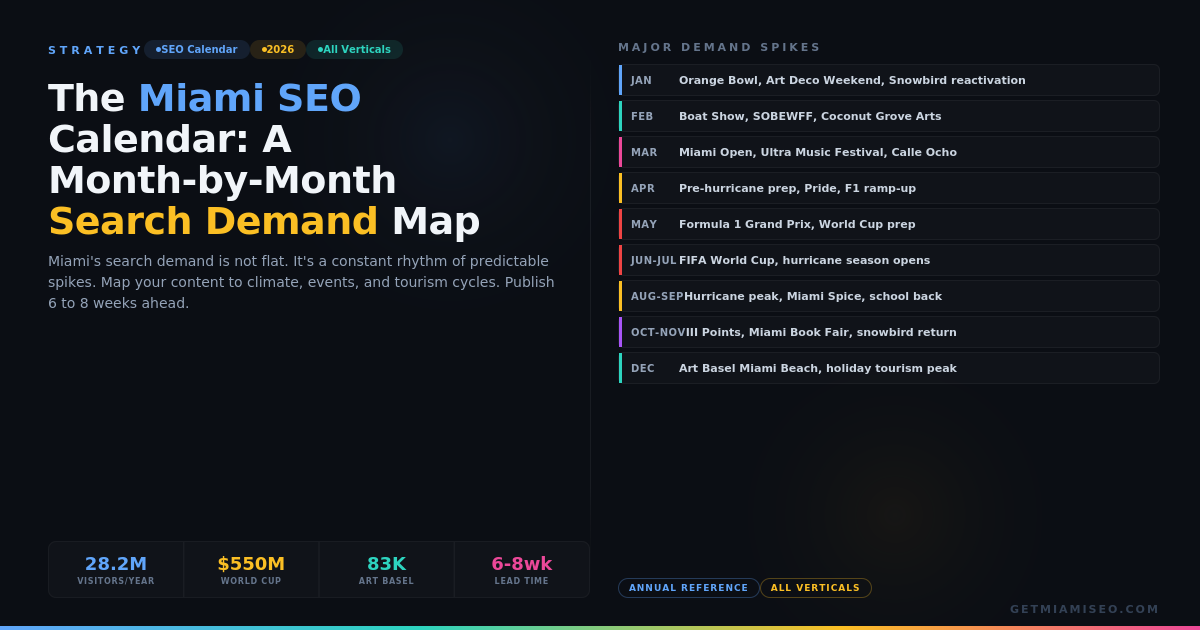
This is the pattern that defines Miami's search economy. The city does not have flat search demand. It has a constant rhythm of predictable spikes driven by climate, events, tourism cycles, and the migration patterns of seasonal residents. A business that maps content production to this rhythm publishes 6 to 8 weeks ahead of each spike and ranks during the peak. A business that publishes reactively chases demand it could have captured.
The good news is that the rhythm is knowable. Every major spike in Miami's search calendar is on the public record months in advance. Hurricane season starts on the same day every year. Art Basel returns to the Miami Beach Convention Center every December. The Formula 1 Miami Grand Prix returns to Hard Rock Stadium every May. Snowbirds arrive in October and leave in May. Once you can see the structure, you can publish into it.
This is the Miami SEO calendar. It applies to restaurants, real estate, beauty businesses, home services, law firms, medical practices, and every other vertical that operates in Miami-Dade County. The events differ by industry, but the framework is the same: identify the spikes that drive your demand, count back 6 to 8 weeks, and publish before everyone else does.
Why Miami's Search Demand Is Not Flat
Most American cities have relatively stable search demand interrupted occasionally by holidays. Chicago restaurants see a small spike around Memorial Day weekend. Phoenix HVAC companies see a summer ramp. Boston law firms see steady demand year-round.
Miami is different. The city is shaped by four overlapping demand drivers that no other US market has at this intensity simultaneously.
Climate. Miami's average annual temperature is 77.2 degrees (NOAA). The city averages 248 days per year above 80 degrees. Hurricane season runs June 1 through November 30 and creates predictable emergency demand for home services, property repair, and emergency lodging. AC repair searches climb 266% from February to July nationally; in Miami, the baseline is higher and the peak is sharper because the AC runs almost year-round.
Events. Miami hosts a calendar of internationally significant events that no other US city matches in density. Art Basel Miami Beach (December, 83,000+ attendees, 268+ galleries from 35 countries). Formula 1 Miami Grand Prix (May, 250,000+ attendees over the weekend). Ultra Music Festival (late March, $79 million annual economic impact per Washington Economics Group). Miami Open tennis (mid-to-late March, 2 weeks). South Beach Wine and Food Festival (February). Miami International Boat Show (February). The FIFA World Cup brings 7 matches to Hard Rock Stadium in June and July 2026, with $550 million in projected economic impact.
Tourism. 28.2 million annual visitors come to Miami every year. Tourism follows a predictable wave: peak season runs December through April, slow season runs May through August, and shoulder season covers September through November. Each wave drives different search patterns. Winter tourists search for restaurants and beach activities. Summer family travelers search for hotel deals and indoor attractions. Fall business travelers search for conference venues and corporate event spaces.
Bilingual demand. 35% of Miami searches happen in Spanish. The Spanish search calendar overlaps with the English calendar but also has unique drivers: Calle Ocho Festival in March, Hispanic Heritage Month in September and October, and the ongoing daily demand from Miami's 1.9 million Spanish-speaking residents. A complete content calendar accounts for both languages.
These four drivers create demand spikes that are not random. They are scheduled. The businesses that win on Google in Miami are the ones that work backward from the schedule and publish into the spikes before competitors do.
January Through March: The Snowbird Reactivation Window
Miami's first quarter is dominated by two overlapping forces: seasonal residents reactivating their lives after returning from the northeast, and a dense calendar of cultural and sporting events that draw international visitors.
January. The Capital One Orange Bowl returns to Hard Rock Stadium on January 1 (kickoff at noon). The Florida Panthers host the 2026 Discover NHL Winter Classic against the New York Rangers on January 2 at loanDepot Park (the first outdoor regular-season hockey game in Florida and the southernmost outdoor matchup in NHL history). Art Deco Weekend celebrates its 49th edition on Ocean Drive January 9-11. The South Beach Jazz Festival runs January 8-11. The Pegasus World Cup at Gulfstream Park is January 24. The Life Time Miami Marathon is January 25. Each of these events drives discrete search patterns: hotels, restaurants, transportation, parking, concierge services.
For most businesses, the January demand is driven less by individual events and more by the snowbird reactivation pattern. Seasonal residents who arrived in October and November are now fully settled in their Miami homes. They reactivate medical appointments, beauty treatments, restaurant reservations, property maintenance, and concierge services. Search volume for "[service] near me" queries climbs throughout January and stays elevated through April.
February. The Miami International Boat Show runs February 11-15 across multiple venues (Miami Beach Convention Center, Pride Park, One Herald Plaza). The Coconut Grove Arts Festival is February 14-16. South Beach Wine and Food Festival is February 19-22, drawing celebrity chefs and culinary travelers from around the world. Each event drives both event-specific searches and overflow demand for adjacent services: yacht charters around the Boat Show, restaurant reservations during SOBEWFF, parking during Coconut Grove Arts Festival.
March. This is Miami's busiest event month of the first half of the year. The Miami Open tennis tournament runs March 18-29 at Hard Rock Stadium. Ultra Music Festival is March 27-29 at Bayfront Park. Calle Ocho Festival (the country's largest Latin music street festival) is March 15. Miami Music Week wraps the entire city in dance music programming for the week leading into Ultra. The combined impact: hotels, restaurants, transportation, and entertainment venues see their highest combined demand of any single month.
The publishing window for Q1. Content for January events should be live by mid-November. Content for February events should be live by mid-December. Content for March events should be live by mid-January. The pattern: 6 to 8 weeks before each event. A restaurant publishing a "best restaurants near Hard Rock Stadium during the Miami Open" piece in early February captures the search demand that builds throughout March. The same restaurant publishing in late March captures nothing.
April Through May: The Pre-Hurricane and Pre-Summer Window
April and May are the most strategically important months in Miami's content calendar, and they are also the months that most businesses ignore. The events are smaller. The tourism is moderate. But what is being prepared for in these two months matters more than what is happening.
April. The O, Miami Poetry Festival runs throughout April for National Poetry Month. Miami Beach Pride is April 11-12. The weather warms steadily. Tourism slows from its winter peak as snowbirds begin departing. Beauty businesses see a pre-summer spike as residents prepare for swimsuit season and vacation travel. Med spas report increased bookings for treatments with longer recovery windows now that snowbird season is winding down.
The most important April activity from an SEO perspective is hurricane season preparation. Hurricane season starts on June 1. Content about hurricane prep, generator installation, emergency plumbing, AC tune-ups before peak summer, roof inspections, and emergency contact preparation needs to be live in April to rank by June. This is the single most important publishing window for home services businesses in the entire Miami calendar. Every week of delay shrinks the window to capture pre-storm and post-storm demand.
May. The Formula 1 Crypto.com Miami Grand Prix runs May 1-3 at the Miami International Autodrome (Hard Rock Stadium complex). The race draws over 250,000 attendees across the weekend. Hotel rates spike. Restaurant reservations fill weeks in advance. Transportation services run at capacity. Every business within five miles of Hard Rock Stadium sees demand surge. Beyond F1, May is also when Miami residents begin shifting to summer routines: pool service activations, AC system stress tests, summer camp bookings.
May is also the month to publish FIFA World Cup 2026 content. The World Cup brings 7 matches to Hard Rock Stadium in June and July 2026 with 164,000 additional tourists and $550 million in projected economic impact. Content published in May has time to index before the first match. Content published in June competes against businesses that prepared earlier.
The publishing window for Q2. Hurricane prep content: live by April 1, ideally earlier. F1 content: live by mid-March. World Cup content: live by mid-April. Pool and outdoor service content: live by early April. Snowbird departure logistics (storage, property closing, mail forwarding): live by mid-March.
June Through August: Peak Emergency, Peak Tourism, Peak Bilingual
Summer in Miami is the most intense quarter of the year for search demand. Three forces compound simultaneously: hurricane season, peak tourism for Latin American and European visitors, and the year's highest temperatures driving non-stop AC and emergency service demand.
June. Hurricane season opens June 1. The first FIFA World Cup matches at Hard Rock Stadium occur in June. School lets out. Summer family tourism begins. AC demand reaches its annual peak. Emergency plumbing searches start their seasonal climb. National data shows "emergency plumber" searches rise 191% from April to July (WebFX/Stacker 2026). In Miami, the floor is higher and the ceiling is sharper because the climate intensifies the underlying demand year-round.
July. Peak summer. Peak tourism for international visitors who can travel during European and Latin American school holidays. The remaining FIFA World Cup matches occur in early July. Hurricane preparation moves from "what if" to "actively monitoring tropical activity." The middle of the month often sees the first named storm watches of the season. AC failures peak. Pool services run at capacity. Restaurant tourism stays strong but shifts toward family-friendly venues.
August. Statistically, the most dangerous month for hurricanes alongside September. Search demand for "hurricane shutters Miami," "generator installation," "tree trimming," and "emergency plumber" climbs steadily. International tourism slows slightly as European holidays end. Domestic family tourism wraps up before school resumes. The first signs of Latin American business travel begin (preparing for fall conferences and Q4 corporate cycles).
The bilingual layer compounds during these months. Miami's Hispanic population does not reduce its search activity in summer; many Hispanic households increase it because school is out and family activity rises. Spanish searches for "plomero emergencia," "reparación aire acondicionado urgente," and "hotel familia Miami" all peak alongside English equivalents but face dramatically less competition. A bilingual business ranking in Spanish during these months captures demand that English-only competitors cannot reach.
The publishing window for Q3. Most Q3 content should already be live before June 1. The publishing window for hurricane recovery content (post-storm services, insurance claims, water damage restoration) is May. Back-to-school content for family-oriented businesses should be live by mid-July. International tourism content for European and Latin American visitors should be live by April or May.
September Through November: Hurricane Recovery and Pre-Holiday
Fall is the quarter of recovery and ramp-up. The most dangerous part of hurricane season is in the first half. The cultural calendar begins rebuilding for the holiday season. Snowbirds begin returning. Business travel resumes.
September. Hurricane season's statistical peak. The first signs of Hispanic Heritage Month (September 15 to October 15) drive Spanish-language cultural and event searches. Schools resume. Business travel ramps up as Q4 sales cycles begin. The Miami Spice restaurant promotion runs throughout the month, driving restaurant searches from both residents and visitors looking for prix-fixe deals.
October. Hurricane season winds down (statistically) but is not over until November 30. Snowbirds begin returning from the northeast. The first wave of seasonal resident demand reactivates. Halloween events drive family-oriented searches. The cultural calendar begins building toward Art Basel: gallery openings, satellite art fair announcements, hotel bookings for December. III Points Music Festival in Wynwood brings the underground music crowd in mid-October.
November. The Miami Book Fair runs November 15-22, bringing literary tourists and authors from around the world. Snowbird population reaches near-full strength. Restaurant reservations for Thanksgiving fill quickly. The first Art Basel content begins ranking for searches that will peak in early December. Black Friday and Cyber Monday drive ecommerce search spikes. Holiday gift guide content needs to be live by mid-November to rank during the December peak.
The publishing window for Q4. Art Basel content: live by mid-October. Holiday gift guides: live by early November. Snowbird welcome content (medical reactivation, beauty maintenance, property reopening): live by late September. Thanksgiving restaurant content: live by mid-October. Black Friday ecommerce content: live by early November.
December: Art Basel, Seasonal Residents, and the Holiday Spike
December is Miami's most internationally visible month. Art Basel Miami Beach runs December 2-6 (or December 4-6 depending on the year's specific dates) at the Miami Beach Convention Center. The fair attracts 83,000+ attendees and 268+ galleries from 35 countries. Surrounding Art Basel is Miami Art Week, which includes Art Miami, Context Art Miami, Scope Miami Beach, Untitled Art, Design Miami, and dozens of satellite fairs in the Design District, Wynwood, Little River, Allapattah, and Little Havana.
The economic impact extends far beyond the art fairs themselves. Hotels run at maximum rates and capacity. Restaurants book out for the entire week. Yacht charters command premium pricing. Beauty businesses see a sharp spike as visitors prepare for gallery openings and gala events. Transportation services run at peak demand. Every business within proximity of an Art Basel venue sees search volume climb dramatically in late November and peak in early December.
Beyond Art Basel, December brings the full holiday tourism wave. Snowbirds are fully settled. Christmas and New Year's tourists arrive. The Orange Bowl game preparation begins for the January 1 contest. Holiday parties drive restaurant and venue demand. Year-end shopping drives ecommerce searches. The Miami Spa Months promotion (running into January) drives wellness searches.
The publishing window for December. Art Basel content should be live by mid-October to rank during the November-December buildup. Holiday tourism content should be live by early November. New Year's Eve venue content should be live by mid-October. Year-end gift guides should be live by late October.
The Major Events That Shape Miami's Search Year
These are the events that drive measurable, capturable search demand spikes for Miami businesses. The dates rotate slightly each year, but the patterns repeat.
The Capital One Orange Bowl returns to Hard Rock Stadium every January 1. The Miami International Boat Show runs in mid-February. South Beach Wine and Food Festival runs in late February. The Coconut Grove Arts Festival runs Presidents Day weekend in February. Calle Ocho Festival is in March (the country's largest Latin music street festival). The Miami Open tennis tournament runs mid-to-late March at Hard Rock Stadium. Ultra Music Festival is in late March at Bayfront Park ($79 million annual economic impact). Miami Music Week surrounds Ultra. Winter Music Conference precedes Ultra. The O, Miami Poetry Festival runs throughout April. Miami Beach Pride is in mid-April. The Formula 1 Crypto.com Miami Grand Prix runs in early May (250,000+ attendees). The FIFA World Cup brings 7 matches to Hard Rock Stadium in June and July 2026 ($550 million projected impact). Miami Spice restaurant promotion runs August through September. Hispanic Heritage Month is September 15 through October 15. III Points Music Festival is in mid-October. The Miami Book Fair is in mid-to-late November. Art Basel Miami Beach and Miami Art Week run early December (83,000+ attendees, 268+ galleries).
That is just the headline calendar. Below it sit dozens of smaller events that drive niche search demand for specific industries: eMerge Americas for tech, the Miami International Auto Show for automotive, Miami Carnival for Caribbean culture, NASCAR Championship Weekend for motorsports, the Miami Beach Polo World Cup for luxury hospitality, Mercedes-Benz Fashion Week Swim for fashion, and many more.
Each of these events is a publishing opportunity. The businesses that own the search results around these events are the ones that planned their content production six to eight weeks in advance.
How to Map Your Industry to the Calendar
The calendar is the framework. Your industry determines which dates matter most to your business. Here is how the major Miami verticals map to the annual calendar:
Restaurants and hospitality. Peak demand: December (Art Basel, holidays), February-March (event season), late November (Thanksgiving), May (F1 weekend). Slow demand: August. Publishing windows: 8 weeks before each peak.
Real estate. Peak demand: October (snowbird arrival, pre-season buying), January-March (winter market). Slow demand: August. Publishing windows: snowbird buyer guides in August, winter market analysis in November.
Beauty, salon, and med spa. Peak demand: pre-event (early November for Art Basel, late February for SOBEWFF, late April for F1, late May for World Cup), pre-summer (April-May), holiday season (December). Publishing windows: 4-6 weeks before each peak.
Home services. Peak demand: hurricane season (June-November, with September-October peak), summer AC failures (July-August), snowbird property reopening (October-November). Publishing windows: hurricane prep in April, AC maintenance in March, snowbird property guides in August.
Medical practices. Peak demand: snowbird reactivation (December-January), back-to-school physicals (July-August), Open Enrollment (October-December). Publishing windows: 6 weeks before each peak.
Law firms. Peak demand: post-hurricane (insurance and property law), tax season (Q1 for tax law), corporate Q4 (M&A and contract work). Publishing windows: 8 weeks before each peak (longer for B2B).
Tech startups. Peak demand: eMerge Americas (April), startup conferences and accelerator cycles, Art Basel adjacent tech events. Publishing windows: 8 weeks before each conference.
Ecommerce. Peak demand: Black Friday/Cyber Monday (November), holiday season (December), Valentine's Day (February), Mother's Day (May), back-to-school (August). Publishing windows: 8 weeks before each peak.
The 6-to-8 Week Lead Time Rule
Every recommendation in this calendar comes back to one rule: publish content 6 to 8 weeks before the demand spike you want to capture. This is not arbitrary. It's based on how Google indexes and ranks new content.
A page published today is not in Google's index immediately. Google needs to crawl the page (typically within hours to days for established sites). After crawling, Google evaluates the page against its quality and relevance signals. The page is then placed in a "rank transition" period where Google tests its position by serving it to actual searchers and measuring engagement (Search Engine Land has documented this as approximately a 90-day window). During this testing phase, the page's position fluctuates as Google calibrates.
By 6 to 8 weeks after publication, most pages targeting realistic competition levels have stabilized at their natural ranking position. Pages targeting low-competition terms (neighborhood + service, niche events) often rank within 4 to 6 weeks. Pages targeting moderately competitive terms typically need 6 to 10 weeks. Pages targeting highly competitive head terms can take 6 to 12 months.
This is why the lead time matters. Content published the week of an event is competing against content that has been ranked and optimized for weeks. The earlier piece almost always wins. The lesson: count back from your demand spike, mark your publishing date, and treat that date as a deadline.
The honest counter-argument. Some businesses operate in such fast-moving competitive markets that the 6-to-8 week rule is too slow. If your competitors are publishing daily and you wait 8 weeks before each event, you fall behind on every other front. The resolution: publish the event-specific piece on the lead time, but maintain a steady publishing cadence in between. The calendar approach is not a substitute for ongoing content production. It's a layer on top of it that captures the predictable spikes that ongoing content cannot.
Common Mistakes Miami Businesses Make With Their Content Calendar
Publishing event content during the event. By the time the event is happening, every relevant search position is occupied by businesses that prepared earlier. The content ranks for nothing.
Treating every event as equally important. Not every event drives demand for your business. A law firm gains nothing from a Calle Ocho Festival content piece. A roofing company gains nothing from Art Basel. Map the events that matter to your industry, ignore the rest.
Ignoring hurricane season because it's not glamorous. Hurricane season is the single largest predictable demand driver in Miami for home services, property repair, insurance, and emergency services. Businesses that downplay hurricane content because it's not exciting miss the highest-volume publishing window of the year.
Forgetting the bilingual layer. Every event that drives English search demand also drives Spanish search demand, and the Spanish demand has dramatically less competition. A business that publishes only English event content captures half the market.
Not updating the calendar each January. Event dates change. New events get added. Some events disappear. A content calendar built in 2024 and never updated will miss the 2026 World Cup window, the new event additions, and the date shifts. The calendar needs an annual refresh in January.
Treating the calendar as a one-time project. The calendar is a working document. It needs to be reviewed monthly, updated as new events are announced, and used as a forcing function for production planning.
Content Calendar Template for Your Business
The simplest approach: a spreadsheet with five columns. Event name. Event date. Publishing target date (6-8 weeks before event date). Content topic. Status. Add one row for every event that drives demand for your industry.
Then layer in the non-event drivers: hurricane season prep (publish by April 1), snowbird reactivation (publish by mid-September), back-to-school season (publish by mid-July), holiday tourism (publish by early November). These are not on the public event calendar but they are predictable demand spikes that need content support.
Then add the bilingual layer. Every English content piece for a Miami event has a Spanish equivalent that captures a separate audience with significantly lower competition. Mark each row with both the English topic and the Spanish topic.
Then assign the work. Who is responsible for each piece? When is the deadline? Where will it be published? How will it be distributed (organic search alone, or also email and social)?
The result is a single document that turns Miami's chaotic event calendar into a structured production schedule. Once it exists, the work becomes execution rather than planning.
FAQs: Building a Miami SEO Content Calendar
How far in advance should I plan my content calendar? At least 12 months. Miami's annual events are announced months in advance, often a year ahead. Building your calendar in January for the entire year means you never miss a publishing window.
What if I don't have time to write all this content myself? Most businesses don't. The options are: hire a freelance writer with Miami market knowledge, work with an SEO agency that handles content production, or batch your content production by writing 4-6 pieces in a single block of time and scheduling them for release across the year.
How do I know which events drive demand for my specific business? Look at your existing customer data. When do your highest-revenue weeks occur? What were customers booking or buying in the weeks leading up to those spikes? If you don't have data yet, start tracking now and review at the end of the year.
Should I publish event content even if I missed the lead time window? Yes. Content that misses the current year's window still ranks for the same event next year. Art Basel content published in November 2026 will be perfectly positioned for Art Basel 2027. The calendar approach compounds: every piece you publish today plants for next year's spike.
How do I track whether the calendar approach is working? Set up Google Search Console and monitor impressions and clicks for your event-related pages in the weeks before, during, and after each event. A successful calendar shows clear traffic spikes aligned with the events you targeted.
Can I use this calendar if I'm a B2B business? Yes. B2B businesses in Miami should map to industry conference dates (eMerge Americas, real estate trade shows, legal conferences), corporate fiscal calendars (Q4 spending decisions), and seasonal hiring cycles. The events differ but the framework is identical.
How does the calendar work with AI search optimization? AI search engines pull from the same content Google ranks. A page that ranks for "best restaurants near Hard Rock Stadium" is also citable by ChatGPT when someone asks the same question conversationally. Building the calendar serves both traditional and AI search simultaneously.
What if I'm a single-location business with limited resources? Pick the three highest-impact events for your industry and execute on those first. A med spa might pick Art Basel, F1 weekend, and pre-summer prep. A roofer might pick hurricane prep, post-storm recovery, and snowbird property reopening. Three perfectly executed pieces beat twelve mediocre ones.
The Calendar Is the Map. The Lead Time Is the Compass.
That hotel near Hard Rock Stadium that booked out six months before the Miami Open didn't get lucky. It got organized. Someone there understood that the moment the tournament dates were announced was also the moment the search demand started building. They published the page that day. By the time other hotels were waking up to the opportunity, the page had already accumulated months of ranking signals.
This is the difference between Miami businesses that grow through search and Miami businesses that compete for scraps. The information is public. Every event date is announced months in advance. Every hurricane season starts on the same day. Every snowbird wave follows the same pattern. The structure is visible to anyone who looks for it. But seeing the structure and acting on it are different things.
The hardest part of the calendar approach is not the calendar itself. It's the discipline of publishing 6 to 8 weeks before you can see the demand. When you publish hurricane prep content in early April, the demand isn't there yet. The temptation is to wait until "people are searching for it." By the time they are searching for it, you are too late.
The businesses that win this game treat the calendar as a deadline, not a suggestion. They publish before they see the demand because they know the demand is coming. They trust the structure because the structure is real. And by the time the spike arrives, they are the page that Google ranks because they were the only ones who built it in time.
The next event on Miami's calendar is closer than you think. The lead time started weeks ago.
Get a free SEO audit and content calendar review for your Miami business →