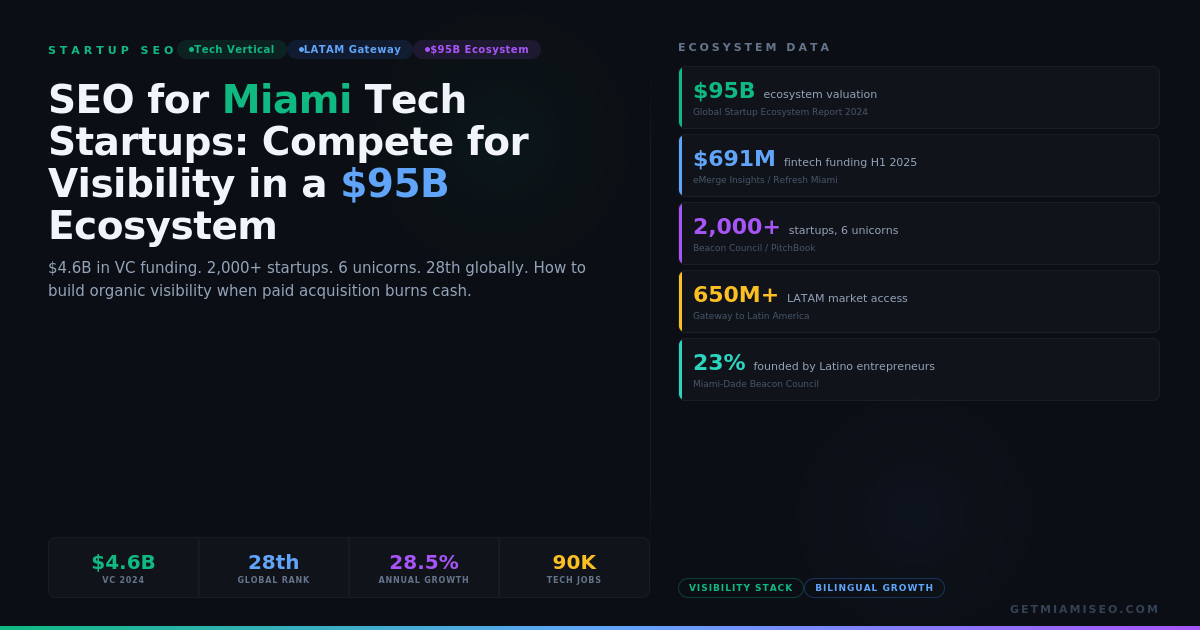
Miami's startup ecosystem attracted $4.6 billion in venture capital in 2024, a 35% increase from the previous year (eMerge Insights, Refresh Miami). The city ranks 28th globally in the StartupBlink Ecosystem Index and is the fastest-growing startup ecosystem in the United States at a 28.5% annual growth rate (StartupBlink 2025). Over 2,000 startups employ approximately 90,000 people. Six unicorns call Miami home. The ecosystem valuation sits at approximately $95 billion (Global Startup Ecosystem Report 2024).
And yet, if you search for most of these companies on Google, they barely exist organically.
This is the paradox of Miami tech in 2026. Startups here are exceptionally good at raising capital, hiring talent, and building product. They are almost universally terrible at SEO. The default growth playbook in Miami's startup scene is paid acquisition: LinkedIn ads, Google Ads, and conference sponsorships at eMerge Americas or Miami Tech Week. Organic search is treated as an afterthought, or worse, something that "takes too long" for a startup's pace.
That thinking is wrong, and it is costing Miami startups money. The average SaaS company that invests in content-driven SEO reduces its customer acquisition cost by 50-60% within 12-18 months compared to paid-only strategies (multiple industry benchmarks). In a market where seed rounds average $5.6 million (Q4 2025, Weidemann.tech) and burn rates are under constant scrutiny, organic search is not a luxury. It is a survival strategy.
This guide is for Miami tech founders and growth marketers who want to build a search visibility engine that compounds. Not the generic "do keyword research and write blog posts" advice. This is SEO strategy specific to Miami's ecosystem, its industries, its bilingual advantage, and its position as the gateway to 650 million potential customers across Latin America.
Why Miami Startups Ignore SEO (And Why That Creates Opportunity)
Three structural factors explain why Miami tech companies underinvest in organic search:
The paid-first culture. Miami's startup ecosystem matured rapidly during the pandemic era (2020-2023), when venture capital was abundant and growth-at-all-costs was the dominant strategy. Founders in that environment learned to scale with paid channels because capital was cheap and immediate results mattered more than long-term efficiency. The hangover from that era is a generation of Miami startups with sophisticated paid acquisition engines and zero organic presence.
The "SEO is for local businesses" misconception. When Miami founders hear "SEO," they think of Google Business Profiles, Map Pack rankings, and plumber marketing. They do not associate SEO with the B2B SaaS content strategies that drive companies like HubSpot, Zapier, or Ahrefs. Miami's SEO industry has historically served local businesses (restaurants, law firms, medical practices), which reinforces this perception. But startup SEO is an entirely different discipline.
The ecosystem is young. 73% of Miami startups were founded since 2010 (Beacon Council, Pitchbook data). Most are still in early or growth stages where product-market fit and fundraising consume all executive attention. SEO is a channel that rewards patience, and early-stage founders are not wired for patience. They will be, once the venture environment tightens further and paid channels get more expensive.
The opportunity for the startups that do invest in SEO now is significant. Unlike San Francisco, where every SaaS keyword has been targeted by well-funded content teams for a decade, Miami's startup content landscape is largely empty. The first Miami fintech to build a serious content engine around bilingual financial content will own those positions. The first Miami proptech to create definitive guides for Latin American real estate investors will capture a market no one else is targeting.
Early movers in SEO capture positions that become increasingly expensive for latecomers to contest. This is the same compounding dynamic that makes SEO a better long-term investment than paid acquisition for any business. For startups, where capital efficiency determines survival, the math is even more compelling.
The Startup Visibility Stack: A Framework for Miami Tech Companies
Startup SEO is not the same as local business SEO. The goals differ, the timelines differ, and the competitive dynamics differ. Here is a four-layer framework that maps the path from zero organic visibility to a compounding search engine.
Layer 1: Technical Foundation (Month 1-2)
Before you write a single blog post, your site needs to work for search engines. This means fast page load times (under 2.5 seconds for Largest Contentful Paint), proper indexation, clean URL structure, XML sitemap, and structured data. For startups running on frameworks like Next.js, Gatsby, or React, server-side rendering or static site generation is critical because JavaScript-heavy sites that rely on client-side rendering are often invisible to Google.
Implement Article schema on every page, Organization schema on your about page, and Product/SoftwareApplication schema if you are a SaaS company. Schema markup delivers 20-40% higher click-through rates and is the primary language AI search engines use to understand and cite your business.
Layer 2: Keyword Strategy and Content Engine (Month 2-6)
Your keyword strategy should map to your sales funnel, not to vanity metrics. A fintech startup does not need to rank for "what is fintech" (massive volume, zero purchase intent). It needs to rank for "best business banking for LLC Miami" or "invoice factoring for startups" (low volume, high intent, near the point of purchase).
Build content pillars around 3-5 core topics that align with your product. Each pillar should have one authoritative, long-form guide (2,000-5,000 words) supported by 5-10 shorter articles targeting long-tail variations. This cluster structure signals topical authority to Google and creates the internal linking architecture that distributes ranking power across your site.
Layer 3: Bilingual LATAM Expansion (Month 4-8)
This is the layer that makes Miami startup SEO different from startup SEO anywhere else in the United States. Miami sits at the geographic and cultural intersection of the US and Latin America. The city connects to 650 million potential customers across the region. And Spanish-language keywords carry 75-85% lower difficulty than English equivalents.
For a Miami fintech targeting business owners across the Americas, creating Spanish-language versions of core content pages does not just capture the 35% of Miami searches that happen in Spanish. It also captures searches from Mexico City, Bogota, Buenos Aires, and Sao Paulo (with Portuguese content). A Silicon Valley fintech cannot do this authentically. A Miami fintech can, because the team likely includes native Spanish speakers and the brand already operates in a bilingual context.
Layer 4: Ecosystem Presence and Authority Building (Ongoing)
Miami's startup ecosystem has specific convening points that build both brand awareness and SEO authority: eMerge Americas (20,000+ attendees from 60+ countries), Refresh Miami, The LAB Miami, Startup OLE Miami, and Miami Tech Week. Getting mentioned, linked, or featured by these organizations builds the kind of authoritative backlink profile that accelerates organic rankings.
Contribute content to Refresh Miami's publication. Get listed in the Beacon Council's tech directory. Sponsor or speak at events that generate press coverage with backlinks. These are not traditional "link building" tactics. They are ecosystem participation that happens to generate exactly the authority signals Google uses to evaluate trustworthiness.
Sector-Specific SEO Opportunities in Miami Tech
Miami's tech ecosystem concentrates around specific sectors, each with distinct SEO dynamics.
Fintech ($691 million in H1 2025, 38 deals) Fintech drew the most funding in South Florida's first half of 2025 (eMerge Insights). Companies like Flex ($225M Series B), Pipe, and newer players are building financial products for entrepreneurs, SMBs, and underserved markets. SEO opportunity: personal and business finance education content targeting both English and Spanish speakers. "Best business bank account for LLC" and "mejor cuenta bancaria para empresas en Miami" capture the same audience in two languages with drastically different competition levels.
Crypto and Web3 ($243 million in H1 2025, 16 rounds) Crypto deals in 2025 were significantly larger than 2024 (eMerge Insights). Companies like QuickNode and MoonPay are headquartered in Miami. Francis Suarez positioned Miami as the "Bitcoin capital" and the city retains that identity. SEO opportunity: educational content around cryptocurrency topics with Miami-specific regulatory and tax angles. Florida has no state income tax, which creates unique content opportunities around crypto tax strategy that resonate with both local and national audiences.
Proptech and Real Estate Tech Miami's $20 billion+ in real estate development and the city's position as a Latin American property investment gateway make proptech a natural fit. SEO opportunity: content targeting Latin American investors searching in Spanish for Miami real estate information. The real estate SEO guide covers traditional real estate, but proptech companies can target the investor side with content about property technology, digital closing processes, and cross-border transaction platforms.
Medtech and Healthtech Florida has more than 2,300 biotech and medical research companies, making it the second-largest hub for medical device manufacturing in the US (DaVinci Virtual). The eMerge Americas Healthtech Innovation Hub has positioned Miami as a healthtech event destination. SEO opportunity: HIPAA-compliant content marketing that targets both healthcare providers and patients. Medical SEO in Miami has specific compliance requirements, but healthtech startups can create content around the technology side (telehealth, AI diagnostics, remote monitoring) with less regulatory friction.
Climate Tech ($965 million in investment, per DaVinci Virtual) Climate tech is growing rapidly in Miami, partly because the city itself faces existential climate risks (sea-level rise, hurricane exposure) that create a natural laboratory for climate solutions. Exowatt raised $120 million in Series A in Q4 2025 alone (Weidemann.tech). SEO opportunity: climate resilience content with Miami as the case study. This positions climate tech startups as authorities on a topic that generates significant search volume in both English and Spanish.
The LATAM Gateway: Bilingual SEO as a Growth Engine
"Miami's evolution from an emerging startup city to a global center of innovation is now a well-established reality," stated the Beacon Council's 2024 technology report. What makes it different from other tech hubs is the Latin American connection.
23% of Miami startups are founded by Latino entrepreneurs (Beacon Council). Miami-Fort Lauderdale is ranked 7th nationally for both venture deal value and number of deals (eMerge Insights H1 2025). The city functions as a bridge to a region of over 650 million people, the majority of whom search in Spanish or Portuguese.
For startups that serve markets beyond the US, this creates an SEO advantage that no other US tech hub can replicate:
Spanish-language content SEO. Create Spanish versions of your core product pages, use cases, and educational content. Target keywords like "software de facturación para empresas," "plataforma de pagos digitales," or "tecnología inmobiliaria Miami." These terms have growing search volume as LATAM markets digitize rapidly and almost zero English-language competition.
Portuguese-language content for Brazil. Brazil is Latin America's largest economy and its tech market is exploding. Miami startups targeting Brazil can create Portuguese content that positions them as the US-based partner for Brazilian companies expanding northward and for US companies expanding into Brazil. With the FIFA World Cup coming to Miami in 2026, Brazilian search demand for Miami-related queries will spike significantly.
Hreflang implementation. If your startup has English, Spanish, and Portuguese content, proper hreflang tags tell Google which language version to serve to which audience. The bilingual SEO guide covers hreflang implementation in detail.
Content Strategy for Tech Startups vs. Local Businesses
The content frameworks that work for local businesses (neighborhood guides, service pages, FAQ content) do not apply to startups in the same way. Startup content strategy is about building category authority and capturing demand at every stage of the buyer journey.
Top of funnel (awareness): Industry education content. "What is invoice factoring?" "How does AI-powered property valuation work?" "Miami fintech landscape 2026." These pieces attract organic traffic from people who may not know your product exists but are researching your category. Volume is high, intent is low, but they build topical authority and generate backlinks.
Middle of funnel (consideration): Comparison and evaluation content. "Best invoicing platforms for small businesses," "[Your product] vs [competitor]," "How to evaluate a proptech platform." These pieces capture people who are actively researching solutions. Volume is moderate, intent is high, and they convert visitors into leads.
Bottom of funnel (decision): Use case studies, integration guides, and pricing pages. "How [Customer Name] reduced accounts receivable by 40% with [Your Product]," "How to connect [Your Product] to QuickBooks." These pieces convert leads into customers. Volume is low, but conversion rates are the highest of any content type.
The startup-specific addition: thought leadership. Founders who publish original analysis, data-driven insights, and industry commentary build personal brands that feed back into company SEO. A founder's LinkedIn post gets shared. A journalist cites the analysis. That citation becomes a backlink. That backlink strengthens domain authority. That authority helps every page on your site rank better. This is the compounding flywheel that separates startup SEO from local SEO.
AI Search Optimization for Startups
45% of consumers now use ChatGPT for local recommendations (BrightLocal 2026). But AI search is not just about local recommendations. It is also about product recommendations, platform comparisons, and industry analysis.
When an investor asks ChatGPT "What are the top fintech startups in Miami?", the AI searches for structured data, news coverage, Crunchbase profiles, and content that positions specific companies as leaders. If your startup has published authoritative content about your industry, has schema markup on your site, and has been mentioned by credible publications (Refresh Miami, TechCrunch, Bloomberg Miami), the AI can cite you. If you have a bare-bones website with no content and no press coverage, the AI cites your competitors.
Google AI Overviews appear on 40%+ of queries and 99% of AI Overview citations come from the organic top 10. Traditional SEO and AI optimization are not separate strategies. They are the same strategy viewed through different lenses.
What Miami Tech Founders Should Do This Quarter
If you are pre-seed or seed stage: Focus on technical foundation only. Clean site architecture, proper indexation, Organization and Product schema, and one core landing page per product feature. Do not invest in content marketing yet. Focus on product-market fit first.
If you are Series A: Start building your content engine. Hire a content marketer or engage an agency. Identify your 3-5 content pillars. Publish 2-4 pieces per month. Begin bilingual content if your product serves LATAM markets. Run an SEO audit to establish your baseline.
If you are Series B+: You should already have organic traffic as a meaningful acquisition channel. If you do not, you are overpaying for growth. Invest in a dedicated SEO team or specialized agency. Build bilingual content infrastructure. Pursue ecosystem backlinks (eMerge Americas, Beacon Council, Refresh Miami). Target the competitive keywords your paid campaigns currently serve and begin replacing paid spend with organic traffic.
Regardless of stage: Claim your Google Business Profile (yes, even for a SaaS startup). Post on LinkedIn consistently. Get listed on Crunchbase, AngelList/Wellfound, and the Beacon Council tech directory. Attend and get mentioned at ecosystem events. These are the foundational signals that both Google and AI search engines use to evaluate your legitimacy.
FAQs: SEO for Miami Tech Startups
Do SaaS startups need local SEO? Yes, but differently than a restaurant or law firm. Claim your GBP for your Miami office address. Optimize for "[your category] Miami" keywords. Build local citations. The combination of local presence and industry authority creates a signal stack that neither alone can match.
How long until SEO generates leads for a startup? 3-6 months for lower-competition terms. 6-12 months for competitive SaaS and fintech keywords. The timeline depends on your existing domain authority, content investment level, and competitive landscape. SEO compounds over time, meaning results accelerate rather than plateau.
Should I hire in-house or use an agency? At pre-seed and seed, an agency is more capital-efficient. At Series A, a hybrid model (in-house content marketer + agency for technical SEO and strategy) is optimal. At Series B+, consider building a full in-house team with agency support for specialized projects. The guide to choosing an SEO partner covers evaluation criteria.
What is the biggest SEO mistake Miami startups make? Waiting until Series B to invest in organic search. By that point, competitors who started earlier own the positions, and displacing them costs 3-5x more than building those positions would have cost initially. The 10 common SEO mistakes are worth reviewing regardless of company stage.
Can SEO help with fundraising? Indirectly but meaningfully. Investors Google your company. A startup with strong organic visibility, press coverage, and content authority signals product-market fit and market leadership. A startup with a thin website and no organic presence raises questions about traction. Your online presence is part of your fundraising deck whether you intend it to be or not.
The $95 Billion Ecosystem Is Building Its Search Presence. Are You?
Miami's startup ecosystem grew from a curiosity to a globally ranked innovation hub in less than a decade. The venture capital is here ($3.5-4 billion in 2025 alone). The talent is here (90,000+ tech jobs). The infrastructure is here (eMerge Americas, The LAB Miami, Wynwood and Brickell as startup corridors).
What is not here yet is the search engine presence to match. Most Miami startups are invisible on Google for the very keywords their customers type when evaluating products like theirs. That gap is closing. The startups that build organic visibility now will own the search positions that late movers will spend years (and millions in paid acquisition) trying to contest.
Talk to GetMiamiSEO about startup SEO strategy →