Most ecommerce SEO guides are written as if geography does not matter for online stores. Ship from anywhere, sell to anywhere. That logic holds for businesses in Ohio or Nebraska. It does not hold for Miami.
Miami is the physical gateway between the United States and Latin America. The Miami Customs District processed $144 billion in trade in 2024, a 5% increase over the prior year (Global Miami Magazine, State of Trade 2025). PortMiami handled $30.4 billion in cargo and processed just over 1 million TEU containers, with 46% of that volume flowing to and from Latin America and the Caribbean (PortMiami Director Hydi Webb, State of Trade 2025). Miami International Airport is one of the busiest international cargo hubs in the Western Hemisphere.
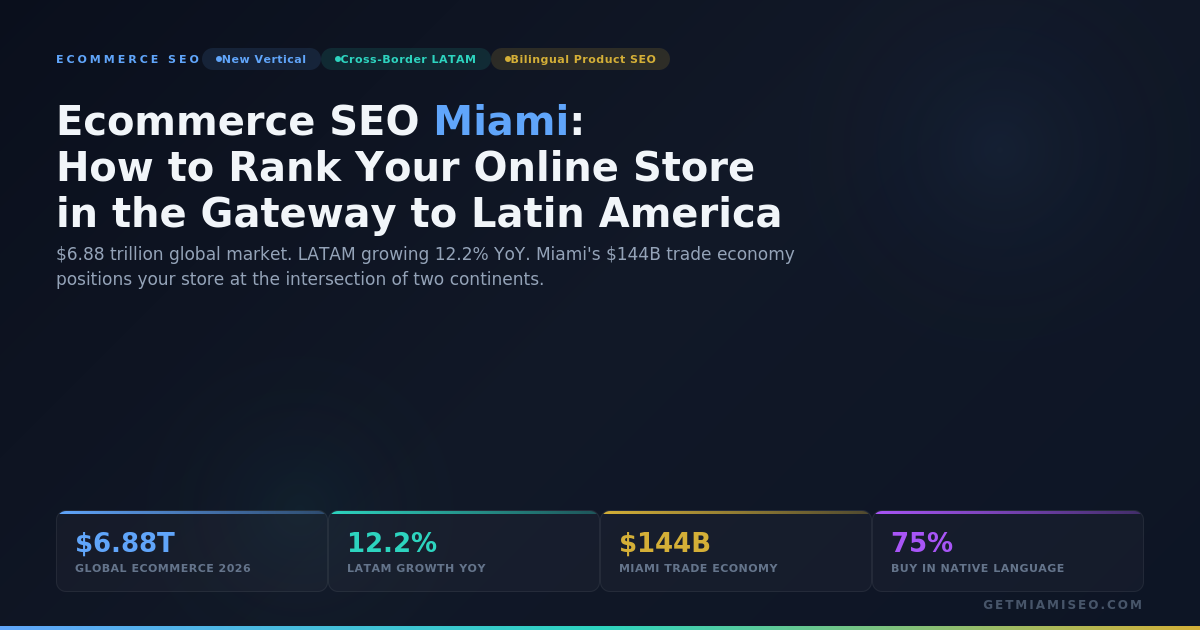
What does this mean for ecommerce? If you operate an online store from Miami, you sit at the intersection of two massive markets: the US domestic market (US ecommerce exceeded $1.1 trillion in 2024, per SeoProfy) and Latin America (the fastest-growing ecommerce region globally at 12.2% year-over-year growth, reaching $191.25 billion in 2025, per Shopify).
No other US city offers this dual-market advantage. A Shopify store in Dallas can sell to American consumers. A Shopify store in Miami can sell to American consumers, to the 43.4 million US Spanish speakers searching in their native language, and to Latin American consumers who are buying cross-border at record rates. The cross-border B2C ecommerce market is projected to reach $2.16 trillion in 2026 (Thunderbit, citing industry sources), and 75% of international shoppers want to buy products in their native language (Capital One Shopping, 2025).
That is why ecommerce SEO in Miami is different. It is not just about ranking product pages on Google. It is about building a search presence that captures demand in two languages, across two continents, from a city with the infrastructure to fulfill it.
The local SEO strategies that work for service businesses in Miami are foundational, but ecommerce SEO requires a different playbook. Product pages, category architecture, structured data, inventory management, and cross-border considerations add layers of complexity that a dentist or attorney never faces.
The Numbers: Why Ecommerce SEO in Miami Is Different
Before diving into tactics, understand the scale of the opportunity with verified data:
Global ecommerce: - Global ecommerce is projected to total $6.88 trillion by end of 2026 (Shopify) - Ecommerce accounts for 20.5% of worldwide retail sales in 2025, projected to reach 22.5% by 2028 (EMARKETER/Shopify) - The global B2C ecommerce market reached $5.2 trillion in 2024 and is expected to grow to $9.8 trillion by 2033 (Shopify, citing industry data)
US ecommerce: - US ecommerce sales exceeded $1.1 trillion in 2024 (SeoProfy) - 68% of US online shoppers search Google before purchasing (Taylor Scher SEO/Charle Agency, 2026) - 60% of US shoppers now use AI tools like ChatGPT for purchase decisions (SeoProfy, 2026) - Mobile commerce accounts for 68% of US ecommerce traffic (SeoProfy/Charle Agency, 2026)
Latin America ecommerce: - LATAM is the fastest-growing retail ecommerce region: 12.2% YoY growth, reaching $191.25 billion (Shopify, 2025) - The Latin America ecommerce market was valued at $1.61 trillion in 2025, projected to reach $4.06 trillion by 2034 at 10.85% CAGR (Market Data Forecast) - Argentina, Brazil, and Mexico account for 84.5% of LATAM retail ecommerce sales (Shopify) - LATAM was among the top five regions for cross-border shopping in 2025 (Pitney Bowes) - 65% of internet users in Brazil engaged with shoppable content on Facebook or Instagram in 2025 (Meta)
Cross-border ecommerce: - The cross-border ecommerce market is worth $1.21 trillion in 2025, projected to reach $1.84 trillion by 2030 (Capital One Shopping) - 75% of international shoppers want to buy in their native language (Capital One Shopping) - 59% of global shoppers buy from retailers outside their home country (Capital One Shopping) - Cross-border ecommerce is growing 28.3% faster than domestic ecommerce (Capital One Shopping)
Miami's trade position: - Miami Customs District: $144 billion in trade in 2024, 5% increase YoY (Global Miami Magazine) - PortMiami: $30.4 billion in trade, 1M+ TEU containers, 46% LATAM/Caribbean (State of Trade 2025) - Miami-Dade: 69% Hispanic population, 1.9 million Spanish speakers (U.S. Census/ACS 2023) - 4,900 new businesses per year, many in ecommerce and DTC
These numbers tell a clear story: ecommerce is growing globally, LATAM is the fastest accelerating region, and Miami is the physical and cultural bridge between the US and LATAM markets.
Product Page Optimization: Where Ecommerce SEO Starts
Product pages are the revenue-generating pages of your store. They are also where 96.55% of indexed pages receive zero organic traffic from Google (Studio 36 Digital, 2026). The difference between pages that rank and pages that do not comes down to execution.
Unique product descriptions. Product pages with unique descriptions perform 30% better in search rankings than those with generic or manufacturer-provided descriptions (Search Engine Journal). This is the most common mistake in ecommerce SEO: using the same description that appears on hundreds of other stores selling the same product. Write original descriptions that answer what the product does, who it is for, how it solves a problem, and why it is different from alternatives.
Title tag strategy. 70% of high-ranking ecommerce pages include keywords in the title tag (Semrush). Your title should follow this pattern: [Product Name] + [Key Attribute] + [Category] + [Brand]. For example: "Colombian Coffee Beans, Medium Roast, 12oz | [Your Brand]." This captures both the specific product search and the broader category search.
Image optimization. 63% of ecommerce traffic comes from Google Images (SparkToro). Every product image needs descriptive alt text that includes the product name, key attributes, and a natural description. Compress images for speed without sacrificing quality. Use WebP format where possible. For products sold to Spanish-speaking markets, create Spanish alt text on Spanish-language product pages.
Customer reviews on product pages. Product pages with customer reviews convert 270% higher than those without (Spiegel Research Center). Reviews also generate unique, user-generated content that Google can index. Encourage reviews in both English and Spanish. Google surfaces language-relevant reviews to matching searchers.
Internal linking between products. 86% of ecommerce brands lack optimized internal links (Reboot Online). Link related products, "frequently bought together" items, and products within the same collection. This distributes authority across your catalog and keeps users browsing.
As the SEO audit checklist covers, technical issues on product pages (slow load times, missing canonical tags, broken links) must be fixed before content optimization will produce results.
Product Schema Markup: The Technical Edge Most Stores Miss
Product schema is structured data markup that tells Google exactly what your product is: its name, price, availability, ratings, reviews, shipping information, and more. Without it, Google has to guess from your HTML. With it, your product pages become eligible for rich results that dramatically outperform standard listings.
The data is conclusive: pages with schema markup achieve 20 to 40% higher click-through rates than pages without (Sixth City Marketing). Rich results achieve 82% higher CTR compared to non-rich results (ALM Corp/Milestone Research). Product schema specifically delivers 4.2x higher Google Shopping visibility (Charle Agency, 2026).
Google's AI Overviews appear in 15% of all searches and use structured data as a primary source for product recommendations (Clickforest, via Charle Agency). A Data World study demonstrates that GPT-4 improves from 16% to 54% correct responses when content relies on structured data (Digidop, 2026). In other words, Product schema is not just for Google Search. It is the infrastructure that feeds AI search engines, voice assistants, and the emerging GEO (Generative Engine Optimization) ecosystem that SEO trends for 2026 are built around.
What Product schema should include: - Product name, description, and image - Price and currency (with PriceCurrency and price properties) - Availability (InStock, OutOfStock, PreOrder) - AggregateRating (star rating and review count) - Individual reviews (Review schema nested within Product) - Brand and manufacturer - SKU and MPN (for product identification) - Shipping details (OfferShippingDetails for free shipping badges in SERPs) - Return policy (MerchantReturnPolicy)
Beyond Product schema, ecommerce stores should implement: - BreadcrumbList schema (replaces URLs in search results with clean category paths) - FAQPage schema on product pages that include FAQ sections - Organization schema on the homepage (establishes brand entity) - ItemList schema on collection/category pages
The Google algorithm updates for 2026 have increased the weight of structured data in determining which content appears in AI Overviews and rich results. For ecommerce, this is not optional. It is the difference between appearing as a plain blue link and appearing with price, rating, availability, and shipping information directly in search results.
Category and Collection Page Strategy
Category pages are the workhorses of ecommerce SEO. They target broader keywords ("Colombian coffee," "handmade leather bags," "organic skincare") while product pages target specific queries ("Colombian Supremo medium roast 12oz").
Write unique category descriptions. A 200 to 500 word introduction above or alongside the product grid gives Google content to index. This content should explain what the category includes, who these products are for, and what differentiates your selection. Do not duplicate this content across categories.
Optimize faceted navigation. Filters for size, color, price, and other attributes create URL parameters that can generate thousands of indexable URLs. Use canonical tags or noindex on filtered pages to prevent duplicate content issues. This is one of the most common technical SEO problems in ecommerce, affecting 53% of sites that are missing canonical tags (Charle Agency, 2026).
Internal linking from categories to content. Link your category pages to relevant blog posts and buying guides. A "Colombian Coffee" category page should link to a blog post about coffee brewing methods. This creates topical authority and keeps users engaged longer. Users spend 38% more time on sites with a clear internal linking structure (Semrush).
The Bilingual Product SEO Advantage
This is the section no other ecommerce SEO guide covers, because no other guide is written for the Miami market.
75% of international shoppers want to buy products in their native language (Capital One Shopping, 2025). In Miami-Dade, where 35% of searches happen in Spanish and 69% of the population is Hispanic, this statistic is not abstract. It is revenue sitting on the table.
How bilingual product SEO works for ecommerce:
Create Spanish-language versions of your top-selling product pages and highest-traffic category pages. These are not translations of your English pages. They are original content written for the Spanish-speaking buyer, addressing their specific concerns, using the terminology they search for, and including Spanish-language reviews.
Implement hreflang tags correctly between English and Spanish product page variants. This tells Google that /products/colombian-coffee and /productos/cafe-colombiano are the same product in different languages, not duplicate content. Incorrect hreflang implementation is one of the most common technical errors in bilingual ecommerce.
Optimize your Google Merchant Center feed in both languages. If you run Google Shopping campaigns, a Spanish-language product feed captures searches from users with Spanish device settings. Most Miami ecommerce stores only submit English feeds, missing the bilingual opportunity entirely.
Write product descriptions that account for cultural context. "Skincare" products marketed to Latin American consumers may emphasize different ingredients, concerns, or use cases than the same products marketed to English-speaking Americans. A Miami ecommerce business that understands both audiences creates content that converts both.
The competitive advantage is stark. Spanish-language keywords carry 75 to 85% lower difficulty than English equivalents. "Organic skincare Miami" may have a KD of 55. "Cuidado de la piel organico Miami" drops to KD 10 to 20. The purchase intent is identical. The competition is almost nonexistent.
Cross-Border Ecommerce: Selling to Latin America from Miami
If you are reading this as a Miami ecommerce business owner, you have an advantage that online stores in Los Angeles, New York, or Chicago cannot replicate: physical, cultural, and logistical proximity to the fastest-growing ecommerce market on the planet.
Latin America's ecommerce market was valued at $1.61 trillion in 2025 and is projected to reach $4.06 trillion by 2034 at a 10.85% compound annual growth rate (Market Data Forecast, 2026). Cross-border ecommerce into LATAM is growing even faster, driven by consumers seeking products unavailable domestically, competitive pricing, and faster delivery from US warehouses.
Miami's cross-border infrastructure: - PortMiami: $30.4 billion in trade, 46% LATAM/Caribbean, 1M+ TEU containers (State of Trade 2025) - Miami International Airport: among the busiest international cargo hubs globally - $144 billion total trade through the Miami Customs District (Global Miami Magazine, 2025) - Over 100 active Foreign Trade Zones (PortMiami Director Hydi Webb, State of Trade 2025) - Companies like Tiendamia (headquartered in Miami) lead cross-border ecommerce from US to LATAM
SEO strategy for cross-border sales:
Build Spanish-language product pages optimized for LATAM search queries. The way a Mexican consumer searches for a product differs from how a Colombian or Argentine consumer searches. "Tenis deportivos" (Mexico) vs. "zapatillas deportivas" (Argentina) vs. "zapatos deportivos" (Colombia) all mean athletic shoes. Keyword research must account for regional Spanish variations.
Implement hreflang tags with country-specific variants. If you target Mexico specifically, use hreflang="es-MX" alongside your US Spanish hreflang="es-US". This signals to Google which version to serve in which market.
Create content that addresses cross-border concerns: shipping times to specific countries, customs duties, payment methods (MercadoPago, PIX in Brazil, OXXO Pay in Mexico), and return policies for international orders. This content ranks for informational queries and reduces purchase friction simultaneously.
The SEO vs. Google Ads analysis is particularly relevant for cross-border ecommerce. Google Ads CPCs for cross-border keywords are often lower than domestic equivalents, making the combination of organic SEO and targeted Ads a powerful dual strategy for LATAM expansion.
Shopify SEO for Miami Stores
Shopify powers over 1 million stores in the United States alone (Statista, via AiTrillion). In Miami's DTC and ecommerce ecosystem, it is the dominant platform. Miami hosts its own Ecommerce Week (February 2026) and the EEE (Ecommerce Experience Evolution) conference, both of which heavily feature Shopify merchants and solutions.
Shopify-specific SEO priorities:
URL structure. Shopify generates URLs with /collections/ and /products/ prefixes. This is acceptable for SEO, but avoid creating unnecessary URL depth. Keep product URLs clean: /products/product-name rather than /collections/category/products/product-name.
Duplicate content management. Shopify creates multiple URLs for the same product (one under /products/ and one under each collection). The platform adds canonical tags automatically, but verify that canonical tags point to the correct version. Use Google Search Console to identify canonicalization issues.
Page speed. Shopify themes vary dramatically in performance. Unoptimized themes with excessive JavaScript, uncompressed images, and third-party app bloat can push load times beyond 5 seconds. 70.5% of ecommerce sites fail Lighthouse performance standards (Charle Agency, 2026). Audit your theme, remove unused apps, and compress images.
Blog functionality. Shopify includes a built-in blog that most stores ignore. Publishing buying guides, product comparisons, and educational content builds topical authority and captures informational searches that feed your product pages. The strategy mirrors what works for content marketing in Miami's service industries: answer the questions your customers actually ask.
Shopify apps for SEO. Apps like JSON-LD for SEO, SEO Manager, and Smart SEO can automate schema markup, meta tag templates, and image alt text across large catalogs. These save significant time for stores with hundreds or thousands of SKUs.
Amazon SEO for Miami Sellers
Many Miami ecommerce businesses sell on both their own website and Amazon. Amazon SEO is a separate discipline from Google SEO, but the two reinforce each other.
Amazon's A9/A10 algorithm prioritizes: - Keyword relevance in product titles, bullet points, and backend search terms - Sales velocity and conversion rate - Review quantity and quality - Inventory availability and fulfillment method (FBA vs. FBM) - Pricing competitiveness
The Miami advantage on Amazon: Miami sellers using Fulfillment by Amazon (FBA) can ship to the southeastern US market and to Latin America more efficiently than sellers in other regions. Amazon's LATAM expansion (including Amazon Mexico and Amazon Brazil) creates cross-border opportunities that mirror the direct-to-consumer strategy.
Connecting Amazon and your website SEO: Products that rank well on Amazon often appear in Google search results through Amazon's domain authority. But products on your own website give you control over the customer relationship, email capture, and margin. The optimal strategy: use Amazon for discovery and volume, use your website (with proper ecommerce SEO) for brand building and higher margins. Link between the two where appropriate.
Technical Ecommerce SEO Priorities
Technical SEO issues affect 82% of ecommerce sites, impacting rankings and sales (Semrush). These are the priorities for Miami ecommerce stores:
Core Web Vitals. Mobile commerce accounts for 68% of ecommerce traffic (SeoProfy/Charle Agency, 2026). Mobile cart abandonment rates reach 85.7% (Charle Agency). Your product pages must load fast on mobile. Target: LCP under 2.5 seconds, INP under 200 milliseconds, CLS under 0.1. The technical audit checklist covers the full testing methodology.
Crawl budget management. Large catalogs with thousands of product pages, filtered URLs, and paginated collections can exhaust Google's crawl budget. Use robots.txt to block filtered URLs, implement proper canonical tags, and submit an XML sitemap that includes only indexable pages.
HTTPS. Ecommerce websites with HTTPS have a 35% higher conversion rate than those without SSL certificates (GlobalSign). For stores processing payments, HTTPS is legally required. For SEO, it has been a ranking signal since 2014.
Site architecture. Every product should be reachable within 3 clicks from the homepage. Use a flat hierarchy: Homepage > Category > Product. Deep nesting hurts both crawlability and user experience. Websites with structured internal links rank 15% higher (Moz).
Duplicate content. Product variants (size, color) that generate separate URLs must use canonical tags pointing to the primary variant. Paginated collection pages should use rel="next" and rel="prev" or, on Shopify, implement proper canonical handling.
Content Strategy for Ecommerce Stores
Ecommerce stores that publish educational content generate 55% more traffic than those that only have product pages (Charle Agency, citing industry data). Content strategy for ecommerce is not about blogging for the sake of blogging. It is about creating content that captures searches at every stage of the buying journey.
Buying guides. "Best Colombian coffee for cold brew," "How to choose a leather bag for travel," "Organic skincare routine for humid climates." These guides target informational keywords, build topical authority, and link directly to your product pages.
Product comparison pages. "[Your Product] vs. [Competitor Product]" captures high-intent comparison searches. These pages rank well because they directly address the searcher's decision-making process.
FAQ content. Structured FAQ sections on product and category pages serve double duty: they answer common objections (reducing cart abandonment) and they qualify for FAQPage rich results in Google, expanding your SERP real estate.
Bilingual content production. Produce buying guides and blog posts in Spanish for the same products you sell. A Spanish-language SEO guide for Miami already demonstrates how this works for service businesses. For ecommerce, the logic is identical: Spanish-language buying guides capture searchers who research purchases in their native language.
Seasonal and event-driven content. Miami's event calendar creates predictable search spikes: Art Basel (December), the Boat Show (February), the FIFA World Cup (June 2026), and the G20 Summit at Trump National Doral (December 2026). Ecommerce stores selling relevant products should create content around these events months in advance.
FAQs: Ecommerce SEO in Miami
How much does ecommerce SEO cost in Miami? Between $2,500 and $8,000 per month, depending on catalog size and bilingual requirements. Stores with fewer than 100 products start on the lower end. Large catalogs with cross-border LATAM targeting push higher. The Miami SEO pricing guide covers investment levels in detail.
Is ecommerce SEO different from local SEO? Yes. Local SEO focuses on Google Business Profile and Map Pack. Ecommerce SEO focuses on product pages, category architecture, Product schema, and catalog management. Miami businesses with both a physical store and an online presence need both strategies working together.
Should my Miami store optimize in Spanish? Absolutely. 75% of international shoppers want to buy in their native language. Miami is 69% Hispanic. And Spanish-language keywords have 75 to 85% lower competition. Beyond the local market, bilingual product pages capture cross-border demand from LATAM, the world's fastest-growing ecommerce region.
What is Product schema and why does it matter? Product schema is structured data that tells Google your product's name, price, availability, and ratings. It delivers 20 to 40% higher click-through rates (Sixth City Marketing), 4.2x higher Google Shopping visibility (Charle Agency), and feeds AI search engines that are reshaping product discovery.
How long does ecommerce SEO take? 3 to 6 months for measurable improvements. Long-tail product keywords rank faster. Competitive category keywords take 6 to 12 months. Spanish-language product pages rank faster due to lower competition. The compound effect means traffic and revenue grow over time.
Can Shopify stores rank on Google? Yes. Shopify provides a solid SEO foundation. Key optimizations: unique product descriptions, proper URL structure, Product schema, compressed images, fast themes, and internal linking between products and collections.
What is the cross-border ecommerce opportunity? The cross-border market reaches $2.16 trillion in 2026. LATAM grows at 12.2% YoY. Miami's $144 billion trade economy and PortMiami's 46% LATAM cargo position make it the ideal base for selling to Latin American consumers through bilingual product SEO.
Ready to Rank Your Online Store?
Miami's position as the US gateway to Latin America is not just a logistics advantage. It is an SEO advantage. Every product page you optimize in Spanish captures demand that your English-only competitors cannot touch. Every piece of Product schema you implement puts your listings ahead of the 82% of ecommerce sites that have not fixed their technical SEO.
The ecommerce opportunity in Miami is measured in trillions, not millions. The bilingual SEO strategy that works for local service businesses works even better for ecommerce, where every product page is a ranking opportunity in two languages.