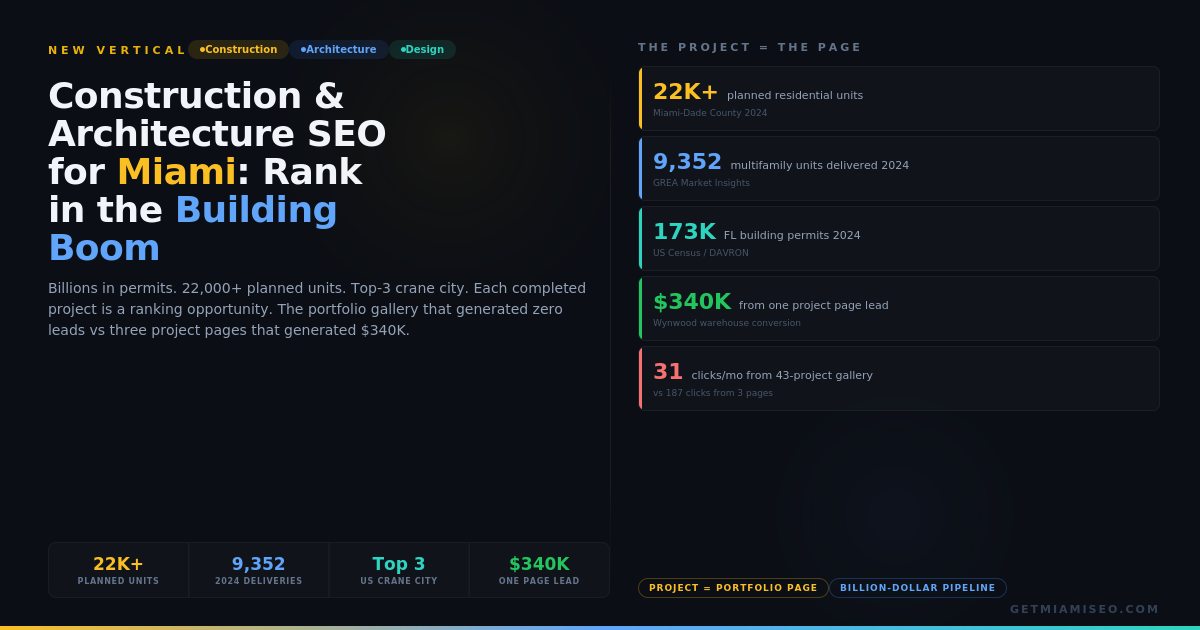
In February 2026, a general contractor in the Design District who had completed 43 residential and commercial projects over 12 years ran an SEO audit on his website. The site had a single "Portfolio" page with a grid of 43 project photos, each linking to a lightbox with two more photos and a one-sentence description: "Luxury kitchen renovation, Coral Gables. 2024." The page received 31 organic clicks per month. In 12 years of business, it had generated exactly zero trackable leads.
An SEO consultant suggested converting three of his most distinctive projects into dedicated pages with full descriptions, neighborhood context, project scope, timeline, materials used, challenges overcome, and before-and-after photography. Each page was built with a location-specific title: "Warehouse-to-Office Conversion Wynwood," "Custom Mediterranean Home Coral Gables," "Luxury Penthouse Renovation Brickell."
Three months later, those three pages generated a combined 187 organic clicks per month, six times the traffic of the gallery that held 43 projects. One of them, "Warehouse-to-Office Conversion Wynwood," ranked position 2 for its target query and generated a $340,000 commercial buildout inquiry from a tech company relocating from San Francisco.
The portfolio gallery had been an archive. The project pages were sales tools. The difference was not the quality of the work (the same projects appeared in both). The difference was that each project page answered a specific search query that a potential client was typing into Google right now, while the gallery answered no query at all.
This is the insight that changes how construction firms, architects, and interior designers in Miami should think about their websites. Every completed project is a keyword. Every project page is a ranking opportunity. And in a market where Miami-Dade authorized billions in new residential construction permits with a pipeline of over 22,000 planned units (Miami-Dade County 2024 economic records), the demand for construction services is not the problem. Visibility is.
Miami's Construction Economy
Miami is in the middle of one of the largest building booms in the United States. The numbers tell a story of scale that most local contractors underestimate when thinking about their digital presence.
Miami-Dade County authorized billions in new construction permits in 2024 to support a pipeline of over 22,000 planned residential units. In 2024 alone, 9,352 multifamily units were delivered across greater Miami, far exceeding the five-year average of 6,574 units absorbed annually (GREA Winter 2025 Market Insights). Over 50% of the new supply is concentrated in downtown Miami, with 90% classified as luxury segment.
The Rider Levett Bucknall Crane Index regularly places Miami among the top three US cities for active construction cranes, alongside Dallas-Fort Worth and Phoenix (Building Radar 2026). Cranes stand over billions in active construction from the $3 billion Little River district redevelopment to $1 billion transit-oriented developments adding thousands of residential units (Free Press Journal 2026).
Major development corridors include Brickell (supertall towers including the 1,049-foot Waldorf Astoria Residences), Edgewater (bayfront luxury high-rises), Wynwood (warehouse conversions and mixed-use), the Design District (luxury retail and residential), North Beach (oceanside redevelopment), and Coral Gables (custom residential and Mediterranean restoration).
For contractors, architects, and design firms, this pipeline represents years of sustained demand. The firms that rank on Google for project-specific and neighborhood-specific queries capture a share of this demand that referrals and word-of-mouth alone cannot match. And yet most construction businesses in Miami have minimal web presence. The gap between market scale and digital visibility is one of the largest of any industry in the county.
Florida issued over 173,000 building permits in 2024, with Miami-Dade accounting for a disproportionate share of high-value commercial and luxury residential permits (DAVRON 2026). Between 2020 and 2024, the state built more than 760,000 new homes. The construction workforce is under intense pressure: labor shortages affect key roles across the trades, and forecasts suggest competition for talent will intensify through 2026 as project pipelines expand faster than the available workforce.
For the individual contractor or architect, these macro numbers translate into a specific opportunity: the people hiring for these projects are searching Google. A developer selecting a general contractor for a $5 million condo renovation in Edgewater is searching "commercial general contractor Miami Edgewater." A homeowner looking to renovate a 1940s Coral Gables bungalow is searching "historic home renovation Coral Gables." A restaurant group converting a Wynwood warehouse into a dining venue is searching "restaurant buildout contractor Wynwood." Each of these searches represents a project worth tens of thousands to millions of dollars. Each search is an opportunity that goes to whoever ranks.
"The Project Is the Portfolio Page"
Most construction and design firm websites treat the portfolio as a gallery: a grid of thumbnail images linking to lightboxes with a few more photos and a one-line caption. This format serves an aesthetic purpose. It does not serve a search purpose.
Google cannot rank a lightbox. A photo of a kitchen renovation with no text, no title, no location, and no description gives Google nothing to index. A grid of 43 such photos on a single page dilutes any ranking signal across 43 subjects, making the page relevant to everything and optimized for nothing.
The alternative: treat each completed project as its own landing page. A page titled "Custom Mediterranean Home Coral Gables" targets searchers looking for exactly that: a contractor who has built a custom Mediterranean home in Coral Gables. A page titled "Restaurant Buildout Wynwood Industrial Space" targets a restaurant owner searching for a contractor experienced with Wynwood's specific building stock.
Each project page should contain: a descriptive H1 with project type and location, the project scope (square footage, number of rooms, commercial or residential), the timeline (start to completion), the specific challenges addressed (permitting in historic districts, hurricane-code compliance, structural modification of warehouse buildings), materials and design choices, before-and-after photography with descriptive alt text, and a CTA inviting inquiries for similar projects.
A firm with 40 completed projects and 40 detailed project pages has 40 keyword-targeted landing pages that Google can index, rank, and serve to searchers with matching intent. A firm with 40 projects and one gallery page has one page that ranks for nothing specific.
The math is simple. The execution takes time. But each project page, once built, ranks indefinitely. A "Kitchen Renovation Coral Gables" page built in 2026 still generates leads in 2028. The portfolio gallery, no matter how beautiful, generates nothing because Google cannot read photographs without text.
For AI search, project pages are citation gold. When someone asks ChatGPT "Who are the best contractors for warehouse conversions in Wynwood?", the AI needs specific, descriptive content to cite. A detailed project page with scope, timeline, and outcomes is citable. A photo gallery is not. As AI Overviews expand into construction and home improvement queries, the firms with structured project content will be cited while the firms with galleries will be invisible.
The compound effect is significant. A firm that adds 8 project pages per year (one for every completed project worth showcasing) has 40 pages after five years. Each page targets a different combination of project type, neighborhood, and style. Together they create a web of ranking opportunities that no single competitor page can match. This is the entity-based search advantage: each project page is an entity signal that strengthens Google's understanding of the firm as an authority in specific categories across specific locations.
Service Page Architecture for Construction and Design Firms
Beyond project pages, every construction firm needs individual service pages for each specialty offered. The same one-page-services mistake that hurts every industry hurts construction firms equally.
For general contractors: separate pages for new construction, renovation, commercial buildout, residential remodeling, kitchen renovation, bathroom renovation, additions, and hurricane damage restoration.
For architects: separate pages for residential design, commercial design, interior architecture, renovation design, historic preservation, and landscape architecture. Each targeting "[service] architect Miami" or "[service] architect [neighborhood]."
For interior designers: separate pages for residential design, commercial design, hospitality design, kitchen and bath design, and staging. Each targeting "[service] interior designer Miami."
For specialty contractors: separate pages for each trade (electrical, plumbing, roofing, painting, flooring, cabinetry) with location-specific targeting. A page for "custom cabinetry Miami" captures a different searcher than "kitchen renovation Miami."
Each service page follows the same structure as every other GetMiamiSEO vertical guide: clear H1 with service and location, direct-answer paragraph (40-60 words), specific situations addressed, process overview, pricing range if possible, related project portfolio links, FAQ section, and booking CTA.
Neighborhood Development Pages
Miami's construction market is neighborhood-driven. A developer building in Brickell faces different permitting, zoning, building codes, and aesthetic expectations than one building in Wynwood. A homeowner renovating in Coral Gables, where the Board of Architects reviews exterior modifications, needs a contractor who understands that specific review process.
For construction firms serving multiple neighborhoods, dedicated neighborhood pages capture searchers with geographic intent. "General contractor Brickell," "architect Coral Gables," "renovation contractor Edgewater," "commercial buildout Wynwood" are all distinct queries with distinct searcher profiles.
Each neighborhood page should include: the specific building types common in that area (high-rise condos in Brickell, warehouse conversions in Wynwood, Mediterranean estates in Coral Gables, oceanfront renovations on Miami Beach), the permitting and regulatory specifics (historic preservation overlay in Coral Gables, Miami 21 zoning code compliance, Florida High Velocity Hurricane Zone requirements), and links to completed project pages in that neighborhood.
The Commercial vs. Residential Search Split
Construction firms that serve both commercial and residential clients need to understand that these are two entirely different search audiences with different queries, different intent, and different content expectations.
Residential searchers use queries like "kitchen renovation Coral Gables," "bathroom remodel cost Miami," "home addition contractor Brickell," and "custom home builder Miami." They are homeowners or individual investors making personal decisions. They evaluate contractors based on portfolio quality, reviews, pricing transparency, and local expertise. Their project values range from $15,000 for a bathroom remodel to $2 million+ for a custom home.
Commercial searchers use queries like "commercial buildout contractor Miami," "restaurant construction Miami," "office renovation Downtown Miami," "tenant improvement contractor Brickell," and "warehouse conversion Wynwood." They are business owners, developers, or facilities managers making business decisions. They evaluate contractors based on experience with similar project types, references, insurance and bonding capacity, and timeline reliability. Their project values range from $50,000 for a small office buildout to $10 million+ for ground-up commercial construction.
The content strategy must address both audiences with separate pages. A residential renovation page speaks to a homeowner's concerns: budget, timeline, design choices, disruption to daily life, permits, and material quality. A commercial buildout page speaks to a business owner's concerns: code compliance, ADA requirements, fire suppression systems, commercial permits, lease coordination, and business continuity during construction.
A firm with both a "Kitchen Renovation Coral Gables" page and a "Restaurant Buildout Wynwood" page captures searchers from both audiences without the two pages competing with each other. They target different queries, answer different questions, and convert different types of clients.
How AI Search Changes Discovery for High-Ticket Services
The construction and architecture market has a specific AI search dynamic that differs from other local verticals. When someone asks ChatGPT "Who is the best architect for a modern home in Coconut Grove?", the answer carries disproportionate weight because the project value is high. A recommendation that leads to a $500,000 construction contract is worth more than any other AI citation in any other local vertical except possibly law.
AI Overviews now appear on 381% more travel-related queries compared to early 2025. Construction and home improvement queries are following a similar trajectory as Google's AI becomes more confident generating recommendations for high-consideration purchases.
The firms that will be cited are the ones whose websites give the AI enough structured information to generate a confident recommendation: detailed project pages, complete schema markup (LocalBusiness, Service, Review), specific FAQ content, and a strong review profile mentioning specific project types. The firms that rely on a photo gallery and a phone number will not be cited because the AI has nothing to extract.
The Bilingual Builder: Why Latin American Developers Search in Spanish
Miami's construction market has a significant Latin American dimension that most construction firm websites ignore entirely. International developers from Colombia, Brazil, Argentina, and Venezuela are active investors in Miami real estate. Many conduct business in Spanish or Portuguese. The Latin American developer community in Doral and Hialeah searches for contractors in Spanish.
35% of Miami searches happen in Spanish. Construction-specific queries in Spanish have virtually zero SEO competition. "Constructor de casas Miami," "remodelacion de cocinas Doral," "arquitecto para apartamento Brickell," and "contratista general Hialeah" are all queries with real volume and no optimized results.
For contractors and architects serving the Hispanic market, bilingual content captures a client base that pays project-level fees. A single custom home project from a Latin American client who found the contractor through a Spanish Google search can generate $100,000 to $500,000 in revenue. The cost of building one Spanish-language service page is a few hours of work.
Google Business Profile for Project-Based Businesses
GBP signals account for 32% of Map Pack ranking factors (Whitespark 2026). For construction firms, the GBP operates differently than for service businesses with recurring customers.
Category selection matters. "General Contractor" is not "Home Builder" is not "Remodeler" is not "Construction Company." Each category triggers different search queries. Choose the most specific primary category and add relevant secondary categories.
Project photos, not stock photos. Upload photos from active job sites, completed projects, and the construction process itself. A time-lapse sequence from foundation to finish tells a story that stock photos of hard hats cannot. GBP listings with photos receive 42% more direction requests and 35% more clicks.
Service area vs physical location. Many contractors operate from a home office or a warehouse, not a customer-facing storefront. GBP allows service-area businesses to define their coverage radius without showing a physical address. Set the service area to include every neighborhood you serve.
Reviews that mention project types. "They renovated our kitchen in Coral Gables beautifully, on time and on budget" is a six-signal review: service (kitchen renovation), location (Coral Gables), quality (beautifully), timeline (on time), cost (on budget), and sentiment (positive). Each signal strengthens ranking for specific queries.
The Counter-Argument: When Construction Firms Should Not Invest in SEO First
The honest counter-argument. Not every construction firm needs SEO as its first marketing investment. A specialty subcontractor who works exclusively through general contractor referrals may never receive a single client from Google search. An architecture firm with a three-year backlog of projects from existing relationships does not have a lead generation problem.
For these firms, the investment hierarchy is different. Link building through industry awards, professional association memberships (AIA Florida, AGC Florida), and trade publication coverage builds brand authority without the lead-generation focus of SEO. The website serves as a validation tool for referrals rather than a discovery tool for new clients.
SEO is most valuable for construction firms that: accept projects from clients who find them online, serve residential clients who search Google before hiring, operate in competitive markets where multiple contractors compete for the same project types, or are expanding into new neighborhoods where they do not yet have referral networks. For these firms, a project-page strategy with neighborhood-specific content is the highest-ROI marketing investment available.
Common Mistakes Construction Firms Make With SEO
Using a portfolio gallery instead of individual project pages. A gallery is an archive. Individual project pages are ranking assets. Convert your best projects into dedicated pages.
No website at all, relying entirely on referrals. Referrals are powerful but limited to one degree of separation. A website with project pages and service content captures the two degrees beyond: the person who searches Google because they do not yet have a referral.
Generic service descriptions. "We handle all your construction needs" tells Google nothing. "Custom residential construction in Coral Gables specializing in Mediterranean and contemporary styles, new builds and full renovations, permitted through the Coral Gables Board of Architects" tells Google exactly what to rank for.
No bilingual content in a market with Latin American developers. Spanish-language construction queries have virtually zero competition while the client base pays project-level fees.
Not updating the website after project completion. Each completed project is a content opportunity. A firm that finishes 8 projects per year and adds 8 detailed project pages per year builds a compounding ranking advantage that grows every year.
Ignoring the Miami SEO Calendar for construction demand. Hurricane season (June-November) drives storm damage repair demand. Pre-hurricane prep content published in April captures the demand that arrives in June. Post-storm content captures the recovery demand that can last months.
What Construction and Design Firms Should Build This Month
Week 1: Convert your three best projects into dedicated pages. Choose projects that represent your most desirable work: the type of project you want more of, in the neighborhoods you want to work in. Build a full page for each with scope, timeline, photos, and neighborhood context.
Week 2: Complete your Google Business Profile. Select the correct primary category. Upload 20+ project photos. Define your service area. Add all services offered with descriptions. If you serve bilingual clients, add Spanish service descriptions.
Week 3: Build service pages for your top three specialties. Each service gets its own page with location-specific titles. Add schema markup (Service, LocalBusiness) and FAQ content answering questions clients ask during consultations.
Week 4: Generate reviews from your last 5 completed projects. Contact recent clients and ask for a Google Review mentioning the specific project type and neighborhood. Each review strengthens ranking for those specific queries. Run the full SEO audit to identify any remaining technical gaps.
FAQs: Construction and Architecture SEO in Miami
How long does SEO take for a construction firm? Project-specific pages with low competition (neighborhood + project type) can rank in 2-4 months. Competitive terms like "general contractor Miami" take 6-12 months. The timeline and cost guide covers expectations.
Is SEO worth it for a construction company that relies on referrals? If every project comes from referrals, SEO adds a second lead channel rather than replacing the first. Even referral-dependent firms benefit from a strong web presence because 80% of prospects who receive a referral Google the company name before making contact. A well-optimized website validates the referral.
How do AI search engines affect construction firm visibility? When someone asks ChatGPT "best contractor for warehouse conversion in Wynwood," the AI generates recommendations based on entity recognition, project content, and reviews. A firm with a detailed "Warehouse Conversion Wynwood" project page is more citable than one without.
Should I invest in Google Ads for my construction business? Google Ads can supplement organic SEO for high-value commercial queries where immediate visibility matters. For residential queries with lower competition, organic SEO often delivers better ROI because the ranking compounds over time while ad costs recur.
How do I handle reviews for a construction business? Ask at project completion when satisfaction is highest. Request that the client mention the project type, neighborhood, and outcome. Respond to every review professionally, referencing the specific project.
What link building works for construction firms? Industry awards (ENR, local AIA chapter), trade publication coverage, chamber of commerce memberships, event sponsorships, and supplier partnerships. Earned media from notable project completions generates high-authority links.
Can I rank for both commercial and residential queries? Yes. Build separate sections of your website for each: commercial services and portfolio on one side, residential services and portfolio on the other. Each section targets different queries with different intent.
How does hurricane season affect construction SEO? Hurricane season creates demand for storm damage repair, restoration, and rebuild services. Content published by April captures the June-November demand window. Post-storm content captures recovery demand that can sustain for months after a named storm.
The $340,000 Search Query
That Design District contractor did not build a better website. He built three better pages. Each one described a specific project in a specific neighborhood with enough detail that Google could match it to a specific search query from a specific person looking for exactly that kind of work.
The $340,000 commercial buildout inquiry came from a search query that no one else in Miami had built a page for. "Warehouse to office conversion Wynwood." The query was specific. The page was specific. The match was exact. And the competitors who had galleries full of beautiful project photos were invisible to that search because their photos had no text, no titles, no locations, and no descriptions for Google to index.
Miami's construction pipeline runs into the billions. Over 22,000 residential units are in the planning pipeline. Cranes mark the skyline from Brickell to Little River. The demand for construction services is not the problem. The problem is that most firms are invisible to the people actively searching for them.
Every project you have completed is a search query someone is typing right now. The question is whether you have built the page that answers it.
Get a free SEO audit for your Miami construction or design firm ->